The latest National Defense Authorization Act (NDAA) has two key amendments from the Republican nominee for Arizona governor, Rep. Andy Biggs (AZ-05).
The two bipartisan-backed amendments impose budgetary restrictions for poor financial management, and a counter to the Chinese threat of critical mineral mining dominance.
Biggs explained in a statement that the two amendments were critical for public confidence in government accountability and independence concerning nonfuel minerals.
“My amendments address critical issues within America’s massive national defense apparatus, ensuring more transparency and accountability within our government and closing the gap between China and the United States for a critical workforce,” said Biggs.
One of the amendments establishes greater financial oversight of the Department of Defense (DOD). The amendment language was derived from Biggs’ “Audit the Pentagon Act,” one of the first bills introduced by Biggs in 2017.
The amendment requires the DOD, and certain military departments and defense agencies, to submit a financial statement for the previous year and receive an audit opinion. Without a financial statement and audit opinion, the discretionary budget authority will be reduced by 0.5%, except for accounts handling military, reserve, and National Guard personnel and the Defense Health Program.
The DOD has presented “unauditable financial statements” for decades and to date has been the only major federal agency to have never passed an audit, according to a May report by the General Accounting Office (GAO). Since 2018, the Pentagon has failed eight consecutive agency-wide annual audits.
The DOD spends more than $1 trillion annually on foreign and domestic defense — nearly half of the federal government’s discretionary spending. It also retains approximately 82% of the federal government’s total physical assets and its financial management problems account for 17% of the federal government’s costs.
The DOD’s prolonged financial weaknesses contributed to the U.S. insolvency announced by the Treasury Department earlier this year. The U.S. has about $6 trillion in assets against nearly $48 trillion in liabilities.
The GAO reported that the DOD had more than $16 billion worth of previously untracked assets and inventory.
Last month, the GAO reported that the DOD weapons programs have continued wasting billions of dollars and decades of time from exceeding cost estimates and delivery schedules.
The other amendment boosted federal support for accredited mining engineering programs. Chinese mining engineering graduates outnumber American mining engineering graduates annually by anywhere from 15 to 1, to 50 to 1. China reports graduating 3,000 to 10,000 mining-related engineers across dozens of programs, while America reports graduating about 200.
Mining engineering program graduates peaked in 1980, declining from then until 2004, when program resurgence occurred until 2015, according to data from the Society for Mining, Metallurgy, and Exploration. Even at its most high peak in 1980 and most recent high peak in 2015, graduates numbered between 600 and 700 a year.
The University of Arizona has a mining program.
President Donald Trump issued a memorandum in May directing the Office of Personnel Management to impose critical position pay for up to 400 positions oriented toward expanding U.S. critical mineral capacity, along with advanced materials and other essential components for the supply chain.
AZ Free News is your #1 source for Arizona news and politics. You can send us news tips using this link.
Congressman Abe Hamadeh (R-AZ-08) has introduced two new pieces of legislation aimed at strengthening America’s commitment to recovering U.S. citizens abroad and ensuring military equipment is properly secured during overseas withdrawals.
The measures, the No American Left Behind Act and the No Equipment Left Behind Act of 2026, were recently approved as amendments to the Fiscal Year 2027 National Defense Authorization Act (NDAA) by unanimous voice vote in the House Armed Services Committee.
The legislation is expected to be considered by the full House in late June.
The No American Left Behind Act seeks to establish a formal “No American Left Behind Doctrine” to guide future U.S. policy and planning regarding Americans detained or stranded overseas.
The legislation was inspired in part by the release of American citizen Dennis Coyle from Taliban custody earlier this year and Congressman Hamadeh’s ongoing efforts to recover the remains of Arizona humanitarian worker Kayla Mueller from Syria.
Congressman Hamadeh said the legislation is designed to improve coordination among federal agencies involved in hostage recovery and citizen repatriation efforts. The bill calls for reviews of collaboration between the Department of War, the Hostage Recovery Fusion Cell, and other government partners to strengthen whole-of-government response.
Hamadeh has made the recovery of Kayla Mueller a central focus of his congressional service. Mueller, a humanitarian aide worker from Prescott, Arizona, was abducted by terrorists in Syria in 2013 after leaving Doctors Without Borders hospital in Aleppo.
Before taking office, Hamadeh pledged to work toward returning Mueller’s remains to her family. When he was sworn into Congress in January 2025, he honored Mueller’s memory by using her family’s Bible during his oath-of-office ceremony, attended by her parents.
That effort continued in August 2025 when Hamadeh made a trip from Jerusalem to Damascus to meet with Syrian President Ahmed al-Sharaa and Syrian Foreign Minister Asaad Hassan al-Shaibani. According to the congressman’s office, the discussions focused on ongoing efforts to bring Americans home and advance “Peace Through Strength” foreign policy agenda.
The legislation also draws from Hamadeh’s efforts to secure the release of Dennis Coyle. Coyle was detained by the Taliban in Afganistan in January 2025 and held in solitary confinement without charge or due process. Hamadeh publicly called for Coyle’s immediate release in February and Coyle was freed the following month.
“The bottom line is clear: the United States is finally making real progress in bringing Americans home,” stated Congressman Hamadeh. “This bill locks in those efforts — strong, coordinated, and enduring. Every American abroad must know that their country will never stop fighting for them. No exceptions. America First means no American left behind.”
The second proposal, the No Equipment Left Behind Act of 2026, addresses concerns stemming from the U.S. withdrawal from Afghanistan in 2021 and previous incidents in Iraq where American-funded military equipment was captured by hostile forces following the collapse of partner governments and security forces.
According to the Department of War findings cited in the legislation, at least $7.1 billion worth of U.S.-funded military equipment was left behind following the Afghanistan withdrawal. The report also found that the Taliban gained access to approximately $57.6 million in U.S. government funds and captured thousand of U.S.-provided vehicles and military assets after Afghan security forces collapsed.
The legislation further references similar events in Iraq in 2014 when ISIS seized large quantities of U.S.-provided military equipment, including hundreds of armored vehicles that were later weaponized against coalition and partner forces.
Hamadeh’s bill would establish enhanced reporting requirements, risk assessments, and accountability measures intended to ensure military assets are properly tracked, secured, transferred, or destroyed during future military withdrawals.
“The American people should never again be forced to watch billions of dollars in military equipment fall into the hands of our enemies,” added Hamadeh. “We’re still haunted by the shameful images of the Biden Administration’s disastrous withdrawal from Afghanistan — weapons scattered across the battlefield, abandoned to terrorists and our adversaries. Those failures exposed dangerous gaps in leadership, accountability, and planning. Our service members and taxpayers deserve far better — and with this bill, we’re ensuring it never happens again.”
Ethan Faverino is a reporter for AZ Free News. You can send him news tips using this link.
Last week, Congressman Abe Hamadeh joined his fellow Republicans in passing the FY26 National Defense Authorization Act (NDAA) with a bipartisan vote of 231-196 in the U.S. House of Representatives.
The landmark legislation delivers critical support for Arizona’s military communities, service members, and defense industry. Hamadeh’s vote reflects his commitment to strengthening national security and prioritizing the needs of his constituents in Arizona’s 8th Congressional District.
“I am proud of the work we have done on the FY26 National Defense Authorization Act to support military families through a pay raise, restore America’s fighting forces, and secure our border,” said Congressman Hamadeh. “This legislation will get our service members what they need, when they need it, while supporting America’s manufacturers and workers.”
Congressman Hamadeh understands that Border Security is National Security, which is why he supports the FY26 NDAA to secure America’s borders.
This means it fully funds the deployment of troops to the border and authorizes nearly $1 billion to combat drug traffickers. pic.twitter.com/UYwP9GgzDh
In a post to X, Hamadeh’s office wrote, “Congressman Hamadeh understands that Border Security is National Security, which is why he supports the FY26 NDAA to secure America’s borders. This means it fully funds the deployment of troops to the border and authorizes nearly $1 billion to combat drug traffickers.”
The FY26 NDAA, shaped through bipartisan collaboration, streamlines military procurement processes, delivering over $20 billion in savings while ensuring critical investments in Arizona’s military installations and defense innovation. Congressman Hamadeh’s leadership secured several key provisions that directly benefit Arizona’s service members, military bases, and defense industry.
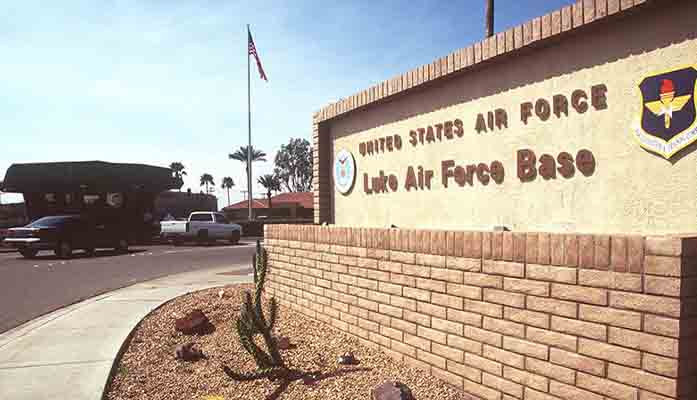
Hamadeh’s office emphasized the key wins for Arizona in the FY26 NDAA. They highlighted two provisions impacting Luke Air Force Base in particular. The first is a provision requiring the Secretary of the Air Force to produce a detailed report on the operational impacts, workforce demands, and costs before any downgrade of leadership at major bases like Luke Air Force Base. This will ensure the base, a critical hub for training and operations, retains its one-star general leadership. The second provision addresses HVAC issues at the West Valley Air Force Base.
In broader moves for his district, Hamadeh worked with Rep. Don Davis (D-NC) to secure a provision eliminating burdensome regulations that required license holders to “babysit” machine guns during fitment and testing. This change will save Arizona’s defense industry, particularly in Congressional District 8, significant costs while boosting efficiency.
Hamadeh added additional provisions as well to invest in cutting-edge gyroscopes produced in Congressional District 8, enhancing intelligence, surveillance, and reconnaissance satellite imagery, fast-tracking the customization of jet engine production in Phoenix for use in collaborative combat aircraft, and increasing the acquisition of dump trucks for the Arizona Army National Guard.
Working in bipartisan cooperation alongside Reps. Andy Biggs (R-AZ-05) and Greg Stanton (D-AZ-04), Hamadeh also secured an order for three additional conversions of AH-64D to AH-64E Apache helicopters, saving jobs at Mesa’s remanufactured Apache production line, which had been at risk of shutting down. In collaboration with Sen. Mark Kelly (D-AZ), Hamadeh included a provision requiring the Secretary of Defense to report on suicide prevention resources under The Brandon Act, named after Congressional District 8 service member Brandon Caserta, who tragically died by suicide.
Hamadeh emphasized the collaborative nature of the NDAA, stating, “I am grateful to my colleagues for their bipartisan support of Arizona’s military installations and innovators.”
Congressman Abraham Hamadeh (AZ-08), a member of the House Armed Services Committee, has delivered a landmark victory for Arizona’s military community, bases, and defense industry through the passage of the 2026 National Defense Authorization Act (NDAA).
During an intense 13-hour amendment process, Congressman Hamadeh delivered over 30 bipartisan provisions, securing critical investments and reforms for Arizona’s servicemembers, veterans, and defense sector.
“I am grateful to my fellow Arizonans and members of the Arizona Congressional Delegation for their input and support of these monumental achievements for our state. They range from investing in cutting edge technology for our warfighters, to preserving our rich military history, to making sure service members are not financially burdened when they want to bring family pets home from abroad,” said Congressman Hamadeh. “My constituents and American voices are being heard on the issues that these amendments address to make sure that we are spending the taxpayers’ money carefully and in a way that addresses the critical national defense and quality of life issues of today and tomorrow.”
Key wins for Arizona’s 8th District include:
Suicide Prevention Oversight: mandates a Department of Defense report on suicide prevention resources under The Brandon Act, honoring AZ-08 servicemember Brandon Caserta, who was sadly, a victim of suicide. Co-led with Senator Mark Kelly (D-AZ).
Protecting Luke Airforce Base Leadership: This requires a report on the operational and cost impacts of downgrading leadership at Luke Airforce Base.
Next-Generation Body Armor: Directs a report on innovative body armor development by Peoria based company, TYR Tactical, to counter advanced threats form adversaries like China and Russia.
Improving Industry Regulations: Eliminates burdensome red tape for machine gun testing, benefiting AZ-08’s savings and national defense industry. Co-led with Rep. Ron Davis (D-NC).
U.S.–Mexico Airspace Cooperation: Explores unprecedented collaboration with Mexico to enhance training capabilities at Luke Airforce Base, MCAS Yuma, and Ft. Huachuca while addressing border drone threats.
Reliable Air Conditioning at Luke Airforce Base: Addresses critical HVAC failures to improve conditions for servicemembers, especially during the hot summers of Arizona.
Submarine Air Recycling Innovation: Supports AZ-08 innovators developing cleaner, more reliable air recycling systems for submarines.
Advanced Satellite Technology: Promotes AZ-08’s production of cutting-edge gyroscopes to enhance intelligence, surveillance, and reconnaissance capabilities.
Statewide Impact for Arizona:
Protecting Ft. Huachuca’s Electronic Proving Ground: Prevents 44% staff cuts with a required review before reductions are finalized. Co-led with Senator Mark Kelly (D-AZ).
Saving Mesa’s Apache Helicopter Jobs: Secures orders for three additional AH-64D to AH-64E conversions, preserving jobs. Co-led by with Reps. Andy Biggs (R-AZ) and Greg Stanton (D-AZ).
Preserving Aviation History: Frees five T-37 jets from Tucson’s boneyard for restoration by the Arizona Aviation Historical Group to promote STEM and recruitment. Co-led with Senator Mark Kelly (D-AZ).
Western Training Range Complex: Directs the Department of Defense to link Arizona bases for joining warfare simulations. Co-led with Senator Mark Kelly (D-AZ).
Securing Ft. Huachuca’s Water Access: Ensures water availability for the base and surrounding communities against environmental lawfare.
Improving Safety at Barry M. Goldwater Range: Distributes $1.1 million for network coverage to prevent accidents and curb smuggling.
Commending Davis-Monthan’s New Special Operations Wing: Reinforces Congressional support for the new Air Force Special Operations Wing.
Strengthening Psychological Operations and Civil Affairs: Requires a briefing on integrating units like Buckeye’s 492nd Civil Affairs Battalion into Army initiatives.
Expanding Air National Guard Refueling Fleet: Raises the floor for refueling tankers, supporting Phoenix’s 161st Air Refueling Wing.
Countering Cross-Border Tunnel Threats: Extends partnerships with Israel to address Arizona’s emerging tunnel threats.
Standard Missile-6 Production: Supports Tucson’s missile production with a report and investment to reduce bottlenecks.
Collaborative Combat Aircraft Propulsion: Fast-tracks jet engine production in Phoenix for autonomous aircraft.
Increased Dump Truck Investment: Boosts acquisition of safer, reliable dump trucks for Arizona’s Army National Guard.
Directed Energy Weapon Development: Sends demand signals for counter-drone directed energy weapons developed in Arizona.
Regenerative Space-Based Solar Production: Requires a briefing on space solar manufacturing, where Tempe is the center of technology innovation.
Irregular Warfare Consortium: Commends Arizona State University’s Department of Defense Irregular Warfare Center and requires a briefing on its long-term strategy.
Addressing Missile Inventory Shortfalls: Applauds the Enterprise Test Vehicle program and directs a briefing on innovative air vehicle production processes.
National Security Advancements:
Pets Are Family: Extends Fly America Act exemptions to allow Department of Defense personnel to travel with up to three pets on foreign airlines, aligning with State Department policies and supporting military families’ quality of life.
Security Clearance Reform: Requires a report to address delays, improve transparency, and ensure a robust pipeline of cleared personnel to meet future defense needs.
Global Threat Response: Authorizes a one-year extension of the counter-ISIS train and equip program in Iraq and Syria, reducing U.S. boots on the ground while preventing the resurgence of the Islamic State.
High-Altitude Balloons and Platforms: Requires a report from the Secretary of Defense on current efforts and future potential of high-altitude platforms, ensuring the U.S. maintains a competitive edge in advanced surveillance capabilities.
U.S. Leadership in Space-Based LiDAR: Directs the Air Force and Space Force to provide a briefing on strategies to sustain U.S. dominance in space-based LiDAR for high-resolution observation, targeting, and object identification, countering China’s advancements.
Oversight on Military “Titling” Practices: Requires a review of unjust “titling” practices, recommendations to protect servicemember privacy from adverse consequences, and exploration of expungement and redress mechanisms. Coordinated with Rep. Eli Crane (R-AZ) and Rep. Cory Mills (R-FL).
Congressman Hamadeh’s unanimously passed amendments reflect collaboration with Arizona’s congressional delegation. He looks forward to partnering with Senate colleagues to deliver these provisions to President Donald Trump’s desk, advancing Peace Through Strength.
Ethan Faverino is a reporter for AZ Free News. You can send him news tips using this link.
Rep. Mary Peltola continues to have support among left-leaning American politicos, after emerging victorious in Alaska’s messy open-primary, ranked-choice general voting system in 2022.
Conservative Alaska voters, faced with a contentious field last year, awarded Peltola enough second-place votes to lock in her win.
As a candidate with low name recognition, Peltola committed to bipartisanship, saying she drew inspiration from the late Congressman Don Young. However, her voting record since November has revealed a different story.
Peltola’s support for Rep. Hakeem Jeffries as House speaker, casting 15 votes in his favor, was the first big item that raised eyebrows around the 49th state.
She voted against the Strategic Production Response Act and justified her absence during the final vote by claiming she was unaware voting was about to occur.
Peltola voted against the censure of Rep. Adam Schiff, who was the unethical impeachment manager for Speaker Nancy Pelosi during the now-discredited “Russia collusion” attack on former President Donald Trump.
Recently, she joined most Democrats in opposing the National Defense Authorization Act. The rationale behind her “no” vote lies in her desire for culture-war earmarks to fund military transgender treatments and surgeries, as well as paying military women a month of leave for late-term abortions. Peltola has also supported transgender males’ participation in female athletic competitions.
She voted against H.R. 5, the Parents Bill of Rights, and has been advocating for a national railroad strike, urging Starbucks baristas to unionize, and encouraging pizza workers in Alaska to do the same.
Peltola’s consistent absence is notable: She has missed 16 times more votes than the median Democrat House member. In a House with 435 members, she is number 12 for most missed votes.
While she participated in the women’s Congressional Softball game against journalists, she failed to show up for work the next day when almost all amendments to the National Defense Appropriations Act were voted on. Her inability to get out of bed deprives Alaskans of a voice in the House.
When she does vote, Peltola votes in line with Rep. Nancy Pelosi 84% of the time, Rep. Ilhan Omar 77%, and Rep. Alexandria Ocasio-Cortez 78%. Keep in mind that 53 percent of Alaskans voted for Trump.
Nick Begich, a lifelong Republican who ran for Congress in 2022, has seen enough. He decided to run again after witnessing Peltola repeatedly vote against Alaska’s values.
Although he faces the challenge of overcoming his relatives, who include well-known Democrats, Begich enjoys the continued support of his followers.
But Alaska’s unique method of selecting representatives, introduced with Ballot Measure 2 in 2020, deviates from the rest of the nation. It’s a tangled mess.
The open primary format eliminated the Republican Party of Alaska’s ability to independently choose its candidate for the general election.
Instead, all candidates, whether clowns or statesmen, participate in the same primary ballot. In 2022, this resulted in a massive ballot with 48 candidates.
The top four vote getters from the primary advance to the general election, where voters are then asked to rank the candidates in order of preference. If a voter’s preferred candidate loses, their vote is transferred to their next choice, granting them an opportunity to vote again. In this scheme, some voters get to vote more than once, while others’ votes are counted just one time.
Given the array of choices Alaskan voters had in November, which included three conservatives and one liberal candidate selected in the primary, it remains perplexing how a radical like Peltola emerged victorious.
Supporters of ranked-choice voting had promised that the system would eliminate extremists, but this is not how it worked in real life. Alaskans ended up with a de facto member of The Squad.
Will it happen again?
Begich begins his campaign with a solid base of one quarter of the likely vote this time around. However, with less than a year remaining until the primary ballot is set in Alaska, a lot can happen with campaign hijinks, as we saw in 2022.
Last year, Begich garnered support from major conservative organizations like Americans for Prosperity and Freedom Works for America, as well as the endorsement of the Alaska Republican Party.
And yet, the National Republican Congressional Committee (NRCC) is not structured to work well with the ranked-choice voting system, which in a state like Alaska all but guarantees the presence of multiple Republicans on a general election ballot.
This time around, the NRCC can and should focus on highlighting Peltola’s extreme positions to ensure that Alaskans can make a more informed decision in the upcoming 2024 primary and general elections.
For now, Alaskans are represented by a bait-and-switcher who holds some of the most mind-boggling positions in the history of the U.S. Congress. Alaska has the distinction of being the most conservative district in the country to be represented by a Democrat. We can do better.
National organizations like the NRCC, Freedom Works, Americans for Prosperity, and Club for Growth will be crucial in helping prevent a recurrence of 2022’s series of unfortunate events.