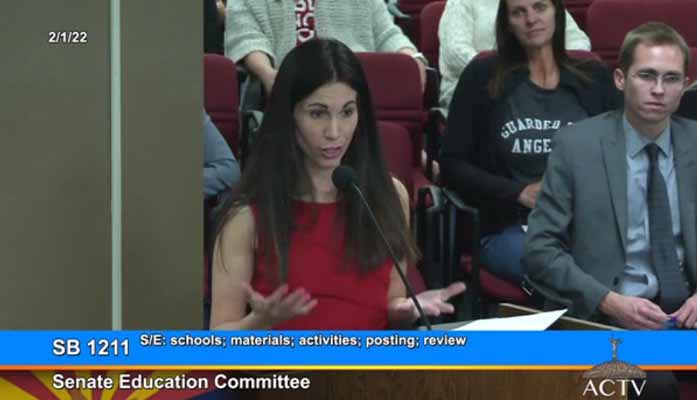
A bill to require K-12 schools to post all curriculum and learning materials on their website passed the State Senate along party lines, 16-13. It now heads to the House for consideration.
Senate Democrats argued that the bill would hinder teachers’ ability to have flexible, constantly changing lesson plans. State Senator Christine Marsh (D-Phoenix) said that while she agrees “100 percent” with transparency, she said that the bill would result in a slew of unintended consequences. Marsh claimed that teachers would be too busy uploading curriculum data to spend additional time with students.
Some Arizona teachers complained that they can’t meet the requirements of the bill because there would be no way to have their curriculum done in time for review. The bill sponsor, State Senator Nancy Barto (R-Phoenix) rebutted that claim during the Senate’s vote on Monday, explaining that what was required of teachers concerned a list of material titles “like a syllabus.”
“It’s been even testified by opponents, teachers who oppose the bill, even in their testimony they were saying they already do something like this,” said Barto. “What it will require is merely putting up the title of what they’re teaching of their lesson plans every week. And not the entire year in advance, which some somehow translate this bill as requiring. Nope. It’s within seven days after, so they just have to use something like a Google Doc, which many are using already — it was testified over and over again.”
Barto cited a study that teachers spend an average of four hours a week searching for material to use in their classrooms.
Nobody expects, and sadly our children don’t deserve, an inquisition… but that is exactly what #SB1211 is – an unjustified, backwards, and blatant example of big/authoritarian government overreach that would hurt AZ’s children.
Some Republicans expressed reluctance to have their vote fall in line with the party.
State Senator Michelle Ugenti-Rita (R-Scottsdale) expressed that the bill was a step in the direction but failed to get at the root of the problem with Arizona’s school system. Ugenti-Rita claimed that the problems concerned leadership, teacher’s unions, and nonpartisan school board members.
“Putting up loads and loads of information isn’t really going to solve the problem we have in K-12,” said Ugenti-Rita. “This is really not enough to get at the problem. This will leave parents with the impression that something is done when nothing is done. I don’t know what our obsession is with putting things online but you need to really go after the sacred cow, and it’s not the materials online, it’s the elections — these nonpartisan school board elections.”
Ugenti-Rita also expressed concerns that the bill was “intense and overkill.” She asked for commitment from House leadership to make the legislation implementable.
“To me, this is like a supplement. It’s like if you had real, deep health problems, a vitamin isn’t going to fix it. You need to diet, you need to exercise. This is helpful, but it’s really not going to get at the problem at our schools. This isn’t going to keep schools open. This is really going to do very little than look as though we’re doing something,” said Ugenti-Rita.
State Senator Tyler Pace (R-Mesa) said bills like Barto’s were the reason he took heartburn pills over the summer. Pace said he disliked the broad scope of what information educators would have to upload. However, Pace admitted there was a need for curriculum transparency, citing his own experience in which he learned a teacher allowed his kids’ class to play games like “Cupcake Vampire Princess Makeup Tutorials” after they finished an exam.
Other Republicans normally on the fence with certain party initiatives supported the bill wholeheartedly. State Senator Paul Boyer (R-Glendale) rebutted that the legislation wouldn’t be a burden on teachers, citing his own experience. Boyer insisted that it would alleviate current burdens on parents as well as benefit teachers looking to improve their curriculum by looking at what teachers are using at successful schools.
Passage of the bill comes over a month after the Senate Education Committee approved the bill.
NOW: SB1211 Academic Transparency passes the AZ senate! Now headed to the House. This bill let’s parents know what’s being taught in their kid’s classroom @GoldwaterInst@NancyBartopic.twitter.com/Or3xi1AYta
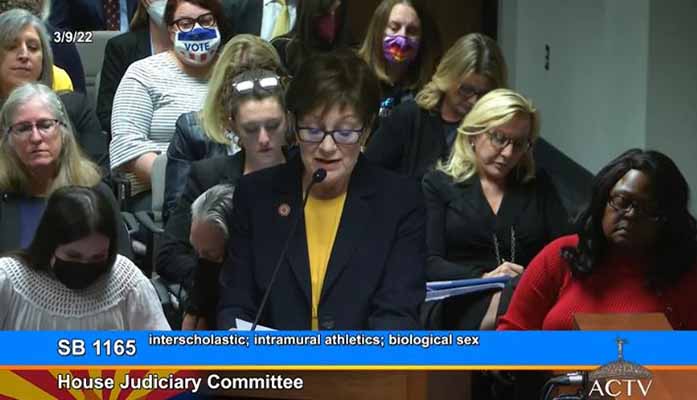
A Senate bill banning males from female sports teams advanced out of the House Judiciary Committee on Wednesday, passing along party lines. The legislation would apply to both private and public K-12 schools, colleges, and universities.
The legislation prohibits political groups, licensing organizations, and athletic associations from investigating or taking action against schools for adhering to the bill provisions. Conversely, a school would bear civil liability for any deprivation of athletic opportunity, or causing direct or indirect harm by ignoring the legislation. Students would be entitled to take a private cause of action and could earn damages and relief.
The bill sponsor, State Senator Nancy Barto (R-Phoenix), said that the bill was based on scientific fact to ensure that girls have a “fair, level playing field.” Barto said that the threat of biological males identifying as females undermined Title IX.
Barto cited data from Save Women’s Sports, a coalition to prevent males from competing in female sports, documenting the males competing in female sports. Barto also cited the case of Lia Thomas, the transgender woman on the Penn State University women’s swim team.
After dubbing Barto the “Queen of Mean,” Arizona House Democrats praised a 13-year-old transgender girl, Skyler Morrison, who spoke against the legislation. The boy was accompanied by his mother.
“I’ve had my childhood ripped away from me by legislators for seven years and I’m sick of fighting for human rights, but I won’t stop until I know that me and all my transgender friends are safe,” said Morrison. “These anti-trans sports bills are unscientific and cause a real mental health issue for the people they would affect.”
Morrison claimed that testosterone doesn’t give biological males an athletic edge, and that females could still win in competition against their male peers.
Here it is! I accidentally said SB1138 instead of SB1165 at first. Click here to watch my testimony: https://t.co/XQRHor7Twj
The Arizona Interscholastic Association revealed that they have received 16 appeals for transgender athletes and only denied one.
Official with the Arizona Interscholastic Association testifies that out of 174k+ high school athletes at any given time, the board has only ever had 16 appeals for transgender athletes, denying 1. #SB1165 does not solve an Arizona problem, but would create multiple new ones.
— Arizona House Democrats (@AZHouseDems) March 9, 2022
Minority Whip Domingo DeGrazia (D-Tucson) claimed that the bill solved something that wasn’t an issue.
“If a youth loses an opportunity for something either to be in competition or that they lose a competition or that they don’t get a sponsorship or that they don’t get to be an influencer of TikTok; if that’s their indirect harm, how do you attribute that to sports to an opposing player?” asked DeGrazia.
After the committee approved the bill, Superintendent of Public Instruction Kathy Hoffman claimed that the bill would harm all student athletes — even those females whose opportunities and possibly safety that the bill promised to protect.
Lawmakers must pass policy that has student input and support.
I'm grateful for Skyler's testimony in opposition to #SB1165 – and incredibly disappointed that the Judiciary Committee chose to pass this anti-trans bill that harms all student-athletes. https://t.co/MHPX1gL5Rf
The Arizona Senate approved a bill to limit abortions after 15 weeks, SB1164, with punishment reserved for physicians providing the abortions and not the mother of the unborn child. Abortions past 15 weeks could be performed in the event that a mother’s life is determined to be at stake, but the physician must file a report with the Department of Health Services (DHS).
The bill sponsor, State Senator Nancy Barto (R-Phoenix), has been invested in phasing out abortion entirely. Barto was the sole state legislator outside the Supreme Court hearing for Dobbs v. Jackson Women’s Health Organization, which considers the legality of Roe v. Wade precedent, the ruling that legalized abortion nationwide.
Barto called her bill a “common-sense limit,” but lamented that the bill didn’t go far enough.
Barto did concede that the bill was still an opportunity to protect more women from late-term abortions, saying it was “honoring life and protecting women.” Barto criticized Planned Parenthood for not using its millions to help women with unplanned pregnancies,
“15 weeks? That puts Arizona in league with China and North Korea,” said Barto.
Senate Democrats defended the decision to end an unborn child’s life as the personal decisions of parents. State Senator Christine Marsh (D-Phoenix) said that the state of Arizona couldn’t put barriers on abortion until there’s a way to stop rape and incest for good.
State Senator Sally Ann Gonzales (D-Tucson) said that unborn children could be “a burden” to families.
“We ought not be supporting bills like this that really place not only a burden onto families but, as I always like to say, it’s really placing our own individual values and beliefs onto all the women of this state,” said Gonzalez.
State Senator Rosanna Gabaldon (D-Sahuarita) said she wanted to be proud to be part of a state that allows families to make the decisions of what their families look like. Gabaldon expressed a wish that the question of abortion would no longer be subject to moral debate but rather an accepted good.
“I want to live in a world where we respect other people’s decisions,” said Gabaldon. “I want one day for Arizona to look back and say, ‘Why did we have a problem with this?’”
State Senator Raquel Teran (D-Phoenix) compared Arizona women’s plight with unplanned pregnancies to the women of El Salvador under their strict abortion ban in place since 1998. Teran insinuated that the third-world justice system practices of El Salvador would befall Arizonans. She called the bill an “injustice.”
State Senator Stephanie Stahl-Hamilton (D-Tucson) claimed to be a Christian and that the Bible supported abortion.
We need a world where people respect each other’s personal decisions around parenthood and pregnancy—whether those decisions involve giving birth, putting a child up for adoption, having an abortion, or choosing not to have children at all. #SB1164#AbortionIsHealthcare
The Arizona Senate Education Committee passed a bill to ensure K-12 schools afford greater transparency to parents concerning the content and adoption procedures for curriculum and all other learning materials. The bill, SB1211, passed 5-3 along party lines. 20 states have introduced similar legislation; the Wisconsin legislature passed a similar bill last year but their governor vetoed it; most recently, the Indiana House moved another similar bill forward. However, no other state has the same legislative language as SB1211.
Specifically, the 14-page bill would require schools to post online in a searchable manner all learning material adoption procedures as well as the content organized by subject, grade, and teacher. The specified learning material covered requires readings, videos, audio, digital materials, websites, instructional handouts, worksheets, apps, assemblies, guest lectures, civics assignments or projects, and service learning projects. Any educational materials concerning nondiscrimination, diversity, equity, inclusion, race, ethnicity, sex, gender, bias, action-oriented civics, service learning, or social and emotional competencies must be referenced in full online at least 72 hours before implementation. Materials outside that scope must be posted online within a week of their implementation and remain accessible on the site for two years. The bill also would require schools to allow all throughout the school day as well as a half an hour before and after school hours for textbook review prior to adoption.
Parents could seek redress for violations of this bill by first submitting a complaint to the school principal. If the principal doesn’t investigate and respond within 15 days, or the response doesn’t solve the issue satisfactorily, parents could submit a complaint to their school board. If the board doesn’t respond adequately or at all within 25 days, then parents may take legal action against the school’s governing body. No teachers would be subject to punishment.
State Senator Nancy Barto (R-Phoenix) insisted all she was introducing was a “simple […] common-sense transparency bill.” Barto clarified that the bill would allow parents a heads-up about what their children would learn.
“So many parents are so frustrated at not having access to what their children are learning in schools. There are so many things that are accessible online now, and curriculum needs to be one of them,” said Barto.
Parent after parent highlighted personal and local incidents concerning willful lack of transparency from their schools and districts. In addition to parents, the Arizona Coalition of School Board Members and Heritage Action for America showed up to support the bill. A handful of teachers, most of them masked, and the Arizona Education Association (AEA) spoke out against the bill. They argued that the bill would create an undue burden on teachers and districts, foster distrust and malcontent between parents and teachers, and even further reduce educational quality. The Arizona Charter School Association (ACSA) was also reportedly against the bill, according to State Senator Gonzales, but none of their representatives gave testimony before the committee on Tuesday.
The first to provide public commentary on the bill was none other than Nicole Solas — the Rhode Island parent sued by her state’s teacher’s union, the National Education Association of Rhode Island (NEARI) for her public record requests and represented by the Goldwater Institute, the Phoenix-based conservative public policy and litigative think tank.
Solas told the committee that her story was a cautionary tale of what occurs when a state doesn’t have academic transparency. Her story began when she requested information about the education her daughter would receive, and learned that the school taught about gender at every grade level in “age-appropriate ways,” as well as teaching five-year-olds on the first day of Thanksgiving what could’ve been done differently during the pilgrim’s Thanksgiving. When Solas attempted to ask more questions about the curriculum, her school told her to submit public records requests. After doing so, the school board of her district put her name on the agenda of a public meeting with a threat to sue her for her records requests.
Solas recalled how the five hour meeting was filled with public harassment and open debates on her moral character and motivations by the board members. Solas shared further that her district then hired a public relations firm to defame her in the national media. The local teacher’s union then decided to sue Solas for filing those records requests. Even after enduring all of that eight months later, Solas said her original requests have gone unanswered. All she received was outdated curriculum; the district told her she hadn’t asked specifically for the current curriculum.
“What they did to me was government abuse of power just because I wanted to know what was being taught,” said Solas. “This is a kafkaesque, bureaucratic problem with a very easy academic solution.”
It wasn’t just the blame from the district that presented a problem to Solas — it was the cost of the records requested. Solas insisted that the cost to districts to fulfill public records requests was unnecessary, and that public schools needed to be protected from squandering their education dollars.
“Pass this bill for public schools and you can save them from themselves. We need our education dollars to be spent on students, not on a petty stand-off between schools and parents,” said Solas. “These are the games they play with public records requests. Our children’s education is not a game.”
Majority Leader Rick Gray (R-Sun City) said Solas’ story was heartbreaking to hear, and expressed condolences for the plight of New Jersey’s children.
“They wanted to send a message that if you want transparency […] they will retaliate against you and punish you for asking for transparency,” relayed Solas.
State Senator Christine Marsh (D-Phoenix) asked Solas if New Jersey had a parental bill of rights similar to Arizona’s. She added that she didn’t understand what Solas’ issue had to do with Arizona schools. Solas said they don’t have anything like that in her state, and informed Marsh that the Phoenix-based Goldwater Institute is representing her for the lawsuit.
Goldwater Institute Director of Education Policy Matt Beienburg offered insight from Arizona teachers in support of the bill. He read a letter from Jessica, an English teacher, who described how she covered over 70 absences in one week and insisted on the bill because it provided an “easy safeguard” for creating a “workshop” between families and schools.
“This bill is pro-student, pro-parent, and pro-teacher,” asserted Beienburg.
State Senator Tyler Pace (R-) asked what a pragmatic solution would be, instead of this bill. Thomas said the best solutions would be at the local level. He said parents already had “a lot of tools” to get the transparency they need.
“The unintended consequence of this is that kids are going to suffer in that their interests aren’t going to be explored at any given instance during the day,” asserted Marsh.
Gray pressed AEA President Joe Thomas, who insisted that better answers were to be had, to give them a tangible solution. Thomas couldn’t. Instead he repeated that parents had the tools to investigate the curriculum themselves. Gray insisted that wasn’t enough of an answer.
“When we see this as a legislative body and this is brought to us, it is our responsibility to see what we can do to solve this problem. Ideally we would never get this problem here because the schools would take care of it,” responded Gray. “We don’t have any solutions from the education industry, but we clearly have problems from the parents.”
In closing public remarks, Beienburg cited how an AEA spokeswoman last year reported that she submitted curriculum materials regularly to her district officials for review.
“That’s indicative of the fact that this is doable,” said Beienburg.
Curriculum Transparency!@NancyBarto's SB1211 bill will be heard on Tuesday at 2PM!
SB1211 would make the curriculum materials available online for parents to view.
Give it a ? on RTS Come testify and support Contact the Senate Education Committee to encourage a YES vote
The “Save Women’s Sports Act,” a bill prohibiting transgender women from competing in K-12 and collegiate women’s sports, advanced out of the Senate Judiciary Committee on Thursday.
State Senator Nancy Barto (R-Phoenix) introduced the bill, SB1165, but was absent from the committee hearing. Matt Sharp, senior counsel for Alliance Defending Freedom (ADF), spoke on behalf of Barto. Sharp recounted several instances of biological men that identified as transgender women dominating in women’s sports, and the losses that biological women faced. Sharp further explained the constitutional and legal support that the bill had in ensuring a “fair and level playing field” for women, citing opinions from the Arizona and federal supreme courts.
“It protects opportunities for women and girls, by ensuring women are not forced to compete against men playing on women’s teams,” said Sharp.
State Senator Martin Quezada (D-Glendale) asked Sharp if Arizona had experienced any instances or issues with transgender women in girl’s sports. Sharp responded that the Arizona Interscholastic Association (AIA) policy allows males to compete in women’s sports. Quezada insisted that a problem hadn’t occurred yet, insinuating that the bill wasn’t necessary; Sharp retorted that the intent of the bill was to be preventative.
Senate President Pro-Tempore Vince Leach (R-Tucson), asked if there were some kind of walls that would keep out the issues of males competing in female sports. Sharp affirmed that he’d witnessed states expressing regret for not taking proactive measures to prevent males from intruding on female sports.
“It’s never a bad time to implement good policy,” remarked Chairman Warren Petersen (R-Gilbert).
Several community members testified, both for and against the bill — including one transgender woman. He said he supported the bill.
“Believe me when I say this is not an attack on transness at all. This bill has nothing to do with that. All this bill has to do with is biological sex, biological reality, alright? So the reality is, we’re stronger, we’re taller, we have bigger bones, we can take in more oxygen, we have a better fat distribution that gives us an advantage in taking hits, right, we have stronger ligaments. There are very clear, obvious advantages,” stated the transgender woman.
This bill is not an attack on transness, it has nothing to do with that. It’s about biological sex, biological reality. #SB1165pic.twitter.com/cGgT2ZfSyQ
Quezada was joined in voting against the bill by Assistant Minority Leader Lupe Contreras (D-Avondale) and Stephanie Stahl Hamilton (D-Tucson). Those who voted to pass the bill in addition to Leach and Petersen were Vice Chairman Wendy Rogers (R-Flagstaff) and Majority Whip Sonny Borrelli (R-Lake Havasu City).
Corinne Murdock is a reporter for AZ Free News. Follow her latest on Twitter, or email tips to corinne@azfreenews.com.