Arizona State University (ASU) received over $3.4 million in funds from the nonprofit founded by leading Democratic dark money donor George Soros.
The online data guru Jennica Pounds, known by her username @DataRepublican, named ASU as a recurring recipient of Soros funds as part of nearly a decade of grants from the Open Society Foundations (OSF).
🚨 Download Soros Grant Spreadsheet 💵
Ever wonder where George Soros is sending his money? 👀 I've extracted and published the public Open Society Foundations grant database in spreadsheet format. This is your chance to dig through the receipts. 📂🧾
🇺🇸 Want to follow the…
— DataRepublican (small r) (@DataRepublican) May 12, 2025
Pounds — who boasts a background as a software engineer for leading American tech companies including Amazon, eBay, Snap, and Upstart — gained recognition among Republican voters and the Trump administration for building AI tools to assist with the ongoing Department of Government Efficiency (DOGE) effort to identify and eliminate wasteful or fraudulent spending.
Pounds’ latest project focused on cataloguing Soros’ philanthropic arm.
From 2018 to 2022, the ASU Foundation received $169,000 for the Mary Lou Fulton Teachers College; $200,000 for the Connected Learning in Crisis Consortium; $1.2 million for the McCain Institute for International Leadership; $200,000 for improving learning amid crises and conflict; $22,000 to bring together global educational leaders, and $24,000 for the New American University.
One of OSF’s largest donations to ASU was over $1.5 million for English Second Language (ESL) at the Open Society University Network (OSUN).
Soros established OSUN in January 2020 at the World Economic Forum in Davos, Switzerland, just weeks before the COVID-19 pandemic swept the world. OSUN serves as a global collaboration of universities. ASU was among the first to be included in OSUN. Of note, ASU’s page for OSUN omits any mention of Soros as the establisher of the network.
Other American universities to later join OSUN were the Bard Early Colleges of Baltimore, Cleveland, Manhattan, New Orleans, Newark, Queens, and Washington, D.C.; the Bard Prison Initiative; Picker Center for Executive Education at Columbia University; Bard College at Simon’s Rock; University of Connecticut Human Rights Institute; Talloires Network of Engaged Universities; Princeton Global History Lab; Tuskegee University; University of California’s Berkeley Human Rights Center; and the University of Pittsburgh’s Afghanistan Project at the Center for Governance and Markets.
Other Arizona-based entities to receive Soros money were:
Arizona Wins ($3.875 million);
Living United For Change in Arizona ($3.3 million);
One Arizona ($1.8 million);
Our Voice, Our Vote Arizona ($1 million);
League of Conservation Voters ($750,000);
Inter Tribal Council of Arizona ($500,000);
Community Foundation for Southern Arizona ($500,000);
Arizona Community Foundation ($400,000);
ADRC Action ($300,000);
PODER ($100,000);
Poder in Action ($75,000);
YWCA of Southern Arizona ($60,000)
Arizona Center for Empowerment ($37,000, and another $325,000 through the Center for Popular Democracy, a partner organization)
Arizona Coalition to End Sexual and Domestic Violence ($25,000);
Sonoran Prevention Works ($15,000)
Other entities were paid by OSF throughout the years to engage in advocacy in Arizona and, ultimately, influence state policies and laws. Among those who received payment for advocacy were: Invest in Education, $700,000; re:power Fund, $200,000; State Engagement Fund, $170,000; PAFCO Education Fund, $150,000; Alliance for Youth Organizing, $50,000; and Vote.org, $20,000.
AZ Free News is your #1 source for Arizona news and politics. You can send us news tips using this link.
The McCain Institute played host to several “disinformation experts” in Phoenix last week, where they discussed how best to control free speech online.
These experts, Bret Schafer and Rachael Dean Wilson, hail from Alliance for Securing Democracy at the German Marshall Fund.
Schafer created and manages Hamilton 2.0, an online open-source dashboard tracking the outputs of Russia, Chinese, and Iranian state media outlets, diplomats, and government officials. Wilson was the communications director and advisor to the late John McCain.
Schafer’s Hamilton 2.0 is a continuation of his original project within Alliance For Securing Democracy, Hamilton 68, which culled data from major social media companies to identify content similarities between foreign adversaries and Americans — X when it was “Twitter” prior to Elon Musk’s buyout, Facebook, and Instagram — shortly after Donald Trump assumed the presidency in 2017. Musk paywalled X’s application programming interface, stymieing Schafer’s data stream.
Schafer was part of investigations into practices by social media companies that were weaponizing the government against right-wing citizens.
During last Thursday’s panel, Schafer said that an individual from Meta (Facebook) told him that they began to implement more “guardrails” following the Christchurch shooting, since the shooter used the company’s live-stream function, “Facebook Live,” to film and publish the attack. Schafer said that artificial intelligence (AI) was the “reverse” of efforts to implement guardrails, and expressed concern that there should be greater limitations on “problematic” online speech.
“I think the concern is this pollution in the information space, so if somebody has a narrative that’s particularly problematic it now seems as if it’s coming from 50, 100, 200,000 different sources and it can kind of drown out competing voices who are not using manipulated information to get their message out,” said Schafer.
Schafer advocated for social media companies to reduce the spread of content not originating from certain officials or media outlets. He recalled how those technology companies did some of this during the 2020 election. Schafer lamented that public perception of social media companies controlling content reach and visibility became “politicized” and controversial.
“The only way to make sure the people who genuinely want to actually access accurate information […] is for [social media companies] to make some decisions about what is and is not quality information,” said Schafer. “That has become politicized in ways that I think are really problematic so I think we do need to pressure the companies to the various mechanisms we can: advertisers, everything else to ensure at least around elections that they are taking an active role in making decisions about what should be prioritized because if it’s just left up to the algorithms we’re not going to see the good information surface at the top.”
Wilson agreed. She added that officials could rely on online influencers to spread their information. Combined with Schafer’s proposal of increasing and prioritizing reach for certain information from certain officials and experts, that may mean influencers would be incentivized to spread certain information in order to increase their visibility, engagement, and monetization.
“I think getting the influencers to encourage referencing experts is really important,” said Wilson.
Secretary of State Adrian Fontes also participated in the panel discussions.
Like the Hamilton initiative, the Alliance for Securing Democracy was founded after Trump took the White House. The organization is led by Laura Thornton, whom the McCain Institute hired in August to serve as senior director of global democracy programs.
Among its team members are David Salvo, former Obama administration foreign service officer within the State Department, and Shanthi Kalathil, former deputy assistant to the president and coordinator for democracy and human rights at the National Security Council under President Joe Biden.
Alliance for Securing Democracy used to publicize its list of advisory members until some time late last year or earlier this year.
Mike Cherthoff, formerly the W. Bush administration Homeland Security Secretary;
Toomas Ilves, formerly the Estonia president and a World Economic Forum co-chair;
David Kramer, formerly a McCain Institute senior director and W. Bush administration State Department official;
Bill Kristol, editor of The Weekly Standard and former staffer for the Reagan and H.W. Bush administrations;
Rick Ledgett, formerly the Obama administration NSA deputy director;
Mike McFaul, formerly the Obama administration ambassador to Russia;
Michael Morelll, formerly the Obama administration CIA acting director;
Ana Palacio, lawyer and formerly European Parliament member;
John Podesta, formerly Hillary Clinton’s campaign chair and an official for both the Clinton and Obama administrations.
Mike Rogers, CNN commentator and formerly a GOP congressman, army officer, FBI special agent;
Marietje Schaake, formerly a European Parliament member;
Kori Schake, American Enterprise Institute director and formerly employed by the State Department, Defense Department, and White House National Security Council; and,
Nicole Wong, formerly the Obama administration deputy chief technology officer, Google vice president and deputy general counsel, and Twitter legal director for products.
This week, the McCain Institute announced it had been accepted to be featured in the competitive annual event, South by Southwest.
Last week’s full panel is available here:
AZ Free News is your #1 source for Arizona news and politics. You can send us news tips using this link.
Arizona State University’s McCain Institute hosted a discussion on the 2020 election on Jan. 6, 2023.
The organization, which claims to be nonpartisan, invited CBS News Chief Washington Correspondent Major Garrett and left-leaning election law advocate David Becker to discuss their 2022 book, “The Big Truth: Upholding Democracy in the Age of ‘The Big Lie,’” with Executive Director of the McCain Institute Evelyn Farkas.
“This book, although it was written in 2022, is incredibly timely… because right now… we have the former president of the United States in D.C.’s court of appeals sitting there listening to an argument about whether he should have immunity for actions that he took, things that he said in the 2020 election,” Farkas said.
In 2020, the election process was “placed under more pressure than ever since the Civil War” and “was carried out with the highest turnout ever, the most diverse populace ever to participate in a presidential election in our history,” according to Garrett.
“Those things are signs of success, not failure,” Garrett continued.
The discussion fell on the third anniversary of the Jan. 6, 2021, breach at the U.S. Capitol and focused on “what actually happened in the 2020 election.” The speakers discussed the “misinformation” designed to “con and beguile Americans into chasing phantom allegations of election crimes.”
“People who spread disinformation don’t necessarily have to convince you of the lie, they just have to convince you that nothing is true,” Becker said at the event.
The election “was an impressive example of democracy at work, despite attempts to overshadow its success,” according to the McCain Institute.
The McCain Institute has a history of dwelling on the 2020 election years after the fact. The ASU center hosted a panel discussing “election denialism” and former President Donald Trump’s “Big Lie” about the 2020 election in February.
Inspired by Senator John McCain and his family, the McCain Institute is part of Arizona State University and based in Washington, D.C. The book discussion was part of the institute’s Authors and Insights book talk series, which started in 2020.
Elizabeth Troutman is a reporter for AZ Free News. You can send her news tips using this link.
The Pentagon’s former policy chief on military relations between Russia and Ukraine — Arizona State University (AUS) McCain Institute Executive Director Evelyn Farkas — is leading an event focused on lobbying for more U.S. support in Ukraine.
The event, “Relentless Courage: Ukraine and the World at War,” will also feature Ukrainian Ambassador to the United States, Oksana Markarova, and panelists for a discussion, “One Way Forward: The Vitality of a Democratic Ukraine,” to advocate for continued Western support for Ukraine.
ASU’s McCain Institute and the Walter Cronkite School of Journalism and Mass Communication (Cronkite School) will co-host the event. Other featured speakers at the event include Cronkite School Dean Battinto Batts; peacebuilding advisor for Romanian Peace Institute, senior protection officer for Center for Civilians in Conflict, and 2022 McCain Global Leader Maria Levchenko; and photographer Svet Jacqueline.
Join us Sept. 25 in Phoenix for an event marking the opening of a new exhibit featuring photography from the book “Relentless Courage: Ukraine and the World at War.” Registration (in-person or livestream) is now open. https://t.co/iyu3SbXmRqpic.twitter.com/7lW9pnKOHN
The Biden administration has sent over $76 billion in aid to Ukraine since last year, with the president pushing for another $24 billion in the ongoing budget discussions. Last year, Congress approved $113 billion of aid to Ukraine.
While Obama’s deputy assistant secretary of defense to Russia, Ukraine, and Eurasia, Farkas advised on Russia’s first invasion of Ukraine and annexation of Crimea in 2014 and was largely responsible for initiating the admission of Montenegro into NATO, a move that caused an escalation from Russia. Then and now, Russia views NATO as a threat.
Shortly after setting the wheels in motion for Montenegro’s admission to NATO and amid divisions within the Obama administration over the correct approach to Russia, Farkas resigned. Leading up to her resignation, Farkas issued similar calls for increased U.S. involvement in the Russia-Ukraine War.
“As the crisis deepens, our European allies and partners will look to the United States to demonstrate resolve and to reinforce solidarity across the continent,” said Farkas in a 2014 Senate Foreign Relations Committee meeting.
Earlier this week, CNN featured Farkas to advocate for additional U.S. support for Ukraine.
Farkas said that it was America’s moral duty to submit to Ukraine President Vladimir Zelensky’s weaponry requests. Farkas characterized reluctance to continue funding to Ukraine as “fickle[ness].”
“If he doesn’t have these things, more civilians will die and more military will die fighting the Russians,” said Farkas. “Politically, certainly, the West can be fickle, and that’s what Vladimir Putin is counting on.”
Farkas upholds the belief that Ukraine’s outcome in this war will determine the “fate of all humanity.”
Caught up with humanitarian @chefjoseandres at #CGI2023 and we discussed how important it is to ensure that America and the world understands what is at stake in the war in Ukraine. The challenges in Ukraine are urgent for all of humanity. pic.twitter.com/qWLFo1327y
Little known fact @TerryMcAuliffe has been multiple times to the Ukrainian front line. He gets that the future of our international system and humanity begins and ends in Ukraine now. pic.twitter.com/OsXIcjWl5B
In February, the McCain Institute hosted the Ukraine Prosecutor General for a meeting with the newly-formed Ukraine Business Alliance (UBA). The UBA coordinates executives from American technology and defense companies, senior U.S. and Ukrainian government and military leaders, and foreign policy experts to strategize public-private partnerships supporting Ukraine. UBA-involved companies include Palantir Technologies, Microsoft, and Amazon.
“We are committed to ensuring that those working to uphold the rule of law & defending Ukraine as a nation state have the software they need for as long as it takes,” Karp told the McCain Institute earlier this year.https://t.co/Ol9DBVuRxw
Palantir Technologies is a Founding Member of the McCain Institute's Ukraine Business Alliance. Yesterday, the Alliance held its first meeting with Andriy Kostin, Ukraine's Prosecutor General, to discuss how leading #tech companies…https://t.co/R031PMMrk4https://t.co/b0trwV2UMV
Even after escaping the turmoil of the Obama administration, Farkas appeared eager to jump back into the fray against Russia. Farkas was one of the first to promulgate the Russiagate conspiracy that former President Donald Trump colluded with Russia to fix the 2016 election, and called for an investigation into the president.
“[T]he Trump folks, if they found out how we knew what we knew about their, the staff, the Trump staff’s dealing with Russians, that they would try to compromise those sources and methods, meaning we would no longer have access to that intelligence. So I became very worried, because not enough was coming out into the open, and I knew that there was more,” said Farkas in an MSNBC interview.
Yet, behind closed doors about a month later, Farkas admitted to the House Intelligence Committee that she “didn’t know” whether anyone within the Trump campaign colluded with Russia. She further admitted that her media tour remarks were based on “a strong suspicion” cultivated from other media reports and reporters calling her. Farkas’ testimony, along with others collected by the committee, weren’t released for about three years.
“So I was making a leap that if, indeed, there was collusion, the way we would’ve uncovered it probably would have involved classified means,” said Farkas. “[I know] nothing outside of what’s been reported by the press.”
Farkas also admitted, contrary to her widespread public remarks, that she had no proof that Russians were interfering in elections aside from propaganda, or that Russians were colluding with the Trump campaign. She concurred with the following statement offered by Gowdy:
“I have no evidence that the Trump campaign colluded, conspired, or coordinated with the Russians,” read the statement.
Corinne Murdock is a reporter for AZ Free News. Follow her latest on Twitter, or email tips to corinne@azfreenews.com.
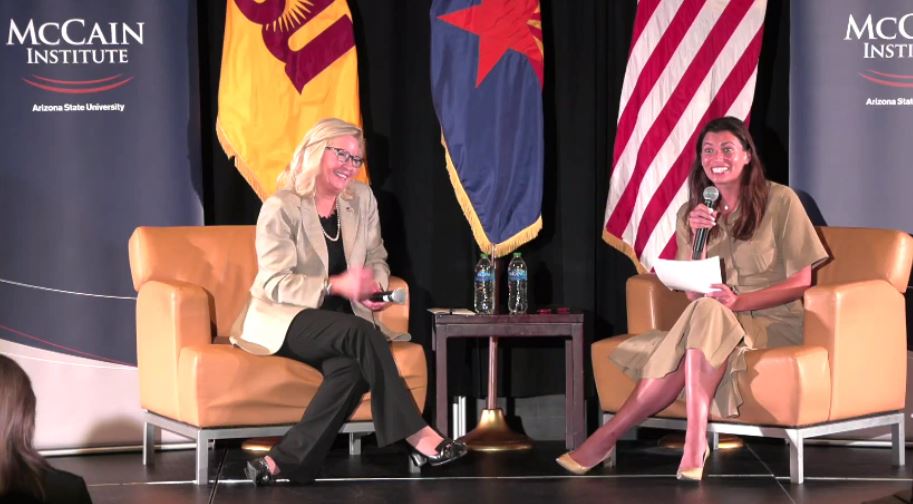
Ousted Congresswoman Liz Cheney (R-WY) told Arizona State University (ASU) students to fight back and stop Republican leaders from coming to Arizona to campaign for Trump-backed candidates. Cheney suggested punishments for those GOP officials, as part of her remarks during the fifth installment of the ASU McCain Institute’s series “Defending American Democracy.”
Cheney made an example of Senator Ted Cruz (R-TX), saying he should “know better” than coming to Arizona to campaign for Republican gubernatorial candidate Kari Lake. Cruz attended a fundraising event for Lake on Wednesday.
Yet shortly after giving that advice, Cheney lamented that “too often, conservative views are canceled.” Cheney also advised the students to vote for Democrats even if they’re Republicans.
Shortly after her loss in August, Cheney launched a $15 million initiative through her political action committee (PAC) to defeat Trump-backed candidates.
At the opening of the ASU event, McCain Institute Executive Director Evelyn Farkus explained that Cheney was their latest guest speaker because she’s the “epitome of American political courage,” having sacrificed her political career by standing up for her values.
The McCain Institute’s first-ever Democracy Fellow, Sophia Gross, interviewed Cheney. Gross said Cheney exemplified a courage and set of values that young men and women should look up to in order to better themselves and serve their country.
This is who @ASU@McCainInstitute had interview @Liz_Cheney tonight, a self-described "pretty big civic nerd": "[When] I showed up to vote for the first time, […] it turned out you voted for a lot more than just president. And, it was a very disenfranchising feeling…" 1/ pic.twitter.com/Iy8aa6R0Af
The McCain Institute stated that the goal of the series is to advance citizens “beyond politics” in order to make America a city on a hill. It’s partially funded by the Knight Foundation, a left-leaning organization.
The four prior events in the “Defending American Democracy” series focused on the dangers of the decline and disappearance of local journalism, implications of verbal threats to election officials, protections for election infrastructure against cyberattacks, and plans to counteract hate.
In this event, Cheney fixed her remarks on several general topics: former President Donald Trump, January 6, and the Russo-Ukrainian War.
Cheney said that the main lesson of the January 6 invasion of the Capitol was that institutions can’t defend themselves, it takes individuals. Cheney insinuated that government institutions were the victims — not citizens. Cheney also commended those who testified before her January 6 Committee: Maricopa County Recorder Stephen Richer, Maricopa County Board of Supervisors Chairman Bill Gates, and Speaker of the House Rusty Bowers. Richer and Gates were reportedly present at the ASU event.
“Arizona and our nation owes Rusty a debt of gratitude,” said Cheney.
Concerning the January 6 invasion of the Capitol, Cheney claimed that Trump didn’t take action to stop the trespassers. She quickly backtracked with a self-correction, noting that the former president did take action but complained that it took him “187 minutes.” Cheney stated repeatedly that Trump was attempting to destroy democracy.
“No nation can have a leader who is so derelict in his duty,” declared Cheney.
At one point, Cheney predicted that the nation was heading toward a future as similar and troublesome as the Holocaust. She issued that prediction as she relayed a recent conversation with a young woman from Wyoming whose grandparents escaped the Holocaust. That young woman reportedly expressed worry to Cheney that America would no longer be a place of refuge like it was when her grandparents escaped.
“I think that’s a very real and serious concern,” said Cheney.
Cheney also said that she’s proud of the January 6 Committee, assuring the audience that it was non-partisan. Cheney said she most respects her fellow select committee and other Democrats, especially those women on the armed service committee.
“I never imagined that I would find myself spending so much time with Democrats. I’m sure they’re surprised to be spending so much time with me as well,” said Cheney “Everybody should be represented by the people that they know are going to do the hard work.”
Cheney said that America needs to get involved in Ukraine’s war against Russia. She said that was a hallmark of patriotism. Cheney also indicated that anyone opposed to her beliefs belonged to the “Russian” wing of the Republican Party.
Toward the end of the event, Cheney opined that true patriotism meant an allegiance to a fundamental sense of human freedom, of inalienable rights from God and not the government.
“Being a patriot means first and foremost loving our country more. We can say to each other ‘we’re Democrats, we’re Republicans, but we love our country more,’ and we’ll act in accordance with that. That means you’ll put your country above politics, your political career,” said Cheney.
Watch the full event below:
Corinne Murdock is a reporter for AZ Free News. Follow her latest on Twitter, or email tips to corinne@azfreenews.com.