by Terri Jo Neff | Jul 21, 2021 | News
By Terri Jo Neff |
For the second time this year, Attorney General Mark Brnovich and Missouri Attorney General Eric Schmitt have authored a “friend-of-the-court” brief to the U.S. Supreme Court in support of a challenge to the constitutionally of a New York state law which severely restricts who can obtain a concealed carry permit.
On Tuesday, Brnovich, Schmitt, and the attorneys general of 24 other states joined in urging the justices to declare New York’s subjective-issue firearm license process as unconstitutional under the Second Amendment. The case is New York State Rifle and Pistol Association v. Corlett.
Forty-two states, including Arizona, have objective-issue systems where a concealed carry permit is issued to an individual who meets a certain set of objective criteria such as a background check, a mental health records review, fingerprinting, knowledge of applicable laws, and firearms training.
However, New Yorkers who want a concealed carry permit must demonstrate to a state worker some type of “special need” for self-protection outside their home that is greater than the average citizen. In effect, the law serves as a de facto ban on most New Yorkers who want to exercise their right to protect themselves when away from home.
The 26 signors of the brief believe they have “a unique perspective that should aid the Court in weighing the value and importance of the rights implicated by the questions presented.” In particular, they cite empirical evidence that legal concealed carry holders are significantly less likely than the general public to commit a crime.
In addition, a 2013 National Research Council study is cited, showing that crime victims who resist with a gun are less likely to suffer serious injury than victims who resist in other ways or who offer no resistance at all.
“Those who obtain firearms-carry permits are, and remain, overwhelmingly more law-abiding than the general population. That conclusion makes perfect sense, as permit holders must typically pass background and other checks prior to being issued a license under state regimes,” the brief argues.
Brnovich issued a statement after the brief was filed Tuesday.
“Law-abiding citizens should not require the consent of faceless bureaucrats to exercise their right to keep and bear arms. New York cannot override the Second Amendment or the natural right of self-preservation,” Brnovich said, adding he will continue to vigorously protect the constitutional rights of all Americans.
According to the attorney general’s office, Arizona implemented a licensed concealed carry regime in 1994. That year, the state experienced 10.5 murders per 100,000 people compared to the nationwide rate of 9 murders per 100,000.
Then in 2010, Arizona implemented a right-to-carry for all law-abiding citizens, even without a license. By 2016, Arizona’s murder rate was 5.5 per 100,000, even though more guns were being lawfully carried in the state.
Joining Arizona and Missouri are the state attorneys general of Alabama, Alaska, Arkansas, Florida, Georgia, Idaho, Indiana, Kansas, Kentucky, Louisiana, Mississippi, Montana, Nebraska, New Hampshire, North Dakota, Ohio, Oklahoma, South Carolina, South Dakota, Tennessee, Texas, Utah, West Virginia, and Wyoming.
The July 20 brief follows one filed in February in which the 26 attorneys general argued why the U.S. Supreme Court should take up the case. The Justices announced in April that they will take up the case in its next term which starts Oct. 4, 2021.
The New York case, however, is not the only Second Amendment challenge Brnovich’s office has been involved with this year.
In April, he co-authored an amicus brief signed by nearly the attorneys general from nearly two dozen states urging the Ninth Circuit Court of Appeals to uphold the Second Amendment by declaring California’s law limiting magazine capacities as unconstitutional.
Then in May, Brnovich led another multi-state coalition in urging the U.S. Supreme Court to review a New Jersey law which limits magazine capacities and requires gun owners to surrender to law enforcement certain magazines which are legal in 43 other states.
And last month, Brnovich led a coalition of 22 states in writing a brief to the Ninth Circuit of the U.S. Court of Appeals in an effort to strike down a three-decade-old California law that bans popular rifles, even when kept in the home for self-defense.
by B. Hamilton | Jun 15, 2021 | News
By B. Hamilton |
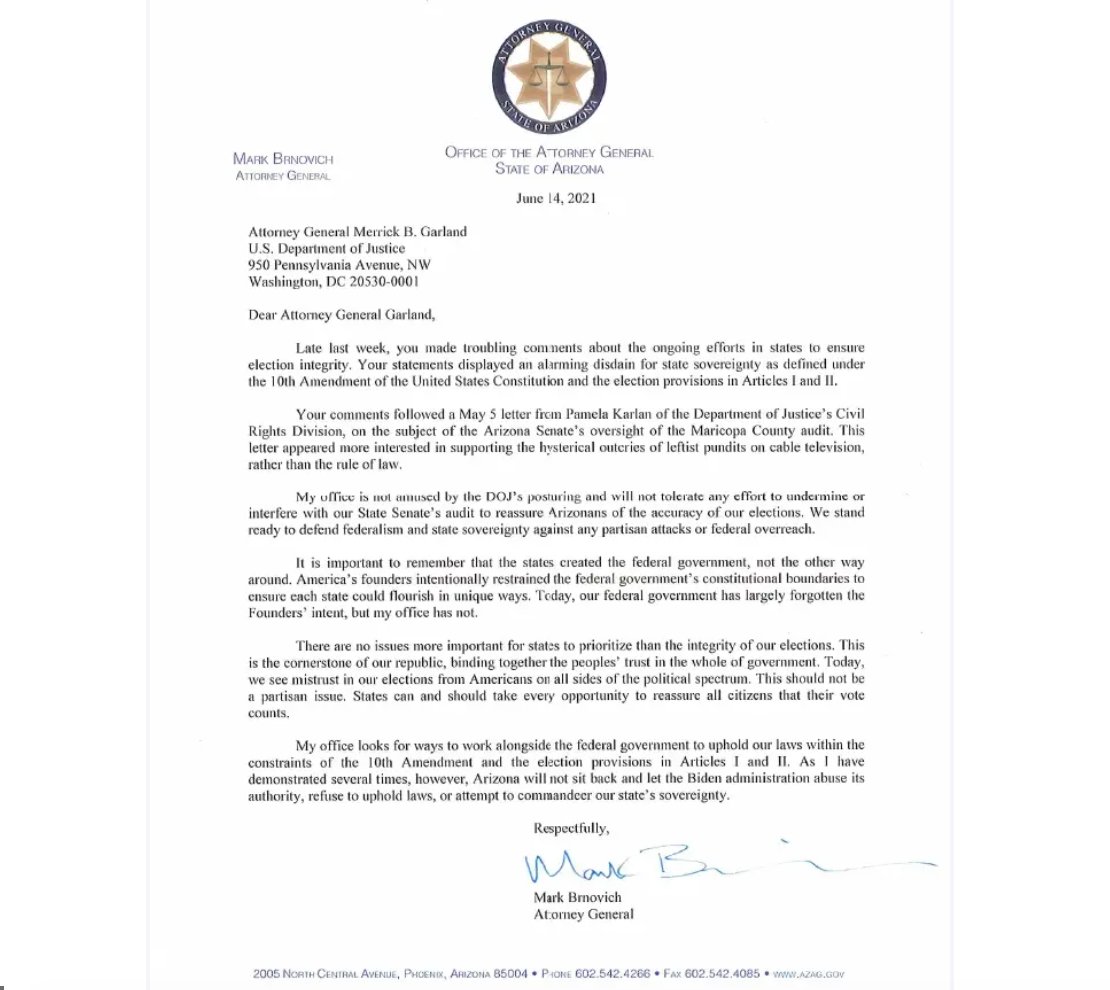
On Monday, Arizona Attorney General Mark Brnovich advised U.S. Attorney General Merrick Garland that the Biden administration’s Department of Justice had no right to interfere with the audit of the Maricopa County 2020 General Election.
Brnovich accused Garland of giving in to the “hysterical” audit opposition.
“My office is not amused by the DOJ’s posturing and will not tolerate any effort to undermine or interfere with our State Senate’s audit to reassure Arizonans of the accuracy of our elections,” wrote Brnovich to Garland.
“My office looks for ways to work alongside the federal government to uphold our laws within the constraints of the 10th Amendment and the election provisions in Articles I and II.” Brnovich concluded, “As I have demonstrated several times, however, Arizona will not sit back and let the Biden administration abuse its authority, refused to uphold laws, or attempt to commandeer our state’s sovereignty.”
Garland has attacked the audit ordered by the Arizona State Senate. “Many of the justifications proffered in support of these post-election audits and restrictions on voting have relied on assertions of material vote fraud in the 2020 election that have been refuted by law enforcement and intelligence agencies,” Garland said last week.
by Terri Jo Neff | Jun 9, 2021 | News
By Terri Jo Neff |
Arizona Attorney General Mark Brnovich has initiated several legal maneuvers focused on forcing the Biden Administration to address the immigration crisis impacting Arizona. On Tuesday, he stepped away from the lawbooks and expressed his opinion about how Arizonans are being treated.
“America is a big generous country but what makes this country great is we have a Constitution and a Rule of Law,” Brnovich said. “And that means there is a process -there’s an orderly process- and what the Biden Administration has done is created chaos. They’ve made Arizona like a petri dish.”
To Brnovich, it appears President Joe Biden and Vice President Kamala Harris “don’t give a damn” about the financial impact to Arizona from thousands of illegal immigrants crossing the border every month. And he suggested they have given Arizonans “the middle finger, essentially” as Harris visited Guatemala this week to pledge U.S. taxpayer money to that country.
Brnovich also discussed the decision by U.S. Immigration and Customs Enforcement (ICE) to use a former Homewood Suites by Hilton in Scottsdale as a 72-hour Emergency Family Staging Center for asylum seeking families.
“It is absolutely unconscionable what the Biden Administration is doing,” he said about the Scottsdale plan, noting the hotel is one block from a school and in the middle of a neighborhood. “It frustrates me that more people aren’t sounding the alarms or joining us in all of our lawsuits.
Brnovich highlighted the fact the Biden Administration has 1.2 million people on deportation lists but has implemented a policy of no deportations, which is another topic the attorney general is litigating. The new policy allows immigrants with criminal histories to walk free in Arizona without supervision.
And, Brnovich added, federal authorities are refusing to take custody of immigrants as they complete their state prison sentences. Many have been convicted of serious crimes like arson and rape.
The fundamental problem, according to Brnovich, is that the Biden Administration “has incentivized and legalized illegal immigration” and is now monetizing immigration, not only for immigrants but also the Cartels. “We know that the Cartels are taking advantage of the situation,” he said.
by B. Hamilton | Jun 3, 2021 | News
By B. Hamilton |
On Wednesday, not only did hundreds of protesters let their concerns about the federal government’s plan to convert a Scottsdale hotel into a migrant detention center be known, but Arizona’s Attorney General did as well.
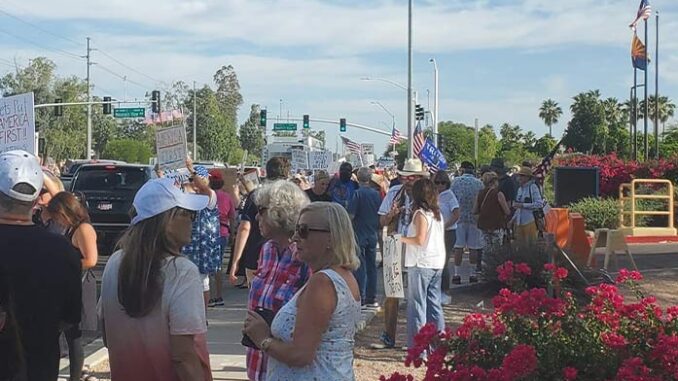
A crowd of approximately 600 protesters turned out in front of the former Homewood Suites hotel which is just one of many properties included in an $80 million-plus contract Endeavors has with Immigration and Customs Enforcement (ICE).
The hotel-turned detention center is near residential and commercial properties as well as a high school.
Arizona Attorney General Mark Brnovich sent a letter to the hotel’s lender and borrower expressing “grave concerns about whether a detention facility is an appropriate and legal use” of the property.
“I am further writing to express public safety concerns about the decision to establish this 1,200-person detention facility at the hotel property,” the Attorney General wrote.
Brnovich shares the concerns of the community that there is no guarantee the migrants will not be released into the upscale community which has little access to social services.
The appropriateness of placing a detention center in the middle of town is not the only issue. The Arizona Attorney General noted in his letter that even the “lender, who stands to potentially receive some of the revenues from this contract, has itself voiced concerns that this dramatic change in use would require rezoning the property or at a minimum obtaining a variance.”
Currently the case is in federal court. However, Alexander Kolodin, a well known Republican attorney, told the AZ Free News, that he hopes someone will challenge the ICE decision in state court on federalism and separation of powers grounds. “The Arizona Supreme Court would love to sink their teeth into this one.”
Attorney General letter:
Brian C. Lake
David M. Neff
Perkins Coie LLP
2901 North Central Avenue, Suite 2000
Phoenix, Arizona 85012-2788
Randy Nussbaum
Philip R. Rudd
Sacks Tierney P.A.
4250 North Drinkwater Blvd., 4th Floor
Scottsdale, Arizona 85251-3693
I understand that you represent the lender and borrower for a property at North Scottsdale Road and East Mountain View Road in Scottsdale (the “Hotel Property”), which is currently the subject of a dispute over being potentially converted into an under 72-hour ICE detention facility for housing up to 1,200 adult and minor migrants.
I am writing to express grave concerns about whether a detention facility is an appropriate and Legal use of the Hotel Property, particularly in light of information that my office recently learned through a court-ordered deposition of the Deputy Director of the ICE Phoenix Field Office, Albert Carter. I am further writing to express public safety concerns about the decision to establish this 1,200-person detention facility at the Hotel Property. The root causes of the current crisis are problems of the Biden Administration’s own making, including policies that have administratively and intentionally crippled ICE’s important law enforcement mission and incentivized illegal immigration. While everyone rightly expects that migrants should be treated humanely, a new detention facility at the Hotel Property should not be established.
First, regardless of how well-intentioned everyone involved is detention facilities inherently carry some risk that one or more individuals who pose a public safety threat are going to be housed there and potentially leave the premises. As outlined in the lender’s Verified Complaint:
The ICE/DHS Contract provides that the hotel on the Property will cease being operated as a hotel and will instead be operated as an ICE/DHS detention center for immigrant families being held in ICE custody who are awaiting deportation, continued custody, or release determinations by ICE, DHS or the Department of Justice.
The ICE/DHS Contract leaves no doubt that the Property will in fact be operated as an ICE detention center, securing and holding all of the individuals who stay there in government custody at all times, day and night. For example, the ICE/DHS Contract states that “[a]all residents will be in the legal custody of ICE, therefore they can only be released at the direction of ICE” (id. at 60, § 2), and “[a]t all times, individuals comprising family units shall remain in the legal custody office, irrespective of residential services provided by Service Provider.” Id. at 62, § 5(a)(iii), (xi). The ICE/DHS Contract also requires that those providing services at the Prope11y “shall structure all programs and implement strategies designed to ensure residents remain within the residential setting to include, if necessary, consequences for depa11ing without authorization.” Id. at 62, § 5(a)(xi).”
This is consistent with the deposition testimony of Director Carter, who testified that ICE “detention facilities are broken down in multiple ways for immigration purposes. There is an over 72-hour facility where individuals are housed for longer term. But there are also under 72- hour facilities that are generally managed through intergovernmental service agreements that would also be included.” Mr. Carter’s testimony confirms that what is being established is a type of detention facility, not a hotel.
Mr. Carter also provided examples of some of the under 72-hour facilities in Arizona including facilities managed by the Coconino County Sheriff’s Office, La Paz County Sheriff’s Office, Santa Cruz County Sheriff’s Office, and the San Luis Detention Center.4 While there was one hotel-the Holiday Inn Express & Suites Phoenix/Chandler-according to the ICE detention data, the average length of stay was only 2 days, and only 2 detainees were being housed there, compared to up to 1,200 contemplated for the Hotel Property.
Second, there is no guarantee that housing 1,200 detainees in this area would not result in some of them being released into the community. ICE has adopted irresponsible “enforcement priorities” that administratively repeal almost all ICE enforcement. Those “enforcement priorities” notably do not include those who have previously been convicted of what the Biden Administration deems insufficiently serious crimes or those who have been charged but not convicted of a crime. Given this, if the prime contractor is unable to place particular detainees, it is foreseeable that ICE could simply release the detainee into the community because they do not fall within the Biden Administration’s extremely narrow “enforcement priorities.”
The State of Arizona and State of Montana recently filed a lawsuit in federal district court in Arizona challenging these enforcement priorities as arbitrary and capricious and contrary to law. The potential release of individuals from the detention facility at the Hotel Prope1ty only illustrates why the enforcement priorities are bad policy that is harmful to public safety. See Arizona and Montana v. Department of Homeland Security, No. 21-186 (D. Ariz.).
Third, based on the limited information available, this does not appear to be a good location for a 1,200-person detention facility in any event, and may well or at least should require a significant additional study by the local government before such a drastic change is implemented. The Hotel Property is adjacent to an apartment complex and near a senior living facility. It is also across the street from a residential neighborhood and another apartment complex. It is less than a block from a high school, less than one mile from a preschool, and less than two miles from a middle school.
The lender, who stands to potentially receive some of the revenues from this contract, has itself voiced concerns that this dramatic use change would require rezoning the property or at a minimum obtaining a variance. The Verified Complaint alleges:
On information and belief, using the Prope1ty in the manner stated in the ICE/DHS Contract would not be in compliance with existing City of Scottsdale zoning ordinances and/or other restrictive covenants governing the Property, and would therefore require a change to, or waiver or exemption from, the existing zoning ordinances and use permits, or would result in a violation of the existing zoning ordinances and use permits.
The Lender’s application for a temporary restraining order, similarly stated:
It is also very likely that Borrower’s conduct in agreeing to the ICE/DHS Contract and preparing to perform it violated the provisions in the Loan Agreement and Deed of Trust prohibiting Borrower from doing anything at the Prope1ty that might not comply with existing zoning ordinances and prohibiting Borrower from attempting to change the zoning ordinances or obtain an exception or variance from them. See Loan Agreement§ 5.18; Deed of Trust§ 3. Borrower has represented that a zoning change from the City of Scottsdale will be needed to convert the hotel on the Property into condominiums (and has not yet been obtained). In that case, it seems unlikely that the City of Scottsdale would allow the Property to change its use from a hotel to an ICE detention center without requiring even more drastic zoning changes or variances.
Fourth, despite obvious potential impacts from the establishment of the detention facility to the “human environment,” 42 U.S.C. §4332(C), DHS has not conducted any of the necessary environmental analysis under the National Environmental Policy Act (“NEPA”) to study such impacts. See, e.g., Hanly v. Mitchell, 460 F.2d 640, 647 (2d Cir. 1972) (NEPA “must be construed to include protection of the quality of life for city residents. Noise, traffic, overburdened mass transportation systems, crime, congestion, and even availability of drugs all affect the urban ‘environment.”‘ (cleaned up)). Absent any such compliance efforts, the contract with DHS is likely invalid as a matter of law.
This violation of NEPA is part of a broader pattern of DHS failing to comply with NEPA concerning immigration and border control policies. Because of these other violations, I have filed suit against OHS and its officials in the U.S. District Court for the District of Arizona. See Arizona v. 1\Mayorkas, No. 21-617 (D. Ariz. 2021).
For all of these reasons, I urge you not to go forward with converting the Hotel Property into a 1,200-person detention facility.
Scottsdale residents intend to protest at the site again Friday evening.
by Terri Jo Neff | Apr 25, 2021 | News
By Terri Jo Neff |
Two judges, one from Maricopa County and the other an Associate Justice of the Arizona Supreme Court, agreed Friday that the Senate Audit of Maricopa County’s 2020 General Election can move ahead for now. Both judges also ordered the parties to submit several court filings in the coming days.
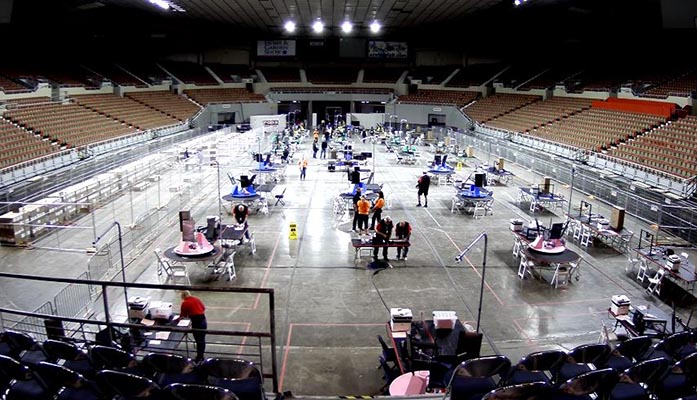
Several hundred of the nearly 2.1 million ballots cast by Maricopa County voters were audited Friday and Saturday. The volunteer counters are looking only at the race for U.S. President and the contest between Mark Kelly and then-Sen. Martha McSally.
For a short time Friday it looked like no audit activities would take place after Judge Christopher Coury of the Maricopa Superior Court agreed to issue a stay requested by the Arizona Democratic Party and Steve Gallardo, the only Democrat on Maricopa County’s five-member Board of Supervisors.
But the stay order was contingent on the plaintiffs posting a $1 million bond in the event they lost their case. AZ Dems chair Raquel Teran announced Friday afternoon that no bond would be posted, meaning the audit can continue unimpeded, for now.
Two other orders issued by Coury are currently in force: that the Senate and its contracted audit team comply with state law and that no blue or black pens can be on the floor of the Veterans Memorial Coliseum where the audit is being conducted.
Coury will be a key player in the audit this coming week, as he ordered the parties back to court Monday morning for an evidentiary hearing on the merits of the lawsuit. The judge set several deadlines for the attorneys, including an order for the audit’s written policies and procedures to be filed by the Senate and general contractor Cyber Ninjas on Sunday.
Teran and Gallardo -who says he joined the lawsuit in his personal capacity as a Maricopa County voter- must decide how far they want to push their allegations about the audit operations, given the fact Senate President Karen Fann and the other defendants have petitioned to the Arizona Supreme Court, which has also ordered a series of legal briefings in the case.
Fann and Sen. Warren Petersen of the Senate Judiciary Committee are named as defendants along with former Arizona Secretary of State Ken Bennett who is serving as the Senate’s audit liaison. The other defendant is Cyber Ninjas, the company Fann contracted with to conduct the audit with help from three subcontractor.
The Senate defendants are represented by Kory Langhofer and Thomas Bastille, who have been involved in several of the election-related lawsuits filed since Nov. 3. Florida-based Cyber Ninjas and its owner Doug Logan have retained Phoenix attorney Alex Kolodin as their Arizona legal counsel.
Another key player is Associate Justice Clink Bolick of the Arizona Supreme Court, who affirmed Coury’s earlier orders during an emergency conference Friday afternoon. Bolick set separate deadlines for the Senate’s challenge to the legality of the lawsuit, with all those filings needing to be in by the end of business April 29.
Participating in the emergency conference with the justice was attorneys for Arizona Secretary of State Katie Hobbs, who has pushed back on Fann’s previous assurances that the Senate’s audit would be “independent” and “transparent.”
Hobbs has pointed to Rep. Mark Finchem’s admitted role with the audit in light of his repeated insistence that President Joe Biden really did not win the popular vote in Arizona, and thus was not entitled to the state’s electoral votes. She also wrote to Attorney General Mark Brnovich with concerns that auditors may not be complying with Arizona’s Elections Procedures Manual (EPM).
For his part, Brnovich was the first prominent Republican to insist after the general election that there was no fraud involved in Biden’s victory. He replied to Hobbs on Friday, suggesting she notify his office when she has “credible facts and not conjecture or politics” for him to investigate.
Another player who could impact next week’s audit operations is First Amendment attorney David Bodney, who warned Fann and Bennett that the audit team’s current refusal to allow journalists to report on audit activities from the main floor of the Veterans Memorial Coliseum.
Bennett, as the audit liaison, is requiring media representatives to sign up for a six-hour shift as an observer. However, observers are prohibited from having cellphones or even pen and paper on the floor.
“Requiring journalists to become active participants in the events on which they seek to report is as unprecedented as it is untenable in a representative democracy,” Bodney wrote. “It also violates the First Amendment, which compels that members of the press be allowed access to report on these public proceedings. “
Bodney also warned that legal action could be forthcoming.
“By making the proceedings accessible to some journalists, you cannot arbitrarily deny access to others or require that others satisfy peculiar conditions not imposed upon those whom you favor,” he wrote. “In the event the audit proceeds while barring the press, we are committed to pursuing all legal remedies we deem appropriate to secure our clients’ rights under the First Amendment,” Bodney said