by Matthew Holloway | Aug 31, 2025 | News
By Matthew Holloway |
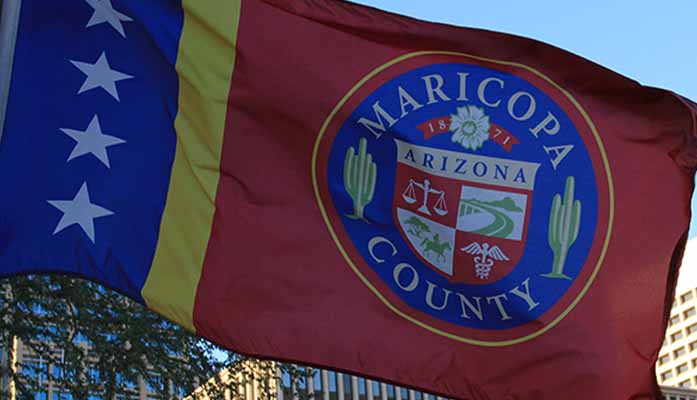
The legal fight between Maricopa County Recorder Justin Heap and the County Board of Supervisors escalated Monday. America First Legal filed two motions on Heap’s behalf, and Arizona’s legislative leaders submitted an amicus brief supporting him.
In a press release, the County Recorder’s Office stated that the motions filed by America First Legal “reveal how the County Board of Supervisors and County Attorney Rachel Mitchell have weaponized county government against duly-elected Recorder Justin Heap simply because he dared to fulfill his statutory duties and protect the sanctity of Arizona elections.”
Heap said in a statement, “It’s unfortunate that the Board’s unprofessional and bad faith actions have forced us to litigate this issue; however, it’s significantly more unfortunate that the Board continues to deny the voters of Maricopa County the positive, common sense election integrity reforms that they voted for last November when they elected me. As I’ve promised from day one, I am working to ensure honest, secure, and transparent elections for every voter in Maricopa County. I am not, and will not, waiver in my commitment to executing on this promise. I’m grateful to America First Legal for standing by my side in this battle.”
America First Legal detailed Heap’s allegations in the first filing: “The Defendants — the members of the Maricopa County Board of Supervisors (‘BOS’) — have crossed from fiscal oversight into outright sabotage. Ignoring [state law] and decades of precedent, the BOS has refused to fund the Recorder’s ‘necessary expenses’ — from modern ballot-processing equipment to indispensable IT staff — while simultaneously seizing control of the very election functions its stonewalling endangers. The BOS’s obstruction is not mere bureaucratic foot-dragging; it is a calculated power grab that throttles the Recorder’s constitutional duty to administer secure, timely elections.”
In an amici filing in support of Heap, Arizona House Speaker Steven Montenegro and Senate President Warren Petersen’s legal representation call for a strict interpretation of state statutes which govern the responsibilities of the county recorder and board of supervisors. They argue that the “court should narrowly conclude that, based on the statutes’ plain language, when the statute authorizes ‘the county recorder or other officer in charge of elections’ to act, it is the recorder’s duty to ensure the statute is complied with unless the recorder expressly agrees to delegate that duty to another ‘officer in charge of elections.’”
As previously reported by AZ Free News, the months-long negotiations between Heap and the Board, led by Chairman Thomas Galvin, devolved steadily since Heap’s election and the replacement of Stephen Richer in January until finally collapsing into litigation in June.
The crux of the disagreement between the Board of Supervisors and County Recorder Heap rests upon a Shared Services Agreement (SSA) agreed to by Heap’s predecessor, Richer, who ardently opposed the election integrity efforts that Heap ran for office to enact. For nearly six months, the two county offices negotiated; however, Heap and the Supervisors were unable to reach an agreement, culminating in a lawsuit filed by Heap.
Since then, Heap has alleged that the Supervisors have “taken retaliatory actions” describing a series of measures that “make it impossible for him to do his job, including removing nearly all his election-related IT staff; seizing the servers, databases, and websites necessary to fulfill his duties; and restricting access to necessary facilities and equipment,” as reported by The Federalist.
In a second filing, Heap and America First Legal introduced allegations involving Maricopa County Attorney Rachel Mitchell, bringing a third County office into the fray in a dispute over who may represent the County Recorder, an attorney chosen by Heap or Maricopa County Attorney Rachel Mitchell. In the legal brief, they allege, “Attorney Mitchell originally appointed a criminal defense attorney to advise the Recorder; however, in April, America First Legal agreed to represent Heap pro bono, a move that Mitchell objected to.”
“When the Recorder complained that the original attorney appointed for him lacked sufficient subject matter expertise, County Attorney Mitchell appointed former Arizona Supreme Court Justice Andrew Gould to advise the Recorder only during negotiations with the Board. However, County Attorney Mitchell and the Board did not allow Justice Gould to litigate on the Recorder’s behalf,” the filing revealed.
But according to AFL, that wasn’t the end of it. “In May of 2025, Justice Gould specifically asked the Maricopa County Attorney’s Office for permission to litigate on Recorder Heap’s behalf but was not allowed to do so because the scope of his representation was limited to negotiation of the SSA and did not include litigation, and, accordingly, the County would not compensate him for litigation-related work.”
Mitchell responded by penning a letter to the AFL attorneys, writing in part, “This letter is to inform you that I am the Recorder’s attorney and that you do not represent the Maricopa County Recorder’s Office or Recorder Heap in his official capacity.”
Per The Federalist, AFL attorney James Rogers retorted that the “County Recorder is allowed to pick his own lawyer in litigation,” adding that Heap “is not subject to the whims of the county attorney.”
In the midst of the complex legal battle between the Recorder’s Office and the Board of Supervisors, which has drawn the attention of legislative leaders, the dispute with Mitchell adds yet another layer of infighting within the already divided county government, with the calendar counting down to the 2026 elections.
Matthew Holloway is a senior reporter for AZ Free News. Follow him on X for his latest stories, or email tips to Matthew@azfreenews.com.
by Matthew Holloway | Aug 28, 2025 | News
By Matthew Holloway |
Last week, Arizona’s Democrat Attorney General Kris Mayes issued an opinion stating that roughly 200,000 voters mistakenly listed in state election records as having provided proof of U.S. citizenship should remain on the rolls, despite questions about their citizenship status and potential conflicts with Arizona law.
As reported by AZ Free News in November of last year, 218,000 voters were confirmed by Senate President Warren Petersen to have obtained their driver’s licenses prior to the 1996 requirement to apply with proof of citizenship, went on to get a duplicate license, and then registered to vote for the first time or re-registered to vote after 2004.
For over 20 years, they were caught up in a compatibility issue between the Arizona Department of Transportation (ADOT) and the state’s voter registration system.
According to VoteBeat’s Jen Fifield, AG Mayes’ opinion marks a notable departure from how election officials have been working to remedy the problem with counties issuing notices to voters in an attempt to collect the information.
“If an Affected Voter responds by providing such evidence, that should dispel doubt,” Mayes wrote. “But if an Affected Voter does not respond, the mere lack of response does not, under current law, authorize the county recorder to cancel the voter’s registration, in whole or in part.”
Fifield, citing the Arizona Attorney General’s manual, noted that it is unclear whether or not the county election officials will conform to Mayes’ formal opinion, which is advisory in nature and does not carry the force of law.
“County recorders may take steps to inquire whether the affected voters are U.S. citizens, including by asking them to provide satisfactory evidence of citizenship,’’ Mayes wrote.
Mayes’ opinion came in response to a request made in May by fellow Democrat Arizona Secretary of State Adrian Fontes. In a statement, Fontes said he has appreciated Mayes’ guidance, writing, “The opinion stands for the notion that these folks have a right to vote,’’ he told the AZ Capitol Times.
“And it falls to the government to prove otherwise–which is the way every other accusation, every other denial of rights exists,” Fontes said. “So the burden has shifted back to where it belongs.’’
In a statement, Fontes wrote, “The consistent treatment of voters caught up in this situation between counties is most important to ensure everyone’s voting rights are protected. I am glad we now have a clear path forward.”
Arizona Republican Party Chairwoman Gina Swoboda agreed with Mayes’ opinion, in particular her assessment of the county recorder’s limited authority to cancel registrations.
“If the recorders have affirmative proof that one of the voters is a non-citizen, they may initiate a notice and cancellation process,” Swoboda told the AZ Capitol Times. “But they may not otherwise do so because of this error.”
Coconino County Recorder Aubrey Sonderegger told the Arizona Republic that the news was welcome. “It’s exactly what Coconino County has been doing all along,” she said. “We have more than cut our list in half.”
She added that “These people weren’t doing anything nefariously” but were merely caught up in the timing of the voter registration standard changing. “I’m very relieved to hear the AG opinion,” she said. “It just means we can keep doing what we’ve been doing.”
According to the Secretary of State’s office, the current number of affected voters stands at 202,760. Maricopa County Recorder Justin Heap issued a notification on June 26, 2025, to the 83,000 county voters on the list, informing them that they must submit proof of citizenship within 90 days. Failure to do so will result in reclassification as federal-only voters, and they will not be issued state and local ballots.
Matthew Holloway is a senior reporter for AZ Free News. Follow him on X for his latest stories, or email tips to Matthew@azfreenews.com.
by Ethan Faverino | Aug 18, 2025 | Economy, News
By Ethan Faverino |
The One Big Beautiful Bill Act (OBBBA) marks the most transformative overhaul of federal tax policy since the 2017 Tax Cuts and Jobs Act (TCJA).
The OBBBA locks in the TCJA’s individual tax provisions, avoiding a tax increase for approximately 62% of tax filers in 2026, according to the Tax Foundation.
The group’s recent analysis also shows that the law will reduce federal taxes for individual taxpayers in every state, with an average national tax cut of $3,752 per taxpayer in 2026.
The economic impact is equally as big, with 938,000 new full-time equivalent jobs created over the long term, including 132,000 in California, 81,000 in Texas, and down to 1,800 in Vermont.
In Arizona, the Tax Foundation says that the OBBBA will deliver an average tax cut of $3,521 per taxpayer in 2026, providing relief to families and individuals across the state.
Maricopa County will see an average tax cut of $4,049 per taxpayer in 2026, driven by key provisions like:
- Income Tax Rate Cuts and Bracket Changes: $1,613 in savings per taxpayer.
- Standard Deduction Expansion: $821 in savings
- Child Tax Credit Expansion: $630 in savings
- Tip and Overtime Deductions: $50 and $229 in savings
- Business Provisions: $1,321 in savings
Other counties in the state will see major tax cuts in 2026, including Coconino County, with $3,096, Yavapai County, with $3,066, Greenlee County, with $3,011, Pima County, with $2,781, and Pinal County, with $2,553.
The Tax Foundation also projects that Arizona will gain approximately 18,014 full-time equivalent jobs in the long run, boosting local economies and supporting communities across the state.
OBBBA’s long-term outlook remains strong, with average tax cuts projected to dip to $2,505 in 2030 due to the expiration of temporary provisions like the tip and overtime deductions, before rising to $3,301 by 2035 as inflation enhances the value of permanent cuts.
Arizona’s business-friendly provisions, such as permanent 100% bonus depreciation and research and development (R&D) expense, will continue to drive investment and job creation.
Ethan Faverino is a reporter for AZ Free News. You can send him news tips using this link.
by Kim Miller | Aug 14, 2025 | Opinion
By Kim Miller |
As with most things, asking the right questions is often more important than getting the answers. This is especially true for parents and grandparents who want to protect their children. We need to ask, then ask some more, to get to the truth at our kids’ school and public libraries.
If you value children, here’s what you should be asking, some important answers, good news of progress, and what YOU CAN DO to protect yours (and others’) kids:
4 Questions (with answers):
1 – Are there actually bad materials in schools and libraries, or is this just ‘pearl clutching’?
Yes, it’s really a problem. Here’s a letter with a long list of shocking books that were/are in Scottsdale schools (sent last summer to the Scottsdale Unified School Board by Scottsdale Unites for Educational Integrity). More was uncovered in Gilbert schools. Find out what’s in your school with this source: TakeBackTheClassroom.com.
Even in public libraries’ juvenile sections, there’s a gross overabundance of books on social activism, early sexual exploration, and questioning one’s sexual identity. (Where did they put the basic books on science, history, and adventure?)
2 – WHY are these materials on shelves (or online) for kids?
Unfortunately, there’s profit behind the sexualization of children. Online it extends from obvious porn (see our blog ‘Put Kids Before Profit’) to “digital learning tools” offered through AZ public tools. Recently, we alerted you that Arizona taxpayers are funding porn-for-kids, an open letter from Pornography is Not Education to the AZ Dept of Education.
Besides the profits for activists and the porn industries, it’s ignorance. Common-sense people are not becoming aware. (This is a reason to subscribe to AZ Women of Action’s weekly Call To Action Update!) Most people have no idea what children see in schools or access in libraries, but we keep them informed.
3 – Isn’t this simply ‘sex-ed’? Is there evidence of the harm on kids when they see sexual material?
This goes way beyond sex-ed, and that’s why there’s no excuse for staying silent. Ignorance is not bliss when you start seeing the fallout in your confused, angry, and sexualized children. Here are stories with supporting evidence: What Happens When Children Are Exposed to Pornography? And From MySpace to OnlyFans: The Dangerous Desensitization of Our Kids — Fueled by Public Schools.
4 – Do parents have a say on what their kids see at public schools and libraries?
YES–but only if they speak up! Arizona has some of the strongest parent rights laws. (See ‘What You Can Do’ for specifics.)
Some Good News!
AZ Women of Action has made progress with Maricopa County Libraries: We asked questions of the MC Library office who told us that no one had ever complained about children’s books (obviously because nobody knew). So, we created a citizen petition, shared the facts with our followers, and presented hundreds of names to the Maricopa County Board of Supervisors. They listened. We emphasized that parents, not libraries, should have the ultimate authority over the type of content their children are exposed to. We argued that the current arrangement, where explicit books are freely available to children, violates parental rights and endangers children’s emotional and mental well-being.
We also met with Maricopa County Attorney Rachel Mitchell and her team. Overall progress is being made, though slowly.
We’re seeing widespread support from parents, teachers, faith-based organizations, and local activists who share the same concerns. Our message is clear: books are not being ‘banned’ but moved to adult sections for parents to decide. It’s not about censorship but protecting childhood. It’s restoring the family’s role in deciding how to protect and nurture each child.
What YOU CAN DO:
1. Ask schools for their opt-out forms for any material you deem inappropriate for your child. Sex education is supposed to be opt-IN (meaning they require your permission before kids see it). Ask to see your school’s curriculum first.
2. Ask your local libraries for a form that limits what their child can check out or access online. If they don’t have one, contact the city, county, or state library office and file a request to change parent-rights policies.
3. Report any concerning material found in schools to the ADE Empower Hotline at 602-771-3500, or submit their online form.
4. Share concerning materials with P.I.N.E. (Pornography Is Not Education)
5. Promote Cleaner, Safer Libraries. Join Arizona Women of Action for a fun, family story hour with positive, wholesome books for kids! We’ve partnered with Brave Books to host “See You At the Library Story Hour” on Saturday, August 16th from 1–2PM at the Phoenix Public Library – Mesquite Branch. Families will enjoy uplifting and wholesome stories read by Arizona Women of Action and special guest Maricopa County Superintendent of Schools Shelli Boggs. Click here to register.
Kim Miller is the President and Founder of Arizona Women of Action. You can find out more about their work here.
by Ethan Faverino | Aug 5, 2025 | Economy, News
By Ethan Faverino |
Maricopa County has secured a spot among Arizona’s top destinations for retirees, according to a new study by SmartAsset.
The study evaluated counties across the United States based on three key factors: tax-friendliness, access to medical care, and social opportunities, putting Maricopa County as an ideal location for those planning the golden years of retirement.
To assess tax-friendliness, the study calculated effective income and sales tax rates for a retiree earning $35,000 annually from retirement savings, Social Security, and part-time work, determining disposable income after taxes.
For medical care, the study measured the number of doctors’ offices per 1,000 residents, and the same for social opportunities, which measured the number by recreation and retirement centers per 1,000, along with the percentage of seniors in each county’s population.
Maricopa County ranked sixth in Arizona with a Best Place to Retire Index score of 43.1.
The county excels in medical care access, with 3.28 medical centers per 1,000 residents, one of the highest rates in the state.
With a tax burden of 15.82% and an offering of 0.12 recreation centers and 0.4 retirement centers per 1,000 people, Maricopa County provides a balanced environment for retirees seeking affordability, healthcare, and an active lifestyle.
While its senior population is lower at 15.99% compared to the top-ranked La Paz County (42.23%), Maricopa County’s urban amenities and vibrant community make it a standout choice.
Retirement dreams of adventure and relaxation require careful financial planning, often overlooked within daily expenses.
Experts recommend saving 10%-15% of annual income and targeting 25 times the yearly expenses to replace 70%-80% of pre-retirement income. For example, if somebody spends $50,000 annually in retirement, they should aim to save around $1.25 million through 401k, retirement, and other investments.
Maricopa County’s high density of medical facilities ensures retirees’ healthcare needs are met, addressing the rising healthcare costs that often challenge retirement budgets. Its moderate 15.82% tax burden supports financial planning by allowing retirees to stretch their savings further.
Ethan Faverino is a reporter for AZ Free News. You can send him news tips using this link.