Election officials’ plan to move up election deadlines in order to accommodate anticipated recounts and meet the federal deadline amounts to election interference, says a former lawmaker.
Michelle Ugenti-Rita — also a candidate for the Maricopa County Board of Supervisors (BOS) — claimed that county officials’ push for legislative reform of the election calendar would result in “mass chaos” and lay the necessary groundwork for installing their preferred election reforms.
The anticipated conflict between state election processes and the election deadlines can be traced back to 2022, when the state legislature passed Ugenti-Rita’s bill increasing the threshold for an automatic recount from a tenth to a half of a percent. Later that same year, Congress moved up the deadline for presidential elector certification through the Electoral Count Reform Act (ECRA).
ECRA requires each governor (or, the preferred executive designated by state law) to certify electors six days prior to when electors meet to cast their votes: this year, that would be Dec. 11 and 17, respectively.
That timeline change leads election officials to believe that potential recounts may not be completed by the federal deadline.
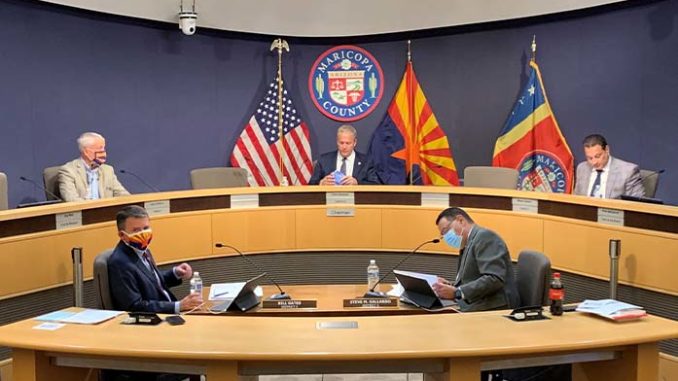
Over the weekend, Supervisor Bill Gates said in an interview with 12 News that it would be up to Gov. Katie Hobbs to fix the election calendar to avoid conflict with the federal deadline: a request of 19 days less for the primary and 17 days less for the general election. Gates and other county officials said that the calendar conflict needs to be resolved by Friday, though it would have to be Thursday since the state legislature doesn’t meet on Friday.
“We need to have the primary date moved up seven days, so in order to accomplish that, we need to get going immediately on that,” said Gates. “We need these calendar changes so that voters aren’t disenfranchised.”
However, Ugenti-Rita contended that the calendar change would result in voter disenfranchisement. She also contended that other, non-legislative solutions existed to remedy the timeline conflict, calling Gates’ appeal for a legislative calendar change “election propaganda.”
“There are plenty of non-legislative solutions that can address potential timeline issues, but that’s not good enough for Maricopa County,” said Ugenti-Rita. “Instead of doing their job, they are relying on their leader, Democrat @GovernorHobbs to bail them out.”
🚨This is what actual election interference looks like!
Too scared to run for reelection @billgatesaz, continues to coordinate with the media to push more @MaricopaCounty election propaganda. There are plenty of non-legislative solutions that can address potential timeline… https://t.co/bX1G3M29zh
Per Ugenti-Rita, non-legislative solutions could have included increasing staffing and shifts, sending sample ballots to party chairs for proofreading, and reducing mail-in ballots by offering military and overseas voters a secure portal of ballot delivery.
May I kindly suggest you follow along more closely before inviting @BillGatesAZ to go on your program and regurgitate County lies. The below article is something I’ve referenced a few times, as well as Chief of Staff @chadcampbellAZ and others.
County officials brought up their concerns with the possible timeline conflict in September, after the 2023 legislative session had concluded: a move that some claim was intentional.
Arizona Daily Independent first reported that Hobbs and county officials were reneging on a deal acceding to the last-minute demand to condense the election timeline in exchange for the state’s first-ever set of signature verification rules.
The deal, laid out in a 41-page draft bill, would also move the primary to July 30 this year and to the second Tuesday in May by 2026; create a category of verified early ballots exempt from review for voters who show ID when turning in their mailed early ballot in person; expand signature curing hours to the weekend before and after an election for elections that include federal offices; and shrink signature verification and canvassing deadlines. Hobbs spokesman, Christian Slater, said that the bill was “dead on arrival.”
In a press conference last week, Hobbs indicated that she wasn’t sure of the details of the issue but told reporters that the state was “well past the point” of shifting the primary date.
“I actually don’t know what the exact issue is; I know we’ve been going back and forth with the Republican leadership and the election officials and I think we’re very close to agreeing on something,” said Hobbs. “I don’t want to compromise Arizonans’ ability to have their votes counted.”
Slater later clarified to reporters that it was Hobbs’ “personal feelings” that the primary date couldn’t be moved up earlier. Gates indicated to 12 News that Hobbs would ultimately give in to their desire to push up the dates.
Corinne Murdock is a reporter for AZ Free News. Follow her latest on Twitter, or email tips to corinne@azfreenews.com.
Former Arizona state Senator Michelle Ugenti-Rita called on Rep. Jake Hoffman, founding chairman ofthe Arizona Freedom Caucus, to amend a bill involving sexually explicit materials in schools to include the Maricopa County Library District.
Senate Bill 1007 proposed by Hoffman, a Republican, makes it a class 5 felony for a public school to show a student sexually explicit materials or use it in the classroom in any way.
“I would like to encourage the bill sponsor, @JakeHoffmanAZ and my former colleagues to amend this bill to include the Maricopa County Library District since @ThomasGalvin won’t do anything to stop county libraries from facilitating a liberal woke agenda by promoting sexually graphic and sensitive material to children,” said Ugenti-Rita, a Republican who represented Arizona’s District 23 from 2019 to 2023.
The bill prohibits Arizona public schools to refer students to sexually explicit material unless “the material possesses serious educational value for minors or serious literary, artistic, political or scientific value” or “the public school requires written parental consent, on a per-material basis, before referring a student to or using the material.”
The public school must also provide students whose parents do not consent for them to see the material with an alternative assignment that does not contain sexually explicit material.
Sexually explicit materials include “textual, visual or audio materials or materials accessed via any other medium that depict sexual conduct, sexual excitement or ultimate sexual acts,” the bill says.
Charter schools can require parents to waive the right to object to learning materials or activities as a condition of enrollment if the charter school provides a comprehensive list of books and materials used for instruction each school year before the student enrolls.
The parent keeps the right to object to those materials if they are altered after the students’ enrollment.
Elizabeth Troutman is a reporter for AZ Free News. You can send her news tips using this link.
The Maricopa County Republican Committee is calling on Arizona state congress members to run a bill that mandates calling voter registration cards by a more accurate name.
“Will one or both of your members please run a bill that mandates all 15 Arizona County Recorders replace erroneous so-called “Voter *ID* Card” terminology, misrepresenting what are, in fact, Voter *Registration* Cards?,” a Sunday Tweet reads.
The Tweet was in response to approximately 260,000 Maricopa County voters recently receiving new voter registration cards, which Maricopa County Recorder Stephen Richer called ID Cards.
“The new ID cards will look exactly like the regular cards but will include a note that indicates the boundary changes,” Richer said.
Voter IDs are a “long & strongly established principle” in Arizona, according to the Maricopa County Republican Party.
“A Voter Registration Card never serves as an authorized form of Voter ID, in & of itself,” the party tweeted. “It may potentially serve as a partial supplement, in combination w/ other docs—but never equivalent—to Voter ID.”
According to Maricopa County Republicans, the Arizona Elections Procedures Manual refers to voter registration cards as such, rather than as a “Voter ID” or “Voter ID Card.” The terms should not be used interchangeably, according to the Republicans.
Arizona voters are required to show a valid government-issued ID, as well as a voter registration card.
“However long ago ‘Voter ID Card’ got started (‘It’s been around so long & it’s only a word!’) & however strong Maricopa County Government’s institutional leverage may be, We The People hold the ultimate leverage: upholding a most basic & essential principle of Election Integrity,” the Maricopa County Republicans said.
Elizabeth Troutman is a reporter for AZ Free News. You can send her news tips using this link.
A Republican ballot chasing effort is hiring 10 full-time ballot chase managers in Arizona to turn the state red in the 2024 election.
Turning Point Action’s Chase the Vote initiative, which launched on July 17, 2023, contacts voters who have received mail-in ballots to urge them to fill them out and make a voting plan, according to Chase the Vote’s website.
Chase the Vote will send outdoor knockers to encourage voters in “battleground states” including Arizona, Georgia, Wisconsin, Nevada, Iowa, Michigan, Ohio, Pennsylvania, North Carolina, and Florida to vote Republican in response to left-wing battle-chasing initiatives.
The initiative will identify Republican voters, help them register to vote, inspire them through rallies and events, and mobilize voters to the polls on election day, according to the website.
Applications are open for ballot chase managers in the cities of Anthem, Glendale, Buckeye, Goodyear, Peoria, Surprise, North Phoenix, Queen Creek, Gilbert, and Mesa.
“The Radical Left is beating us in the ballot game,” Chase the Vote’s website says. “They have strategically concentrated their efforts on key states, massively expanding their ballot-chasing operations in critical battlegrounds.”
In 2020, President Joe Biden won the vote in Maricopa County, Arizona’s largest county. Chase the Vote aims to turn Maricopa County red in the 2024 election.
“In 2024, Turning Point Action will launch the first and most robust conservative ballot-chasing operation,” the website continues. “With a strong national grassroots network and a track record of empowering conservative leaders, we are committed to ensuring every American makes a voting plan for victory.”
Responsibilities of ballot chase manager positions include “daily communication, training and guiding ballot chasers across the state of Arizona, and volunteers;” and “hiring and building a community of the nation’s most aggressive and highly skilled ballot chasers in recent American history,” according to the job description.
Chase the Vote hopes to mobilize more than 1,000 field organizers to track and chase target ballots in battleground states.
Turning Point Action is partnering with Early Vote Action, Tea Party Patriotic Action, and America First Works to build the ballot chasing operation.
“Whether we like it or not, it’s time for conservatives to accept that our elections have been fundamentally transformed from traditional same-day voting to an early vote mobilization game. It’s time for our side of the aisle to adapt and respond,” Tyler Bowyer, Turning Point Action chief operating officer, said in a news release. “Our new coalition will build and execute an early vote juggernaut, giving us the upper hand in this logistical battle. From now on, we will play by the Left’s rules and chase every vote before Election Day even begins.”
Turning Point Action did not immediately respond to a request for comment from AZ Free News.
Executive director of Turning Point’s partner, America First Works, said conservatives need to mobilize early for the America First movement to succeed.
“In partnership with Turning Point Action, we will outmatch the Left’s early vote and ballot harvesting machine and, finally, even the election playing field,” Ashley Hayek said. “Our side has the winning message and the winning policies. And through this coalition, we will no longer wake up after an election wondering what went wrong.”
Elizabeth Troutman is a reporter for AZ Free News. You can send her news tips using this link.
While the contests weren’t as significant as in other states , last Tuesday, Arizonans concluded a month of elections, which largely took place via absentee ballots.
The majority of races across the state, primarily in Maricopa County, were for bond approvals. Flagstaff voters made decisions on almost two dozen questions, while Tucson voters considered mayoral and city council selections.
Opponents of municipal bonds had a decent night of results. On the Arizona Republic’s Election Tracker page, twelve of forty-four of those questions appeared to be rejected by voters. Many of those results came in the west and east regions of Maricopa County.
In the lead-up to the election, both the Arizona Free Enterprise Club and the Arizona Tax Research Association (ATRA) shed light on the spending requests up for adjudication by the voters. ATRA wrote in September that the “$3.5 billion in bonds is easily the largest statewide K12 bond request in history.” The Arizona Free Enterprise Club added, “This level of borrowing being sought by local school districts is both unwise and unnecessary, especially given the large amounts of money that have been pumped into the system.”
Most of the bond questions were approved, however, with several of those results occurring in Glendale and Phoenix. Glendale had five successful bond outcomes and Phoenix had four.
Jeff Barton, the City of Phoenix’s Manager thanked his municipality’s voters for their positive support for the bonds, saying, “Thank you, Phoenix residents, for supporting the 2023 General Obligation Bond Program. Because of your support, we will be able to fund critical infrastructure and rehabilitation needs of both aging City facilities and areas of rapid growth, with new and enhanced parks, libraries, fire and police stations, affordable housing, street improvements and more.”
In 2024, Arizona voters will have higher-profile races to make determinations on, including a President of the United States, a U.S. Senator, and a bulging list of initiatives with critical implications for the future of the state. Although elections in even years have both mail-in and in-person components, most of the voting is still done via absentee opportunities, making the return of those ballots critical to candidates’ and propositions’ successes.
Daniel Stefanski is a reporter for AZ Free News. You can send him news tips using this link.