by Staff Reporter | Feb 15, 2026 | News
By Staff Reporter |
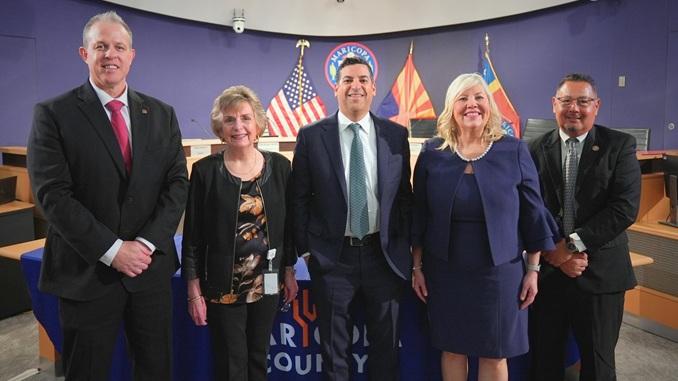
The Maricopa County Board of Supervisors is divided on moving forward with a pathway that may result in the recorder’s removal, even with little time left before the primary election.
The board published a statement Wednesday announcing their vote requiring Recorder Justin Heap to provide a written report and sworn public testimony on February 18.
The board statement accused Heap of “lying to the public” and stonewalling the board.
“He has been unreliable. He has been unprofessional. He has been untruthful. He has been unaccountable,” read the statement. “The Board cannot responsibly set a budget, make policy decisions, or oversee county operations, including an active election in Tempe right now, without complete and truthful information from Mr. Heap.”
The board made its decision during its formal meeting on Wednesday. State law authorizes the board to require any county officer to make reports under oath concerning office duties.
The written report would address key issues identified in Chair Kate Brophy McGee’s letter to Heap last month concerning expenditures and prepayments, signature verification and curing, and the special election board and deputy registrar program.
Heap will also be required to provide the identities of the provisional voters his office said were disenfranchised; records of requests by his office for federal funds, legislative appropriations, or county funds; communications with the Maricopa County Attorney’s Office concerning the distribution of mail-in ballots to voters who didn’t request them in the 2025 special election in Congressional District 7; and records of the reassignment of the space in the Maricopa County Tabulation and Election Center from the Maricopa County Sheriff’s Office to his office.
Although the supervisors voted unanimously to impose these requirements on Heap, not all supervisors supported the official statement condemning Heap.
Supervisor Mark Stewart said the statement wasn’t approved by him. Not only that, Stewart said, but the remarks were disrespectful and potentially damaging to current negotiations with Heap.
“We are in active negotiations on the Shared Services Agreement, and my focus remains on reaching a constructive resolution that delivers results for the people we serve,” said Stewart.
Other supervisors fanned the flames of the statement.
Supervisor Debbie Lesko shared her remarks from Wednesday’s meeting, in which she said she endured over a year of frustrations with Heap. Lesko lodged multiple accusations against Heap, such as that he had something to hide.
“I feel Recorder Heap has left us no alternative,” said Lesko.
The only alternative for the board would be to continue negotiations with the recorder’s office through public discussions and the court.
This pathway by the board may lead to the largest county in the state and fourth-largest county in the nation without its elections leader with a few months left to go before elections begin. The primary election was moved up from August to July recently.
Should Heap refuse to comply with Wednesday’s order, the board may opt to remove the recorder from office with just five months to go before the primary elections.
This latest action by the board appears to be their response to the Maricopa County Superior Court striking down the board’s attempt to subpoena three staff members within Heap’s office. This court restraining order occurred within the case initiated by Heap last summer to restore elections powers to his office.
AZ Free News reached out to Heap regarding the board’s decision. As of this report, no response has been received.
AZ Free News is your #1 source for Arizona news and politics. You can send us news tips using this link.
by Staff Reporter | Feb 9, 2026 | News
By Staff Reporter |
Several of the Maricopa County Board of Supervisors reviewed the recorder’s new signature verification process this week.
Supervisors Mark Stewart and Debbie Lesko visited the recorder’s office on Friday to observe what Recorder Justin Heap has promised to be a stronger approach to signature verification.
Also present were members of the Maricopa County Republicans and local election integrity advocates.
Supervisor Stewart publicized some of the training materials given to elections workers tasked with signature verification, including metrics for accepting or flagging signatures based on broad and local characteristics.
The new format for signature verification has two levels of review, the first for the user and second for the manager. At the level one user review, two signature reviewers of differing political parties compare signatures with the reference signature on file.
Signatures with obvious matches based on characteristics may be accepted as good signatures, while signature comparisons that yield differences outweighing similarities must be flagged for level two review by a manager.
The level two managerial review concerns the review of all available signatures in a voter’s registration record, which can be upwards of 50 samples. The signature pool could include signatures from voter registration forms, verified early voting affidavits, and in-person sign-ins from rosters.
Signatures consistent with the signature pool would be approved and sent to another level two manager of a differing political party for review, while nonmatching signatures would be set aside for further action. The recorder’s office has a set limit of disposition types: no signature, household exchange, need packet (a catch-all disposition type), deceased (which flags National Voter Registration Act research), and pre-questioned signature.
That last disposition qualifies for automatic submission to another manager of a differing political party for level two review.
All signatures with any discrepancy at any levels are required to be part of a mandatory audit review, set at two percent currently.
Training materials also made clear the efforts by the recorder’s office to integrate user-friendly updates to signature review software.
Level one reviewer screens will display the current election affidavit signature alongside the historical affidavit signatures from newest to oldest, removing the old requirement for users to scroll to compare signatures.
The training materials also stressed that users should default to flagging signatures for review for any reasons other than a “good signature” determination.
The visit marked an unusual bright point in the strained relationship between the board and the recorder.
The board and recorder have been engaged in a year-long legal battle in the Maricopa County Superior Court over elections administration powers.
This week marked a particularly tenuous moment in the battle after board leadership issued subpoenas against three of the recorder’s staff members.
The Maricopa County Superior Court sided with the recorder on the issue and put in place a temporary restraining order against the board to halt the subpoenas.
Friday’s visit was not a signal by the two visiting supervisors that they were on the recorder’s side in this court battle. Lesko reposted statements from Board Chair Kate Brophy McGee addressing the subpoenas. Stewart issued his own statement recognizing the validity of arguments from both his fellow board members and the recorder’s office.
AZ Free News is your #1 source for Arizona news and politics. You can send us news tips using this link.
by Staff Reporter | Feb 7, 2026 | News
By Staff Reporter |
In the latest escalation between Maricopa County leaders’ legal jockeying for elections authority, the Board of Supervisors reportedly subpoenaed staff with the Recorder’s Office.
Recorder Justin Heap issued a statement on Tuesday accusing the board of attempting “to intimidate and bully” his staff and “unduly influence” the pending court ruling. The recorder and board have been fighting for months in the Maricopa County Superior Court over who has proper authority over which elections administration powers.
“Their actions are beyond inappropriate,” said Heap. “My staff has bent over backwards to work with the Board, yet despite our earnest efforts the Board continues to engage in unhinged, emotional, and unprofessional behavior.”
Within the hour of Heap’s post, supervisor and former chair Thomas Galvin quoted Scripture that appeared to allude that the truth of the matter was beyond Heap’s remarks.
“‘And you will know the truth, and the truth will make you free.’ – John 8:32,” posted Galvin.
Galvin also shared a video from Chair Kate Brophy McGee addressing the accusations from Heap. McGee said their subpoena concerned an apparent conflict between Heap’s remarks during his annual budget request and sworn testimony on voter disenfranchisement from Heap’s staff, both of which took place last week on separate days.
“At Maricopa County, we count every lawful vote. That’s why we take any claim of disenfranchisement seriously, and have asked the Recorder’s office to provide further testimony regarding conflicting claims recently made by Recorder Heap and his staff,” said McGee. “This is an important issue and we need straight answers. If any voters are being disenfranchised, we will fix it immediately. If not, then the Recorder’s office must clarify to the court why it provided such testimony. Maricopa County voters need the truth.”
During last week’s board hearing, Heap said no voters had been disenfranchised since he took office in January 2025.
“We stated that we want this machine to make sure that we don’t disenfranchise voters. We didn’t say that any voters have been disenfranchised since I took office in the administration,” said Heap.
Two days earlier, Heap’s chief of staff, Sam Stone, issued sworn testimony in the Maricopa County Superior Court that disenfranchisement was occurring in the present.
“We had two potential places we would have made the substantial changes to one or the other to bring this in, to not disenfranchise voters, which is happening now,” said Stone.
Stone directed the court to testimony from Janine Petty, senior director of voter registration, who said disenfranchisement occurred during the 2024 election when certain provisional ballots were processed as federal-only due to time constraints even though they were voted as a full ballot.
“[Those provisional ballots] would be counted, but they would not be afforded the full ballot. So they would be duplicated by the elections board to be a federal ballot, when that voter was entitled a full ballot and voted a full ballot,” said Petty.
Heap earned a legal win on Wednesday against the board after the Maricopa County Superior Court rejected the board’s move to stop America First Legal (AFL) from representing Heap in court going forward.
AFL sued the board on behalf of Heap last summer over the contested elections administration powers, a battle stemming from a “lame duck” agreement between the outgoing recorder, Stephen Richer, and a board majority also on their way out.
AZ Free News is your #1 source for Arizona news and politics. You can send us news tips using this link.
by Ethan Faverino | Jan 9, 2026 | News
By Ethan Faverino |
Maricopa County Elections’ latest newsletter, released January 1, 2026, delivered key updates for upcoming elections, including precinct boundary changes, opportunities to support upcoming elections, and important dates for the 2026 election cycle.
The Maricopa County Board of Supervisors recently approved 235 voting precinct changes, which took effect on January 2, 2026, eliminating precincts with zero voters, aligning boundaries with major freeways, reducing overall precinct sizes for better manageability, and minimizing splits across cities, towns, and school districts.
These adjustments aim to accommodate ongoing population growth across the county and ensure sufficient precinct capacity to support efficient in-person voting operations. Additionally, the Board established a new Justice Court District in the West Valley, named Canyon Trails.
Maricopa County Elections also continues its search for community partners willing to host Vote Centers for the 2026 election season. By providing a suitable space, hosts play a direct role in strengthening election access and supporting participation in the community.
Ideal Vote Center locations must meet the following requirements:
- Minimum room size of 1,600 square feet
- Full ADA accessibility
- Reliable power and air conditioning
- Ample parking to handle high voter traffic
Hosts may commit to one of several durations: 27 days, 12 days, 4 days, 2 days, or 1 day, depending on the election period and location needs.
For the City of Tempe, Maricopa County Elections will conduct an all-mail election on March 10, 2026. Under Arizona law, eligible voters will automatically receive a ballot by mail. The voter registration deadline for this election is February 9, 2026.
Replacement ballots will be available for in-person voting starting March 3, 2026, at the Tempe History Museum.
Maricopa County Elections serves as the filing officer for a range of countywide elected offices, including Justice of the Peace, Constable, Judges seeking retention, Special Taxing Districts, and Precinct Committeemen.
To assist prospective candidates, Maricopa County Elections will host the following virtual training sessions:
- January 13 and February 5, 2026 – General candidate training
- January 15 and February 3, 2026 – Precinct Committeeman training
Ethan Faverino is a reporter for AZ Free News. You can send him news tips using this link.
by Staff Reporter | Jan 4, 2026 | News
By Staff Reporter |
Corporate media is making the case that the state’s largest sheriff’s office still needs federal oversight for racial profiling.
ABC 15 aired a segment criticizing a court filing requesting an end to the decade-long federal oversight of the Maricopa County Sheriff’s Office (MCSO). The oversight emerged from the Melendres v. Arpaio case, a class action complaint against allegedly racially motivated detentions that occurred during illegal migrant sweeps.
FOIAzona caught reporting errors made within a report by ABC 15 that no longer appears to be published, including the claim that MCSO filed the court motion.
However, it was the Maricopa County Board of Supervisors (MCBOS) who submitted that court filing earlier this month. MCBOS has budgetary power over MCSO.
In their court filing, MCBOS made the case that MCSO had long ago achieved 100 percent compliance in remedying issues of racially motivated detentions. The county argued that further federal oversight would only divert critical funds for public safety.
In a video explaining the filing, MCBOS Chairman Thomas Galvin said the end to federal oversight was long overdue.
“After 14 years, four sheriffs, and hundreds of millions of spent tax dollars, it is essential to defend taxpayer money if federal oversight is no longer warranted,” said Galvin. “All that’s left to enforce are matters unrelated to discriminatory policing which should be left to the sheriff who was elected by you: the Maricopa County residents.”
The 14 years of oversight have cost the county over $300 million in compliance. Around ten percent of those payments went to the court monitor, Robert Warshaw.
Leading up to MCBOS filing were months of allegations that Warshaw has a financial incentive to continue federal oversight of MCSO. Warshaw has earned over $30 million in monitor fees since taking on oversight of MCSO in January 2014 — around $3 million annually.
Warshaw faces similar accusations of exploiting federal oversight orders for personal gain in connection to his 15-plus years of monitoring the Oakland Police Department in California. There he earns over $1 million annually.
Warshaw has also earned millions from federal monitor assignments in New York, Michigan, and Louisiana.
Warshaw formerly served as the deputy drug czar for the White House Office of National Drug Control Policy under former President Bill Clinton.
Almost a decade ago, Judicial Watch reported on allegations that Warshaw allegedly employed “harsh” tactics that distracted from the county’s law enforcement activities.
Maricopa County Attorney Rachel Mitchell said Warshaw’s presence is no longer warranted.
“There is no defense for this ‘federal monitor,’” said Mitchell. “One more reason I like to get my news from the non-fiction section.”
Mitchell has been a vocal critic of Warshaw’s continued presence.
“It’s time we stop talking about Joe Arpaio — he is long gone and has been replaced by 3 different sheriffs from both political parties — and start talking about why the federal monitor, Robert Warshaw, is dragging this on and on,” said Mitchell in a May post. “Maricopa taxpayers should be outraged that we are at $350 million. Warshaw has no incentive to wrap this up.”
Back in October, Congressman Andy Biggs also asked Attorney General Pam Bondi to lift MCSO’s federal oversight. Supervisors Mark Stewart and Debbie Lesko, along with Mitchell, offered their support for the letter.
AZ Free News is your #1 source for Arizona news and politics. You can send us news tips using this link.