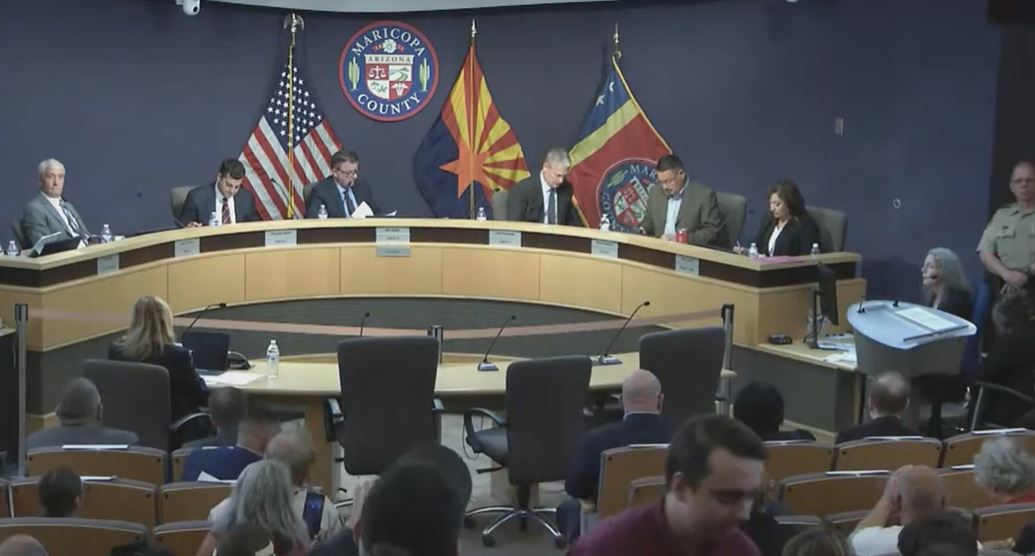
During the Maricopa County Board of Supervisors meeting on Monday, several poll workers testified that election machines at their locations had issues prior to Election Day.
During its canvass of the election results, the county reported that stress testing prior to Election Day didn’t reveal tabulator or printer issues. The board ultimately voted to certify the election results.
Tom Vanek, who reported being a registration clerk at Dysart Community Center, said that his location experienced issues with the printers on the day before Election Day. He reported that those issues were resolved by the day’s end. However, Vanek said that none of the sitebooks were connected to the server on Election Day. That meant that none of their workers could clock in.
Vanek relayed that no troubleshooter was on site, and that the county hotline couldn’t resolve the issue. He reported that the first rounds of voters that showed up to vote left the site without voting. The troubleshooter couldn’t resolve the problem and sent for another technician: the t-tech . There was still a communication issue with the printers. The first voter was able to check in at 7 am, over an hour later, but the printer failed to print her ballot.
Poll Worker explains how his ENTIRE polling location was inoperable when they opened on Election Day.
This is getting very, very bad for Maricopa County. Very bad. Like, unbelievably bad. pic.twitter.com/Fsh83t6b26
Michelle Altherr, who reported working at the Estrella Foothills High School vote center, claimed that the tabulators were malfunctioning during training. Come Election Day, Altherr reported that her location’s scanners were down for two hours.
Several other workers who testified also questioned why the screening processes failed to capture the election machine issues prior to Election Day. They challenged the county’s assertion that the Election Day troubles didn’t qualify as disenfranchisement.
One such worker, Martha Kochi, reported that the machines at her location didn’t offer any explanation for many of the rejected votes like they normally could. Kochi added that there were three ballot-on-demand printers not functioning at her location, one of which stopped working for several hours.
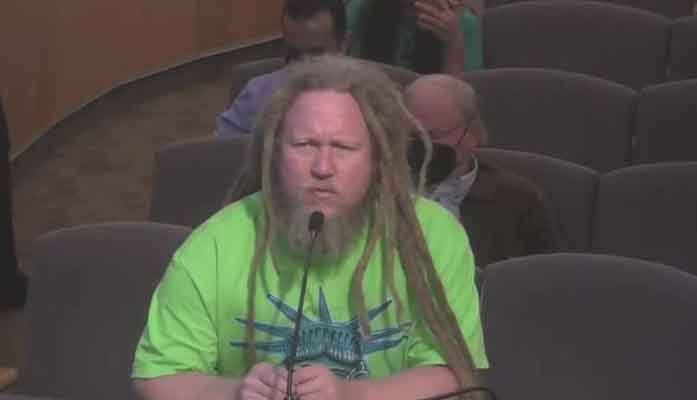
Mary Ziola, a worker at Happy Trails Resort wearing a #AZREVOTE shirt, said the Door 3-only option for those affected by malfunctioning tabulators caused mass concern and anger with voters. Ziola said she witnessed voters who left without voting because of the wait times or concerns with provisional ballots. One purported voter was a policeman that had to leave on an emergency call; another, a nurse that had to leave to return to work.
Several others in addition to Ziola wore “#AZREVOTE” shirts: a growing movement of activists demanding a redo of the 2022 general election. The county reported over 16,700 ballots cast in Door 3 boxes.
Another worker, Mike Peterson from the Paradise Valley Community College location, said that forcing voters to cast a provisional ballot was disenfranchisement. He alleged that only 150 of 675 voters cast a vote at one point. Peterson contended that the county didn’t train poll workers on check-out procedure.
“We, as poll workers, were not taught how to check out voters at our poll centers,” said Peterson.
Maricopa Poll Worker CONFIRMS: Poll Workers WERE NOT trained properly, voters were 100% disenfranchised.
Peterson’s testimony conflicts with the county’s response to the attorney general about this issue. The county stated that it trained workers on check-out procedure, included relevant materials in inspectors’ training materials, and trained inspectors on check-out procedure in weekly workshops.
According to the county, 206 voters checked in at one location and voted at another. Of those voters, 84 successfully checked out and cast a regular vote. The other 122 cast provisional ballots.
Raquel Cantacessi, an observer at one of the Lutheran churches, expressed concern with the mixing of tabulated and untabulated ballots in Door 3. She claimed those were lost votes.
In their report, the county explained that two vote centers ran into that Door 3 ballot mixing issue: Church of Jesus Christ of LDS Gilbert and Desert Hills Community Church. The county stated that it backed out results reported on Election Night and retabulated those ballots.
Following public comment, the county issued over two hours of an in-depth dissection of election data. Explanations of this data and Election Day issues were also made available in a report issued on Sunday by the county’s newly-launched election disinformation center.
Elections day and emergency voting director Scott Jarrett disclosed that the county is conducting a root cause analysis to determine why the tabulators malfunctioned on Election Day.
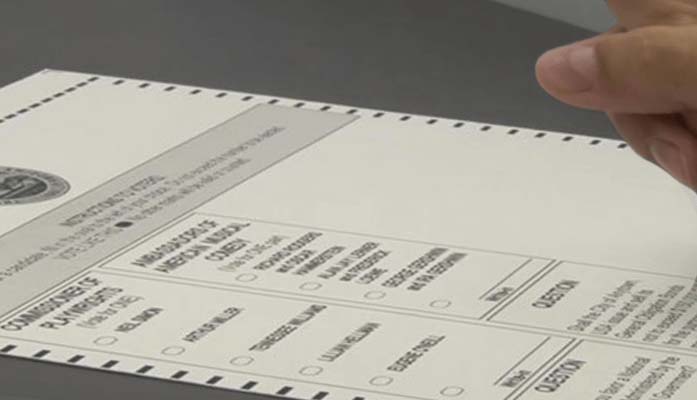
Jarrett reported that, so far, they discovered one of the issues behind the widespread tabulator failures: one of the two types of ballot-on-demand (BOD) printers used by the county had a printer setting incompatibility with the ballot paper sizing. The county increased the ballot size from 19 to 20 inches to accommodate for several candidates and propositions that weren’t finalized until late August.
The county uses two different BOD printers. One of the printer types, the “Oki” model, had a heat setting that printed the ballot markings either too lightly or in a speckled manner. The Oki model was retrofitted in 2020 to be a BOD printer for this election.
“It was very perplexing to us why this was an issue because we stress-tested our ballot on demand printers; we did it right before as we were coming up to the election,” stated Jarrett.
. @MaricopaVote : the faulty printer setting causing widespread tabulator issues occurred in one of two types of printers: the one retrofitted to be a ballot-on-demand printer, "Oki." County expressed confusion with its failure since stress testing went well. 71 sites impacted. pic.twitter.com/jZEmQiZXQn
Contrary to circulated claims of hours-long wait times at most vote centers, the county declared that the average wait time on Election Day was three to six minutes and the longest wait times for 189 of the 223 vote centers was between one and 45 minutes.
The county said that none of their vote centers put a time limit on voters casting their vote. The county said that the Door 3 option for casting a ballot has been in place since 1996.
At one point, about 80,000 people were watching the meeting’s live stream. Much to the audience’s chagrin, public comments remained at the two minute time limit.
Arizona: It's been a long day at The Maricopa County Board – was up to 80,000 live viewers – now a reduced audience is waiting for them to certify their latest election debacle.
Some commenters criticized Maricopa County Board of Supervisors Chairman Bill Gates’ and Recorder Stephen Richer’s involvement with the Republican Accountability Project (RAP): a Democratic dark money group. RAP’s Republican Accountability PAC spent over $4.5 million to ensure GOP gubernatorial candidate Kari Lake’s defeat according to trigger reports on the secretary of state’s campaign finance portal.
Gates disputed allegations that the county speeded up their certification process. He reminded the audience that it was taking place 20 days after Election Day.
“To challenge unofficial results would be like to challenge a TV network’s prognostications after the polls close,” stated Gates. “The canvass is what makes the results official.”
Nothing like a golden hour to commemorate the delivery of our 2022 General Election Canvass to the State Capitol. ☀️ You can find out more about the canvass here: https://t.co/PwpG4yOb2Dpic.twitter.com/tUj9NGi0XV
— Maricopa County Elections Department (@MaricopaVote) November 29, 2022
Corinne Murdock is a reporter for AZ Free News. Follow her latest on Twitter, or email tips to corinne@azfreenews.com.
Maricopa County ended the public comment portion of its Monday meeting certifying the election results with compliments from a Democratic activist.
The final speaker after an hour and a half of public comments was Blake Lister: a 2020 Arizona State University (ASU) Barrett Honors College political science graduate who worked recently with the Human Rights Campaign (HRC) to lobby for the Equality Act. That legislation would protect sexual orientation and gender identity under the Civil Rights Act.
Lister said he is a supporter of the Constitution as instituted by the Founders. Lister thanked the county for upholding election integrity. His remarks prompted angry outbursts from the audience.
“As an American citizen, I am a supporter of our Constitution and the process for our republic our founders set out for us over 200 years ago: that we are a republic chosen for us by We the People through our Democratic process,” stated Lister. “While being faced with threats, including threats on your life Mr. Gates, this board, the recorder, and county employees, many of them temporary, worked tirelessly long, 16-plus hour days to count every vote in a manner as timely as possible.”
Prior to HRC, Lister worked as a Democratic Congressional Campaign Committee (DCCC) field manager and a campaign assistant for failed Democratic congressional candidate Hiral Tipirneni. Lister also worked as an Arizona Democratic Party field organizer; an intern with the Arizona Advocacy Network (AAN), a political action committee that shuffles leftist dark money; and an intern for Senator Kyrsten Sinema (D-AZ).
Lister is also a graduate of several activist training groups: the Maricopa County Democratic Party’s Activist Academy, the Arena Academy, and Leading for Change programs.
This morning, I spoke at the @maricopacounty BOS meeting to uphold our democratic process and to thank our hardworking election workers.
Leading For Change (LFC) was founded by Beth Meyer: a former executive for the Center for Progressive Leadership and Planned Parenthood of Central and Northern Arizona. Meyer also founded and serves on the board of AAN.
Meyer formerly served on the boards of Defenders of Children, NARAL Arizona, Arizona American Jewish Committee, Arizona ACLU, and the Arizona Family Health Partnership Board of Directors.
Among LFC’s board of directors is House minority leader Reginald Bolding (D-Laveen). Also on the board is: Nate Rhoton, the executive director of One-N-Ten: an LGBTQ+ youth advocacy organization and longtimecollaborator with the Phoenix Children’s Hospital (PCH) transgenderism unit; Michelle Steinberg, public policy director and lobbyist for Planned Parenthood Arizona; Julie Rivera Horwin, former Arizona Education Association president and presently an National Education Association board member; and Roy Herrera, founding partner of a law firm that teamed up recently with Russiagate lawyer Marc Elias’ firm to prevent the cleaning of Arizona’s voter rolls.
Their board of directors previously included governor-elect Katie Hobbs when she was the Senate minority leader.
Corinne Murdock is a reporter for AZ Free News. Follow her latest on Twitter, or email tips to corinne@azfreenews.com.
On Wednesday, the Maricopa County Board of Supervisors (BOS) advised voters to petition the legislature for the election reform they’d like to see — yet it was a lobbyist who spoke out on behalf of the counties against certain election reform bills desired by constituents this past session.
Supervisor Thomas Galvin said during the meeting that voters dissatisfied with the election processes needed to direct their frustration at the state legislature. He claimed that the legislature was “sitting on their butts” when it came to establishing election law, hence why it takes so long to count the votes.
“Go to the state legislature — they’ve been sitting on their butts, they haven’t done a single thing. If you want changes in how votes are counted, let them know,” said Galvin. “We’re all very disappointed in what happened, and we want to make sure it doesn’t happen again.”
Similarly, Supervisor Steve Gallardo said that it was incumbent on the legislature to reform election law.
“Many of the suggestions that were made, this board can’t do. We’re an arm of the state. You have to go to the legislature. You have to change the laws,” said Gallardo. “Give us the authority to make some of the changes that are being suggested.”
Bills designed to restructure election processes were lobbied against by someone designated to speak on behalf of the counties. Jen Marson, a lobbyist and executive director of the Arizona Association of Counties (AACo), spoke out against a number of bills introduced to refine the election processes which ultimately failed, including:
SB1056, invalidating ballots not included in chain of custody documentation and making it a class 2 misdemeanor to knowingly put a ballot into the collection, verification, or tabulation process outside of the official chain of custody;
SB1360, granting election observers the right to observe, document, and question all stages of the election process;
SB1577, requiring county recorders or other lead election officials to separate and record duplicated and adjudicated ballots by their type and defect or damage, compiled in a report submitted to the legislature;
SB1609, requiring a court to order an election to be repeated within 90 days if a contested ballot measure or candidate didn’t receive the highest number of votes;
SB1359, requiring unique election system passwords for election employees, volunteers, and contractors;
SB1570, implementing additional voting equipment chain of custody requirements such as access restricted to authorized election personnel, tamper-proof seals for accessible ports, and chain of custody logging, as well as prohibiting voting equipment from having internet access capabilities;
SB1572, requiring county recorders to publish a list of eligible voters on their website 10 days before primary and general elections, as well as all ballot images and sortable cast-vote records, and requiring all ballots to be separated and tabulated by precinct;
SB1358, requiring ballots in counties with voting centers to be separated and grouped by precinct for hand count audits;
SB1404, repealing the Active Early Voting List (AEVL) and limiting early ballot voting eligibility;
SB1357, prohibiting election machines or devices certified by laboratories not accredited at the time of certification;
SB1474, declaring primary and general election days as state holidays, prohibiting voting locations from being used as on-site early voting, and establishing voting on election day only;
HB2241, requiring anyone dropping off an early ballot to either show ID or sign an acknowledgment that they have permission to do so on behalf of the voter.
Marson also spoke out against bills that passed, such as HB2492, which requires proof of citizenship when registering to vote. That particular law attracted lawsuits from the Department of Justice (DOJ) and voting rights groups.
Corinne Murdock is a reporter for AZ Free News. Follow her latest on Twitter, or email tips to corinne@azfreenews.com.
The Maricopa County Board of Supervisors (BOS) meeting on Wednesday included over an hour of public comment on Election Day issues. The majority of the public who spoke expressed frustration over the county’s handling of the election. BOS Chairman Bill Gates asked the crowd repeatedly not to clap, cheer, or issue commentary.
The main takeaway from several commenters and the BOS was that voters dissatisfied with current election processes needed to petition their legislators to change election law.
Several individuals thanked the BOS for their handling of the election. Among them was Ann Wallach, former Maricopa County Democratic Party Chair. Wallach said she doesn’t believe widespread voting suppression or election fraud are occurring. Wallach suggested that those dissatisfied with elections processes petition their legislators. Wallach said that mail-in voting doesn’t increase fraud, prompting angry cries from the audience.
“If there are people that are unhappy with our present system, I suggest that they take a look at the legislature and see if there’s action taken there that they don’t like,” said Wallach. “We’re all Americans and I think we all want to win fair and square.”
Several poll workers questioned election processes. One poll worker said the election needs to be nullified because of all the problems she witnessed. Another poll worker claimed that her location had 200 more ballots than voters that had checked in, located in Box 3 storage — where Election Day voters dropped ballots the tabulators failed to read. That same poll worker also claimed that the 17,000 voters affected by Election Day tabulation failures was a low estimate.
Another citizen expressed concern about the impartiality of the county officials, considering that Gates and Recorder Stephen Richer supported a PAC to defeat Trump-backed candidates.
“It’s not just a conflict of interest, it’s a specific agenda and a pre-bias going into it, so at the very least you should’ve recused yourself from any part of this election having opened that in 2021,” stated the woman.
Multiple citizens also expressed frustration with how they felt the officials brushed off the Election Day issues.
Martín Quezada, who lost in the treasurer’s race to Republican incumbent Kimberly Yee, thanked the BOS for their administration of last week’s election.
One voter proposed that the county have a runoff to provide a remedy for those who were prevented from voting due to mass tabulator failures and delays. He also questioned why Gates promised 99 percent of votes would be counted by last Friday, then announced on Thursday that the goalposts had shifted.
— Maricopa County Elections Department (@MaricopaVote) November 16, 2022
BOS Supervisor Steve Gallardo defended the county’s handling of the election, commending the workers. Gallardo added that the voters expressed valid concerns but indicated that these weren’t pervasive. However, he said nullification of an election has no legal pathway under current law.
“Our election system is safe, secure, and accurate,” stated Gallardo.
BOS Supervisor Thomas Galvin thanked the poll workers for sharing issues they’d experienced. Galvin said that the state legislature had been “sitting on their butt” when it comes to establishing election law, hence why it takes so long to count the votes.
“We’re all very disappointed in what happened and we want to make sure it doesn’t happen again,” said Galvin.
Vice Chairman Clint Hickman added that Arizona couldn’t count more quickly like Florida because this state’s laws are different. Hickman told the citizens he was grateful that they behaved better than some anticipated.
“There were certain people and groups that want us to believe that you will come and act up and be ungracious and unhumble. That is pathetic, but we were girded for that,” said Hickman. “I want to thank you guys for coming here and speaking your voice.”
Gates said that their conduction of elections only took 8 days rather than the historical average of 12 days. Gates said he was disappointed that the audience kept interrupting him.
“It’s important people know the facts,” said Gates.
Gates promised they would publish a canvass of the votes soon.
Watch the BOS meeting here:
Corinne Murdock is a reporter for AZ Free News. Follow her latest on Twitter, or email tips to corinne@azfreenews.com.
Newly re-elected State Senator Ken Bennett criticized Maricopa County’s handling of this election as one full of missteps and gaffes. In a Thursday interview with “The Conservative Circus,” Bennett called Maricopa County’s handling of this election “disheartening.”
Bennett promised to introduce legislation that would ensure elections could be more “transparent, trackable, and publicly verified.” This election marks Bennett’s return to the state legislature, having served for nearly a decade from 1999 to 2007.
“Especially with the focus and scrutiny that’s been on our entire state and on Maricopa County for the last two years, this was the election that we had to begin reinstalling confidence that we know what we’re doing in elections,” said Bennett.
Ken Bennett discusses the Maricopa County elections Department failures for the 2022 midterm and how confidence mus https://t.co/n7cyvfXldT
According to Bennett’s platform, the newly re-elected state senator promises to see through legislation requiring counties to publish their list of registered voters by name, address, and precinct before each election, followed by a list of who voted in the election by name, address, and precinct, as well as ballot images and cast vote records.
Bennett’s insight comes from his time as the secretary of state. He oversaw 12 statewide elections, and one recount. In 2010, one of the ballot propositions led by 126 votes and triggered a full statewide recount of two million ballots. Only 12 votes changed. He said that elections should have that level of accuracy.
Bennett further stated that the Election Day fiasco wasn’t caused by the tabulation machines as initially thought — it was the printers. Bennett said that this was good news, since that means the tabulation machines require precision.
“They rejected the ballots because the darkness of the ink printed on there wasn’t even enough,” explained Bennett.
The secretary of state’s office wasn’t to blame, according to Bennett, although he noted that there could be better preventative measures put in place to ensure Tuesday’s issue doesn’t reoccur.
The secretary of state’s office included two main responsibilities, one of which includes ensuring a month before the election that county machines are spot-checked for accuracy. Based on the Election Day fiasco, Bennett suggested that the on-demand printers receive more scrutiny during the spot-checking process.
Bennett served as the liaison to the State Senate’s controversial Cyber Ninjas-led audit of the 2020 election. His time in the role was fraught with issues that would prompt him to step down and later continue to haunt the Cyber Ninjas.
During this election, Time sought out Bennett and a fellow former secretary of state, Democrat Richard Mahoney, to obtain their perspective on Democratic gubernatorial candidate Katie Hobbs’ oversight of her race. Both Bennett and Mahoney suggested that Hobbs recuse herself.
Corinne Murdock is a reporter for AZ Free News. Follow her latest on Twitter, or email tips to corinne@azfreenews.com.