by Matthew Holloway | Dec 16, 2025 | Education, News
By Matthew Holloway |
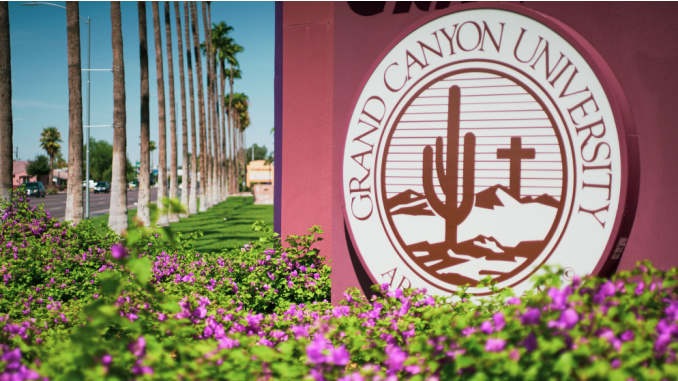
The U.S. Department of Education under Secretary Linda McMahon has formally restored Grand Canyon University’s nonprofit status, a reversal of a years-long dispute that had kept recognition of the Phoenix-based university’s tax-exempt classification in limbo.
The Department of Education’s (USDOE) action means it will now consider Grand Canyon University (GCU) a nonprofit institution for federal purposes, aligning its treatment under federal student-aid rules with the university’s longstanding recognition as a nonprofit by the Internal Revenue Service.
“We are appreciative that officials within the current Department of Education adhered to the recent Ninth Circuit decision in our favor and conducted an objective and thorough review of GCU’s operations in determining GCU’s nonprofit status under the correct legal standard,” GCU President Brian Mueller said in a statement. “We look forward to working with the Department in a cooperative manner moving forward and being part of the conversation to address the many challenges facing higher education.”
The move follows a May decision by the USDOE to reverse a $37 million fine against GCU, imposed under the Biden administration with prejudice. The fine was the largest ever levied by the agency against a university.
In November 2024, the U.S. Court of Appeals for the Ninth Circuit ruled that the Department of Education had unlawfully denied GCU nonprofit status and remanded the matter to the department for reconsideration under the correct legal standard. In 2018, the IRS reaffirmed GCU’s 501(c)(3) tax-exempt status after a multi-year audit, concluding that the university met all requirements of a nonprofit educational institution.
The restoration of nonprofit recognition comes as several Arizona members of Congress and other lawmakers have publicly advocated for the university’s status.
U.S. Rep. Eli Crane (R-AZ02) took to X on Monday to highlight the Education Department’s decision, calling the reinstatement of nonprofit status a significant development for the institution.
U.S. Rep. Andy Biggs (R-AZ05) also posted on X following the department’s announcement, noting the change in federal recognition and urging continuation of support for aligned legislative efforts.
In previous years, Arizona Republican lawmakers, including Reps. Gosar and Biggs had criticized the Department of Education’s handling of the university’s nonprofit status and its regulatory actions. They characterized earlier denials and fines as misplaced or excessive and called for greater alignment between federal treatment and GCU’s IRS-recognized status, per the Arizona Sun Times.
Gosar told the outlet at the time, “GCU is being targeted for its religious views and for being the largest Christian university in the country. The Department of Education should recognize GCU’s lawful nonprofit status and stop the harassment.”
With the Education Department’s updated decision, the agency will now consider GCU’s application as a nonprofit institution in future federal evaluations, including eligibility for Title IV federal student financial aid programs.
“This decision removes the cloud of confusion over our nonprofit status and allows us to put our complete focus and resources on our mission to provide affordable, Christian higher education to students from all socioeconomic backgrounds,” Mueller added. “We are excited to move forward with clarity and purpose.”
According to the university, nonprofit recognition is also expected to expand access to private scholarships restricted to nonprofit institutions, increase eligibility for nonprofit-specific grants and partnerships, restore eligibility for future government relief programs, reduce legal expenses associated with defending its status, and solidify GCU’s standing as a voting member of NCAA athletics.
Matthew Holloway is a senior reporter for AZ Free News. Follow him on X for his latest stories, or email tips to Matthew@azfreenews.com.
by Jonathan Eberle | Oct 28, 2025 | Education, News
By Jonathan Eberle |
Arizona Superintendent of Public Instruction Tom Horne is welcoming discussions between the University of Arizona (UA), Arizona State University (ASU), and the Trump administration on a new Compact for Academic Excellence in Higher Education, a federal initiative promoting merit-based standards and accountability in universities.
Horne, who also serves on the Arizona Board of Regents, said the compact reflects his long-held belief that education policy should prioritize individual achievement over racial or identity-based criteria.
“Since I took on the Tucson Unified district in 2008 to end the racially divisive ‘Ethnic Studies’ program, I have been fighting against racial entitlements,” Horne said in a statement. “People should be judged on their character and merit, not the color of their skin. The Trump administration’s federal compact for universities shares that same goal, and I am pleased that universities, including the University of Arizona and Arizona State University, are in discussions with the President on enshrining those principles in their schools.”
Horne also disputed recent reports suggesting that the University of Arizona had declined to participate in the compact, pointing instead to a recent letter from UA President Suresh Garimella to U.S. Education Secretary Linda McMahon. In the letter, Garimella expressed alignment with the administration’s goals of strengthening higher education through merit, excellence, and accountability.
“We share your vision of continuing to strengthen our higher education system for the betterment of the country — a vision rooted in a merit-based pursuit of excellence that directly or indirectly benefits all Americans,” Garimella wrote. He added that the university finds “much common ground with the ideas your administration is advancing” and welcomes collaboration with other institutions, higher education associations, and Congress “to advance and implement our principles in alignment with the national interest.”
Garimella’s Statement of Principles, included with the letter, outlines commitments to nondiscrimination, academic freedom, fiscal responsibility, and research integrity. It reaffirms that admissions and hiring decisions at UA will continue to be merit-based, and that diversity statements will not be used in employment processes. The document also emphasizes free speech protections, pledging to uphold the Chicago Principles on Freedom of Expression and to publish results from campus surveys on viewpoint diversity.
Under Garimella’s leadership, UA reports a 22% reduction in administrative spending, a tuition freeze for in-state students, and an expanded focus on aligning research priorities with national and economic security needs — reforms he described as consistent with the compact’s goals.
Horne said those steps demonstrate “a serious commitment to the kind of merit-driven, excellence-focused education system that Arizona taxpayers deserve.”
Both UA and ASU are expected to continue discussions with federal officials about implementing the compact in ways that preserve institutional autonomy while aligning with national standards for merit and accountability.
Jonathan Eberle is a reporter for AZ Free News. You can send him news tips using this link.
by Staff Reporter | Sep 18, 2025 | Education, News
By Staff Reporter |
The Department of Education (ED) announced a significant new investment in school choice.
On Monday, ED pledged “historic” investments into charter schools, American history and civics programs, Historically Black Colleges and Universities (HBCUs), and Tribally Controlled Colleges and Universities (TCCUs).
The department repurposed funding from Diversity, Equity, and Inclusion programs to fund these investments.
ED Secretary Linda McMahon said the funds were reserved for programs “which support student success.”
“The Department has carefully scrutinized our federal grants, ensuring that taxpayers are not funding racially discriminatory programs but those programs which promote merit and excellence in education,” said McMahon. “The Trump Administration will use every available tool to meaningfully advance educational outcomes and ensure every American has the opportunity to succeed in life.”
ED also pledged over $160 million to the American History and Civics Education National Activities — Seminars for America’s Semiquincentennial program. 2026 will mark the 250th anniversary of the founding of the United States of America.
ED will award American history and civics grants for seminars that “directly commemorate the 250th anniversary of the Founding of the United States.” Eligible seminar programming must make a feature study of American political tradition: the ideas, institutions, and texts instrumental to this nation’s constitutional government and history. The seminars must also be based on “the first principles of American founding.” Eligible seminars must include the Declaration of Independence, Constitution, and Bill of Rights.
$500 million in grants will be distributed to charter schools for the 2025 fiscal year. Another total of nearly $500 million collectively will be sent as one-time investments to HBCUs and TCCUs.
As justification for the reallocation of millions in government grants, ED cited the poor student outcomes exhibited by the 2024 National Assessment of Educational Progress (NAEP) scores released earlier this month. Student NAEP scores reached “historic lows” throughout K-12.
Nationally, average NAEP scores were lower across all three assessments: science at grade 8, mathematics at grade 12, and reading at grade 12.
Arizona students scored lower across the various subjects than the average national scores for both fourth and eighth graders. Fourth grade math scores averaged 232, compared to the national average of 237; fourth grade reading scores averaged 208, compared to the national average of 214; and fourth grade science scores averaged 149, compared to the national average of 153.
Eighth grade math scores averaged 270, compared to the national average of 272; eighth grade reading scores averaged 254, compared to the national average of 257; and eighth grade science scores averaged 148, compared to the national average of 153.
McMahon called the NAEP results “devastating,” and indicative of a trend of generations unprepared for adult life. McMahon questioned the spending of billions annually with such dismal results, and pledged to claw back some of those funds to invest in individual states and educational choice.
“At a critical juncture when students are about to graduate and enter the workforce, military, or higher education, nearly half of America’s high school seniors are testing at below basic levels in math and reading. Despite spending billions annually on numerous K-12 programs, the achievement gap is widening, and more high school seniors are performing below the basic benchmark in math and reading than ever before,” said McMahon. “If America is going to remain globally competitive, students must be able to read proficiently, think critically, and graduate equipped to solve complex problems. We owe it to them to do better.”
In May, ED pledged to increase charter school funding by $60 million for a program budget total of $500 million.
AZ Free News is your #1 source for Arizona news and politics. You can send us news tips using this link.
by Ethan Faverino | Sep 16, 2025 | Education, News
By Ethan Faverino |
The U.S. Department of Education released the 2024 National Assessment of Educational Progress (NAEP) results, known as the Nation’s Report Card, revealing historic lows in academic performance for eighth and twelfth-grade students in science, mathematics, and reading.
The data highlights persistent post-pandemic challenges and a widening achievement gap, prompting U.S. Secretary of Education Linda McMahon to call for a transformative shift in education policy.
“Today’s NAEP results confirm a devastating trend,” said Secretary McMahon in a statement released by the U.S. Department of Education. “American students are testing at historic lows across all of K-12. At a critical juncture when students are about to graduate and enter the workforce, military, or higher education, nearly half of America’s high school seniors are testing at below basic levels in math and reading. Despite spending billions annually on numerous K-12 programs, the achievement gap is widening, and more high school seniors are performing below the basic benchmark in math and reading than ever before.”
The 2024 NAEP results show significant declines in average scores compared to 2019:
- 8th Grade Science: The average score for eighth graders dropped for the first time since 2009, with 38% performing below the NAEP Basic level, a five-point increase from 2019. Only 31% scored at or above the Proficient level, down four points from 2019.
- 12th Grade Mathematics: The average score hit its lowest point since 2005, with 45% of twelfth graders scoring below Basic, a five-point increase from 2019. Only 22% achieved Proficient or above, which is down two points.
- 12th Grade Reading: The average score fell below all previous assessments since 1992, with 32% of twelfth graders below Basic, up two points from 2019, and 35% at or above Proficient, down two points again.
According to the National Center for Education Statistics, in the 2020-2021 school year, the United States (between local, state, and federal governments) spent $18,614 per student enrolled. This totals $927 billion in expenditures between public elementary and secondary schools.
Secretary McMahon added, “The lesson is clear. Success isn’t about how much money we spend, but who controls the money and where that money is invested. That’s why President Trump and I are committed to returning control of education to the states so they can innovate and meet each school and student’s unique needs.”
The data highlights a growing achievement gap, with lower-performing students at the 10th and 25th percentiles showing significant declines, while scores for the highest performers remained stable.
The report also reveals a rise in absenteeism, with 31% of twelfth graders missing three or more school days in the past month, up 26% from 2019. Additionally, only 33% of twelfth graders were deemed academically prepared for college in mathematics and 35% in reading, down from 37% in both subjects in 2019.
The NAEP assessments, conducted from January to March 2024, involved approximately 23,000 eighth graders in science and 43,600 twelfth graders in mathematics and reading. The results provide a snapshot of student performance across public and private schools.
Secretary McMahon emphasized the need for action across the U.S., saying, “If America is going to remain globally competitive, students must be able to read proficiently, think critically, and graduate equipped to solve complex problems. We owe it to them to do better.”
Ethan Faverino is a reporter for AZ Free News. You can send him news tips using this link.
by Matthew Holloway | May 20, 2025 | Education, News
By Matthew Holloway |
In a dramatic reversal of policy from the days of the Biden administration, the U.S. Department of Education (USDOE), under Secretary Linda McMahon and President Donald Trump, rescinded a $37 million fine against Grand Canyon University with prejudice Friday. The decision scraps the largest fine ever levied against a university by the USDOE.
As previously reported by AZ Free News, Grand Canyon University launched an appeal challenging the enormous fine and allegations of advertising false degree costs. The university was supported by the Goldwater Institute, which launched its own lawsuit in February after the USDOE failed to respond to a Freedom of Information Act request to gain clarity on the fine against GCU.
In a statement following the decision, GCU President Brian Mueller described the dismissal as welcome, but unsurprising news.
“The facts clearly support our contention that we were wrongly accused of misleading our Doctoral students and we appreciate the recognition that those accusations were without merit,” he said. “GCU is a leader in innovation, transparency and best practices in higher education and we look forward to working cooperatively with the Department in the future – just as we have with all regulatory agencies.”
The USDOE dismissed the case in its entirety with neither findings, fines, liabilities, nor penalties of any variety. According to GCU, the USDOE, “confirmed it has not established that GCU violated any Title IV requirements, including the claim that GCU ‘substantially misrepresented’ the cost of its doctoral programs that was alleged by ED officials under the Biden Administration. The Dismissal stated unequivocally that ‘there are no findings against GCU, or any of its employees, officers, agents, or contractors, and no fine is imposed.’”
In a statement the University said, “The proposed fine action was, by far, the largest the Department of Education had ever levied against a university. GCU filed an appeal to ED’s Office of Hearings and Appeals, maintaining that the unsubstantiated accusations were gross mischaracterizations based on isolated, out-of-context statements from certain enrollment documents and that, in fact, GCU students receive robust information about the time, cost and credits needed to complete a doctoral degree throughout their enrollment and onboarding process. Moreover, GCU maintains that its disclosures surrounding continuation courses, which are common in higher education doctoral programs, provide more information than is legally required or that other universities typically provide. As such, GCU has consistently insisted that it would contest any fine amount – even $1, let alone $37.7 million.”
In a post to X, Arizona Congressman Abe Hamadeh (R-AZ08) praised the dismissal writing, “The record-breaking fine imposed on Grand Canyon University (@gcu) was just one of many attacks by the Biden Administration on Christian organizations. Congressman Hamadeh applauds the Trump Administration’s decision to rescind the fine with prejudice.”
Congressman Andy Biggs made a similar post saying, “I’ve urged investigation into the outrageous fine since the moment it was handed down by the radical Biden-Harris regime. Thank you @POTUS and @EDSecMcMahon for working to ensure that the weaponization of government against @GCU isn’t allowed to stand!”
Matthew Holloway is a senior reporter for AZ Free News. Follow him on X for his latest stories, or email tips to Matthew@azfreenews.com.