How long must taxpayers be forced to throw money at a failed plan before something is done about it? For the Maricopa Association of Governments’ (MAG) regional transportation plan—which for two decades spent billions on light-rail and other wasteful “active transportation” projects and has primed the pump for another twenty years of boondoggle spending—The Club hopes the answer is not much longer.
Since 2004, local governments through MAG have siphoned more and more funding from a transportation tax to build white elephant transit projects throughout Maricopa County. Yet MAG won’t budge from its broken plan despite collapsed ridership, worsened congestion, and ballooningcosts – for projects that don’t match how people actually travel.
The good news is that with the next statutory transportation audit coming due July 2026, lawmakers on the Joint Legislative Audit Committee (JLAC) will have an opportunity to weigh in on the MAG plan and provide recommendations for change.
State law requires that these five-year audits evaluate several elements of the MAG plan, including transit service, costs, ridership, congestion, and mobility. While previous audits flagged some deficiencies, they lacked any concrete performance metrics, and on a few occasions were prepared by a firm tied to MAG (a conflict of interest). So, to further bolster the JLAC process, the Arizona Free Enterprise Club brought in a nationally recognized transportation expert to conduct an audit of the plan. The result: MAG’s plan is failing and needs a major overhaul.
The idea to extend light rail to the State Capitol has occupied the dusty shelves of bureaucratic transit plans for ages. Phoenix first floated it in their 2000 “Transit 2000” plan, their 2015 Transportation 2050 initiative, and the concept has taken up space in every MAG and regional planning cycle since 2004. The idea’s longevity is not a testament to how good ideas endure; rather how bureaucrats remain unaffected regardless of light rail’s failure; unwilling to change course despite low ridership, high costs, high crime, or changing travel patterns. The world changes but a transit plan apparently never dies.
In fact, it turns out it can’t be stopped from destroying the Capitol corridor even when lawmakers pass a law to stop it.
In 2023, Republican legislators negotiated Proposition 479, Maricopa County’s half cent sales tax for transportation, which included a clause prohibiting the use of any public resources for light rail coming within 150 feet of the State Capitol. The goal of the provision was to insulate lawmakers from the disruption and destruction caused by light rail. This neat trick of making the “Capitol Line” someone else’s problem would likely backfire.
Well, it turns out we were right, and what Phoenix has in store for the Capitol corridor is worse than anyone could have imagined.
Phoenix residents are petitioning the Phoenix City Council to improve security on the city’s light rail, claiming the transportation remains far too dangerous.
The state of the light rail was once again the focus of the council in a Public Safety and Justice Subcommittee meeting last month.
Dangers of the light rail contributed to the defeat of the city’s plan to landlock the State Capitol.
Jessica Mefford-Miller, Valley Metro CEO, reviewed their light rail security. Mefford-Miller reported that their private security does face limitations: only 75 percent of their scheduled shifts were filled, or 80-85 security officers out of the 110 needed; they only have 87 percent fare compliance; and they can’t issue citations to those riders who refuse to provide ID unless police are present. Each shift only has nine law enforcement members: one sergeant, four officers, and four police assistants.
Mefford-Miller noted that they would be expanding their police presence on stations and trains in the future. However, challenges to Mefford-Miller’s presentation revealed that the actual presence of security was lower.
Councilman Jim Waring questioned how many security personnel a rider could expect to encounter on the light rail. Mefford-Miller said only “about a third” of trains have personnel on them at any given time.
Waring further disclosed that multiple constituents had complained of seeing “vomit everywhere” and “people [that] were acting crazy.”
“I got tired of hearing too many constituents call and say, ‘Wow, I rode that one time. Never doing that again.’ It’s too expensive and too ungodly inefficient to justify anything we’ve spent, but now that it exists, you know, at least we shouldn’t be chasing away our customers,” said Waring.
Waring said he was “curious” with Mefford-Miller’s reference to homeless riders that were, “presumably, not paying.” He said her messaging was “unsound.”
“Those aren’t actually customers. They’re chasing away people who might actually be customers,” said Waring. “You’re not a customer if you didn’t pay. Then you’re stealing services from the people who did pay, and I guess asking the rest of us to subsidize it. And, if you’re harassing people who did pay, and making them never use it again, leaving more cost to be picked up by taxpayers who never use it.”
Mefford-Miller rejected Waring’s claim that riders were at significant risk of witnessing an incident or sustaining a personal attack. She said that “most” of the assaults on passengers in the Phoenix area were between two individuals known to each other, not strangers.
However, Waring rebutted that even the fact that so many fights were breaking out at all was cause for concern.
“To say, ‘Well, they’re attacking each other, so you’ll be perfectly fine.’ Well, okay, I’m not sure I’m going to be using that mode of transportation again,” said Waring. “The idea that this is great for everybody, this is not the feedback I’m getting.”
Valley Metro sustained over 575,100 incidents from January to July of this year across Phoenix, Mesa, and Tempe. Those incidents consisted of nearly 24,600 removals, nearly 300 trespasses, over 100 assaults on passengers, over 30 assaults on security, and over 400 citations issued.
During that same time period, police reported over 3,500 criminal investigative reports, and over 1,100 transit unit arrests for drugs, criminal damage, and assaults.
Waring further shared that his and other councilmembers’ constituents have endured waves of criminals obtaining transport to their areas, where before the light rail they couldn’t.
Councilman Kevin Robinson responded that the 12 Arizona State University (ASU) students in his class reported enjoying the light rail and felt safe. Robinson said he would try riding the light rail himself to gain his own perspective on it.
Public comment was overwhelmingly negative.
Jeff Spellman with the Violence Impact Project Coalition said that light rail security has been a “disaster” for years, despite consistent constituent complaints.
Shannon McBride with North Mountain Village Planning Committee said that all but one from over 300 respondents to a survey of those living near the light rail described the light rail as very unsafe.
Darlene Vallo, with the 19th Avenue Community Safety Plan and Phoenix Block Watch Advisory Board, reported observing drug deals, individuals high on drugs, individuals drinking alcohol, fights taking place on the light rail, and individuals taking baths in the public water fountain daily along her neighborhood patrols near the light rail.
Despite Mefford-Miller claiming that Valley Metro upholds a “See Something, Say Something” program, Vallo reported that Valley Metro employees have dismissed her reports of criminal activity on light rail property.
Councilwoman Betty Guardado expressed concerns with how much it would cost to add more police to Valley Metro. Guardado also expressed concerns with the impact that fully staffing the transit with law enforcement would have on the current police shortage. The councilwoman indicated that Valley Metro should make do with their current resources.
“Is it worth it at the end of the day?” asked Guardado. “Is it going to be cost efficient?”
Corinne Murdock is a reporter for AZ Free News. Follow her latest on Twitter, or email tips to corinne@azfreenews.com.
How much do you like to walk in 110-degree heat? If you’re a resident of the city of Phoenix, you may need to start getting used to it if the city council gets its way.
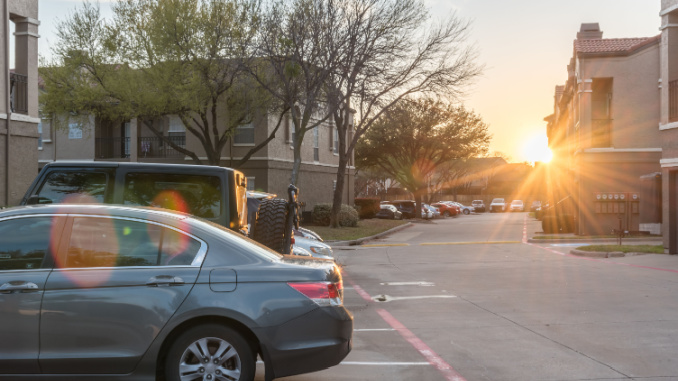
A proposed ordinance in Phoenix is looking to significantly reduce the minimum number of parking spaces it requires for apartments. Currently, Phoenix requires a minimum of 150 parking spaces for every 100 one or two-bedroom apartments. Under the proposed ordinance, that number would decrease to 125 spaces. But that’s not the end of it. For new affordable apartment complexes near light rail stations, the requirement for most would be reduced to zero! Yes. Zero parking spaces at an apartment complex. Have you caught on to their agenda yet?
If you’ve been keeping score, you already know that—in just this year—climate change zealots have been seeking to prohibit gas stoves; put limits on things like lawn and garden equipment, motorized boating, and water heaters; and ban the internal combustion engine. Now, this latest attempt to reduce parking spaces makes it clear. They want to force you out of your air-conditioned car to walk in 110-degree heat with your reward being to wait for a bus or light rail. But that’s not all…
State taxpayers should not be bailing out a broken Maricopa Association of Governments (MAG) plan. But that’s exactly what lawmakers are doing in the recently enacted Arizona state budget. That’s right. Your elected leaders just passed a budget that includes hundreds of millions of dollars for road projects—all being paid for with your tax dollars. (You can see for yourself on pages 9-11 right here.)
At first glance, that probably doesn’t seem like a big deal. After all, it makes sense for tax dollars to go toward necessary road projects. But the problem is that these road projects are supposed to be paid for by the Maricopa County Prop 400 regional plan that was assembled by MAG…