

UA Professor Sues Board Of Regents, Alleging DEI Retaliation And Committee Blacklisting

UA Professor Sues Board Of Regents, Alleging DEI Retaliation And Committee Blacklisting

By Matthew Holloway |

University of Arizona (UA) English professor Dr. Matthew Abraham has filed a federal lawsuit alleging he was blacklisted from key faculty-governance committees after raising concerns about DEI-driven hiring practices within his department. The complaint, filed Nov. 25 in the U.S. District Court for Arizona, names the Arizona Board of Regents (ABOR) as the sole defendant and alleges retaliation in violation of Title VII of the Civil Rights Act.

Abraham, a tenured faculty member, argues that the university systematically excluded him from participation in faculty oversight bodies, including the Committee on Academic Freedom and Tenure (CAFT) and the English Department’s Academic Program Review Committee (APR), after he questioned policies, which he believed to be rooted in racial preferences, through legally protected internal and administrative channels.

According to filings and documentation released by the Liberty Justice Center, Abraham’s concerns date back several years, culminating in multiple internal grievances, public records requests, and a 2022 complaint filed with the U.S. Equal Employment Opportunity Commission (EEOC). The EEOC initially dismissed the complaint but later issued a right-to-sue letter in August 2025, clearing the way for the federal lawsuit.

In the lawsuit, Dr. Abraham alleges that UA administrators and faculty leaders applied “confidential” criteria when selecting committee members, criteria he argues were influenced by DEI ideology and were used to sideline dissenting faculty.

Slides and internal correspondence referenced in the lawsuit reportedly categorized certain faculty members as “problematic,” “not appropriate,” or otherwise unfavored for committee roles. Abraham says those labels stemmed directly from his vocal opposition to using race as a factor in hiring or governance.

“University officials cannot blacklist a professor because he dared to question race-based hiring practices,” said Ángel J. Valencia, senior counsel at the Liberty Justice Center, in a press release. “Retaliation for speaking out about unlawful discrimination is itself illegal. We seek to restore lawful, transparent standards for committee service, to remove the stigma the University has placed on Dr. Abraham, and to hold the University accountable for their unlawful actions.”

Abraham’s lawsuit seeks several remedies, according to the Liberty Justice Center, including:

  • Removal of “stigmatizing” labels placed in faculty records
  • Clear, viewpoint-neutral criteria for determining eligibility for governance committees
  • An injunction barring ABOR and UA from using race-based or DEI-based selection practices in committee assignments
  • Restoration of Abraham’s participation rights within faculty governance

The University of Arizona declined comment, citing “what is an active legal matter,” according to The Center Square.

Dr. Abraham’s lawsuit comes as public universities nationwide face increasing scrutiny over the role of DEI in hiring, admissions, and internal governance. Arizona’s public higher-education system has been under heightened legal and political pressure in the past year, as previously reported by AZ Free News.

If Abraham prevails, even just by forcing broader disclosure of committee-selection records, the case could become a significant test of how DEI principles intersect with federal civil rights protections and the speech rights of public employees.

The Board of Regents has not yet filed a response in federal court as of this report.

Matthew Holloway is a senior reporter for AZ Free News. Follow him on X for his latest stories, or email tips to Matthew@azfreenews.com.
Mayes Faces Setback In Legal Challenge Against President Trump’s ‘Liberation Day’ Tariffs

Mayes Faces Setback In Legal Challenge Against President Trump’s ‘Liberation Day’ Tariffs

By Matthew Holloway |

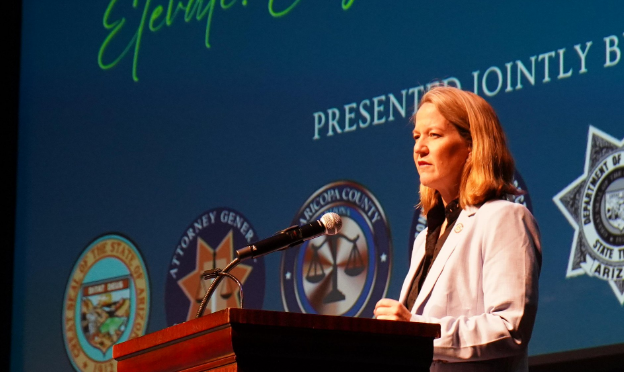
Arizona Attorney General Kris Mayes faced a setback last week in her legal challenge against President Donald Trump’s ‘Liberation Day’ Tariffs. The U.S. Court of Appeals for the Federal Circuit issued a favorable ruling for the President, allowing the tariffs challenged by Mayes’ and eleven other state Attorneys General to remain in effect pending appeal.

The appeals court blocked an order from the U.S. Court of International Trade, which struck down the tariffs on May 28th in State of Oregon, et al., v. Trump, et al. The appeals court acknowledged the Trump tariffs’ raise “issues of exceptional importance” and agreed to expedite the case. It will hear arguments before the entire court on July 31st. In the ruling, the court found that “both sides have made substantial arguments on the merits” and stated, “The court also concludes that these cases present issues of exceptional importance warranting expedited en banc consideration of the merits in the first instance.”

Responding to the ruling, President Trump wrote on Truth Social, “A Federal Appeals Court has just ruled that the United States can use TARIFFS to protect itself against other countries. A great and important win for the U.S.”

The May 28th ruling against the President resulted from two separate lawsuits, one brought by the Liberty Justice Center on behalf of five small U.S. businesses which depend on foreign imports and the second from a coalition of 12 states including Arizona.

Mayes claimed in a post to X that “The president does not have the authority to implement tariffs unilaterally.”

White House spokesman Kush Desai responded to the ruling saying, “The Trump administration is legally using the powers granted to the executive branch by the Constitution and Congress to address our country’s national emergencies of persistent goods trade deficits and drug trafficking. The U.S. Circuit Court of Appeals’ stay order is a welcome development, and we look forward to ultimately prevailing in court.”

At issue in the case are the discounted reciprocal tariffs that the Trump administration announced on April 2nd, which apply a 10% minimum tariff across the board, particularly in Europe, while applying more punitive tariffs, as high as 49%, in the case of Cambodia which charges the U.S. a 97% tariff or 34% initially for China, which at that point charged 67% on U.S. imports.

Through subsequent negotiations with China and a ratcheting upward of the tariffs, the U.S. duties on China stabilized at approximately 55% and will remain there under a new trade deal, Commerce Secretary Howard Lutnick told CNBC.

Despite the legal imbroglio with leftist State AGs, President Trump announced Wednesday that China’s duties on U.S. goods will remain at 10%, where they paused in May when both sides agreed to a 90-day reprieve, and he provided a glimpse into the new agreement pending with Beijing.

In a post to Truth Social, Trump wrote, “OUR DEAL WITH CHINA IS DONE, SUBJECT TO FINAL APPROVAL WITH PRESIDENT XI AND ME. FULL MAGNETS, AND ANY NECESSARY RARE EARTHS, WILL BE SUPPLIED, UP FRONT, BY CHINA. LIKEWISE, WE WILL PROVIDE TO CHINA WHAT WAS AGREED TO, INCLUDING CHINESE STUDENTS USING OUR COLLEGES AND UNIVERSITIES (WHICH HAS ALWAYS BEEN GOOD WITH ME!). WE ARE GETTING A TOTAL OF 55% TARIFFS, CHINA IS GETTING 10%. RELATIONSHIP IS EXCELLENT! THANK YOU FOR YOUR ATTENTION TO THIS MATTER!”

Matthew Holloway is a senior reporter for AZ Free News. Follow him on X for his latest stories, or email tips to Matthew@azfreenews.com.