The Kyrene School District (KSD) will be closing six schools over the next two years due to budgetary concerns from declining enrollment.
After months of deliberations, the KSD Governing Board voted unanimously to close four elementary schools and two middle schools.
The four elementary schools closing are Kyrene de la Colina, Kyrene de la Estrella, Kyrene de las Manitas, and Kyrene Traditional Academy. The two middle schools closing are Kyrene Akimel A-al and Kyrene del Pueblo.
Kyrene de la Colina, Kyrene de la Estrella, and Kyrene de las Manitas will close in the 2026-27 school year. Kyrene Traditional Academy, Kyrene del Pueblo, and Kyrene Akimel A-al will close in the 2027-28 school year.
This consolidation will result in the boundary modification of nine schools within the district: Kyrene de la Esperanza, Kyrene de las Lomas, Kyrene del Milenio, Kyrene de la Mirada, Kyrene de la Sierra, Kyrene Altadena, Kyrene Aprende, Kyrene Centennial, and Kyrene Middle School will experience boundary changes.
The governing board projected the six closures would save the district around $5.8 million annually, thereby avoiding most of a projected $6.7 million budget deficit.
Some parents who spoke against the school closures asked the governing board to reduce the number of closures to five instead of six. Overall, most who took to the podium recognized the need for a reduction in the number of schools in the district.
Superintendent Laura Toenjes promised the district would prioritize student needs during the upcoming transition.
“This is about caring for people through change and making sure students and staff are supported every step of the way,” said Toenjes.
KSD will provide families with information on enrollment pathways and school assignments, bell schedule updates, and transportation information in January prior to the enrollment portal opening in February.
Per the Common Sense Institute Arizona, KSD’s enrollment declined by nearly 20 percent over the past six years, but its budget increased by nearly 80 percent.
Kyrene’s enrollment is down 19 percent since 2019. Over the same period of time, their total budget has increased by 79 percent. Total capital expenditures have increased by 44 percent.
A data dashboard on all district enrollment, capacity, and budgets by the Common Sense Institute Arizona shows that over half the school districts in the state have declined in enrollment since 2019.
On average, their research found school districts haven’t grown since 2008. Apart from the declining student-age population, parents are choosing alternatives to traditional public schooling. Charter school enrollment nearly doubled during the pandemic, from 2020 to 2022; a majority of private schools researched had reported enrollment growth; and homeschooling increased from two percent to an 11 percent peak during the pandemic before falling back to a new high average between six and seven percent.
Despite this significant decline in traditional public school enrollment, Common Sense Institute Arizona found, further, that these schools reported a significant increase in spending: 80 percent since 2010.
Since January, at least eight other school districts have announced school closures and consolidations: Cave Creek Unified School District (two schools), Phoenix Elementary School District (two schools), Mesa Unified School District (staff layoffs), Isaac School District (two schools), Edkey, Inc. Sequoia Village School (one school), American Heritage Academy (one school), Roosevelt Elementary School District (five schools), Amphitheater School District (proposed four schools for closure).
AZ Free News is your #1 source for Arizona news and politics. You can send us news tips using this link.
Just two years after voters approved a $161 million bond in 2023, the Kyrene Elementary School District has unveiled a deeply unpopular, albeit long overdue, austerity plan to shutter nine of its 25 schools. Final decisions on which campuses will close remain in flux until December.
This should alarm not only Kyrene residents but also taxpayers in neighboring East Valley districts such as Chandler, Gilbert, and Mesa, which have likewise postponed needed consolidations despite data showing the urgency for school districts to “rightsize” to avoid future financial shocks.
Kyrene’s predicament shows what happens when district leaders, aided by special-interest boosters, ignore demographic realities and lean too heavily on bonds and overrides to prop up aging, half-empty facilities. Beyond the loss of schools and public trust, Kyrene’s crisis is a cautionary case study in how long districts can keep kicking the can on closures and restructuring before the math catches up.
For decades Kyrene ESD has fiercely defended its autonomy, resisting consolidation with Tempe Elementary School District, most notably in 2008, when Tempe voters approved a merger that Kyrene voters rejected by a 2-to-1 margin. The district has also resisted unifying with Tempe Union High School District, which serves most Tempe and Kyrene graduates. The result: three separate, duplicative bureaucracies servicing the same boundary zones of attendance.
That independence once seemed justified. By the 1980s and 1990s, Kyrene’s fortunes soared with population growth and rising property values following Phoenix’s annexation of Ahwatukee. A building boom beginning in the 1970s relieved Kyrene’s historic reliance on drawing students from outside its boundaries. That same appetite in housing translated to Kyrene’s expansion of schools, fueled by voter-approved bonds and overrides. Like many East Valley districts, Kyrene’s bond and override measures have passed easily, and typically without organized opposition.
Those glory days are long gone. Enrollment has fallen from 20,000 students in 2001 to roughly 12,000 today. That represents a 40 percent drop while the district continues operating 26 schools, a daunting figure considering it only serves grades K-8. Demographers project another 1,000-student decline within five years, equating to roughly $7 million less in state funding. Eight Kyrene campuses are less than half full, and three others are barely above that mark, culminating in the present restructuring effort.
Although Kyrene does have an override measure on the ballot for 2025, it remains to be seen if the drastic restructuring plan will have any impact on voter sentiment in the area for future bond requests. Given that Kyrene has spent millions from the recent bond request on schools now marked for closure, governing board members would be hard-pressed to make their case to residents for additional funding. Taxpayers who were told in 2023 by Superintendent Laura Toenjes that the bond would be “one more example of Kyrene’s commitment to fiscal responsibility” are right to demand answers about the gap between two decades of declining enrollment and the district’s continued inaction.
Kyrene is hardly alone. Large systems such as Chandler Unified remain locked in a perpetual bond-and-override cycle, masking structural enrollment declines with new debt and vague promises of an enrollment recovery effort that grows less plausible each year.
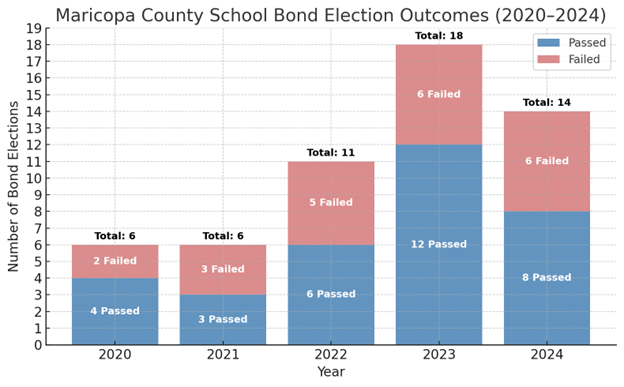
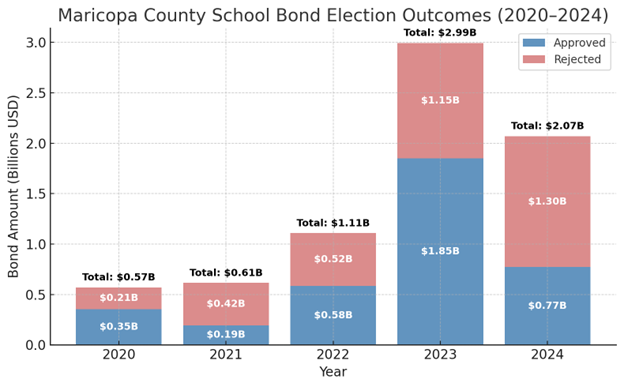
As seen in the chart below between 2020 and 2024, bond requests across Maricopa County have ballooned as pandemic stimulus dollars expired and districts turned back to property-tax financing. The pace of school bond elections far exceeds municipal ones, and the total amounts sought have surged as seen in the 2nd chart below. Inflation alone doesn’t explain the escalation, though it is often erroneously cited as the root cause of this growth.
The lesson isn’t that districts should never seek voter support, but that leaders must confront an uncomfortable truth: demand for traditional district schools is shrinking. Some causes, like rising housing costs and lower birth rates, are beyond their control. Others, like families choosing charters or ESAs, are the direct result of competition and consumer preference. Pretending otherwise guarantees more sudden, painful closures down the road, along with wasted opportunities adding up to hundreds of millions in taxpayer funds.
Kyrene’s crisis is neither the first nor the last domino of overbuilt school districts. Every district that keeps chasing bonds to prop up half-empty schools is writing the same ending. The can has been kicked far enough. It’s time to stop borrowing from tomorrow to preserve yesterday’s mistakes.
Arman Sidhu is a lifelong Arizona resident and educator who has served as a teacher and principal in both traditional public and charter schools. He is a doctoral student in education at Arizona State University’s Mary Lou Fulton Teachers College. His opinions are entirely his own.
In the corridors of education, a seismic shift is underway. Local superintendents, entrusted with shaping the educational landscape, are being influenced by a woke agenda that transcends their official roles. Behind this phenomenon lies the shadowy hand of leftist interests, channeled through national and state chapters of the School Superintendent Association (AASA), driving an agenda that reaches deep into the heart of public education.
Recent events in El Paso County, Colorado, underscore the extent of this influence. Allegations have surfaced of a superintendent employing intimidation tactics, supported by legal counsel, to suppress reports of a sexualized gender focus in classrooms. Such incidents reveal a troubling trend of silencing dissent and stifling transparency in the pursuit of ideological conformity.
At the national level, the AASA is actively seeking to modify the Protection of Pupil Rights Amendment (PPRA), often hailed as the Parents Bill of Rights (PBOR). While PPRA mandates parental notification of policies and surveys, the proposed amendments could erode parental consent requirements, potentially leading to increased control over data collection by schools, to the detriment of parental rights and oversight.
Arizona provides a stark example of the consequences of such ideological influence. In Scottsdale Unified School District (SUSD), Superintendent Scott Menzel’s equity-driven agenda has resulted in a dramatic reallocation of funds away from academics toward social support infrastructure. The repercussions are profound, with declining academic achievement, escalating violence, and growing student dissatisfaction.
Menzel’s emphasis on Diversity, Equity & Inclusion (DEI) has permeated every aspect of district life, reshaping classroom dynamics and disciplinary measures. Yet, amidst the proliferation of gender identity and sexuality clubs, concerns about academic focus and student safety persist.
Similar challenges echo across Arizona’s educational landscape. In Flagstaff, revelations about controversial sex education curriculum content have sparked parental concern, while in Mesa, allegations of clandestine aid to students undergoing gender transitions have led to legal battles and ethical scrutiny.
The reluctance of some superintendents to address concerns about new survey questions addressing social-emotional learning and sex education, further exacerbates tensions and raises questions about accountability.
Amidst these local debates, broader concerns loom about the influence of ideological agendas within educational institutions. The rise of what critics term the “Communist Whole/Community School philosophy” underscores the need for vigilance and a return to fundamental principles of education.
In this landscape of change, House Bill 2717 proposes a radical overhaul of the educational system in Mohave and La Paz County. Advocates argue for increased efficiency and cost savings, but questions linger about the potential concentration of power in the hands of county superintendents and its impact on local autonomy and accountability.
As parents and residents, it is incumbent upon us to remain vigilant and hold school officials and school board members accountable. The future of education hinges not only on academic excellence but also on safeguarding the principles of transparency, parental rights, and proper legal oversight in our schools.
Tamra Farah has twenty years of experience in public policy and politics, focusing on protecting individual liberty and promoting limited government. She’s served at the director level at Americans for Prosperity-Colorado, FreedomWorks, and currently with Arizona Women of Action.