by Staff Reporter | Sep 17, 2026 | Education, News
By Staff Reporter |
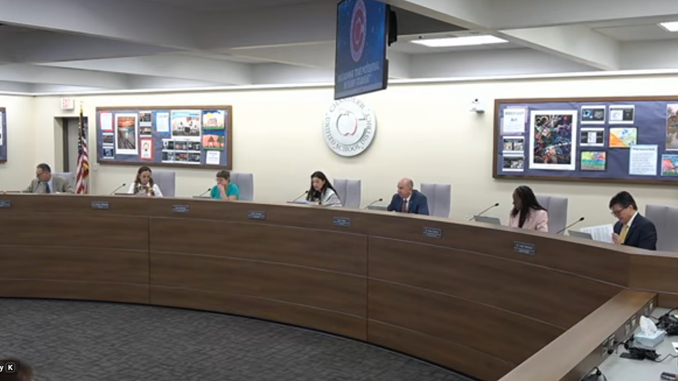
Chandler Unified School District (CUSD) narrowly approved a land acknowledgment statement for Native Americans during its regular meeting last week.
The board approved the land acknowledgment statement 3-2. The governing board will read a land acknowledgment statement at every meeting and at all graduation ceremony programs.
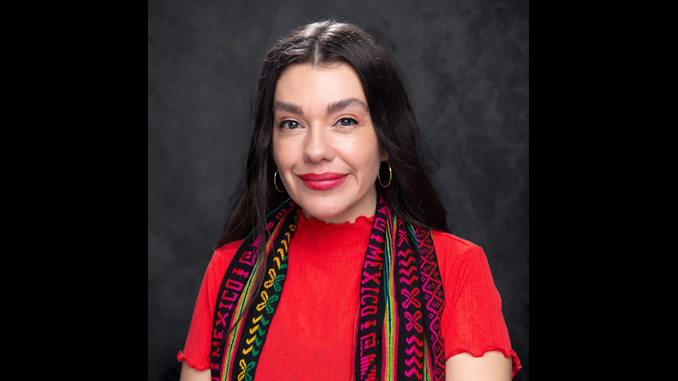
Board President Patti Serrano, donned in a pro-Palestine keffiyeh scarf and MEChA t-shirt, joined Member Claudia Mendoza and Vice President Barb Mozden in voting to require the land acknowledgment statement. Members Kurt Rohrs and Ryan Heap voted against the measure.
Serrano said this land acknowledgement statement was necessary to make Native American students feel “safe” to show up and learn at CUSD schools.
Serrano also claimed that a land acknowledgment statement did not mean that the district would be required to accept requests for acknowledgments for other identity groups.
CUSD has posted a land acknowledgment statement and accompanying video on its Indigenous Education Program page since 2025.
That land acknowledgment statement reads that the district exists on lands previously occupied by the Piipaash, Akimel O’odham, Gila River, Salt River, Pima, Maricopa, and Yaqui tribes.
Board member Rohrs questioned whether there would be future efforts to expand the requirement to read a land acknowledgment statement throughout other aspects of district activities, such as student functions like football games, CUSD staff meetings, and the beginning of classes.
Rohrs also said that land acknowledgement statements signaled bias and favoritism toward certain groups. He warned that the board’s approval would lead to demands by countless other identity groups: Holocaust recognition for Jewish students, acknowledgments for the various religious groups, or commemorations of veterans for students in military families.
Rohrs contended that the statement was rooted in “identity politics” that would further cause division in the CUSD community.
“Despite denials, this is clearly a political statement that reveals a preferential and exclusive bias towards a certain point of view of a certain identity group. The district must remain neutral in these matters,” said Rohrs. “For practical matters, this unnecessarily politicizes our board meetings. It has no real purpose in addressing our primary mission of improving academic performance for our students. This statement is an empty performance gesture of wokeness which really doesn’t accomplish anything and distracts from our core mission.”
Board member Heap remarked that the district faces much more pressing matters concerning student outcomes, citing an example of two more students who left the district for homeschooling due to the district ignoring or dismissing requests to curtail teacher and student usage of vulgar language. Heap also remarked that reading scores have declined to the lower 50th percentile.
Heap expressed doubt that the lack of a land acknowledgment statement was having negative impacts on the district, especially the current pressing issues of declining enrollment. According to the board, less than 2% of students will be directly impacted by the land acknowledgement statement.
Heap questioned why there were acknowledgments for certain identity groups but not others, which prompted laughter from the pro-land acknowledgment statement audience in attendance.
“Any time when we choose to highlight a group of students only based on their identity, nationality, heritage, we indirectly eschew — that means, you ignore — other people. We have a Hispanic heritage month. Do we have an Irish month? Do we have an Anglo-Saxon month?” asked Heap. “I don’t think that it’s appropriate for us to engage in that activity, either, because we are now wandering in areas that even if it’s right or wrong, I believe this statement ends up [having] a political connotation. Anytime you do that, you show bias, and that’s going to end up driving away students.”
Mendoza said that the statement was necessary for respecting diversity and belonging.
“By doing this, we are demonstrating that every story matters and every voice has value,” said Mendoza.
Mozden predicted the statement would improve Native American students’ academic performance.
“We have to start somewhere to try to raise our academic performance for some of our subgroups,” said Mozden.
The land acknowledgment incited some community members to call on Serrano to step down from the board, since Serrano led on the effort of its adoption.
Serrano has been accused of imposing a land acknowledgment without board concurrence at board meetings and graduation ceremonies.
Serrano has historically declined to participate in recitation of the Pledge of Allegiance, and took her oath of office on a fiction book written by Arizona State University professor David Boyle describing the gay sexual fantasies of a boy and his peers and the boy’s rejection of the values held by his conservative, Christian parents.
AZ Free News is your #1 source for Arizona news and politics. You can send us news tips using this link.
by Matthew Holloway | Sep 9, 2026 | Education, News
By Matthew Holloway |
Chandler Unified School District (CUSD) Governing Board member Kurt Rohrs is calling for Board President Patti Serrano to step down, accusing her of attempting to impose a land acknowledgment at board meetings and graduation ceremonies without the board’s concurrence. His proposed resolution comes as the board is scheduled to consider approving the acknowledgment at its September 9 meeting.
The district’s current agenda lists Serrano’s proposal as Item 9.01, “Possible Action to Approve CUSD Land Acknowledgement.” The proposal requests approval to include the acknowledgment at every governing board meeting and in all district graduation ceremony programs.
The proposal initially appeared as an information item on the August 19 agenda, announcing that the practice would begin September 9. According to the district’s draft minutes, board member Ryan Heap requested that it return at the next meeting as an action item.
The district’s proposal describes the acknowledgment as a “meaningful expression of respect and recognition” honoring Indigenous peoples’ sovereignty, history, and contributions. Serrano defended the practice during the August discussion.
Rohrs’ resolution alleges that Serrano attempted to introduce the acknowledgment without the board’s agreement and created division through politically motivated activity unrelated to academic performance.
In the resolution, Rohrs wrote that Serrano “has abused her authority as Board President” and “should immediately step down as Board President and be replaced by another Board Member who can faithfully carry out those duties.” The document contains no recorded vote or adoption date.
Rohrs also criticized Serrano for declining to recite the Pledge of Allegiance in the resolution. Video obtained from meeting attendees in April 2025 showed Serrano standing with her hand over her heart without reciting the pledge. The report said Serrano declined to discuss her reasons during public comment because the matter was not on the agenda and offered to follow up personally with the community member who raised it.
In his written request to remove the item, Rohrs argued that the acknowledgment would inject political and social activism into district business.
“This is an arbitrary decision that was never discussed or approved by the board,” Rohrs said during the August meeting. “There is no district policy that either requires or allows this. Land acknowledgment can be considered as a progressive socialist partisan political performance piece that has nothing to do with improving academic performance of our students.”
In his written removal request, Rohrs alleged that the acknowledgment appeared to violate provisions of A.R.S. § 15-112 and A.R.S. § 41-1494. “This statement is also divisive and promotes negative stereotypes and guilt-shaming regarding certain other ethnic groups,” he wrote.
Serrano disputed Rohrs’ contention that the acknowledgment would violate state law, arguing that the acknowledgment concerns sovereign Native nations and pointing to similar practices at Arizona’s public universities and community colleges.
The dispute also involved Rohrs’ decision to speak during public comment as a private citizen and taxpayer. The draft minutes record Serrano warning that the attorney general’s office had discouraged board members from switching roles during meetings because of potential Open Meeting Law concerns and confusion over whom they represent.
Rohrs responded that he had a right to speak and would not be intimidated into silence. Serrano said she was relaying the attorney general’s guidance and that her remarks were not intended to intimidate him, as noted in the minutes, which remain a draft pending board approval.
CUSD already maintains a “Land Acknowledgement 2025” section on its Indigenous Education Program website. The page identifies the district’s location as ancestral land of the Piipaash, Akimel O’odham, Gila River, Salt River, Pima, Maricopa, and Yaqui tribes and includes a land acknowledgment video.
Board members Barb Mozdzen and Claudia Mendoza expressed support for the acknowledgment during the August discussion, citing respect for Indigenous history, Native students, and the district’s community.
The September 9 public meeting is scheduled to begin at 6:30 p.m. at 1525 W. Frye Road in Chandler. The action portion is tentatively scheduled for 8:20 p.m. The agenda notes that listed times are approximate.
Matthew Holloway is a senior reporter for AZ Free News. Follow him on X for his latest stories, or email tips to Matthew@azfreenews.com.
by Loretta Hunnicutt | Nov 16, 2022 | Education, News
By Loretta Hunnicutt |
From the Office of Superintendent of Public Instruction (SPI) to local school board positions, several conservatives are currently leading or have already won key races on the education front in the 2022 General Election.
As of press time, Republican candidate for Superintendent of Public Instruction (SPI), Tom Horne, had increased his lead in his challenge of incumbent Kathy Hoffman. Horne previously served as SPI from 2003 to 2011, prior to successfully running for the Arizona Attorney General’s Office. If the results hold up, Horne says his focus as SPI will be on improving student performance and eradicating Critical Race Theory-based curriculum from Arizona’s public schools.
In the Peoria Unified School District race, Heather Rooks won a hard-fought and challenging race. Her efforts to expose the Social Emotional Learning-based policies and practices in the district eventually led her to request an injunction against an activist parent. As reported by the Arizona Daily Independent, Rooks, a mother of four school-aged children, obtained the injunction based on threats from Democrat activist, Josh Gray.
Two other conservative candidates, Amy Carney and Carine Werner, secured seats on the Scottsdale Unified School District (SUSD) Governing Board. Their victories serve as a powerful repudiation of out-going Governing Board Member Jann-Michael Greenburg. Greenburg was sued by parents who accused him of trying to silence them after they exposed his secret Google Drive dossier on them. As AZ Free News reported in April, that dossier included a trove of political opposition research on parents, who opposed the district’s adoption of Social Emotional Learning and Critical Race Theory.
In the race for Flowing Wells School District Governing Board—an area known for being blue—conservative Brianna Hernandez Hamilton is currently holding on to one of two open spots. A mother of three very young children, Hernandez Hamilton ran with the slogan: “Parents + Teachers = Quality Education.”
Kurt Rohrs, a long-time education activist and frequent contributor to AZ Free News, won a spot on the Chandler Unified School District Governing Board. Rohrs, like Horne, focused on improving student performance and eliminating the divisive Critical Race Theory from the district’s curriculum. Many see Rohrs’ presence on the board as an opportunity to restore calm to the district which had become the center of controversy thanks to out-going board member Lindsay Love.
In the race for Dysart Unified School District Governing Board, conservative Dawn Densmore was retained by voters. As current president of the board, Densmore successfully led the fight to end the district’s relationship with the Arizona School Board Association (ASBA). Jennifer Drake also won a seat on the board.
Sandra Christensen is set to win a seat on the Paradise Valley Unified School District Governing Board. Libby Settle and Madicyn Reid are in the lead for spots in Fountain Hills. Paul Carver should take a win in Deer Valley. Jackie Ulmer appears to have been successful in Cave Creek as well as Rachel Walden in Mesa and Chad Thompson in Gilbert. In the Higley Unified School District, conservative Anna Van Hoek also won a seat on the board.
In a tweet from earlier this week, former Secretary of Education Betsy DeVos summed up what many parents have been feeling over the past few years – left out. In response to the National Education Association’s claim that teachers “know better than anyone” what students need in the classroom, DeVos responded, “You misspelled parents.”