by Daniel Stefanski | Sep 4, 2023 | News
By Daniel Stefanski |
Arizona investments continue to be in good hands under the oversight of Republican State Treasurer, Kimberly Yee.
On Tuesday, Treasurer Yee announced that the Local Government Investment Pool earned $24.49 million in July, and that the Permanent Land Endowment Trust Fund (PLETF) soared to a record high of $7.99 billion the same month.
Yee unveiled the report at the August State Board of Investment meeting, which was open to the public via an online web service. According to a press release issued from her office, “the monthly meeting reports on Arizona’s investment activity, cash flow, future market conditions, and Arizona’s Education Savings Plan.”
The August 2023 report showed that the total assets under management were $5,886,428,849, and that earnings were up 241.51% year over year.
AZ Free News reached out to Treasurer Yee for comment, and the second-term official provided the following statements:
“I am the first Treasurer in Arizona’s history to meet regularly with local government leaders throughout Arizona’s fifteen counties to go over their record performing investments with our office. That’s why we’ve seen a 74% increase in local government assets under management during my administration. My office distributed a record-high of over $212.6 million to Local Government Investment Pool participants in FY 2023. This historic number of earnings surpasses the combined earnings of the last five fiscal years. Since I took office in January 2019, I have distributed record earnings of over $3 billion to local governments, state agencies and K-12 education, among other land endowment beneficiaries. This outstanding performance is fantastic news for Arizona taxpayers as our investment team continues to outperform benchmarks and receive record setting earnings, resulting in less direct local taxes for Arizonans.”
In the Arizona Treasury’s Education Endowment Report, not only did the PLETF hit a record high market value, but $424 million was to be distributed to K-12 education in Fiscal Year 2024. The Treasurer’s Office also revealed that the PLETF 10-year annualized total return approached 8%, which outperformed the average U.S. College and University endowments nine years in a row. According to the report, PLETF “is an endowment fund that the Arizona Treasurer deposits the land sales of Arizona into and invests the proceeds for education and other state beneficiaries, such as AZ K-12 education, AZ universities, AZ School for Deaf & Blind, AZ Pioneers’ Home, AZ State Hospital, and state prisons.”
The cumulative distributions for the PLETF over its history (since the 1990s) has been just under $4 billion ($3,823,070,913). When Yee took office in 2019, the market value of the PLETF appeared to be hovering around $6 billion.
Treasurer Yee’s Office also highlighted that “since taking office in January 2019, Arizona Treasurer Kimberly Yee has distributed record earnings of over $3 billion. This breaks down to $1.245 billion for the LGIP and State Agencies and $1.758 billion to beneficiaries of the PLETF as of June 30, 2023.
Daniel Stefanski is a reporter for AZ Free News. You can send him news tips using this link.
by Daniel Stefanski | Jul 19, 2023 | Education, News
By Daniel Stefanski |
A fight for the future of some federal grant dollars for Arizonans appears to be brewing.
Last week, John Thorpe with the Goldwater Institute sent a letter to Arizona Treasurer Kimberly Yee, expressing the organization’s “concern about Governor Hobbs’ purported cancellation of ESA-related grants that would enable children to attend all-day kindergarten” and urging Yee’s office “to go forward with the program as a legal obligation and for the sake of the parents.”
The Goldwater Institute’s letter references Hobbs’ action in May, which determined that “a $50 million grant made to the Treasurer in the final hours of the Ducey Administration is illegal and invalid.” Hobbs said at the time, “Illegally giving $50 million to private schools while failing to properly invest in public education is just one egregious example of the previous administration’s blatant disregard for public school students.”
After receiving the governor’s notice earlier this year, Treasurer Yee released a statement, writing: “It is clear Governor Hobbs does not care about what is best for Arizona kids or respect the rights of parents to determine the best environment to educate their child. Instead, she is using these children as pawns in a desperate and transparent attempt to win back support from union bosses and her ultra-progressive base. Educational choice is the civil rights issue of our time, and unfortunately, Governor Hobbs thinks she knows better than parents. I fundamentally disagree, and so do Arizona families.”
In that statement, Yee also said that her legal team was “currently reviewing the lawfulness of the governor’s move and determining next steps.”
The Goldwater Institute’s June 14th letter to Treasurer Yee states that “on January 1, 2023, the Governor’s Office entered an Interagency Service Agreement with the Treasurer’s Office to provide up to $50,000,000 in federal grant money from the American Rescue Plan (ARPA), via the ESA program, to children in kindergarten starting with the 2023 academic year…In exchange for your office’s commitment to administer and report on the grant program, the Governor made a contractual commitment to provide the funds and to ‘work with’ your office ‘to establish a cadence whereby [the Governor] will transfer funding to [the Treasurer] to then disburse to grant program recipients.’ The Agreement was, and is, a legally binding contract.”
Thorpe’s letter also asserts that “nothing in the Agreement or in state law permits unilateral termination by the Governor,” calling Hobbs’ prior justifications “groundless,” adding that “the Governor has no right to simply cancel an agreement based on unfounded speculation that the agreement violates the law.”
The first-year Arizona governor had touted that by taking this action, her office had “adverted a violation of federal law and the State Constitution.”
The attorney for the Goldwater Institute’s Scharf-Norton Center for Constitutional Litigation also communicated that “we find it troubling that Governor Hobbs is attempting this rollback of the ESA program after a long history of campaigning against, and promising to end, the Legislature’s recent expansion of the Arizona Empowerment Scholarship program.” He continued, “Having already failed in her bid to defund the ESA program through the budget process earlier this year, it appears Governor Hobbs is attempting to cancel the all-day kindergarten grants, not in order to comply with state or federal law (as described above, the program is entirely lawful), but as part of a transparent effort to harm and undermine the ESA program wherever possible.”
In a supplemental post, Thorpe added, “It’s simple: the governor does not have a right to lawlessly renege on promises made to Arizona families. Goldwater will never stop fighting to empower parents, expand choices in education, and to hold government officials accountable – in Arizona and throughout the country.”
Daniel Stefanski is a reporter for AZ Free News. You can send him news tips using this link.
by Daniel Stefanski | Jul 13, 2023 | News
By Daniel Stefanski |
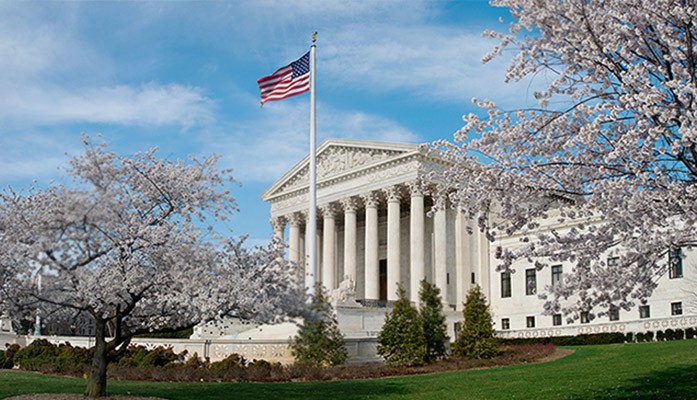
The U.S. Supreme Court saved one of the biggest opinions of the term for its second-to-last day, and its decision triggered reactions on both sides of the aisle in Arizona.
When the nation’s high court handed down its highly anticipated ruling in Students for Fair Admissions v. President and Fellows of Harvard College, it made a significant correction in the standards for admissions systems used by public universities around the United States. The Court held that race-based standards in Harvard’s and UNC’s admissions programs “violate the Equal Protection Clause of the Fourteenth Amendment.”
Writing for the majority coalition of the Court, Chief Justice John Roberts stated, “…the student must be treated based on his or her experiences as an individual – not on the basis of race. Many universities have for too long done just the opposite. And in doing so, they have concluded, wrongly, that the touchstone of an individual’s identity is not challenges bested, skills built, or lessons learned but the color of their skin. Our constitutional history does not tolerate that choice.”
The historic decision by the Supreme Court, drew reactions from Arizona’s politicians on both side of the aisle.
In response to an inquiry from AZ Free News, Senate President Warren Petersen replied, “This is a great decision for the fight against discrimination. The highest court in the land agreed with Martin Luther King Jr. in that you should not be judged by the color of your skin. An individual should be considered for college admissions based on academics, experience, qualifications and character—not by race. I’m thrilled this ruling will bring some sanity back to institutions of higher learning.”
Senate President Pro Tempore T.J. Shope told AZ Free News, “SCOTUS made the right decision today. As the proud son of a Mexican American mother and a white father of German ancestry, our family always knew that we should be judged on our character and not our color. We’re all Americans and we all share a responsibility in keeping this country free of racism & bigotry.”
Democrats, however, took issue with the Court’s ruling. Senate Democratic Leader Mitzi Epstein released a statement after the opinion’s revelation, saying, “Affirmative Action has never been about jumping to the front of the line without any merit. It has been about providing a ladder of equity to help those who have faced adversity in education, the workplace, housing, and every aspect of American life. Affirmative Action has been about providing opportunities for students who are Black and Brown to attend colleges, and for college students to live, love and learn among diverse peers. The same people celebrating this bad Court decision have been actively trying to whitewash history and walk America back to the book-burning past. SCOTUS did not rule against legacy admissions, employee and family recommendations, and grandiose donor admissions. The Court ruled to allow favoritism, but not favoritism for those who have faced racist obstacles. The Court ruled for the favored to get more favors, just as Republican politicians have pushed ways for the rich to get richer, and for the powerful to get more power.”
Democrat Representative Analise Ortiz called the Court’s opinion “devastating,” adding that “this ruling upholds white supremacy in higher education and the workforce. Simultaneously, the efforts to privatize K-12 education and drain public schools of funding achieve the same end. We must fight back to ensure racial equity in education.”
Kimberly Yee, the State’s Republican Treasurer, also weighed in on the news of the day, writing, “I applaud the U.S. Supreme Court’s decision to keep merit, character and academic achievement the center point of college admissions. The American Dream is attained by putting in the honest, hard work. No one should be able to cut ahead of the line in the name of affirmative action, based on the color of their skin. This decision upholds the core Constitutional principle that no institution in America is allowed to discriminate based on race.”
Daniel Stefanski is a reporter for AZ Free News. You can send him news tips using this link.
by Corinne Murdock | Nov 15, 2022 | News
By Corinne Murdock |
Maricopa County’s long-awaited drop of 71,000 ballots on Monday night locked in three key races for Democrats: governor, secretary of state, and senator. The vote results remain unofficial, with two statewide races remaining close.
Republicans easily won the state treasurer’s race with incumbent Kimberly Yee at the helm, leading Democratic challenger Martín Quezada nearly 56 to 44 points.
Quezada retweeted political commentary indicating that the Democratic Party didn’t offer him enough support, financial or otherwise.
Incumbent Democratic Senator Mark Kelly will likely win handily over Republican challenger Blake Masters, 51 to 46 percent.
It appears that Masters issued a preliminary concession on Friday, preparing for what Monday’s returns made more apparent.
Democrat Katie Hobbs will be Arizona’s 24th governor, becoming the fifth woman to do so. Hobbs pulled in 50 percent of the vote to Republican opponent Kari Lake’s 49 percent. Hobbs announced that she won on Monday, but Lake didn’t concede.
Rather, Lake questioned why Maricopa County’s top election officials, Recorder Stephen Richer and Board of Supervisors Chairman Bill Gates, launched a political action committee (PAC) to defeat certain Republicans.
Democrat Adrian Fontes prevailed over Republican Mark Finchem in the Secretary of State race, bringing in 52 percent over Finchem’s 47 percent. Fontes declared victory on Monday morning, long before the ballot drop that night.
Finchem refused to believe the results of Monday’s ballot counts. He reminded voters that the polls didn’t reflect the results at all, challenging the ballots’ validity.
Several races remained too close to call. In the race for superintendent of public instruction, Republican Tom Horne leads Democrat incumbent Kathy Hoffman by .02 percent — just over 6,400 votes. In the attorney general’s race, Democrat Kris Mayes also leads Republican Abraham Hamadeh by .02 percent: nearly 3,200 votes.
Greenlee and La Paz counties had 100 percent of their votes completed. Yavapai and Gila counties had over 99 percent of their votes completed as of Monday night. Maricopa County had nearly 99 percent of votes completed. Yuma and Pima counties had 98 percent of votes completed. Coconino County had 97 percent of votes completed. Pinal and Navajo counties had 94 percent of votes completed. Cochise County had nearly 91 percent of votes completed. At the rear, Apache County had 74 percent of votes completed.
Nearly 48,800 ballots remain.
No estimated percentages of completion were given for Graham, Mohave, and Santa Cruz counties. Altogether, they account for over 106,100 votes.
Corinne Murdock is a reporter for AZ Free News. Follow her latest on Twitter, or email tips to corinne@azfreenews.com.
by Corinne Murdock | Sep 3, 2022 | News
By Corinne Murdock |
On Tuesday, the Arizona Treasurer prohibited the use of Environmental, Social, and Governance (ESG) scoring when determining investments. ESG scoring is comparable to a social justice scoring, sometimes dubbed a “social credit score.”
Revisions to the Arizona Treasurer’s Investment Policy Statement (IPS) declared that ESG factors were non-pecuniary and therefore had no material effect on the financial risk or return of an investment.
The IPS further clarified that board shares couldn’t be voted to further “environmental, social, political, ideological, or other benefits or goals.”
READ THE FULL INVESTMENT POLICY STATEMENT HERE
Treasurer Kimberly Yee declared that ESG scoring enables malicious government manipulation of the private sector.
“Biden’s Administration uses big government overreach to manipulate the private sector in picking winners and losers based on radical ESG policies,” wrote Yee. “We must protect American free market principles and not allow environmental or social goals to dictate how taxpayer monies are managed.”
This wasn’t the first time this month that Yee took action to counter the effects of ESG scoring. Last week, the treasurer gave a major global financial firm, Morningstar, 30 days to prove that they weren’t complicit in its subsidiary company’s alleged boycott of Israel due to ESG policies. Without sufficient proof, Yee will place Morningstar on the state’s list of prohibited investments.
Yee’s opponent in the upcoming November election, Arizona State Senate Minority Whip Martín Quezada (D-Glendale), responded that he supports ESG scoring.
The Arizona state legislature attempted to outlaw ESG scoring discrimination through HB2656 during this past legislative session. However, State Representatives Joel John (R-Buckeye) and Michelle Udall killed the bill. John declared that he voted against the bill in accordance with his belief that such discriminations don’t exist.
However, firearms industry business owners testified earlier in the legislative session about the need for another bill, HB2473, because banks refused to do business with them because they deal with firearms. One testimony came from Ruger Firearms VPO Tim Powney, who shared that Bank of America cut short their decades-long relationship due to his being in the firearms industry. That decision was likely based on ESG criteria.
The concept of ESG dates back to 2004 when former United Nations (UN) Secretary General Kofi Annan gathered just over 50 of the world’s top financial institution CEOs to discuss influencing markets via ideological criteria. Early prototypes of ESG scoring occurred through the New York Stock Exchange’s Principles for Responsible Investment (PRI) in 2006, then the Sustainable Stock Exchange Initiative (SSEI) in 2007.
Almost all major companies rely on ESG criteria. Many model their ESG scoring systems after the Stakeholder Capitalism Metrics developed by the World Economic Forum (WEF), a globalist lobbying organization. “Stakeholder capitalism” is the attempt to modify corporations’ behaviors to benefit stakeholders instead of shareholders, necessitating corporate cooperation with government: something Yee claimed allows government overreach and free market subversion.
The WEF claims that ESG criteria are financially material. They argue that poor ESG scoring played a role in 15 out of 17 S&P 500 bankruptcies that occurred between 2005 and 2015.
Corinne Murdock is a reporter for AZ Free News. Follow her latest on Twitter, or email tips to corinne@azfreenews.com.