Arizona’s school choice program allows participants to use funds to pay for college, per a reminder from the state’s top elected education official.
Tom Horne, Arizona Superintendent of Public Instruction, promoted this usage of Empowerment Scholarship Account (ESA) program funds in an interview with The Center Square last week.
Horne said this option was more than just a benefit to families. The superintendent made the case that higher education directly correlated to strengthening Arizona’s economy.
“We want kids to go to college,” said Horne. “The percentage of college-educated students in a state has something to do with the success of its economy.”
This is not a new allowance. Arizona law has allowed this use of school choice funds since universalization occurred in 2022 under the former governor, Doug Ducey. Arizona was the first state to open school choice to all students.
Over 102,800 students have enrolled in the ESA program for the 2025-2026 school year, as of last week.
Horne is touting the benefits of the ESA program amid attacks from various special interests.
The Arizona Department of Education (AZED) is under pressure from a major media outlet, 12News, and anti-school choice organizations over misspending rates within the program.
12News reported that 20 percent of ESA expenditures were improper purchases. AZED reported the misspending rate amounted to less than two percent.
12News argued both figures can be true depending on the context, but Horne argued that was not the case. He said the actual amount of fraudulent purchases out of all misspending was 0.3 percent.
“The people who’ve made these criticisms fundamentally did not understand. To start with, [12News] said there was 20 percent fraud,” said Horne in a KTAR interview last month. “The 20 percent figure was the percentage of purchases under $2,000 to see if they were okay or not. But only 20 percent of that 20 percent were improper. That’s four percent. And the other thing to know is, they’re not all fraud. A lot of times it’s innocent mistakes.”
While Horne continues to defend and promote the merits of the ESA program in its present form, both supporters and detractors of the program argue changes need to be made.
Horne’s primary election challenger, Treasurer Kimberly Yee, announced last month that reforms were needed to reduce improper spending, starting with a switch in the reimbursement vendor.
Regardless of the outcome of this election, either Horne or Yee may face new challenges from school choice opponents.
The benefit to pay for higher education through the school choice program, and universalization as a whole, may be limited later this year pending the outcome of a ballot initiative seeking to place an income cap on eligibility.
Under the initiative, only families earning less than $150,000 a year would qualify to enter the ESA program. That income ceiling would be adjusted annually.
Under that income cap, approximately 15 percent of current ESA students would be removed from the program.
The initiative would also further restrict the list of allowable purchases. All tutors, schools, and service providers would be required to fall under State Board of Education oversight, and pay a fee and register annually with AZED to receive ESA funds.
It would also eliminate the current ability for families to rollover funds. All unspent funds would be recouped and returned to the state. That would, effectively, end ESA students’ ability to set aside funds over the years to pay toward college.
The Arizona Education Association and Save Our Schools Arizona are behind the ballot initiative, “Protect Education Act,” filed last month (this version superseded a previous version, the “Protect Education, Accountability Now Act”).
The initiative requires nearly 256,000 signatures to make the ballot.
AZ Free News is your #1 source for Arizona news and politics. You can send us news tips using this link.
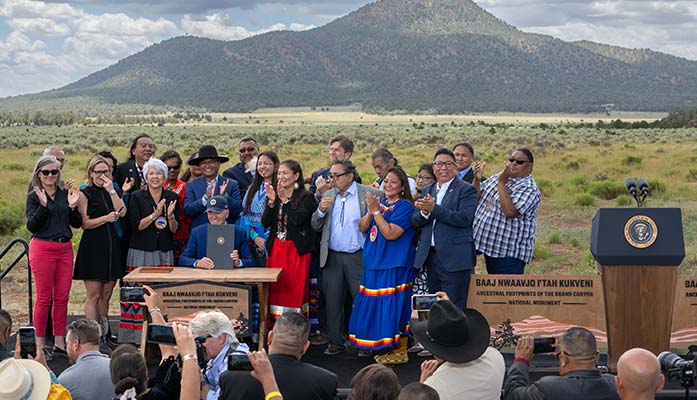
A federal appeals court rejected Republican lawmakers’ effort to undo a million-acre monument near the Grand Canyon.
The Ninth Circuit Court of Appeals upheld former President Joe Biden’s designation of the monument. Biden issued a proclamation establishing the monument on land surrounding the Grand Canyon National Park. The former president justified its creation as a means of conservation and deference to Native American tribe history.
The acreage is now referred to as the Baaj Nwaavjo I’tah Kukveni Ancestral Footprints of the Grand Canyon National Monument.
The monument name comes from two of the Native American tribes who lived in the region: the Havasupai (Baaj Nwaavjo, meaning “where Indigenous peoples roam,” and I’tah Kukveni meaning “our ancestral foot prints”).
The designation further shielded the acreage from mining operations, first prohibited in 2012 under a Department of Interior (DOI) ban lasting until at least 2032.
Today marks a historic step in preserving the majesty of the Grand Canyon.
First among American landmarks. Sacred to Tribal Nations. Revered by every American.
— President Biden Archived (@POTUS46Archive) August 8, 2023
The Bureau of Land Management (BLM) and U.S. Forest Service jointly manage the monument.
The initial announcement prompted lawmakers to call Biden’s proclamation a “dictator-style land grab” and “government overreach” that had the potential to impact national security.
Arizona legislative leaders, State Treasurer Kimberly Yee, Mohave County, and the towns of Colorado City and Fredonia sued to reverse the designation in 2024.
The three local governments argued the monument would hurt the potential of future tax revenues, pending the DOI ban lapsing after 2032. Colorado City also argued the water supply coming from an aquifer under the monument could be infringed if federal actors decided to restrict it.
Arizona lawmakers and the state treasurer argued the monument designation limited their ability to sell, lease, set royalty rates, and set values for the land. They also argued the designation forced them to divert resources to address the effects of the monument.
As to the ban on uranium mining, all against the designation claimed economic harm would occur due to the potential for higher energy prices in the future.
The Ninth Circuit Court of Appeals rejected all of those arguments in a ruling issued on Wednesday. The judges found their claims to be speculative.
Apart from the physical land management provided by BLM, the Baaj Nwaavjo I’tah Kukveni Ancestral Footprints of the Grand Canyon National Monument is overseen by a Monument Advisory Committee (MAC).
The MAC, established in the fall of 2024, has 15 members:
Luke Thompson, Arizona Game and Fishing Department representative;
Jason Chavez, Gov. Katie Hobbs’ tribal affairs director;
Patrice Horstman, Coconino County Board of Supervisors member;
Angelita Bulletts, BLM district manager and Paiute tribal member;
Bennett Wakayuta, Hualapai tribal member;
Lena Fowler, Coconino County Board of Supervisors member and Navajo tribal member;
Forrest Radarian, a high school science teacher representing outdoor recreations;
Amanda Podmore, a conservationist with Grand Canyon Trust;
James “Jim” Unmacht, executive director of Arizona Sportsmen for Wildlife Conservation;
Kathryn Leonard, state historic preservation officer with Arizona State Parks and Trails;
Clare Aslan, associate professor and director of Northern Arizona University’s school of earth and sustainability;
Sherre Finicum, a rancher;
Clarinda Vail, mayor of the town of Tusayan; and
Members of the public Dale Barlow and Lydia Breunig.
Their terms are set to expire in 2027 or 2028. It doesn’t appear that the MAC has conducted any meetings.
AZ Free News is your #1 source for Arizona news and politics. You can send us news tips using this link.
Arizona Treasurer Kimberly Yee is advocating for reforming the Empowerment Scholarship Account (ESA) Program to reduce improper spending.
The treasurer’s office manages the contract with the vendor operating the portal through which ESA holders submit reimbursement payments.
Yee shared that she directed her office to seek out vendors proposing to innovate better means of facilitating the expanding ESA program. The treasurer’s office will publish a formal request for information to secure a platform better suited to support the current scope of the program.
Over 100,000 families participate in the ESA Program.
“If there is a financial platform, or are updates to the current platform, that can provide families ESA program funds efficiently and identify any misspending or misuse, then Arizona taxpayers deserve to use that system,” said Yee.
Today I announced that the ESA marketplace platforms must be improved to protect taxpayer dollars. Arizona taxpayers deserve to have a platform that efficiently provides families with ESA funds while identifying misspending or misuse.
— Arizona Treasurer Kimberly Yee (@AZTreasurerYee) March 19, 2026
Yee announced her RFI plan following a public dispute between Arizona Department of Education (ADE) Superintendent Tom Horne and the media over fraud, abuse, and waste within the ESA Program.
Horne maintains the program has low levels of those problems, but 12News argues they’re much higher.
12News claimed based on a risk-based audit that 20 percent of purchases under $2,000 within the ESA Program were fraudulent. Horne disputed that total as a “ridiculous” misunderstanding of data.
“Only 20 percent of that 20 percent were improper — that’s only four percent,” said Horne in an interview with KTAR News. “The other thing to know is, [those improper expenditures are] not all fraud. A lot of times it’s innocent mistakes, a paper that needs to be submitted, things that people think are okay but don’t fall into our standards. The amount of actual egregious purchases or fraud is 0.3 percent.”
It's "ridiculous" to say that 20% of ESA purchases under $2,000 were fraudulent, according to Tom Horne, Arizona's superintendent of public instruction. @BroomheadShowpic.twitter.com/4WT3gGXUIJ
The 0.3 percent figure came from a randomized study by a Stanford PhD, per Horne, which reviewed 3,000 random ESA orders between July 2025 and February 2026.
12News relied on public records to estimate in a report published last month that misspending “could” amount to 20 percent of all purchases in the ESA Program. According to their report, at least 18,000 of the 102,000 ESA Program participants had one or more unallowable purchases over the course of one year, which amounted to nearly 84,000 unallowable purchases.
Horne has demanded that 12News issue a retraction of their reporting perpetuating the 20 percent claim.
“A ridiculous figure of 20 percent fraud has been circulating concerning ESA purchases which resulted from a total misinterpretation of data provided to Channel 12. The 20 percent figure represented program participants that ADE had selected for risk-based auditing,” said Horne in a press release last week. “Continued use of the 20% fraud allegation is an outrageous misrepresentation to the public that must stop.”
AZ Free News is your #1 source for Arizona news and politics. You can send us news tips using this link.
Over the past couple of months, the nation’s eyes have (rightfully) been turned to the State of Minnesota, as concerned citizens have unearthed what appears to be significant abuses of taxpayer dollars going to seemingly fraudulent daycare and healthcare centers run by Somali immigrants. These discoveries have exposed Minnesota Democrat officials, who have (at the least) looked the other way as this fraud was ongoing and escalating.
Minnesota isn’t the only state where we are seeing this rampant misuse of hard-earned taxpayer dollars.
Over the past three years, Arizona has been governed by a Democrat Governor and Attorney General, Katie Hobbs and Kris Mayes. These two have combined to cultivate a culture of corruption in the Grand Canyon State that rivals the illegal shenanigans from Minnesota. There have been several instances of this abuse and chicanery from the Governor’s Office that the Attorney General’s Office has clearly provided cover for during this term in office.
Whether in Minnesota or Arizona or any other state or jurisdiction across the country, American taxpayers deserve honest, transparent public servants, who are committed to putting the interests of citizens above the political elite. Thankfully, for the people of Arizona, the Republican-led state legislature has worked to hold these lawless Democrats accountable to the rule of law, though Hobbs and Mayes continue to stonewall our efforts and perpetrate new avenues of corruption.
Likely the most egregious action of Hobbs’ administration to-date, the alleged pay-to-play scandal will define the culture of corruption surrounding her administration. Almost two years ago, The Arizona Republic reported that a for-profit, state-contracted group home operator, Sunshine Residential Homes, received a significant rate increase approval from the Hobbs-led Department of Child Services (DCS). Leading up to this rate increase, the group donated to Hobbs’ inaugural fund – after its request for a rate increase had been denied by the outgoing Republican administration. The reporting showed that Hobbs had not approved rate increases to any other group homes, nor were the rate averages for these group homes comparable with Sunshine Residential Homes. Additionally, DCS ended state contracts with 16 group homes, making the arrangement with Sunshine all the more suspicious.
Attorney General Kris Mayes did go through the motions of announcing an investigation into this alleged pay-to-play, but she attempted to order Maricopa County Attorney Rachel Mitchell and the Arizona Auditor General off the case – despite those offices being asked to investigate the uncovered scheme by state legislators. Mayes was soundly rebuked by Arizona Treasurer Kimberly Yee, who also requested that the Maricopa County and State Auditor General investigations continue. The Democrat Attorney General was also accused of a conflict of interest in that she was again shielding her same-party official from the full weight of accountability under the law. There have been no updates from Mayes’ office into the status of this investigation in almost two years, leading credence to the idea that this was a cover-up meant to protect Hobbs and her administration. Compounding the shady behavior from her administration, Hobbs vetoed a bill during last year’s legislative session meant to fool-proof future executives from exploiting any perceived loopholes to perpetuate this kind of abuse.
SNAP
The Supplemental Nutrition Assistance Program (SNAP) program doles out almost $100 billion annually to Americans to purchase food. However, like many government programs, this one is rife with fraud and theft. According to the U.S. Government Accountability Office, there were over $320 million in stolen benefits between October 2022 and December 2024. Additionally, the U.S. Department of Agriculture reported in 2023 (during the Biden administration) that approximately twelve percent of these benefits were fraudulent. The politics and policies of this bloated program aside, it is undeniable that SNAP needs more oversight and guardrails to ensure that taxpayer dollars are being stewarded appropriately.
Hobbs and Mayes disagree. Mayes sued the Trump administration over its commonsense efforts to request more information from states on SNAP beneficiaries. Hobbs, for her part, refused to acquiesce to the administration’s data requests. These two are politicizing an issue that should enjoy consensus across party lines. No government official should be standing in the way of efforts to root out fraud in any public program, where taxpayer dollars are at risk for abuse. Every taxpayer dollar should be protected to the highest level. Unfortunately, for Arizona, Katie Hobbs and Kris Mayes don’t want the federal government – and the taxpayer – to find out exactly how much fraud is in our state; and that’s a shame.
Late last year, a top official in Mayes’ State Government Division was arrested for “controlling and trafficking stolen property.” Mayes’ office had been warned by the City of Peoria nearly two years earlier about serious allegations against this official – including fraud, conversion, and breach of fiduciary duty – yet Mayes kept her in a position of authority leading up to her arrest.
Arizona has long been known for its rugged independence and spirit of doing the right thing. Unfortunately for our state and its proud history, that reputation is being shattered by the culture of corruption from Hobbs and Mayes. Democrats across the country – from Arizona to Minnesota – have proven themselves incapable of governing our states – the laboratories of democracy – as the people rightly expect and deserve. It will be up to the voters to course correct this November and usher in legislators and executives who can – and will – steward the peoples’ money as it was intended.
Warren Petersen is the President of the Arizona State Senate and represents Legislative District 14.
Superintendent Tom Horne and Treasurer Kimberly Yee are at odds over a sizeable loan to a school district.
Horne wants Yee to approve a $3 million cash advance to Nadaburg Unified School District (NUSD), located inside Wittman. He stated in a Monday press release that Yee failed to conduct a proper review of the district’s finances before denying the advance.
The superintendent cleared up previous reports of a projected deficit as a “clerical error.” Horne called Yee’s denial “irresponsible” and urged her to reconsider.
“Our Finance Division did its research and determined that Nadaburg is operating within its budget, and by the end of the year they will have a projected positive cash balance of $1.3 million. Initially it was thought that they would have a negative cash balance at the end of the year, but the Department of Education, being a service institution, checked the forms and found the district made an unintentional clerical error that they can correct,” said Horne. “The Treasurer could have done the same review because she has the necessary forms, which were provided to her by our office, and her office failed to follow up with us to determine why we approved the advance.”
Yee not only denied the district a $3 million cash advance to address a $5 million deficit, she asked the Joint Legislative Audit Committee to direct a special investigation of the district through the Auditor General. The reported deficit amounted to three times the total amount of revenue NUSD anticipates from property taxes.
Yee’s announcement came last week, several days before Horne issued his response.
The treasurer expressed concern that Horne and the Arizona Department of Education had approved an advance to a district “in considerable financial crisis.” Although Horne alleges Yee failed to conduct a proper review of NUSD finances, Yee claimed in that preceding press release that she identified poor financial practices.
“The state’s top education agency should have been able to identify, as the Arizona Treasury has, that this District may desperately need financial experts to bring their books into the black,” said Yee.
In the denial letter to NUSD Superintendent Aspasia Angelou, Yee said the district failed to justify the necessity of the expenses the advance would cover and failed to show efforts to reduce current expenses to the minimum.
“[This] raises concern that the deficit is not necessary due to the timing of property tax collections, but could potentially be indicative of gross financial mismanagement,” said Yee. “[Our office] is seriously concerned that an advancement of funds now will only compound the district’s deficit and harm the financial stability of the district for years to come.”
In his Monday press release, Horne dismissed Yee’s claim of financial mismanagement as lacking any evidence. Rather than evidence of impropriety, Horne said the request was normal.
“District cash advances are common because a school district’s income and expenses may fluctuate,” said Horne. “As long as the district’s cash position is positive by the end of the year, and the funds will be paid back, cash advances are allowable.”
NUSD cited a low ending fund balance from the prior fiscal year and decreased property tax collections in 2024 as the main reasons for the deficit.
There are nearly 1,500 students in NUSD.
AZ Free News is your #1 source for Arizona news and politics. You can send us news tips using this link.