by Corinne Murdock | Mar 9, 2024 | News
By Corinne Murdock |
The “Freedom to Move” bill, a ballot referral that would create a constitutional ban on taxes or fees for Vehicle Miles Traveled (VMT) and limitations on travel miles, SCR1002/HCR2018, failed to pass in the Senate on Wednesday.
The resolution failed as Republican State Sen. Ken Bennett (R-LD01) joined Democrats in voting against it.
VMTs levy fees based on miles driven, generally for passenger vehicles only. Oregon implemented a VMT in 2015, and Utah implemented a VMT in 2020. The federal government has encouraged VMT pilots and enhancements through its Surface Transportation System Funding Alternatives (STSFA) grant program. Arizona is a member state of the STSFA Road Usage Charge (RUC) America Pilot, as are 12 other states.
Bennett expressed frustration that he was unable to have “reasonable changes” made to this or any other resolution like it.
The senator said that while he agreed with the desire to prevent limitations to free movement, he had concerns that the bill didn’t provide sufficient exceptions for governmental entities to monitor their vehicles for maintenance and employee reimbursement purposes.
Bennett further noted that businesses brought concerns to him that they would be prevented from complying with or taking advantage of the state implementation plan through Arizona Department of Transportation (ADOT), Arizona Department of Environmental Quality (ADEQ), and federal statutes.
“We do not want Arizona ever to be going down the road of what’s happening in other jurisdictions where they’re using VMT taxes or fees to limit people’s ability to move freely wherever they want to go,” said Bennett.
Bennett also claimed the bill wouldn’t appropriately apply to alternative fuel vehicles, such as electric vehicles. He suggested the legislature first come up with an energy equivalency calculation to bring alternative fuel vehicles into the process of paying for the roads.
“The growing number of electric vehicles is outside the HURF [Highway User Revenue Fund] revenue in this state, and we have to address that,” said Bennett.
Sen. Jake Hoffman (R-LD15) dismissed Bennett’s concerns as “patently false” and alleged that his counterpart knew that to be the case.
Hoffman countered that the bill does allow for governmental entities to enact VMT monitoring or limitations, just not mandates for businesses, and that the bill wouldn’t preclude businesses from voluntarily engaging with VMT rules or policies. The latter was a provision added under an amendment at the request of Intel Corporation, according to Hoffman.
Hoffman said that the federal government and entities bent on advancing environmental interests and policies were behind a feverish push for VMT.
“It’s called choice architecture, it’s a theory of the left. In choice architecture, you artificially alter the inputs with which people make decisions, so that the architecture surrounding those decisions changes,” said Hoffman. “You raise the price of gas to an unreasonable level, well, what’s the resulting behavior? They don’t drive as much.”
Correction: A previous version of this story incorrectly stated that Republican State Sen. Frank Carroll (R-LD28) voted against SCR1002/HCR2018. Sen. Carroll voted in favor of the resolution.
Corinne Murdock is a reporter for AZ Free News. Follow her latest on Twitter, or email tips to corinne@azfreenews.com.
by Daniel Stefanski | May 18, 2023 | News
By Daniel Stefanski |
Another election integrity bill has cleared the Arizona Legislature and is awaiting final action from Democrat Governor Katie Hobbs.
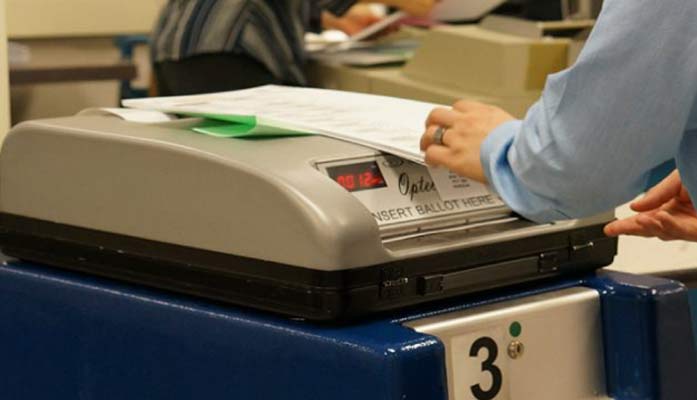
On Monday, HB 2560, sponsored by Speaker Ben Toma, passed out of the Arizona House of Representatives with a party-line 31-27 vote (with one Democrat not voting and one vacant seat). The proposal “directs the County Recorder to transmit to the Secretary of State to post on a secure website: a list of all registered voters before an election, a list of all persons who voted in the election, the unaltered images of ballots used to tabulate election results and the cast vote record in a sortable format.” The Senate then substituted SB 1324 with the House version Monday, giving the legislation the green light, 19-9 (with two Democrats not voting).
Earlier in the session, the bill had been approved by the House Municipal Oversight and Elections Committee along partisan lines (6-4).
The bill had previously garnered the support of Democrat Secretary of State Adrian Fontes and Republican Maricopa County Recorder Stephen Richer. On April 7, as he was about to mark his 100th day in office, Fontes’ office released a statement on the legislative proposal, writing: “Additionally, Secretary Fontes has been a strong proponent of SB 1324, a bipartisan piece of legislation concerning ballot imaging sponsored by former Secretary of State and current State Senator, Ken Bennett. An identical bill was introduced in the House as HB 2560. The bill, which is similar to legislation passed in other states such as Colorado, would allow people to compare ballot images to a cast vote record and would help restore confidence for some voters in our elections.”
Richer had issued a statement earlier in the year on February 13, saying, “Elections work when there is openness and transparency. SB 1324 does that by creating a system where each county recorder can inform voters before and after every election about who is eligible to vote while protecting voter confidentiality. All three – the list of eligible voters, the list of who voted, and the cast vote record – will be available to anyone who wants them. SB 1324 and Speaker Ben Toma’s legislation, HB 2560, contain similar language and will further strengthen our elections by enshrining the kind of transparency that can build public trust in our elections.”
After the bill received the go-ahead from the Senate on Monday, Senator Wendy Rogers tweeted, “Great effort to restore accountability in our elections.”
Daniel Stefanski is a reporter for AZ Free News. You can send him news tips using this link.
by Daniel Stefanski | Apr 11, 2023 | News
By Daniel Stefanski |
A bill to protect children on the internet is nearing the finish line in the Arizona Legislature, though some partisan opposition puts its fate in jeopardy with Democrat Governor Katie Hobbs should it reach her desk.
SB 1503, sponsored by Senator Wendy Rogers, “directs a commercial entity to verify that any person attempting to access an internet website containing a substantial portion of material harmful to minors is at least 18 years old.” The bill “authorizes the age verification to be made through a commercially available database that is regularly used by businesses or governmental entities for the purposes of age and identity verification; or any other commercially reasonable method of age and identity verification.” It “subjects a commercial entity that violates the verification requirement to civil liability for damages, including attorney fees and costs, resulting from the minor’s access to the material.”
Rogers was joined on her bill by co-sponsors (and fellow Senators) Ken Bennett, Sonny Borrelli, Frank Carroll, David Farnsworth, Jake Hoffman, Steve Kaiser, John Kavanagh, Janae Shamp, T.J. Shope, and Justine Wadsack.
The bill first cleared the Arizona Senate Transportation and Technology Committee in February with a bipartisan vote of 5-2. Democrat Senator Christine Marsh joined four other Republicans to advance the legislation out of committee. After a Rogers’ amendment was adopted on the floor, the full chamber approved the bill with a bipartisan 19-11 vote, though Marsh did not vote in favor.
Senator Rogers cheered the passage of her proposal after the Senate vote, tweeting, “Need to be age 18 to view ‘content harmful to minors’ (pornography) on the internet. My SB 1503 passed the Arizona Senate. #ProtectChildInnocence”
SB 1503 was then transmitted to the Arizona House of Representatives where it was assigned to the Regulatory Committee. In March, the Committee took up and considered this bill, passing it with a party-line 4-3 vote. It awaits the green light from the House before it travels to the Governor’s Office for her final decision.
During the House Regulatory Committee hearing, Representative Nancy Gutierrez explained that she thought this legislation was “an infringement on our First Amendment rights,” and she found it “ridiculous” that anyone would suggest that a company would be at fault for a child looking at inappropriate websites. Gutierrez was baffled that anyone would also suggest that “there is a mechanism that would even be able to verify age.”
Her Democrat colleague, Representative Alma Hernandez, agreed with these sentiments. Before Hernandez voted against SB 1503, she first stated that she didn’t want children looking at pornography on the internet, but that this was “almost impossible to actually enforce.” She argued that the United States is “not North Korea, China, or Iran, where those countries have internet censorship,” and she challenged her Republican colleagues to return to their freedom-loving roots when coming up for solutions of problems that are perpetrated on the internet. Hernandez stated that she believes “it should be up to the parents to decide if they want to put screening mechanisms on their children’s phones.”
Daniel Stefanski is a reporter for AZ Free News. You can send him news tips using this link.
by Pat Nolan | Apr 6, 2023 | Opinion
By Pat Nolan |
Governor Hobbs has proposed a budget that is a radical’s dream. It increases funding for a laundry list of pet programs of the radical left, while at the same time cutting programs that are supported by the vast majority of Arizonans. The Hobbs budget expands funding for illegal immigrants and increases taxpayer funding of abortions. At the same time, Hobbs would kill the expansion of our popular parental school choice program and defund the Border Strike Force.
House Majority Leader Leo Biasiucci describes the Hobbs budget: “Attacking school choice, peddling state-funded abortions, and incentivizing illegal immigration in Arizona are all non-starters and, frankly, something you’d expect to see proposed by a politician in California, not Arizona.”
In response to Hobbs’ radical budget, Republicans passed a responsible, “baseline budget” which would continue state spending at last year’s budget levels, with adjustments to education and health care programs to account for inflation. When asked if Hobbs would reject the baseline budget Rep. Biasiucci responded, “If she does that, it’s party politics. This is everything we need to make sure that schools don’t shut down, make sure government stays open, make sure all our essential services stay open while we figure out what we need to do with the rest of the money.” Unfortunately, Hobbs vetoed the legislature’s reasonable budget. She is playing a game of chicken, threatening a government shutdown.
If Republicans stay united, the taxpayers will be protected from the free-spending Democrats. Given the one-vote margin in each house, we can’t afford to lose a single Republican vote. To protect us from Hobbs’ costly budget, it is essential that Republicans stick together.
I have heard disturbing reports that some Republicans are quietly signaling they are willing to cut a deal with the Democrats behind the backs of their leadership. That would severely weaken the bargaining position of Republicans as they negotiate for smaller government. More important, it would betray their constituents who voted for them based on their promises to limit the growth of state government.
Why on earth would Republicans be willing to cave to the Hobbs budget? There are a couple of possibilities. They could trade their votes for a pet project. Or they could be self-promoters with a messianic complex seeking acclaim from the liberal press as “rising above the partisan bickering.”
Believe it or not, it could happen here in Arizona. Around the country and in Congress, turncoat Republicans have made side deals to expand government spending. And though it seems odd, these quislings frequently represent “safe” Republican districts. Senator Romney comes to mind, and he is not alone.
In California, back when Jerry Brown was governor, a Republican representing the most Republican district in the state voted for the bloated budget after she had promised to oppose it. When asked why she flipped, she blithely replied that she got a new library for UC Irvine. Another Republican sold out for even less—Willie Brown promised him an office with a wet bar in it. Judas at least got thirty pieces of silver. As sure as night follows day, the press heaped praise on both of them for their “courage” in avoiding a budget impasse. But in truth, they voted against the interests of their constituents.
To avoid such a betrayal from happening here in Arizona, conservatives must press their representatives for a firm commitment that they won’t cut a side deal on the budget. We must lock in those commitments now and shut down any side deals before negotiations start in earnest.
My State Senator is Ken Bennett, and my representatives are Quang Nguyen and Selena Bliss. LD 1 is the most Republican district in the state. Conservatives shouldn’t have to worry about them keeping faith with their promises to the voters, but as President Reagan told us, “Trust but verify.”
Therefore, I am asking all three for a firm commitment that they will only vote for a budget that is supported by the rest of their Republican colleagues. The great conservative Senator Everett Dirksen famously said, “When I fell the heat, I see the light.” And I hope conservatives in all Republican districts will turn up the heat, so Republicans stay united to protect the wallets of the taxpayers.
Otherwise, it will be every legislator for themselves, and they’ll cut the hog fat. And we the taxpayers will be the hog.
Pat Nolan is the Director Emeritus of the Nolan Center for Justice at the American Conservative Union, and lives in Prescott.
by Daniel Stefanski | Mar 28, 2023 | News
By Daniel Stefanski |
An Arizona legislative proposal to increase transparency into state elections is slowly making progress through the Senate, and it appears to have some bipartisan support.
SB 1324, sponsored by Senator Ken Bennett, “requires a county recorder to publish a list of eligible voters, with outlined information, on the county recorder’s website 10 days before a primary and general election,” and it “requires the Secretary of State to digitally publish a list of all persons who voted in an election, all ballot images and a sortable cast vote record” – according to the purpose provided by the Arizona Senate.
In defense of his bill after shepherding it through the Committee of the Whole session, Senator Bennett said, “The answer to confidence in our elections is transparency. As leaders of this state, we should not fear transparency. Candidates, whether they’re winners or losers, should not fear transparency. County and state election officials should not fear transparency. If things were done right in the election, there’s no need to fear that detailed information being released so people can verify.”
During the Committee of the Whole session, three amendments were added to the bill – two from the bill sponsor and one from Democrat Senator Christine Marsh. Bennett alluded to Democrat Secretary of State (SOS) Adrian Fontes supporting his second amendment, which would prohibit “the SOS, county recorder and other county officer in charge of elections from altering or adding any voter data as part of any security measure in implementing the requirements relating to voter lists and ballot images.”
The multifaceted Marsh amendment “requires the SOS to establish and administer an electronic portal to receive requests for access to the ballot image materials”; “requires, for a person requesting access to the materials, the SOS to require the person’s contact information and a declaration signed by the person stating that the person will not use the material for a commercial purpose as prescribed by statute, alter the images or information, or use the information or images for voter intimidation”; and “classifies, as a class 5 felony, the act of using any portion of a voter list or ballot image for a commercial purpose or intentionally altering any information of images of the voter lists, ballot images or cast vote record.”
Marsh was asked if she would support SB 1324 after her amendment was adopted and told her Republican colleagues that she was still a no on the bill.
Bennett explained that his bill is about “four pieces of data: before the election, release the list of people eligible to vote in the election; after the election and canvass, release the list of who voted in the election; the ballot images – there should be one ballot image for everyone on the who-voted-list; the cast-vote record, which is a spreadsheet with the votes of individual anonymous ballots.” He engaged several questions and answers from his Democrat colleagues during the Committee of the Whole session.
In February, the Senate Elections Committee, chaired by Senator Wendy Rogers, approved the legislation with a party-line 5-3 vote.
Maricopa County Recorder Stephen Richer, a Republican, announced his support for SB 1324 back in February after it passed through the Senate Elections Committee. Richer stated, “Elections work when there is openness and transparency. SB 1324 does that by creating a system where each county recorder can inform voters before and after every election about who is eligible to vote while protecting voter confidentiality. All three – the list of eligible voters, the list of who voted, and the cast vote record – will be available to anyone who wants them. SB 1324 and Speaker Ben Toma’s legislation, HB 2560, contain similar language and will further strengthen our elections by enshrining the kind of transparency that can build public trust in our elections.”
Daniel Stefanski is a reporter for AZ Free News. You can send him news tips using this link.