by Staff Reporter | Feb 19, 2026 | News
By Staff Reporter |
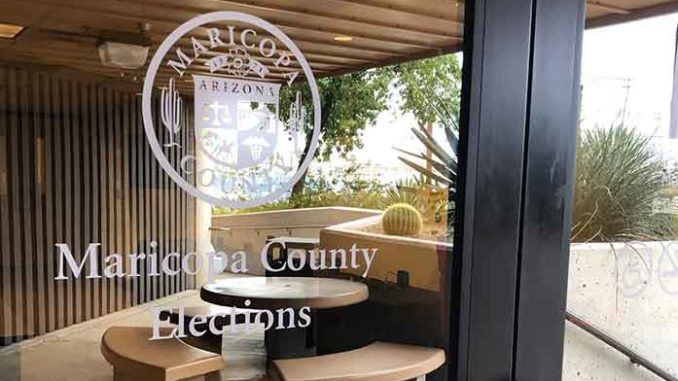
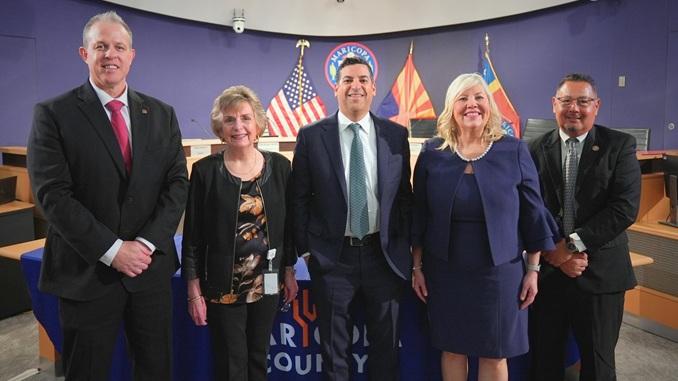
The Arizona Republican Party is picking sides in the ongoing spat between the Maricopa County Board of Supervisors and County Recorder Justin Heap.
The party’s new chair, Sergio Arellano, issued a press release on Tuesday commending Supervisor Mark Stewart for speaking out against the rest of the board for their posturing to oust Heap from office.
“I appreciate those Republicans who are able to ignore the rancor being generated by those outside the process, and who are willing to listen to the voices of those of us who want a solution that unites Republicans behind the proposition that Arizona voters deserve a process that respects their choices, and that the power of the people, exercised through their vote, prevails and is honored,” said Arellano.
Arellano advised voters to focus on the merits of policy over the noise of personal conflicts in the matter; the chair agreed with Stewart that Heap should have full restoration of elections administration duties under the Shared Services Agreement (SSA).
“Ignore the fake news and those who are intent on whipping up hysteria to further their own personal ambition, but we as a Party must deliver on real and effective reform and restore full faith in our elections,” said Arellano. “Recorder Heap must be allowed to do his job and then he must do it properly. The same goes for our County Supervisors. I am grateful to Supervisor Stewart for seeking a path that accomplishes all of this and encourage everyone involved to follow his lead and reach an agreement of which we might all be proud.”
The board ordered Heap to appear on Wednesday to provide a report and testify on his administration and allegations of voter disenfranchisement made by his office.
It is the latest escalation in the public spat between the two over who has primary control over elections via the SSA. The current SSA, all but gutting the recorder’s office of elections duties, was put in place by a “lame duck” recorder, Stephen Richer, and board majority in their final months in office. After Heap failed to convince the board to reverse course on that SSA, Heap sued last summer.
Supervisor Stewart announced on Monday that he sought outside legal counsel to negotiate with Heap over the SSA, since the board and recorder’s office appear to have hit a stalemate.
Stewart retained counsel after failing to receive a response to his request to postpone Wednesday’s meeting from Chair Kate Brophy McGee. The supervisor said all members of the board ought to have additional time to consult with counsel about negotiations with Heap.
“My counsel requires additional time to fully evaluate the issues raised, assess the scope and legal basis for the required direct report, and advise me accordingly. Proceeding before that review is complete would not allow me to participate in the discussion or any potential vote with the preparation and confidence that such a consequential action demands,” said Stewart. “Out of respect for the institution, the Recorder’s Office, and most importantly, the residents we serve, I believe it is prudent to delay consideration of this item until all members of the Board have had sufficient opportunity to consult with counsel and fully assess the implications.”
Stewart also denounced the possibility of Heap’s removal should he refuse to show on Wednesday.
AZ Free News is your #1 source for Arizona news and politics. You can send us news tips using this link.
by Staff Reporter | Feb 15, 2026 | News
By Staff Reporter |
The Maricopa County Board of Supervisors is divided on moving forward with a pathway that may result in the recorder’s removal, even with little time left before the primary election.
The board published a statement Wednesday announcing their vote requiring Recorder Justin Heap to provide a written report and sworn public testimony on February 18.
The board statement accused Heap of “lying to the public” and stonewalling the board.
“He has been unreliable. He has been unprofessional. He has been untruthful. He has been unaccountable,” read the statement. “The Board cannot responsibly set a budget, make policy decisions, or oversee county operations, including an active election in Tempe right now, without complete and truthful information from Mr. Heap.”
The board made its decision during its formal meeting on Wednesday. State law authorizes the board to require any county officer to make reports under oath concerning office duties.
The written report would address key issues identified in Chair Kate Brophy McGee’s letter to Heap last month concerning expenditures and prepayments, signature verification and curing, and the special election board and deputy registrar program.
Heap will also be required to provide the identities of the provisional voters his office said were disenfranchised; records of requests by his office for federal funds, legislative appropriations, or county funds; communications with the Maricopa County Attorney’s Office concerning the distribution of mail-in ballots to voters who didn’t request them in the 2025 special election in Congressional District 7; and records of the reassignment of the space in the Maricopa County Tabulation and Election Center from the Maricopa County Sheriff’s Office to his office.
Although the supervisors voted unanimously to impose these requirements on Heap, not all supervisors supported the official statement condemning Heap.
Supervisor Mark Stewart said the statement wasn’t approved by him. Not only that, Stewart said, but the remarks were disrespectful and potentially damaging to current negotiations with Heap.
“We are in active negotiations on the Shared Services Agreement, and my focus remains on reaching a constructive resolution that delivers results for the people we serve,” said Stewart.
Other supervisors fanned the flames of the statement.
Supervisor Debbie Lesko shared her remarks from Wednesday’s meeting, in which she said she endured over a year of frustrations with Heap. Lesko lodged multiple accusations against Heap, such as that he had something to hide.
“I feel Recorder Heap has left us no alternative,” said Lesko.
The only alternative for the board would be to continue negotiations with the recorder’s office through public discussions and the court.
This pathway by the board may lead to the largest county in the state and fourth-largest county in the nation without its elections leader with a few months left to go before elections begin. The primary election was moved up from August to July recently.
Should Heap refuse to comply with Wednesday’s order, the board may opt to remove the recorder from office with just five months to go before the primary elections.
This latest action by the board appears to be their response to the Maricopa County Superior Court striking down the board’s attempt to subpoena three staff members within Heap’s office. This court restraining order occurred within the case initiated by Heap last summer to restore elections powers to his office.
AZ Free News reached out to Heap regarding the board’s decision. As of this report, no response has been received.
AZ Free News is your #1 source for Arizona news and politics. You can send us news tips using this link.
by Staff Reporter | Feb 7, 2026 | News
By Staff Reporter |
In the latest escalation between Maricopa County leaders’ legal jockeying for elections authority, the Board of Supervisors reportedly subpoenaed staff with the Recorder’s Office.
Recorder Justin Heap issued a statement on Tuesday accusing the board of attempting “to intimidate and bully” his staff and “unduly influence” the pending court ruling. The recorder and board have been fighting for months in the Maricopa County Superior Court over who has proper authority over which elections administration powers.
“Their actions are beyond inappropriate,” said Heap. “My staff has bent over backwards to work with the Board, yet despite our earnest efforts the Board continues to engage in unhinged, emotional, and unprofessional behavior.”
Within the hour of Heap’s post, supervisor and former chair Thomas Galvin quoted Scripture that appeared to allude that the truth of the matter was beyond Heap’s remarks.
“‘And you will know the truth, and the truth will make you free.’ – John 8:32,” posted Galvin.
Galvin also shared a video from Chair Kate Brophy McGee addressing the accusations from Heap. McGee said their subpoena concerned an apparent conflict between Heap’s remarks during his annual budget request and sworn testimony on voter disenfranchisement from Heap’s staff, both of which took place last week on separate days.
“At Maricopa County, we count every lawful vote. That’s why we take any claim of disenfranchisement seriously, and have asked the Recorder’s office to provide further testimony regarding conflicting claims recently made by Recorder Heap and his staff,” said McGee. “This is an important issue and we need straight answers. If any voters are being disenfranchised, we will fix it immediately. If not, then the Recorder’s office must clarify to the court why it provided such testimony. Maricopa County voters need the truth.”
During last week’s board hearing, Heap said no voters had been disenfranchised since he took office in January 2025.
“We stated that we want this machine to make sure that we don’t disenfranchise voters. We didn’t say that any voters have been disenfranchised since I took office in the administration,” said Heap.
Two days earlier, Heap’s chief of staff, Sam Stone, issued sworn testimony in the Maricopa County Superior Court that disenfranchisement was occurring in the present.
“We had two potential places we would have made the substantial changes to one or the other to bring this in, to not disenfranchise voters, which is happening now,” said Stone.
Stone directed the court to testimony from Janine Petty, senior director of voter registration, who said disenfranchisement occurred during the 2024 election when certain provisional ballots were processed as federal-only due to time constraints even though they were voted as a full ballot.
“[Those provisional ballots] would be counted, but they would not be afforded the full ballot. So they would be duplicated by the elections board to be a federal ballot, when that voter was entitled a full ballot and voted a full ballot,” said Petty.
Heap earned a legal win on Wednesday against the board after the Maricopa County Superior Court rejected the board’s move to stop America First Legal (AFL) from representing Heap in court going forward.
AFL sued the board on behalf of Heap last summer over the contested elections administration powers, a battle stemming from a “lame duck” agreement between the outgoing recorder, Stephen Richer, and a board majority also on their way out.
AZ Free News is your #1 source for Arizona news and politics. You can send us news tips using this link.
by Jonathan Eberle | Nov 29, 2025 | News
By Jonathan Eberle |
Maricopa County officials are asking a federal judge to rein in what they describe as years of mission creep by the court-appointed monitor overseeing reforms within the Maricopa County Sheriff’s Office (MCSO), arguing that the agency has fully complied with the policy changes required under a landmark racial-profiling case.
In a new legal filing submitted last week in Sheridan v. Melendres—a case that began nearly two decades ago over civil-rights violations during traffic stops—Board of Supervisors Chairman Thomas Galvin and Vice Chair Kate Brophy McGee contend that the county has long met the terms of the court’s orders and that continued federal intervention is no longer justified.
The filing points to a central argument: since the court issued its first injunctive order, MCSO has undergone sweeping reforms, leadership changes, and years of federal scrutiny. “Since the issuance of the Court’s first injunctive order, fourteen years have passed, three new Sheriffs have taken office (from both political parties), MCSO has achieved 100% compliance with required policy changes, and there have been zero new allegations of targeted immigration enforcement by MCSO,” the document states.
At the heart of the county’s challenge is the work of federal monitor Robert Warshaw, who has overseen MCSO’s compliance efforts for nearly 15 years. According to the filing, Warshaw and his team have collected more than $30 million in fees during that time. County leaders say they have been increasingly frustrated with what they describe as an expansion of Warshaw’s role—particularly his recent “audit” of county spending related to the case. They argue that federal oversight was intended to ensure constitutional policing practices, not to scrutinize local budgeting decisions.
“In today’s legal filing, we highlight how far the federal monitor has strayed from his original charge,” Galvin and Brophy McGee wrote in a joint statement. “Digging into county finances and trying to minimize the cost of Melendres compliance is not just an insult to taxpayers, it’s beyond the federal court’s jurisdiction.”
County attorneys note that nothing in the county’s budgeting practices violates state or federal law. For that reason, the Board says it will not participate in further disputes over compliance-related costs. The county’s brief argues that questions about staffing, budgets, and administrative costs fall squarely within local authority. Citing Supreme Court precedent, the filing asserts that “federal-court decrees must directly address and relate to the constitutional violation itself.”
The county maintains that because MCSO has reached full compliance with all policy reforms stemming from the Melendres orders—including the creation of 209 positions tied directly to those requirements—the original purpose of the decree has been fulfilled. “It would be a complete waste of taxpayer money to engage the federal courts in a back-and-forth over what is clearly an issue of local jurisdiction,” the statement reads.
Galvin and Brophy McGee say the Board’s priority is protecting taxpayers and ensuring resources are directed toward public safety needs determined at the local level. The Board of Supervisors represents roughly 4.5 million residents. “We’ll keep standing up for transparency, common sense, and your right to self-govern,” they wrote.
The federal court will now determine whether the county’s arguments warrant narrowing or ending the monitor’s authority—a decision that could significantly reshape the long-running oversight of one of the nation’s most closely watched law-enforcement reform cases.
Jonathan Eberle is a reporter for AZ Free News. You can send him news tips using this link.
by Matthew Holloway | Sep 14, 2025 | Education, News
By Matthew Holloway |
A dozen Maricopa County libraries have removed more than 50 books on sex education and puberty from their children’s sections. The move follows complaints from parents and advocacy groups who said the books contained inappropriate material.
As previously reported by AZ Free News, the Maricopa County Library District (MCLD) has been subject to increasing criticism from parents’ rights advocates like Arizona Women of Action (AZWOA) and EZAZ, who engaged with the Maricopa County Board of Supervisors (BOS) in June. The groups objected to books such as “It’s Perfectly Normal” by Robie H. Harris and “This Book Is Gay” by Juno Dawson for the titles’ graphic depictions of sex and sexual behavior.
Responding to a petition launched by AZWOA, the BOS approved a pilot program at the Queen Creek Library, allowing parents to submit a form listing books their children may not check out.
According to AZCentral, the Board later directed the books to be relocated in response to the concerns brought to them. Due to the administrative nature of the move, a formal vote was not required. Supervisor Steve Gallardo, the board’s only Democrat, expressed objections to the outlet, saying, “Call it whatever you want … it’s wrong, and we shouldn’t be engaging in this.” Gallardo claimed that although he “agreed with some of the changes,” parents should be responsible for monitoring their children in the libraries.
Republican Supervisors Lesko, Stewart, and Brophy McGee supported the measure fully, stating that the measure is intended to:
- “Protect our youngest from their prying eyes and curiosity,” per Stewart.
- “Relocate questionable books into areas of the library that are less, or not, accessible to children,” according to Brophy-McGee.
- “Make sure that sexually explicit library books are out of the reach of minors,” as described by Lesko.
As reported by the Arizona Daily Independent, several books were brought to the BOS’s attention, though the complete list of inappropriate books is extensive. The AZWOA referred to a book rating site, ratedbooks.org, as well as a book list on Scottsdaleunites.com.
Merissa Hamilton of EZAZ later posted a list of egregious books found on MCLD shelves. Highlighted titles include “It’s Perfectly Normal: Changing Bodies, Growing Up, Sex, and Sexual Health” by Robie H. Harris, which features cartoon-like drawings with sexually graphic information. “This Book Is Gay” by Juno Dawson is also in question because it instructs children on how to engage in meetups for casual sexual encounters. Novels by Ellen Hopkins graphically depict sex, human trafficking, and abuse. These books may violate state statutes, including ARS 13-3506:
“It is unlawful for any person, with knowledge of the character of the item involved, to recklessly furnish, present, provide, make available, give, lend, show, advertise, or distribute to minors any item that is harmful to minors. C. A violation of this section is a Class 4 felony.”
These library books may also violate ARS 13-3507:
“A. It is unlawful for any person knowingly to place explicit sexual material upon public display or knowingly to fail to take prompt action to remove such a display from property in his possession or under his control after learning of its existence. B. A person who violates any provision of this section is a Class 6 felony.
The potential prompted citizens to consider bringing these books to the attention of the county’s sheriff and attorney’s offices.
County Manager Jen Pokorski told Republic reporters in June that the county is contemplating a new rule, a new “software solution” which would permit parents to restrict their children’s access to different books by category.
“I think the goal of the new software would be, the books that we’ve deemed — or that have illustrative pornography, will be off limits to children under a certain age,” Supervisor Mark Stewart explained. “And then anything that a parent would want to opt their child into, they’re welcome to sign up and do that.”
However, he did clarify, to the Arizona Republic, “I did not say that sex-ed books are illustrative pornography.”
Matthew Holloway is a senior reporter for AZ Free News. Follow him on X for his latest stories, or email tips to Matthew@azfreenews.com.