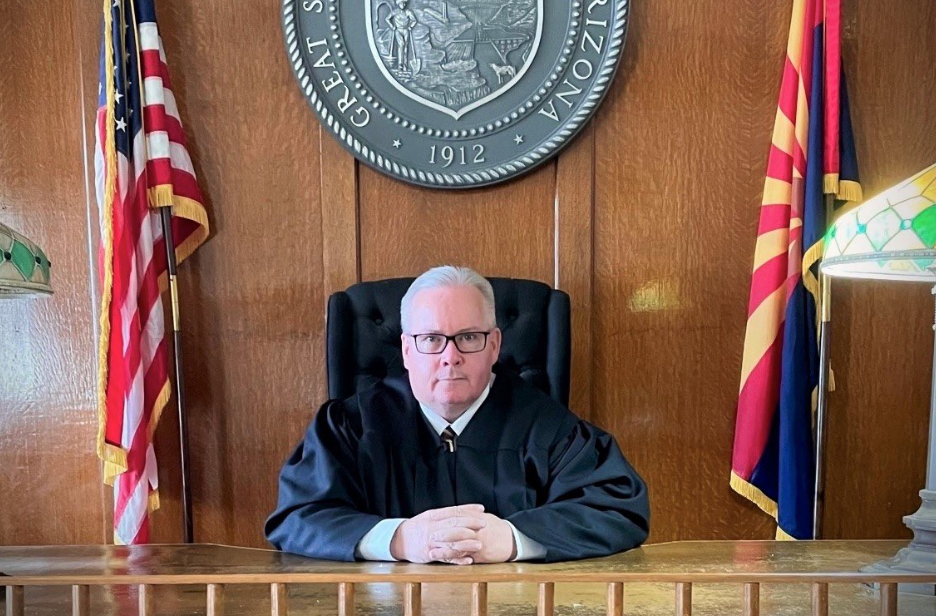
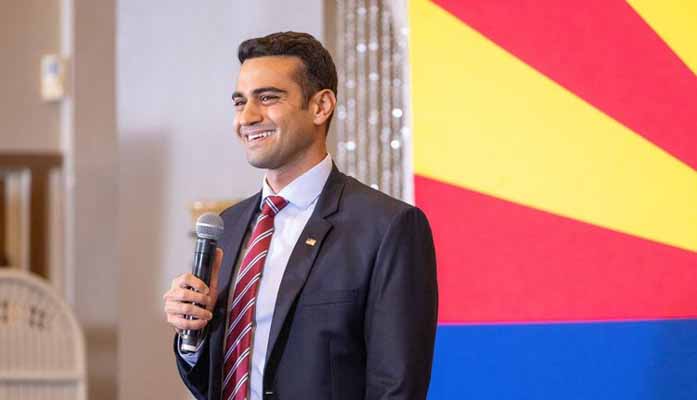
Republicans are hoping to field a candidate against Mohave County Superior Court Judge Lee Jantzen should he decide to run for re-election in 2026. Jantzen, who presided over the 2022 Arizona Attorney General election challenge by now-Congressman Abe Hamadeh, was accused in that case of gross incompetence by lawyers on both sides of the political aisle.
“Lee Jantzen reached levels of incompetence that I honestly did not know were possible,” tweeted Brian Anderson, a Republican influencer and owner of Saguaro Group. “Kept ‘forgetting’ to issue rulings, then ‘forgot’ to sign the rulings, then ‘accidentally’ labeled the AG race as the SOS race, etc. Historic miscarriage of justice.”
Lee Jantzen reached levels of incompetence that I honestly did not know were possible.
Kept "forgetting" to issue rulings, then "forgot" to sign the rulings, then "accidentally" labeled the AG race as the SOS race, etc.
In 2023, after a series of serious missteps, attorneys on both sides of Hamadeh’s election contest discovered that Jantzen signed what should have been a final order, but left matters pending, resulting in an “unfinal” final order. The judge’s failure delayed final judgment, leaving Hamadeh without the opportunity to file an appeal on the denial by Jantzen for a new trial.
At that time, Mohave County residents reached out to the Arizona Daily Independent, telling the outlet that they were “embarrassed and frustrated by the continued missteps by Judge Jantzen. Residents are concerned about Judge Jantzen’s history of malfeasance and how his conduct in this case could indicate issues with other more routine cases that he presides over.”
An X account operated by supporters of Congressman Hamadeh weighed in on the discussion started by Mohave County Republicans last week, asking:
“Do we have any brave attorneys in Mohave County who want to run to become a judge in Superior Court? ‘Judge’ Jantzen, who inexplicably ruled against @AbrahamHamadeh’s election lawsuit WITHOUT considering the evidence is up for election again in 2026. He helped disenfranchise THOUSANDS of voters. We have to uproot the corruption in Arizona. We can start with this judge.”
Jantzen’s repeated mistakes left court watchers wondering if he was intentionally slow walking the case, saying that it created an increased air of distrust in both the judicial system and the electoral process.
That distrust of the judicial system only worsened when nine months to the day after Jantzen denied Hamadeh’s election challenge did the Arizona Supreme Court issue an order to Jantzen to do his job “forthwith” and sign-off on two overdue judgments in the case, one of which dated back to Dec. 23, 2022.
Hamadeh’s case was not the first time Jantzen ran afoul of the Arizona Supreme Court. According to public records obtained by the Arizona Daily Independent through Hamadeh’s attorney, Jen Wright, Jantzen stipulated in May 2018 to a censure by the Arizona Supreme Court for “misconduct in office” following an investigation that showed the judge missed the 60-day deadline by more than one year.
Jantzen, who became a superior court judge for Mohave County in 2009, acknowledged as part of the censure that “he has previously received a warning from the Commission for similar misconduct involving a delayed ruling.”
He was also reprimanded in 2021 for the same problem.
A censure is one step down from a suspension and one step above a public reprimand. A censure can be imposed by the Arizona Supreme Court while a reprimand can be imposed by the Court or the Court’s Commission on Judicial Conduct (CJC).
The Arizona Judicial Branch has two check-and-balance systems in place in an attempt to guard against judges accidentally or intentionally ignoring the 60-day deadline.
“The 2018 censure noted Jantzen had, from June 2015 to September 2017, falsely signed statements pursuant to ARS 12-128.01 by certifying he had no matters outstanding more than 60 days,” according to the Arizona Daily Independent. “Jantzen’s 2021 Reprimand Order shows the judge signed his March 2020 payroll certification with a notation that a ruling in a 2020 case was overdue. The ruling was finally issued at 78 days.”
AZ Free News is your #1 source for Arizona news and politics. You can send us news tips using this link.
Republican attorney general challenger Abe Hamadeh has yet to receive a ruling, a month after Mohave County Superior Court Judge Lee Jantzen promised one. The delay aligns with the judge’s history of tardiness on issuing rulings.
Hamadeh argued for a new trial in mid-May. At the time, Jantzen said he had a specific date in mind to issue a ruling, which he didn’t disclose, but promised to issue a ruling in several weeks’ time. That would’ve meant a ruling at some point near the end of May, possibly early June. It’s nearly July now.
Jantzen has been disciplined twice for failing to issue rulings on time.
In 2018, Jantzen was censured for violating the Code of Judicial Conduct, after failing to rule on an individual’s petition for post-conviction relief for over two years. Over those two years, Jantzen falsely certified on multiple payroll statements that he had no matters under submission that were pending and undetermined for over 60 days.
At some point prior to that punishment, Jantzen received a warning from the Commission on Judicial Conduct for similar misconduct involving a delayed ruling.
In 2021, Jantzen was again publicly reprimanded for failing to issue a ruling within 30 days as promised. He ended up issuing the ruling after 79 days. During that time, Jantzen again signed a payroll certification falsely claiming that he had no tardy matters under submission pending and undetermined.
Hamadeh trails Attorney General Kris Mayes by 280 votes: a fraction of the original 511 vote lead Mayes had prior to the recount. During oral arguments for a new trial in May, Hamadeh argued for the favorable existence of hundreds of “lost” uncounted votes — or, undervotes — and provisional ballots.
Incompetent election officials and those who protect them have attacked democracy. pic.twitter.com/P1AXJWs1NB
There were over 9,000 provisional votes that weren’t included in the final count. About 70 percent of Election Day voters were in favor of Hamadeh. Based on that scale, Hamadeh could have more than enough votes to surpass Mayes.
Provisional vote totals took as long as they did to discover due to a delay in response from the counties, according to Hamadeh. The disjunctive information flow between the government and the public is one of the warranting factors for a new trial, per Hamadeh.
“We have to get information from 15 different government agencies, and it’s complicated,” said Hamadeh. “I wish we had access to the information that the government has. That’s why we’re asking for a new trial.”
Democracy requires ACCURACY and ACCOUNTABILITY.
The amount of discrepancies in the November 2022 election is unacceptable. There are still over 9,000 uncounted ballots. Count the votes. https://t.co/AZyJ6x9WQ9
During the oral arguments, Mayes’ team focused on the amount of time that has passed since last fall’s election and her swearing in. Hamadeh has dismissed that claim. He argues that the Arizona Constitution’s absolute statement that the candidate with the most votes wins the election trumps any statutory timelines set by legislatures.
Of note, Mayes’ counsel never staked the claim that Mayes obtained the most votes. Conversely, Hamadeh’s team took every opportunity to present samples of evidence of uncounted, existing votes. The merits of these claims went uncontested by Mayes’ team.
Corinne Murdock is a reporter for AZ Free News. Follow her latest on Twitter, or email tips to corinne@azfreenews.com.
Abe Hamadeh argued for a new trial on Tuesday before the Mohave County Superior Court.
The judge, Lee Jantzen, seemed interested in sampling the evidence presented by Hamadeh’s team in the case, Boyd v. Mayes, despite multiple objections from opposition. Arguments presented by the opposition — the attorney general, secretary of state, and Maricopa and Pima counties — mainly focused on the amount of time that’s transpired since the election and Hamadeh’s December trial. Arguments presented by Hamadeh’s team focused on evidence of allegedly disenfranchised voters, claiming that hundreds of “lost” (uncounted) votes from undervotes and provisional ballots proved that Hamadeh won the race.
Lawyers present for the oral arguments included former assistant attorney general Jen Wright, State Rep. Alex Kolodin (R-LD03), and James Sabalos for Hamadeh; Alexis Danneman and Paul Eckstein for Attorney General Kris Mayes; Craig Morgan for Secretary of State Adrian Fontes; Daniel Jurkowitz for Pima County; and Joseph La Rue for Maricopa County.
Sabalos opened up the oral arguments, quoting Thomas Jefferson and summarizing general discoveries in the course of their months-long review of voter data as a precursor to Wright’s arguments.
“We do not have a government by the majority; we have a government by the majority who vote,” quoted Sabalos.
Sabalos insisted their case wasn’t about fraud, but about the evidence and facts supporting the reality of Hamadeh as the winner of last November’s election contest. He claimed that Gov. Katie Hobbs, in her former capacity as secretary of state, was aware of and neglected to immediately publicize 63 Pinal County undervotes that lent to Hamadeh’s claims last December of lost votes.
Sabalos said this intentional concealment of facts served to handicap their team’s due diligence of reviewing election data for the courts. Sabalos further claimed that there were 76,339 votes counted as undervotes in the attorney general’s contest. Of the approximately 2,000 ballots they inspected, 14 were misread (.61 percent). With that percentage applied to the larger total of undervotes statewide, Sabalos said that amounted to 466 or more votes — more than the 288-vote lead Mayes holds over Hamadeh.
Sabalos then claimed that there were uncounted provisional ballots that constituted legal votes, and that the majority of those would’ve turned in favor of Hamadeh.
“We don’t come today with hyperbole or speculation. We come with some reasonably solid evidence, and we need a heck of a lot more for this judge and this court to get its hands around,” said Sabalos.
Wright followed up Sabalos’ arguments by first focusing on Hobbs. She said that Hobbs didn’t fulfill her duty of being a neutral, nominal party, since Hobbs argued heavily that Hamadeh had no evidence to support his claims, while allegedly knowing of the dozens of undervotes recovered during the recount, and pushed for his case to be dismissed. Wright further noted that Maricopa County Elections Director Scott Jarrett admitted during the December trial that he wasn’t sure why certain votes weren’t counted, and instead counted as undervotes.
Wright expanded on Sabalos’ claim of the 63 undervotes, noting that they were counted as valid during the recount. Wright asserted that Hobbs knew of this fact, which she said rendered Hamadeh’s claims during the December trial valid. Wright also dismissed Hobbs’ claim that she was under an order preventing her from disclosing the undervotes, since the order only applied to counties discussing the recount results from vote totals. Wright claimed that the judge would’ve permitted Hamadeh a review of the evidence had Hobbs been forthright all those months ago.
“I find it questionable that a government agent would take support of or opposition to a candidate in an election contest,” said Wright.
Wright further noted that Hamadeh was unable to obtain the provisional ballot data from Maricopa County until days after the trial occurred, further hindering his ability to meet statutory deadlines.
When Wright attempted to discuss the evidentiary numbers on undervotes, both Mayes and Fontes’ legal teams raised objections. The judge overruled their objections, however.
Wright claimed that their team interviewed hundreds of high-propensity voters affected by statewide computer system changes, which allegedly altered their registration address without their consent and therefore deprived them of the right to vote. She claimed that over 1,100 Election Day provisional voters were disenfranchised.
Election Day votes went overwhelmingly for Hamadeh: over 69 percent to nearly 29 percent for Mayes. Wright said that this would mean about 760 of provisional ballots would be for Hamadeh, and 316 for Mayes. By Wright’s math, Hamadeh would prevail on the provisional ballot issue alone by 165 votes.
Wright further noted that their team had collected sworn affidavits of hundreds of voters claiming disenfranchisement due to bureaucratic failures. When she attempted to read the account of one allegedly disenfranchised voter, Mayes’ team raised an objection. The judge promptly overruled.
The allegedly disenfranchised Maricopa County voter, Marlena, attempted to vote on Election Day but was denied. Marlena had reportedly experienced issues with the county’s registration system for months: earlier that year, she discovered that her registration had changed without her knowledge and consent. Wright presented evidence that on October 10, 2022, Marlena attempted to correct her voter registration before the deadline. Wright also presented evidence from Maricopa County confirming Marlena’s registration. Yet, she was denied on Election Day.
Danneman, Mayes’ lawyer, said Hamadeh’s claims were speculative and based on unsworn opinions. She emphasized repeatedly the timeliness of his contest, noting that it has been over five months since the December trial and that their team could only present an argument that they needed more time to look for votes.
Danneman further rejected the argument that Hamadeh should be granted a new trial to undertake further investigation. She said that evidence must be material, in existence at the time of trial, and not be discovered with reasonable diligence.
She added that Hamadeh’s request for a more complete ballot inspection proved there wasn’t any newly-discovered evidence warranting a new trial.
The provisional voters list didn’t hold much weight in Danneman’s view. She claimed Hamadeh was undertaking a “fishing expedition” for evidence, which she pointed out was prohibited by court precedent.
“This list of names proves nothing,” said Danneman. “The plaintiffs had their day in court.”
Morgan, with Fontes, added that it was “long past time” for this election contest to end. He said that Hamadeh’s challenge impugns the validity of election processes as well as the integrity of election officials.
La Rue with Maricopa County concurred. Jurkowitz with Pima County argued further that statute time bars any further contest.
Following the hearing, Hamadeh expressed optimism that the oral arguments ultimately were in his favor.
A judge in Mohave County is expected to rule by noon on Monday whether Arizonans could lose their ability to vote by mail without providing an excuse.
Judge Lee Jantzen is being asked by the Arizona Republican Party and its chair, Kelli Ward, to declare the state’s no-excuse voting by mail “system” unconstitutional despite the fact the system has been in effect for three decades. The judge heard arguments last Friday to issue a preliminary injunction to ban no-excuse voting by mail effective with the upcoming Nov. 8 General Election.
About 85 percent of all ballots cast in the 2020 General Election—including Ward’s ballot—were mailed out to voters in advance of the election. But the AZGOP contends the law passed by the Legislature in 1991 violates the constitutional requirement that Arizona’s elections be held in such a way to ensure “secrecy in voting.”
The lawsuit argues the only ballots which should be accepted through the mail are those from voters who provide a satisfactory excuse—such as military service, a disability that makes it a burden to vote in person, or being out of town on Election Day.
(The AZGOP acknowledged in their May 17 lawsuit that there is not enough time to outlaw no-excuse voting for the Aug. 2 Primary Election as ballots are in the process of being printed so they can be in voters’ mailboxes in early July.).
Attorneys for Arizona Secretary of State Katie Hobbs and several county election officials argued to Jantzen that there is nothing unconstitutional with Arizona’s no-excuse voting by mail system. They also advised the judge of the practical problems with trying to ban a practice after 30 years without much advance notice to voters and those responsible for running each county’s elections.
One such problem involves the Active Early Voter List, from which ballots are sent to voters who have signed up to receive them by mail. Those voters recently received a reminder notice from their respective county recorder with the 2022 election schedule and confirming the voters will receive ballots by mail for the primary and general elections.
The AZGOP argued to Jantzen that counties can be forced to accommodate changes in time for the General Election, even if it requires hiring thousands more poll workers and election staff across the state, scrounging to find enough voting machines and other election-related equipment, and locating facilities which can accommodate millions more in-person voters than have turned out in years.
That argument was pushed back on during Friday’s hearing by an attorney for seven of Arizona’s 15 county recorders responsible for the voting by mail process and county election directors who are responsible for election day voting and ballot tabulation.
“They cannot conjure polling places or poll workers out of nothing,” Karen Hartman-Tellez of the Maricopa County Attorney’s Office told Jantzen.
Whatever order Jantzen issues in response to the AZGOP’s preliminary injunction request is likely to be appealed. But even if no-excuse voting by mail is allowed to take place this year, the AZGOP’s constitutional challenge does not die.
Instead, the litigation will move forward to a trial under civil court rules, same as any other lawsuit.