by Matthew Holloway | Jul 13, 2025 | News
By Matthew Holloway |
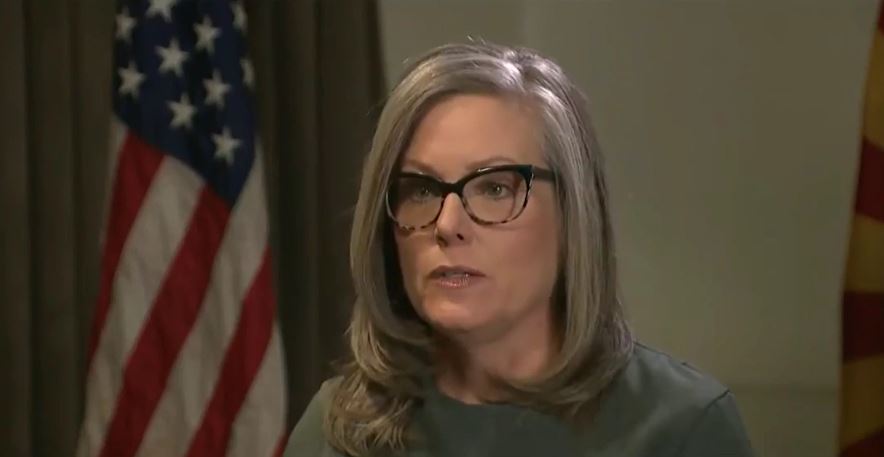
Arizona’s Democrat Governor Katie Hobbs is facing a new round of severe criticism and wide condemnation. On July 9th, reports surfaced that Hobbs nominated her Democrat ally and failed District 17 legislative candidate Dana Allmond for a role in the Department of Veterans’ Services. Hobbs then pulled back the nomination and appointed Allmond to a newly created post with a $170,000 annual salary and a $114,000 annual contract for her assistant, Marcus Trombetta.
Arizona Senator Jake Hoffman (R-LD15) released a scathing statement posted to X on Wednesday writing, “Katie Hobbs nominated fellow Dem politician, Dana Allmond, for a cushy gov’t job. Then Katie DEMOTED her. Then Katie invented a job that’s never existed before for her. Then Katie paid her & her asst. nearly $600,000 of YOUR money!
“FULL STATEMENT: Katie Hobbs’ jaw-dropping nearly $600,000 handout of taxpayer money to a former Democrat politician and her assistant for newly invented jobs reeks of corruption.
“It’s sickening that Hobbs continues to treat Arizona’s government like her personal friends-and-family slush fund, doling out lavish six-figure salaries to political cronies.
“With Hobbs it’s clear, when she’s not entangled in pay-to-play schemes, she’s plundering Arizonans’ hard-earned dollars as if they’re her own personal piggy bank.”
Hoffman’s statement aligns well with reporting from the Arizona Capitol Times, which was confirmed by the Department of Economic Security. Per the Times, after her replacement as nominee for head of the Department of Veterans’ Services with John F. Scott II in April, Hobbs reportedly created the role of “senior executive consultant” for Allmond and promptly renewed her state contract.
Hobbs’ press aide Christian Slater told the outlet that Allmond is part of the DES “senior engagement team” in her new role and will be tasked with helping Arizona veterans access DES services. The move follows a 5% reduction in force at the Department of Economic Security, owing to the Governor’s failure to adjust the budget for reduced federal grants.
According to the Times, the terminated staffers at DES received their 2 ½ weeks’ notice just days after Allmond’s new contract became effective.
In a statement, Slater dismissed any connection and attempted to shift blame to the federal budget cuts driven by the Trump administration, ignoring that Hobbs and Democrat legislators had ample opportunity to work with GOP leaders to account for the difference.
“The workforce reduction at DES was an unfortunate consequence of the Trump administration’s reckless cuts that endanger DES’s work to combat fraud and efficiently deliver the critical services Arizonans rely on,” Slater claimed.
As previously reported by AZ Free News, Republican legislative leaders have questioned the apparent duplication of duties between the new DES “senior executive consultant,” and the Department of Veterans’ Services existing responsibilities.
Earlier in the year, Sen. Hoffman challenged DES Director Michael Wisehart before the Committee on Director Nominations. Per the Times, Wisehart didn’t refute that the role duplicates the responsibilities but answered that Allmond would help connect veterans with needed services, noting that DES also has programs that work with veterans.
A blistering article issued by the Arizona Free Enterprise Club, dating back to March 2024, has also shown that the new role for Allmond is only the most recent in a series of controversial new jobs created by Governor Hobbs. According to the article, at that time, Hobbs had created forty new roles including: six people working in the Office of Resiliency, four new employees in the Office of Tribal Relations, and three new in-house attorneys.
Matthew Holloway is a senior reporter for AZ Free News. Follow him on X for his latest stories, or email tips to Matthew@azfreenews.com.
by Jonathan Eberle | Jul 10, 2025 | News
By Jonathan Eberle |
Sixteen months before the 2026 General Election, Arizona voters already know at least three ballot measures they’ll be weighing come November. Referred to the ballot by state lawmakers during the most recent legislative session, the proposals span issues of taxation, public safety, and individual privacy.
If passed, each measure would amend the Arizona Constitution — changes that can only be undone by future statewide votes. And these early additions may just be the beginning of what’s shaping up to be another crowded ballot.
In 2024, the number of voter questions was so high that some Arizona counties resorted to printing two-sheet ballots, prompting widespread voter complaints about ballot length. With dozens of potential referrals still under consideration, the 2026 ballot may once again test voters’ patience and attention spans.
Here’s a closer look at the three measures already set for the 2026 ballot:
1. Local Food Taxes Face New Restrictions
Sponsored by Rep. Leo Biasiucci (R–LD30), House Concurrent Resolution 2021 seeks to limit the ability of local governments to impose taxes on groceries.
If approved, the measure would require cities, towns, or counties to obtain voter approval before creating or increasing a tax on food. Currently, local governments can make that decision without direct input from the electorate.
The measure would also impose a temporary moratorium on any food tax hikes until June 30, 2027.
Proponents argue the change would make groceries more affordable during a time of rising costs. Local officials, however, warn it could impact critical revenue for municipal services.
The proposal passed with bipartisan support.
2. Ban on Mileage-Based Vehicle Taxes
Senate Concurrent Resolution 1004, sponsored by Sen. Jake Hoffman (R–LD15), would preemptively ban any tax or fee based on the number of miles a vehicle travels on Arizona roadways.
While Arizona does not currently impose such a tax, Hoffman and supporters argue the measure is necessary to protect personal freedom and prevent government overreach.
“There is nothing more insidious than the government trying to limit or control their citizens’ freedom,” Hoffman said earlier this year.
Mileage-based taxes have been explored in other states, like Oregon and Utah, as a way to replace declining fuel tax revenues and reduce pollution. Environmental advocates in Arizona, including the Sierra Club, support such measures as a means of curbing emissions and promoting sustainable transportation.
The resolution passed along party lines, with Republicans in favor and most Democrats opposed or absent.
3. Designating Cartels as Terrorist Organizations
In one of the final acts of the 2025 legislative session, lawmakers approved House Concurrent Resolution 2055, which seeks to classify drug cartels as terrorist organizations under Arizona law.
Introduced by House Speaker Steve Montenegro (R–LD29), the measure would direct the state’s Department of Homeland Security to take all possible actions within its authority to counteract cartel activity.
Supporters say it complements Proposition 314, a 2024 ballot measure that authorized Arizona to enforce its own border security measures — though that law remains on hold pending the outcome of a related Texas lawsuit.
These early measures may just scratch the surface. Dozens of proposed ballot referrals were introduced during this year’s session, and lawmakers still have the 2026 legislative calendar to revive stalled proposals or introduce new ones.
As Arizona continues its tradition of robust direct democracy, election officials may once again find themselves preparing for a complex and lengthy ballot — and voters will need to prepare for an equally complex decision-making process at the polls.
Jonathan Eberle is a reporter for AZ Free News. You can send him news tips using this link.
by Jonathan Eberle | Jun 22, 2025 | News
By Jonathan Eberle |
A scheduled confirmation hearing for Karen Lee Peters, Governor Katie Hobbs’ nominee to lead the Arizona Department of Environmental Quality (ADEQ), was abruptly postponed on Wednesday by the Senate Director Nominations Committee.
Committee Chair Sen. Jake Hoffman (R-Queen Creek) announced the delay just hours before the hearing was set to begin, citing unresolved questions about certain aspects of Peters’ background that surfaced during the vetting process.
“Based on possible discrepancies with information relating to items we vetted, further clarification is necessary prior to holding Ms. Peters’ confirmation hearing,” Hoffman said in a written statement. He did not specify the nature of the discrepancies, nor whether they pertained to Peters’ previous professional experience or policy positions.
The postponement also came as the Arizona Senate worked to advance the state budget, which Hoffman noted was straining staff capacity.
“Given the Senate attempting to move the state budget today, our staff is stretched thin, and it is best to simply table the nomination for now,” Hoffman said. “I have communicated to Hobbs’ staff that we will reschedule her hearing soon.”
Peters’ confirmation is one of several being closely watched, as the Republican-controlled Senate continues to scrutinize the Democratic governor’s nominees for key state agencies.
Jonathan Eberle is a reporter for AZ Free News. You can send him news tips using this link.
by AZ Free Enterprise Club | Jun 21, 2025 | Opinion
By the Arizona Free Enterprise Club |
Around the country, the “war on cars” has become apparent. From New York’s congestion pricing scheme to the onslaught of road diets and protected bike lanes to “reallocate” the public space away from cars, there is hardly anywhere you can travel without experiencing the increased hassle and cost of driving your personal vehicle.
Despite the Trump administration’s efforts to reverse the woke transportation trends at the U.S. Department of Transportation under former Secretary Pete Buttigieg, many state and city governments remain committed to punishing drivers.
One specific tool being used to implement the anti-car, woke transportation agenda is vehicle mileage limits and taxes. For example, in Washington State, they passed a law that sets a target of reducing vehicle miles traveled per capita by 50% by 2050. Their department of transportation is empowered to create policies and strategies that would effectively force people to give up their cars. And of course, for our neighbors to the West, California lawmakers have proposed a mileage tax or “road charge” determined by how many miles a person drives in an effort to reduce carbon emissions and endlessly subsidize their failed transit system. Implementing this would require invasive measures such as reporting odometer readings or installing “special plug-in devices.” This kind of Orwellian intrusion on our freedom to travel privately has no place in any American city, even in California…
>>> CONTINUE READING >>>
by Jonathan Eberle | Jun 16, 2025 | News
By Jonathan Eberle |
The Arizona House of Representatives passed a structurally balanced, conservative budget on Thursday, advancing a financial plan that focuses on strengthening public safety, reducing costs for families, and increasing government accountability.
Speaker Steve Montenegro (R-LD29) called the budget a reflection of voter priorities. “This budget delivers safe communities, strong families, and a government that works for the people — not the other way around,” he said. “It cuts tuition, raises pay for law enforcement, fixes critical roads, and reins in waste — all without raising taxes.”
Key components of the budget include a 5% pay raise for Department of Public Safety and corrections officers, $94 million for repairs to major highway infrastructure, and a 2.5% in-state university tuition reduction alongside a freeze for the subsequent two years. The budget also fully funds school choice programs and clears a backlog of Empowerment Scholarship Account applications.
Additional funding is designated to keep voter rolls accurate and up to date, fully fund payments for parents acting as caregivers, and provide developmental disability services. An expanded adoption tax deduction is also included.
“The House-passed budget puts the House Majority Plan into action,” Majority Leader Michael Carbone said. “We’re protecting opportunity by lowering costs for students and parents. We’re backing public safety with strong support for our law enforcement officers. And we’re holding government accountable by cutting waste and demanding better results — this is the kind of leadership Arizona voters asked for.”
Speaker Pro Tempore Neal Carter stressed the budget’s potential for boosting small business. “The House-passed budget gives long-overdue relief to Arizona’s small businesses by eliminating the administratively burdensome business personal property tax under the $500,000 threshold,” Carter said. “This helps local job creators grow, hire, and invest in their communities — and makes Arizona a more competitive place to do business.”
The budget package — HB2945 through HB2961 — now moves to the Senate for consideration.
Jonathan Eberle is a reporter for AZ Free News. You can send him news tips using this link.