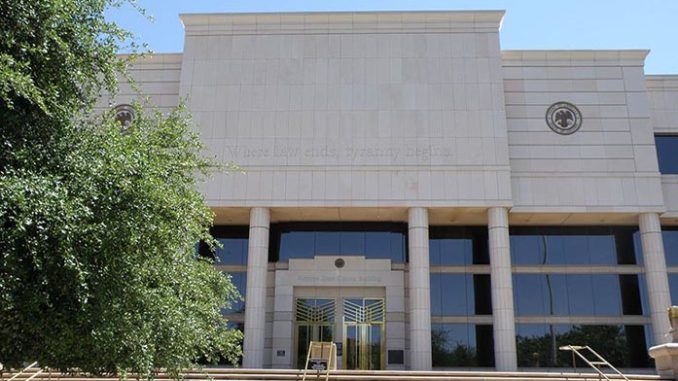
Arizona GOP leaders are in court defending three abortion restrictions they say protect women and deter coercion after Attorney General Kris Mayes declined to defend the state laws. The Plaintiffs, supported by the Center for Reproductive Rights, argue that the statutes defy the 2024 constitutional amendment legalizing abortion up to fetal viability.
The lawsuit, Isaacson v. Arizona, was filed in May 2025 by Phoenix obstetrician-gynecologist Dr. Paul Isaacson, a Proposition 139 supporter. Isaacson was joined by Dr. William Richardson and the Arizona Medical Association in the lawsuit, which challenges:
A “reason ban” barring abortions based solely on fetal abnormalities (non-lethal or otherwise), gender, or race.
A “two-visit requirement” requiring a second clinic visit and 24-hour delay after viewing an ultrasound.
A telehealth ban prohibiting diagnosis, prescription, or mailing of abortion medication via phone or video.
Isaacson dropped a related federal case in April 2025 to advance this state challenge and was joined by the Arizona Medical Association and two other OB-GYNs.
Senate President Warren Petersen and House Speaker Steve Montenegro intervened to defend the laws, represented by attorney Emily Gould of Holtzman Vogel, after AG Kris Mayes declined to defend them, according to KJZZ. In June 2023, Governor Hobbs signed an executive order centralizing abortion-related prosecutions in the Attorney General’s office, a move Mayes said underscores their shared commitment to “fight … to protect the rights of Arizonans to make their own private medical decisions without interference.”
The case is before Judge Greg Como in Maricopa County Superior Court, who denied a motion for dismissal from Petersen and Montenegro, and ordered a three-day evidentiary hearing to explore the laws’ impact on abortion in Arizona.
Defendants’ witness, Phoenix OB-GYN Dr. Steven Nelson—who manages miscarriage care but has not performed abortions—backed the telehealth ban, stressing in-person exams detect coercion via nonverbal cues like facial expressions in trafficking scenarios. Gould, representing Petersen and Montenegro, cited American College of Obstetricians and Gynecologists data and argued that at least 10% of abortion patients later report coercion. Nelson urged limiting telehealth to emergencies, as it “prohibits all of this,” and said he would provide such services only in the most dire cases.
Plaintiffs’ Wednesday witnesses—including Isaacson and experts from the Center for Reproductive Rights and ACLU—argued the laws burden low-income and rural patients with over two-hour drives and confidentiality risks in abusive settings. They argued that pre-abortion ultrasounds are unnecessary for early dating with reliable menstrual tracking. Experts clashed on the 24-hour delay’s health value, with one testifying that it undermines women’s autonomy and timely care.
Isaacson claimed the restrictions “create unnecessary barriers to essential reproductive health care,” echoing concerns from the Arizona Medical Association about access for vulnerable groups.
On ultrasounds, Nelson countered these arguments and described them as “essential to dating” pregnancies, estimating 60% of patients misjudge gestational age due to implantation bleeding. He noted ultrasounds pinpoint asymptomatic ectopic pregnancies, often undetected until seven weeks, requiring specific interventions. Nelson suggested local physicians could handle initial visits to ease rural travel burdens.
On day two of the hearing on Thursday, Judge Como indicated he may treat the record as sufficient for a permanent injunction, with closing arguments pending, according to Courthouse News. The hearing was set to continue on Friday, but as of Monday, no additional information was publicly available regarding the case.
This week, Arizona Senate President Warren Petersen delivered a clear message: Arizona will not stand by while abortion providers try to dismantle the protections that defend women and children in our state. At the center of the lawsuit Isaacson v. Arizona is a basic truth: our laws were written to protect the vulnerable, not to support the bottom line of the abortion industry.
President Petersen made it plain that this case is about one fundamental question: will women keep their right to informed consent before an abortion? In every other area of medicine, informed consent is a non-negotiable standard of care. Women deserve the right to know their medical situation fully, to see an ultrasound, and to hear their baby’s heartbeat before making a life-altering decision. To deny them that right is not empowerment, it is exploitation.
But the stakes go even further. Arizona’s Prenatal Non-Discrimination Act makes it illegal to end a child’s life simply because of their race, sex, or disability. Just as America rejected slavery and other injustices that denied whole classes of people their humanity, we must not allow a new form of discrimination to take root in the womb. Every life has value, and no child should be targeted for elimination simply for who they are.
President Petersen is a champion for life, and he is willing to speak on hard truths and act to defend laws that reflect the dignity of every human being. His courage stands in sharp contrast to our current Attorney General Kris Mayes, who has made “reproductive rights” one of her central causes and even gone so far as to file consumer fraud reports against pregnancy resource centers that offer help and hope to women.
As Petersen runs to be Arizona’s next Attorney General, voters will have a choice between two very different paths. One leads toward a state where the powerful and profitable abortion industry writes the rules. The other leads toward a state that defends women’s health, protects children, and affirms that equality must extend to every human life, born and unborn.
Discrimination in the womb is still discrimination. Arizona must not go backwards. We must continue to stand on the side of life, justice, and truth. President Petersen has shown he is ready to fight that battle, and Arizona’s future depends on it.
Here’s where the case stands: on September 15th, there will be a motion to dismiss certain aspects of the lawsuit without even needing a hearing. And a trial is scheduled for November 5th through 7th.
Katarina White serves as Board Member for Arizona Right to Life. To get involved and stay informed, visit the Arizona Right to Life website.
The Arizona Supreme Court has once again pumped the brakes on the state’s total abortion ban which dates back to pre-statehood days.
The order in the case, Planned Parenthood v. Hazelrigg, offered a temporary lifeboat for abortion supporters awaiting possible appeal. The court’s order, combined with the separate directive in Isaacson v. Arizona, means the abortion ban won’t go into effect until Sept. 26 of this year.
The Arizona Supreme Court rejected attempts to nullify the total abortion ban last month. That ruling, posted here, reflected the justices’ commitment to following their “limited constitutional role and duty to interpret the law as written” and deferring to the legislature.
“To date, our legislature has never affirmatively created a right to, or independently authorized, elective abortion,” ruled the court. “We defer, as we are constitutionally obligated to do, to the legislature’s judgment, which is accountable to, and thus reflects, the mutable will of our citizens.”
A version of the total abortion ban dated back to Arizona’s territorial days, to the final year of the Civil War: 1864. The law on the books, A.R.S. § 13-3603, prohibits abortions except when necessary to save the mother’s life.
The Supreme Court’s injunction only served to reduce the amount of time the ban would be enforced. The Arizona legislature passed a bill repealing the total abortion ban; Governor Katie Hobbes signed the bill earlier this month.
Arizona’s 1864 abortion ban is now officially where it belongs — in the past. https://t.co/sT7LETOuFn
Currently, state law banning abortions after 15 weeks remains in effect.
An activist group hopes to end all restrictions on abortion in the state by enshrining abortion as a constitutional right.
Arizona for Abortion Access is gunning to secure a constitutional amendment question on the November ballot. Most of the group’s funding has come from out of state. The activists have until July 3 to gather just over 383,900 valid signatures for ballot referral.
Leftist organizations and Democrats, including Hobbs, are in full support of making abortion a constitutional right.
In response to her signing the bill repealing the total abortion ban, Hobbs’ administration rolled out a website advocating for unfettered abortion access, painting those opposed to abortion as “radical extremists.”
The website also depicted crisis pregnancy centers as inaccurate and deceptive operations, citing an Attorney General Kris Mayes webpage portraying these centers as predatory with personal health information and potentially even dangerous.
Repealing this 1864 ban is a major victory for reproductive rights. But the fight isn’t over — right now Arizona women are still living under these extreme abortion bans.
Mayes celebrated the court’s decision. She said that her office may use the time afforded them to petition the U.S. Supreme Court.
“I am grateful that the Arizona Supreme Court has stayed enforcement of the 1864 law and granted our motion to stay the mandate in this case for another 90 days,” said Mayes. “During this period, my office will consider the best legal course of action to take from here, including a potential petition for certiorari to the U.S. Supreme Court.”
Apart from the additional stay granted, Mayes said that she opposed the Arizona Supreme Court’s ruling. Mayes indicated that abortion was a form of medical care.
“I continue to believe this case was wrongly decided, and there are issues that merit additional judicial review,” said Mayes. “I will do everything I can to ensure that doctors can provide medical care for their patients according to their best judgment, not the beliefs of the men elected to the territorial legislature 160 years ago.”
My Statement on Arizona Supreme Court Ruling Granting Additional Stay of 1864 Abortion Law. pic.twitter.com/8akSTWR3jt
— AZ Attorney General Kris Mayes (@AZAGMayes) May 13, 2024
Former Attorney General Mark Brnovich, during his last months in office, backed the total abortion ban.
AZ Free News is your #1 source for Arizona news and politics. You can send us news tips using this link.