by Daniel Stefanski | Jun 16, 2024 | News
By Daniel Stefanski |
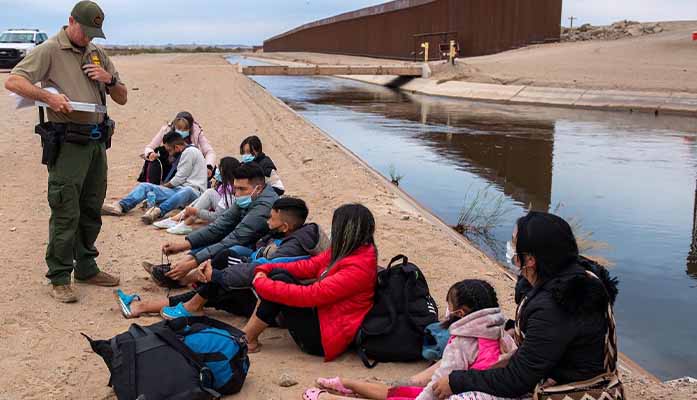
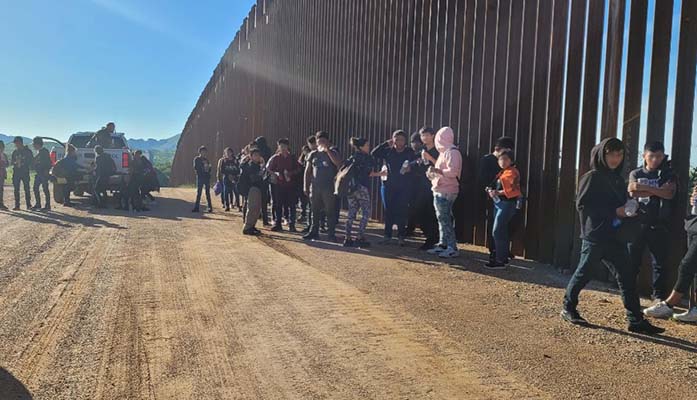
Border apprehensions continue to be high in southern Arizona.
Last week, the Chief Patrol Agent of the U.S. Border Patrol’s Tucson Sector, John R. Modlin, posted an update on the number of apprehensions of illegal aliens from his area of jurisdiction. Chief Modlin wrote that there were 7,500 encounters over the last week.
According to Modlin, there were also 23 human smuggling events and 6 significant arrests.
A local reporter noted that “apprehensions in the Tucson Sector remain steady in the first week with Biden’s executive order in effect.” There were over 7,400 encounters of illegal aliens in each of the previous two weeks.
Chief Modlin also shared a chart to compare year-over-year apprehensions in the sector, showing that the past three weeks have produced thousands more encounters than in Fiscal Year 2023.
Over the past year, Tucson has been at the top – if not the top – of the nation when it comes to apprehensions of illegal immigrants at the southern border each month.
These numbers do not factor in the ‘gotaways’ who escape detection from law enforcement on the ground. The ‘gotaways’ in the Tucson Sector are always estimated to be very high.
In addition to a large number of apprehensions and ‘gotaways,’ the Tucson Sector is home to one of the most active drug smuggling corridors in the nation, with international cartels able to send much of their illicit and deadly stashes north through Arizona and across the rest of the country.
The out-of-control and dangerous border crisis has forced Arizona legislative Republicans to find ways to take matters into their own hands to help secure and protect communities around the state. Earlier this month, the Arizona Legislature put the finishing touches on HCR 2060, the Secure the Border Act, to send the measure to state voters for the November General Election. If courts do not pause its inclusion on the ballot, Arizonans will have the opportunity to enact multiple border-related policies that will help local law enforcement to mitigate the negative effects of this crisis.
Daniel Stefanski is a reporter for AZ Free News. You can send him news tips using this link.
by AZ Free Enterprise Club | May 17, 2024 | Opinion
By the Arizona Free Enterprise Club |
Illegal immigration is the number one issue heading into November’s election, and Democrats have no one to thank but themselves. Over the past three years, the left has single-handedly created an open-border disaster under the neglectful policies of a Biden administration that has completely abandoned its constitutional duty to protect each state from invasion. As ground zero for the current border crisis, the people of Arizona know this all too well.
A surge in illegal immigrants in the Tucson Border Sector along with a dramatic rise in the number of “gotaways” has left our state on edge. Meanwhile, cartel violence has increased near southern Arizona communities, and we’ve even seen a report revealing that thousands of “special interest aliens” from mostly Middle Eastern countries have been apprehended while crossing the border illegally in the past two years. And that’s just barely scratching the surface of the catastrophe that has become our border.
You would think that the governor of a state facing a daily invasion would do something, but Katie Hobbs has proven time and time again that she would rather ignore the problem and hope it goes away. So, after Hobbs vetoed the Arizona Border Invasion Act (SB 1231), which would have significantly enhanced our state’s border security, Republican legislators decided it was time to allow voters to take matters into their own hands through the Secure the Border Act (HCR 2060). And the response from Democrats has been telling…
>>> CONTINUE READING >>>
by Daniel Stefanski | May 5, 2024 | News
By Daniel Stefanski |
Arizonans will likely have the opportunity to bolster their state’s protections against illegal immigration in the November 2024 election.
This week, Senate President Warren Petersen announced that Arizona legislators would soon be passing HCR 2060, the Secure the Border Act. Arizona Senate Republicans will “adopt a strike everything amendment to HCR 2060,” giving them the legislative vehicle to consider and pass the ballot referral for the November General Election.
“Arizona Democrats in power have shown us time after time, with every ‘no’ vote and veto of our border security legislation, that they are not concerned for the safety and well-being of our citizens, nor do they have any care for the wasted taxpayer dollars being used to mitigate the fallout from Biden’s border invasion,” said Senate President Warren Petersen. “Their priorities are tone deaf to the realities Arizonans are facing, and this will be confirmed when voters have the chance to take matters into their own hands this November. Republicans are committed to securing the border and returning sanity to our state after the chaos Democrats have willfully perpetuated with our current Governor leading the charge.”
According to Petersen’s press release, the ballot referral will be heard in committee this upcoming Wednesday, and it is expected on the Senate floor the following week.
The revelation of this push from Arizona legislators to send this referral to state voters comes almost two months after Governor Katie Hobbs vetoed SB 1231, the Arizona Border Invasion Act, which would have “ma[de] it unlawful for a person who is an alien (unlawful immigrant) to enter Arizona from a foreign nation at any location other than a lawful port of entry and outline[d] penalties for violations of illegally entering Arizona and provide[d] immunity from civil liability and indemnification for state and local government officials, employees and contractors who enforce this prohibition” – according to the purpose from the state Senate.
In her veto letter to Senate President Warren Petersen, Hobbs said, “This bill does not secure our border, will be harmful for communities and businesses in our state, and burdensome for law enforcement personnel and the state judicial system. Further, this bill presents significant constitutional concerns and would be certain to mire the State in costly and protracted litigation.”
Senator Janae Shamp, the sponsor of SB 1231, vowed that members of her party would continue to push forward solutions to combat the border crisis, saying, “The Republican-controlled Legislature will continue to prioritize closing our border and providing law enforcement with the tools they need. This veto is a slap in the face to them, Arizona’s victims of border-related crimes, and other citizens who will inevitably feel the wrath of this border invasion in one way, shape, or form at the hands of Hobbs and Biden.”
Earlier this spring, a group of legislative Republicans signed a letter to request that House Speaker Ben Toma and Senate President Warren Petersen “convene a special committee hearing, whereby Texas-style border security legislation can be promptly advanced and placed on the ballot.”
Democrats were quick to react to the latest news from President Petersen, signaling their adamant opposition to these efforts. Representative Nancy Gutierrez said, “They can feel the majority slipping away. Instead of working in a bipartisan manner, they choose to be petty and vindictive.”
Daniel Stefanski is a reporter for AZ Free News. You can send him news tips using this link.
by Dean Riesen | Mar 27, 2024 | Opinion
By Dean Riesen (The Center Square) |
As a border state, Arizona has confronted the consequences of illegal immigration for decades. A not-often-discussed constitutional loophole is making this challenge perpetually harder to resolve.
Counting illegal aliens as citizens, as outlined in the 14th Amendment, leads to the over-allocation of seats to the dominant party in districts with large illegal populations. Democrats benefit from this, which may be why they don’t seem interested in solving the border crisis.
To analyze this, we can examine the districts where there is a high concentration of illegal immigrants and compare the number of registered voters in those districts to the ones where there are very few illegal immigrants. The districts with more illegal immigrants will likely have a significantly lower number of total voters compared to the ones with fewer illegal immigrants.
This is covered in detail in Howard Husock’s Citizenship and Congressional Districting in National Affairs-Fall 2023. He shows how congressional district voting totals vary widely for districts that are supposed to be equal, as in equal representation but aren’t.
In the 2022 Congressional Election, Jim Jordan’s Ohio 4th District had 290,156 votes, with 69.2% in his favor, while Alexandria Ocasio-Cortez’s New York 14th District had 118,062 votes, with 70.6% supporting her. Interestingly, Jordan’s district had 146% more votes cast than AOC’s, despite being equal in size. It’s interesting to note that Jordan’s district is 99.1% U.S. citizens, and AOC’s is only 76.4% U.S. citizens (source: Data USA).
How is this possible? Due to the drafting of both the U.S. Constitution and the 14th Amendment, the courts have determined that for the apportionment of the U.S. House of Representatives, we must count all the “persons” residing in a state. The drafters likely had no idea that their words would be used to give political power to individuals who are not citizens and, in many cases, are breaking the law by even being in the U.S. Nothing short of a constitutional amendment will solve this problem on a federal level.
What about the states?
Arizona may adopt counting resident U.S. citizens for apportioning districts for state offices. Most states count all persons for apportioning state legislatures, including illegal immigrants, which can significantly affect seat allocation. By counting only residents of the U.S., Arizona could have a more accurate representation.
In the 2022 Arizona State Senate election, Republicans won 17 out of 32 districts, while Democrats won 15. If the theory is correct, Democrat districts should average a significantly lower number of total votes than Republican districts because most illegal aliens tend to live in Democrat majority districts. They are counted in the census, even though they are not U.S. citizens, and therefore, they are counted for purposes of apportionment.
In fact, the differences in voting population have been proven. The Democrat-winning districts have an average number of voters of 54,310, with a range of 25,626-123,321 total voters. The Republican-winning districts have an average total number of voters of 91,260, with a range of 59,471 to 133,510 total voters. The overall average total number of voters in a state senate district is 78,123. The average Republican-won district’s total number of votes is 68% greater than the average Democrat-won district’s total number of votes. These figures are prima facie proof of the theory.
Two U.S. Supreme Court decisions are of particular interest to state reapportionment. In 2016, the court decided Evenwel v. Abbott, which found a state (Texas) could not be forced to use a method, in this case voter-eligible population, to apportion its state legislative seats. The court ruled that the total population of persons was an acceptable method as it is the same method used by the U.S. House of Representatives and certainly met the court’s one-person, one-vote standard articulated in Reynolds v. Simms (1964).
In the Evenwel case, the plaintiffs failed to prove that the state’s method of counting the total population of persons violated the one person, one vote principle. The court clarified that the total population of persons was not the only basis for apportionment. Justice Ginsburg’s opinion indicated that it may not be the only method the court would accept for state legislative apportionment. Justice Alito’s concurrence vehemently disagreed with the Solicitor General’s argument that state legislative districts must be equal in total population, even if it resulted in grossly unequal districts in the number of eligible voters, particularly because of the illegal alien concentration in certain parts of the state. Alito called it a meretricious argument, “apparently attractive but having in reality no value or integrity-according to Oxford Languages.”
In 1966, the Court decided in Burns v. Richardson that Hawaii’s apportionment based on registered voters was valid. The state used registered voters because of the large number of tourists and non-resident military members. The Court clarified that the equal protection clause doesn’t require using total population figures from the census. It suggested that in Hawaii’s case, the state-resident U.S. citizen population would be more appropriate. While the court allowed the use of registered voters, it indicated that state citizen population was the best method. The court also noted that the distribution of registered voters approximates the distribution of state citizens or another permissible population base.
Arizona may change its constitution to use the US resident population for apportionment in state offices. Other states should consider doing the same.
Originally published by The Center Square.
Dean is Chairman of the Arizona Free Enterprise Club.
by Daniel Stefanski | Mar 2, 2024 | News
By Daniel Stefanski |
On Wednesday, the Arizona House of Representatives passed SB 1231, the Arizona Border Invasion Act. The bill, which was sponsored by Senator Janae Shamp, would “make it unlawful for a person who is an alien (unlawful immigrant) to enter Arizona from a foreign nation at any location other than a lawful port of entry, [and] outline penalties for violations of illegally entering Arizona and provides immunity from civil liability and indemnification for state and local government officials, employees and contractors who enforce this prohibition,” according to the purpose from the Arizona State Senate.
The vote in the House was 31-28 in favor of SB 1231, with one seat vacant. Earlier this month, the bill passed the Senate with a 16-13 vote (with one member not voting).
“Arizonans want and deserve safe communities, but the invasion at the border has led to countless fentanyl overdoses, rapes, murders, human smuggling, child sex trafficking, high-speed chases, subsequent deadly car crashes, and other heinous crimes that are forever transforming our state and the lives of our citizens right before our eyes,” said bill sponsor Senator Janae Shamp.
Senator Shamp also called on the governor to use every tool available to her office to help law enforcement enforce the law, writing, “Governor Katie Hobbs has declared on numerous occasions her disapproval for the lawlessness caused by the federal government’s open border policies and her desire to take action to protect our citizens. This legislation is exactly what our local law enforcement needs and has asked for to rein in the dangerous criminal activity that’s being thrust upon law-abiding Arizonans by the Biden Administration. The Legislature has done its job. Now is her chance to protect the citizens of Arizona by signing this bill into law, so that we can take the handcuffs off of our law enforcement and allow them to do their job.”
On the Arizona Legislature’s Request to Speak system, a representative from Arizona Catholic Conference endorsed the bill, while representatives from the American Civil Liberties Union of Arizona, the City of Phoenix, and Arizona Faith Network signed in in opposition to the legislation.
One of Senator Shamp’s colleagues, Senate President Pro Tempore T.J. Shope, also highlighted the passage of the bill through both chambers of the state legislature and echoed the desire for the governor to sign the legislation. He posted, “I call on Governor Hobbs to sign this bill and make good on her promise from the State of the State Address this year to take the situation at our Border seriously. Katie Hobbs, sign SB 1231.”
Arizona House Democrats vehemently protested the bill on the floor before it won final passage. The Caucus’ “X” account called the measure the “ghost of SB 1070,” and confidently predicted a veto from Governor Hobbs.
Despite a heightened tone in rhetoric from Governor Hobbs over the border crisis, the Democrat chief executive of Arizona is unlikely to go along with many – if any – of the immigration-related bills currently being offered in the legislature by Republicans. Legislative Republicans have pointed to Hobbs’ vetoes of their border bills in the 2023 session as proof that her actions speak louder than words, and the forthcoming decisions on these new proposals will certainly add to that narrative as an election year kicks into high gear for both political parties.
Daniel Stefanski is a reporter for AZ Free News. You can send him news tips using this link.