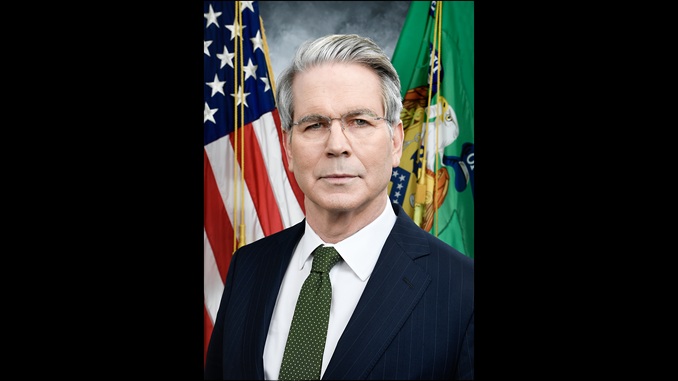
Treasury Secretary Scott Bessent is expected to visit Arizona on Wednesday and Thursday, with stops including a Casa Grande appearance alongside House Speaker Mike Johnson (R-LA) and Rep. Juan Ciscomani (R-AZ-06). The tentative itinerary, provided exclusively to AZ Free News by Treasury Department officials, also includes meetings with manufacturers, business leaders, and community bankers.
Bessent is scheduled to travel to the state on August 5 and 6 to discuss the Trump administration’s economic agenda and efforts to strengthen the integrity of the nation’s financial system, Treasury officials said.
The visit will include a tour of a manufacturing facility in Casa Grande with Johnson and Ciscomani. The three officials are also expected to participate in an economic roundtable with Arizona business leaders.
The Treasury Department had not yet publicly identified the manufacturing facility as of Monday night.
The administration plans to use the event to highlight the effects of the tax and business provisions it refers to as the Working Families Tax Cuts, including incentives for domestic manufacturing and capital investment.
The tax provisions were enacted as part of Public Law 119-21, which President Donald Trump signed on July 4, 2025. The law permanently extended several provisions of the 2017 Tax Cuts and Jobs Act and created temporary federal income-tax deductions for qualified tips and overtime compensation.
The law also allows businesses to immediately deduct qualifying research and development costs and the cost of certain equipment and machinery. It provides accelerated deductions for qualifying investments in new and expanded manufacturing facilities, according to a White House summary.
Arizona Republican lawmakers and Governor Hobbs reached a bipartisan budget agreement in June that eliminated state income taxes on qualified tips and overtime, increased the standard deduction, and added other tax provisions tied to the federal law. Republican legislative leaders described Arizona as the only state to fully adopt the federal tax package at the state level.
🚨FOR IMMEDIATE RELEASE: Arizona Becomes Only State in the Nation to Deliver Historic Trump Tax Cuts As Part of Bipartisan FY 2027 Budget Agreement
The White House, citing a National Association of Manufacturers analysis, said the law’s manufacturing provisions sustained an estimated 119,000 Arizona jobs, $22 billion in state economic output, and $11 billion in wages.
The Congressional Budget Office (CBO) estimated that the law would increase federal deficits by approximately $3.4 trillion from 2025 through 2034, excluding macroeconomic and debt-service effects. The CBO attributed the increase to an estimated $4.5 trillion reduction in revenues, partially offset by a $1.1 trillion reduction in direct spending.
During a separate engagement, Bessent is expected to meet with community bankers from across Arizona alongside Comptroller of the Currency Jonathan Gould.
Bessent and Gould reportedly plan to discuss the administration’s efforts to reduce regulatory burdens on community banks and expand their ability to finance local businesses and economic development.
Reducing regulatory and supervisory burdens on community banks has been one of Gould’s stated priorities. The agency said in May that it had begun tailoring examinations according to a bank’s size, complexity, and risk profile, while giving smaller institutions greater flexibility to use a simplified capital framework.
The Office of the Comptroller of the Currency (OCC) has also revised its model-risk guidance and narrowed the scope of information-technology and cybersecurity examinations for community banks, according to an agency announcement.
“Community banks are anchors of local economies, providing essential banking services and small business lending that helps power job creation,” Gould said in the announcement.
The Arizona meeting is also expected to address the administration’s campaign against fraud, identity theft, money laundering, and other illicit activity involving the financial system.
Trump issued an executive order in May directing Treasury and federal banking regulators to strengthen customer-identification requirements and consider changes to regulations implementing the Bank Secrecy Act.
The order directed Treasury and federal financial regulators to propose stronger risk-based customer due-diligence requirements and consider changes to customer-identification rules. It instructed regulators to examine the use of foreign consular identification documents, invalid or mismatched Social Security and taxpayer-identification numbers, payroll-tax schemes, and accounts associated with workers who lack employment authorization.
It also directed financial regulators to consider whether banks should obtain additional information concerning immigration status and employment authorization when those details are relevant to fraud, identity misrepresentation, sanctions evasion, or another identified financial risk.
The Treasury’s Financial Crimes Enforcement Network (FinCEN ) subsequently issued a June 5 advisory urging banks and other financial institutions to identify and report suspicious activity associated with identity theft, payroll fraud, and the unlawful employment of people without work authorization.
FinCEN said some employers conceal unauthorized workers by using stolen identities, mismatched Social Security numbers, false payroll information, or off-the-books payment arrangements. The agency reported that financial institutions filed suspicious activity reports involving more than $2.5 billion in transactions associated with potential payroll-tax fraud during 2025.
The advisory was issued jointly with the Federal Deposit Insurance Corporation, OCC, and the National Credit Union Administration, and in coordination with the Internal Revenue Service.
The Treasury Department said Bessent and Gould will discuss how Arizona community banks can support the administration’s enforcement efforts while continuing to provide financing and banking services to local businesses.
Additional details regarding the facility, participating business leaders, event times, and press access are expected later on Tuesday.
Maricopa County’s former recorder, Stephen Richer, says Republican’s concerns over illegal alien voting are “bogus.”
The former elections leader for one of the nation’s biggest counties published that claim earlier this week in an opinion piece for The New York Times.
“Confirmed: non-citizens aren’t voting,” said Richer.
Richer cited state investigations into noncitizen voting in which voter rolls were cross-checked with citizenship status. The recorder said concerns over illegal alien voters were a myth jeopardizing democracy.
“People largely aren’t willing to risk their status in the United States — the land of economic opportunity — for the ability to cast one more vote out of hundreds of thousands or millions in a state and hundreds of millions in the country,” stated Richer. “Playing politics with the idea of fraudulent voters and stolen elections comes at a real cost to American confidence in our elections. It’s an affront to our democracy and to all those who work to deliver free and fair elections. It’s also an ominous sign for where things may be heading this year.”
However, the cross-check referenced by Richer doesn’t address the common practice of identity theft among illegal aliens. Voter rolls can only confirm the citizenship of the individual listed, not of an individual who may be usurping that identity.
According to some federal estimates, 75 percent of illegal aliens are using stolen identities. There’s about 11.5 million illegal aliens in the country per the latest federal estimate, which would mean over 8.6 million illegal aliens use stolen identities under those estimates. Around 7 million of those illegal aliens claim employment per the government.
Of the smaller number of illegal aliens whose employment is recorded on the books, the government’s low estimate for illegal alien identity theft totals over one million.
With that range of estimates, there may be anywhere from 20,000 to 170,000 illegal aliens living under stolen identities in each state, assuming equal population distribution.
A day after The New York Times published Richer’s opinion piece, the Department of Justice announced the case of another illegal alien convicted of voter fraud.
An illegal alien from Columbia voted in the 2024 presidential election under a stolen identity, which she’d been using for over 20 years. Lina Maria Orovio-Hernandez, 59, had obtained a Real ID and received over $400,000 in stolen federal benefits.
Those stolen benefits included over $250,000 in Housing and Urban Development rental assistance. Orovio-Hernandez also obtained eight other state IDs in addition to the Real ID she obtained in Massachusetts.
🚨 HOLY SMOKES. A jury just convicted an illegal alien of VOTER FRAUD, illegally voting in the 2024 election
What the Democrats PROMISED you never happens — happened again.
Since leaving the recorder’s office, Richer has taken up elections-related leadership positions that advance claims similar to the ones he made in his most recent opinion piece, to include senior practice fellow in American democracy with the Harvard Kennedy School and adjunct scholar with the Cato Institute.
Richer pulled away from the Republican Party during the 2024 election when he announced his intent to vote for Democratic candidate Kamala Harris.
Other illegal aliens have voted in elections without the use of identity theft.
Last month, an illegal alien pleaded guilty to voting in the 2020 election.
Last December, two illegal aliens were indicted for voting in the November 2020 general election.
Last November, an illegal alien from Mexico elected to be the local mayor was charged for having voted illegally numerous times over his decades spent in the U.S.
Last August, a Canadian citizen voted in two federal elections, once in 2022 and in 2024.
AZ Free News is your #1 source for Arizona news and politics. You can send us news tips using this link.
Financial fraud is emerging as one of Arizona’s most costly economic threats, with residents projected to lose more than $4 billion in 2025, according to a new analysis from the Common Sense Institute (CSI). The report, The Impact of Financial Fraud in Arizona, outlines how scams, identity theft, and other fraudulent activity are draining household finances and hampering economic growth. In 2024, Arizonans reported nearly 55,000 fraud cases, leading to $521 million in losses—an increase of 384 percent since 2020.
CSI economists estimate that only about 14 percent of fraud is ever reported, meaning the true cost is far higher. By next year, the institute projects that reported losses could reach $558 million, with an additional $3.4 billion in unreported incidents.
“Arizona is projected to lose over $4 billion to financial fraud in 2025. That’s nearly 1% of the state’s total GDP,” said Zachary Milne, senior economist and research analyst at CSI. “Fraud is a systemic drain on Arizona’s families and the economy. Eliminating these losses would mean billions in growth, tens of thousands more job opportunities, and lower prices for Arizonans.”
Key Findings from the Report
The average loss per incident in Arizona was $6,270—nearly 30 percent higher than the national average.
Arizona ranked 11th nationally for fraud cases, with 1,459 reports per 100,000 residents.
Older residents face the greatest impact. Adults 60 and older account for two-thirds of internet-based fraud losses, with those 70 and older suffering the highest average dollar losses.
For every dollar lost to fraud, Arizonans lose $1.06 in personal income due to broader economic effects. Families also face slightly higher prices on everyday goods and services.
Fraud contributes to reduced economic activity, costing Arizona more than 45,000 jobs.
Fraud schemes cited in the report range from identity theft and phishing to romance scams, wire transfer fraud, and elder financial abuse. As more commerce moves online, CSI researchers warn that the risks will only grow.
The study also highlights how financial crime affects more than direct victims. Lost spending power, higher security costs, and reduced consumer confidence create ripple effects across the state’s economy. CSI estimates fraud-related losses shrink Arizona’s GDP by $5.2 billion annually. Nationally, the FBI and Federal Trade Commission tracked tens of billions of dollars in fraud losses in 2024, part of a steady upward trend over the past five years. Arizona, with its above-average loss rate and older population, is particularly vulnerable.
The report concludes that combating fraud is not only a matter of protecting individuals but also of preserving Arizona’s long-term economic health.
Jonathan Eberle is a reporter for AZ Free News. You can send him news tips using this link.