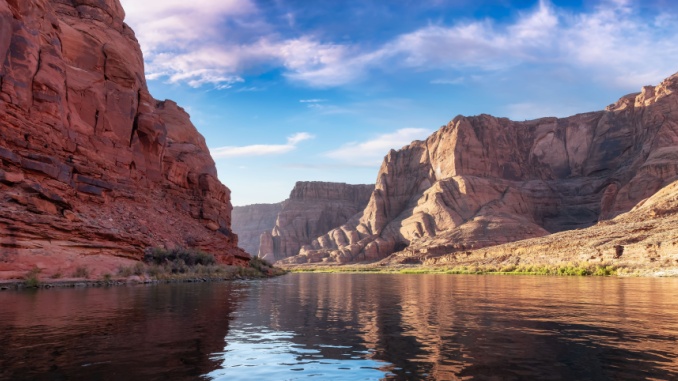
The Trump administration has finally come to an agreement with Arizona and the other Lower Basin states on Colorado River water usage.
The news was met with a mixed reaction.
Gov. Katie Hobbs described the agreed-upon deal in an announcement on Friday as adequately protecting the state from the “disastrous and unacceptable forced federal water cuts” that were floated by the federal government earlier this month.
I'm glad the federal government has chosen to implement the Lower Basin's water allocation plan. We've protected Arizona from disastrous and unacceptable forced federal water cuts.
Together, we’ve proven that the Lower Basin will work in meaningful ways to protect the Colorado…
Under the federal government’s proposal, Arizona would have seen cuts up to 77%.
Under this deal, Arizona will lose about 61%: the most out of the Lower Basin states.
While Arizona will give up 760,000 acre-feet between 2027 and 2028, California and Nevada will collectively lose 490,000 acre-feet. Overall, the cuts represent a reduction of approximately 25%.
The Upper Basin states will not see cuts under this plan.
Brenda Burman, Central Arizona Project (CAP) general manager, said the Upper Basin states needed to pull their weight.
“Lake Mead should not be sacrificed to protect Lake Powell or other Upper Basin reservoirs, and every state that relies on the river should be part of the solution,” CAP General Manager Brenda Burman said in a statement. “The Colorado River needs to be treated as the system it is.”
Some of Arizona’s elected leaders issued stand-in statements in which they disclosed that they were still reviewing the plan.
Rep. Juan Ciscomani (R-AZ-06), co-chair of the congressional Colorado River Caucus, said that upon initial review the current plan avoids the “most drastic options” previously announced by the Trump administration. However, Ciscomani intimated that long-term solutions were still lacking in this latest plan.
“The goal is clear: long-term water certainty and security for Arizona,” said Ciscomani. “I will continue working with the Administration and bipartisan leaders at every level of government to protect this critical resource for our farmers, ranchers, businesses, tribes, and every Arizona family that relies on the Colorado River.”
Rep. Greg Stanton (D-AZ-04) said that the deal provided two years of “welcome” stability, but that it was only “another short-term fix” and not a lasting solution.
“[A] two-year reprieve is not a solution. The agreements holding this decision together must be durable, and a record-breaking drought won’t suddenly resolve itself,” said Stanton. “Every two years, this same threat of ‘CAP to zero’ will hang over Arizona’s head. That’s no way to run a system millions of people depend on for water, power and food.”
Rep. Yassamin Ansari (D-AZ-03) didn’t issue a statement on the plan, but did post on social media calling water “the lifeblood of Arizona,” promising “bold action to confront the climate crisis,” and including a link to the city of Phoenix’s water quality page.
Rep. Adelita Grijalva (D-AZ-07) issued a statement blending elements from colleagues Stanton and Ansari, calling for a more permanent solution among both the Upper and Lower Basin states while also urging action on climate change as the purported root causes of the prolonged drought.
Democrat Senators Mark Kelly and Ruben Gallego issued a joint statement simply expressing gratitude for the two years the plan afforded Arizona, and presented a lighter look forward at the road ahead for a more “lasting” plan of action. The senators also indirectly called on the Upper Basin states to take on some of the water-cuts burden as well.
“This decision provides much-needed certainty for Arizona and the Colorado River over the next two years,” Kelly and Gallego said. “The 2027 and 2028 guidelines protect Arizona from even deeper near-term cuts while giving the seven Basin states more time to reach a long-term agreement.”
Danny Seiden, Arizona Chamber President and CEO, said that the deal was “workable,” not perfect. Seiden credited state leaders for working in a bipartisan manner to accomplish the deal, specifically Hobbs, Senate President Warren Petersen (R-LD14), and House Speaker Steve Montenegro (R-LD29).
“We are still working through the details, but today’s decision appears to provide a workable path forward over the next two years and avoids some of the most damaging scenarios our state was facing,” said Seiden. “Arizona has already put real conservation and real cuts on the table, and the work now continues toward a long-term agreement that requires every Basin state to share in the responsibility. Arizona’s business community will continue to support our leaders as they fight for a fair, durable solution that protects our water and our economic future.”
Others weren’t so optimistic.
Scot Mussi, president of the Arizona Free Enterprise Club, called the deal “a total failure of leadership.” Mussi criticized the deal, saying it imposes water cuts on single family homes but not data centers and apartments.
This deal is a total failure of leadership. On top of that, this deal will place most of the cuts on new single family homes while data centers and apartments get unlimited water. Conveniently, those big water users happen to be some of your biggest campaign contributors. https://t.co/pLaenPuDCc
The University of Arizona and Gila River Health Care have announced a long-term partnership to establish what the university says will be the nation’s first MD-granting medical school branch located on the lands of a sovereign Tribal Nation.
The University of Arizona College of Medicine – Phoenix Regional Medical Branch will operate in Sacaton within the Gila River Indian Community and place medical students inside the community’s tribally operated healthcare system for part of their training.
Beginning in July 2027, the branch will admit 10 students each year to the College of Medicine – Phoenix’s three-year Primary Care Accelerated Program. Students will complete the first 18 months of their medical education in Phoenix before moving to Sacaton for another 18 months of clinical education.
Gila River Health Care will provide full-tuition scholarships to participating students and has committed more than $25 million through 2034 for scholarships, faculty positions, and educational infrastructure supporting the branch.
U.S. Reps. Eli Crane (R-AZ-02) and Greg Stanton (D-AZ-04) joined Gila River Indian Community, university, and healthcare officials at Tuesday’s announcement.
Crane praised the agreement Wednesday, saying the partnership would strengthen healthcare in his district.
“It was great to visit the Gila River Indian Community yesterday with @RepGregStanton to celebrate an important agreement between @uarizona and @Gilariverhealth,” Crane wrote. “This partnership will strengthen healthcare in #AZ02 for years to come.”
It was great to visit the Gila River Indian Community yesterday with @RepGregStanton to celebrate an important agreement between @uarizona and @Gilariverhealth.
This partnership will strengthen healthcare in #AZ02 for years to come.
The program is intended to increase the number of physicians working in tribal, rural, and medically underserved communities, where officials say recruiting and retaining healthcare professionals has remained difficult. The University of Arizona said Arizona ranks 42nd nationally for primary care access and cited projections from the Association of American Medical Colleges that the United States could face a shortage of as many as 86,000 physicians by 2036.
University President Suresh Garimella said the program combines accelerated medical education, scholarships, and potential residency opportunities aimed at keeping physicians in the communities where they train.
“Tribal and rural communities have some of the nation’s greatest unmet primary care needs,” Garimella said. “This partnership to establish the country’s first medical school branch within a Tribal Nation will train physicians through an accelerated three-year MD program, support them with full scholarships to free them of debt burden and provide residency opportunities that anchor them to the places and patients they know. That is how you build a physician workforce that remains in the communities that need them most.”
Gila River Indian Community Gov. Stephen Roe Lewis said the program could allow members of the community interested in medicine to pursue careers closer to home.
“For too long, many of our young people who dreamed of becoming doctors had to leave home to pursue that goal,” Lewis said. “This partnership with the University of Arizona changes that. It gives them the opportunity to learn, train and build their careers right here in the Community, where they can make a real difference for the people they serve.”
Students will work under faculty supervision across multiple clinical settings within Gila River Health Care while learning about historical, cultural, and social factors affecting healthcare in Native communities. Officials are also exploring the development of primary care residency programs within Gila River Health Care in an effort to retain graduates in underserved communities.
Dr. Fredric Wondisford, dean of the University of Arizona College of Medicine – Phoenix, told Arizona’s Family that patients in some rural communities can face drives of two to three hours to obtain healthcare.
“The tribal community has unique ways of viewing Western medicine, all of which requires students to be in that community to learn about the community,” Wondisford said. “If they don’t learn about the community, they’re not really going to reach their patients, and they’re not really going to deliver good healthcare.”
Gila River Health Care Board Chairman Robert Pablo said rural healthcare facilities continue to face difficulties attracting trained medical professionals.
“There’s a real challenge for rural health hospitals to recruit trained professionals to come and work in their communities,” Pablo said. “We are very fortunate to launch this first-of-its-kind partnership between Gila River Health Care and the University of Arizona, which will establish a starting ground for these young doctors to jumpstart their careers.”
The Gila River initiative follows another community-based medical education partnership announced by the University of Arizona with Onvida Health in Yuma last year.
The Gila River medical school branch is scheduled to enroll its first 10 students in July 2027.
Lisa Everett, a Dysart Unified School District Governing Board candidate who describes herself as a Republican activist, has recently drawn attention for criticizing conservative candidates, including Arizona Corporation Commission nominee Ralph Heap, and the conservative groups that supported his campaign.
Everett has filed two campaign-finance complaints against Heap, one with the Arizona Citizens Clean Elections Commission and one with the Secretary of State’s Office while publicly defending his primary rivals, Kevin Thompson and Nick Myers. She has also repeatedly called on Heap to withdraw from the race, even after he advanced to the general election over Myers.
Everett’s public support for the two Republican incumbents Heap challenged predates the complaints. In her June 1 “Patriotnheels” newsletter, Everett published a section titled “Truth vs. Lies: The Record of Arizona Corporation Commissioners Kevin Thompson and Nick Myers.” The newsletter summarized Thompson and Myers’ defenses of their records on renewable-energy mandates, President Donald Trump’s energy agenda, utility rate mechanisms, and grid reliability.
Heap challenged Thompson and Myers for one of two Republican nominations to the Corporation Commission. In the July 21 primary, Thompson finished first with 35.8% of the vote, Heap finished second with 33%, and Myers finished third with 31.2%. Thompson and Heap advanced to the November general election.
After the primary, Everett escalated her public opposition to Heap. She announced her Secretary of State complaint, publicly thanked Clean Elections when commissioners denied Heap’s request to leave the public-financing program, and subsequently urged Republicans to call for Heap’s withdrawal. She has continued publishing updates about the campaign-finance proceedings through her Patriotnheels account.
Heap entered the Corporation Commission race with support from the Arizona Free Enterprise Club and Turning Point Action. Everett has previously criticized Turning Point’s influence in Arizona Republican primaries. In May, she told the Arizona Capitol Times that Turning Point “puts their money behind people, and that machine rolls, but it turns off the independent voters.”
Everett has also directly criticized the Arizona Free Enterprise Club’s involvement in Corporation Commission races. In a post to X on August 4 she wrote, “Some have asked me why I am pursuing this. – Accountability. Some are concerned a Democrat could get elected. My prayer is Heap removes himself from the ballot and the Party appoints a great candidate. If we lose this seat the blame lays at the feet of Arizona Free Enterprise Club and their partners. They ran candidates against two great incumbents simply because the incumbents could not be controlled. The blame also lies at the feet of Heap for violating campaign finance laws. This is truly a case of don’t blame the messenger.”
Some have asked me why I am pursuing this. – Accountability. Some are concerned a Democrat could get elected. My prayer is Heap removes himself from the ballot and the Party appoints a great candidate. If we lose this seat the blame lays at the feet of Arizona Free Enterprise… pic.twitter.com/VbzS6qRbhH
In an August 7 reply on X, she added, “Arizona Free Enterprise Club continues to recruit candidates that know nothing about utilities. They do this because they want a puppet at the ACC. Nick and Kevin follow statutes and understand the issues.”
Everett describes herself as a conservative Republican. Her Patriotnheels website identifies her as a longtime Republican organizer and describes the outlet as a West Valley platform that promotes conservative viewpoints and candidates. The same site also features an essay written by Everett titled, “The Republican Party Is Still A Big Tent — Let’s Start Acting Like It.” In that piece, she criticized Republican “purists” and “RINO” labeling and argued against isolating “McCain Republicans” and “moderate Republicans.” She also urged Republicans to engage with political opponents rather than limit their political activity to people who already agree with them.
Everett has applied that argument to disputes over Republican political figures as well. During an August 7 discussion on X over whether former Mesa Mayor John Giles (now the running mate for Democrat Governor Katie Hobbs) should be described as a leftist, Everett wrote, “The far right does not understand that concept. If you fail their purity test – you are a leftist.”
The far right does not understand that concept. If you fail their purity test – you are a leftist.
Everett drew attention for that approach in 2025 while serving as chair of the Legislative District 29 Republican Committee. In April of that year, Everett organized Republican counter-protests against Northwest Valley Indivisible demonstrations targeting President Donald Trump and Rep. Abe Hamadeh (R-AZ-08). Everett told AZ Free News at the time that she organized supporters after seeing the anti-Hamadeh demonstrations and said the Republican participants supported the Trump administration’s agenda.
Four months later, Everett joined Brent Peak, co-chair of Northwest Valley Indivisible, in advocating for Peoria-area restaurant owner Lai Kuen “Kelly” Yu after Yu was detained by U.S. Immigration and Customs Enforcement. AZ Free News reported in August 2025 that Everett and Peak were working on Yu’s behalf even as Democratic Senators Ruben Gallego and Mark Kelly, along with Rep. Greg Stanton (D-AZ-04), also supported Yu. Everett told The Center Square that Yu came to the United States while pregnant, sought asylum, and became active in the Peoria community. Department of Homeland Security Assistant Secretary Tricia McLaughlin said Yu had entered the country illegally in 2004 and had exhausted her legal avenues to remain. Court records cited by AZ Free News showed the Ninth Circuit denied Yu’s asylum appeal in 2016.
The Maricopa County Republican Committee subsequently censured Everett by a 23-6 vote over her advocacy for Yu and her work with Peak. It also called for her resignation from her district leadership position. Everett defended her actions and later wrote on X that the county party was increasingly controlled by people she considered extremists, describing them as “so far right they are turning left.”
MCRC Censures LD29 Chairwoman Lisa Everett
Last night, the Maricopa County Republican Committee voted to censure me, Lisa Everett, Chairwoman of LD29. With that vote, my name is now listed alongside an ever-growing roster of Republicans who have been censured by MCRC: County… pic.twitter.com/5hvdhA5iTZ
Everett is now campaigning for the Dysart Unified School District Governing Board, where her campaign lists protecting the district’s A rating, supporting teachers and staff, and maintaining facilities among her priorities.
Heap and Thompson will appear on the Nov. 3 Corporation Commission ballot alongside Democrats Clara Pratte and Jonathon Hill and Green Party candidate Mike Cease.
A coalition of U.S. House Democrats have banded together to pledge against socialism, but none of Arizona’s Democrat congressional leaders signed on.
Reps. Adelita Grijalva (D-AZ-07), Greg Stanton (D-AZ-04), and Yassamin Ansari (D-AZ-03) have not signed the Promise to America, an organization pushing a pledge to align the Democratic Party around the principles of capitalism, safety, fiscal responsibility, effective government, common purpose, and patriotism.
The three congressional leaders have not publicly aligned with socialism, and are not known to be members of the Democratic Socialists of America. Stanton’s primary challenger, Kai Newkirk, was a self-identified democratic socialist.
However, top Democrats in Arizona appear to be looking to reclaim and redefine socialism. Gov. Katie Hobbs’ consultant Stacy Pearson, who has represented her campaign to the media, recently told KJZZ that all public goods qualified as socialism, and that Democrats needed to reclaim socialist ideology as their own.
“[W]hen politicians are arguing against socialism, they’re arguing against well-funded public education and good universities and public transportation and affordable housing,” said Pearson. “The Democrats need to get a hold of the word socialist like we did with abortion, and we stopped using weird pitter-patter words like ‘reproductive freedom’ and ‘reproductive rights.’ No, we’re really talking about a woman’s right to have an abortion when she needs one, period. And so I think we need to get a hold of the word again and remind people what it really means.”
The new pledge from U.S. House Democrats against socialism declares a belief in an economy driven by merit and hard work, secure borders and orderly immigration, a balanced budget, reduced bureaucracy, free speech, common political ground, and confidence rooted in patriotism.
“We are proud, not ashamed of America,” stated the pledge. “We believe America’s story is one of extraordinary achievement and unfinished work. We honor America’s strengths and exceptional character while striving to build a freer, stronger, more prosperous, and more perfect union.”
Ten congressional Democrats and five candidates have signed the pledge as of this report. Signatories hail from California, Colorado, Michigan, Nevada, New Hampshire, New Jersey, New York, North Carolina, Oregon, and Texas.
The pledge was developed by New York Rep. Tom Suozzi and California Rep. Adam Gray alongside a team of fellows following sizable wins from socialist candidates in the June primaries. The founding fellows were Felix Frisch, who serves as director; Mac Healey; Sarah Buchanan; Molly Uthoff; Aarynn Deleon; Chloe Stevelman; and Yenjay Hu.
Suozzi and Gray market themselves as the two Democrats to have successfully flipped districts that President Donald Trump won in the 2024 election cycle.
Promise to America appears to be aligned with the Welcome Party, which has an affiliated political action committee with millions in funding from the likes of LinkedIn cofounder and tech venture capitalist Reid Hoffman, former 21st century Fox CEO James Murdoch, and Walmart heir Samuel Walton.
Only one Democratic candidate from Arizona was listed as having signed the pledge: Marlene Galan Woods, who lost the Democratic nomination for the 1st congressional district seat to Amish Shah.
Candidates Jonathan Nez, 2nd congressional district; Elizabeth Lee, 5th congressional district; JoAnna Mendoza, 6th congressional district; Bernadette Greene-Placentia, 8th congressional district; and Dani Sterbinksy, 9th congressional district, also have not signed the pledge.
AZ Free News is your #1 source for Arizona news and politics. You can send us news tips using this link.
Rep. Andy Biggs (AZ-05), Republican gubernatorial candidate, is leading Arizona’s congressmembers in a bipartisan petition to House leadership to include emergency funding for Colorado River Basin infrastructure.
The Colorado River serves as a critical water supply for Arizona and the six other basin states. 36% of the state’s supply comes from the river. Put another way, the river supplies drinking water for one in 10 Americans.
Additionally, around 2.5 million individuals across the Western states rely on the river for power.
The river has reached historically low water levels due to prolonged drought and increasing aridity. These levels haven’t been seen on the river since the late 1950s.
The letter requested emergency funding to provide for infrastructure investments, upgrades, and long-term planning, noting that the present average flow measurements on the river amount to 20% less of what they were in the 20th century.
Democratic Reps. Yassamin Ansari (AZ-03), Adelita Grijalva (AZ-07), and Greg Stanton (AZ-04) joined the letter alongside Republican Reps. Eli Crane (AZ-02), Abe Hamadeh (AZ-08), and Paul Gosar (AZ-09).
The letter argued that the river’s decline represented a national security threat worthy of emergency funding, citing its critical function as more than a water and energy source for individuals but also as a source for the national security industry. California and Arizona are consistently among the top 10 states for defense spending, and Colorado is in the top 20.
“In addition to helping meet basic needs of communities out West by supplying drinking water, serving as a power source, supporting municipal services, and helping put food on the table, the Colorado River and its related parks, forests, and recreation areas also contribute over $26 billion to the outdoor recreation economy each year,” said the letter. “In addition, the River supports critical national security industries that have taken root in the West, including in the advanced manufacturing, aerospace, and defense sectors.”
The letter also documented congressional precedent for the proposed emergency funding. In 2022, Congress issued $4 billion for drought mitigation with priority given to Arizona and the other basin states. According to the congressmembers, this cash infusion did mitigate the water crisis.
By comparison, congressional funding sits currently at less than $100 million for the river.
“We have no doubt that without this vital funding source, the water crisis today facing our communities would be much worse,” stated the letter. “Funding is urgently needed to limit the pain that could be felt by communities across the basin in the near term and may smooth the path forward for post-2026 operating agreements.”
Biggs said in a statement that bipartisanship was a need because the river represents a crisis far bigger than either party.
“For desert dwellers, nothing is more important than protecting and cultivating our water resources,” said Biggs. “The Colorado River situation is not just an issue for Arizona and the West; it’s an issue that affects the entire country because of the national industries that depend on this water source. I hope that House leadership and appropriators will heed our request and include the necessary funding to prevent this crisis from getting worse and needlessly harming vulnerable Americans.”
AZ Free News is your #1 source for Arizona news and politics. You can send us news tips using this link.