by Ethan Faverino | Oct 21, 2025 | Education, News
By Ethan Faverino |
A new study has revealed that Arizona has one of the lowest college graduation rates in the nation at 49.58%.
Ranking eighth worst in the U.S., Arizona’s graduation rate falls 11.34% below the national average of 60.92%, according to the latest data from the U.S. Department of Education’s National Center for Education Statistics.
The study, conducted by Hennessey Digital, analyzed graduation rates across all colleges in each state, highlighting a troubling trend for Arizona, where only 49.58% of the students in the cohort completed their degrees within 150% of the normal program completion time (4 years).
This places Arizona alongside other struggling states, making it one of the eight states below 50% graduation.
“Regardless of what you’re studying, college can be a challenging time, said CEO of Hennessey Digital, Jason Hennessey. “For many, it’s the first experience of independence, a change from the environment you’ve grown up in and ultimately, incredibly intense. It’s not surprising to see that many drop out of their courses before graduation, but ultimately, every student needs to consider what’s going to make them happy and successful and an academic path is not always going to achieve that.”
The research identifies Alaska as the state with the lowest college graduation rate at 32.93%, a staggering 27.99% below the national average. Only 735 of 2,232 students in Alaska’s cohort completed their degrees.
Following closely are Nevada, with 45.20% completion, with 4,932 out of 10,912 students graduating, and New Mexico, with 47.80% completion and 3,523 out of 7,370 students graduating. Both are struggling with significant gaps in degree completion compared to the national average.
In contrast, Massachusetts leads the nation with a 75.41% graduation rate, 14.49% above the national average, with 40,011 out of 53,060 students completing their degrees.
Rhode Island follows at 73% with 8,835 of 12,103 students graduating and then Connecticut at 70.77% with 14,898 of 21,052 students graduating.
Ethan Faverino is a reporter for AZ Free News. You can send him news tips using this link.
by Staff Reporter | May 20, 2025 | Education, News
By Staff Reporter |
Mesa Public Schools (MPS) won’t allow military stoles to be worn by graduating students this year.
According to information provided by board membership, MPS defended the rule as a means of honoring their desire to maintain uniformity during graduation ceremonies. MPS policy does not explicitly bar military stoles from being worn, but it does not make an allowance for them, either.
However, MPS policy does allow students eligible to belong to or belonging to a federally recognized Native American tribe to wear traditional tribe regalia or “objects of cultural significance” at their graduation ceremony. The policy noted regalia could include eagle feathers or eagle plumes.
Additionally, students may wear pins or other “small symbol[s]” denoting their accolades related to scholastic or academic honors. These little accolades were allowed to be from “a city, county, state, or tribal government or its representative,” so long as they wouldn’t “detract from the unity achieved by graduates” uniformed in a common cap and gown. The district also drew the line at decorating caps and tassels, unless given permission by their school’s principal.
Governing Board member Rachel Walden opposed the policy and pledged to request Board President Courtney Davis to agendize graduation policy for amending.
“Military students at Mesa Public Schools must be allowed to wear their Military stole at graduation! Yet, students are forbidden to wear this symbol of commitment and achievement for their high school graduation. The community went through this last year and was able to get the ban lifted, yet here we are again,” said Walden. “I’m disappointed that this even needs to be said. To quote our enlisted National Guard student, not wearing the stole ‘disregards the values of honor and achievement that our school purports to uphold.’ There is also a link to his petition in the comments.”
As of this report, the petition to allow military stoles at Mesa graduations has reached 250 signatures. The student who launched the petition, Daniela Rascon-Rivas, is a student at Mesa High School and a National Guard member. Rascon-Rivas is also petitioning for the allowance of her to wear cords denoting her accomplishments through the East Valley Institute of Technology (EVIT), a trade school in the area.
According to Walden, last year Red Mountain High School attempted to bar military stoles from their list of allowable graduation attire. Walden advised the board was able to overturn that policy.
The district’s policy on the display of military-related accolades caught the attention of state leaders.
Congressional candidate and former Arizona House Speaker Travis Grantham said allowing graduates to wear their military stoles was a “no brainer.” Grantham is a lieutenant colonel and commander within the Arizona Air National Guard.
“Hopefully the district does the right thing and changes their policy ASAP!” said Grantham.
State Representative and House Judiciary Chair Quang Nguyen, whose daughter serves in the Navy, seconded Walden’s take on the situation.
AZ Free News is your #1 source for Arizona news and politics. You can send us news tips using this link.
by Matthew Holloway | Apr 28, 2025 | Education, News
By Matthew Holloway |
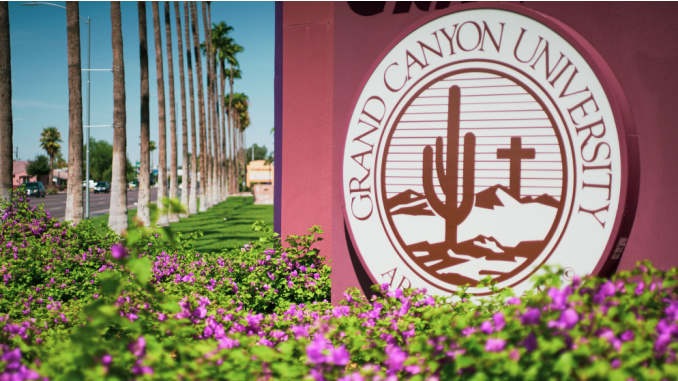
Grand Canyon University, despite a tumultuous period which saw unprecedented fines and targeting by the Biden administration, reported the largest number of graduates in the Christian university’s history for its 75th Anniversary.
According to the university, the GCU Class of 2025 will graduate 31,104 students, 5,669 of them in person at the university’s Phoenix campus and another 25,435 online. Commencement ceremonies for in-person students are already underway as of this report and will take place between April 29th and May 2nd for online students.
“This year’s record-breaking graduating class reflects the dedication of our exceptional students, the unwavering support of our faculty and staff, and our commitment to offering innovative educational opportunities across multiple delivery platforms,” said GCU President Brian Mueller.
“Whether through in-person classes, online learning, hybrid models or accelerated pathways, our flexible approach allows us to connect with students no matter their life circumstances. Increasingly, more and more families are seeking these opportunities, especially when taught from a Christian worldview perspective,” he added.
“Our focus remains on partnering directly with employers to help them address their workforce shortages, especially in critical sectors like education, healthcare, technology, engineering, social work, counseling and the military,” Mueller said. “While many universities have scaled back programs amid declining enrollments since the pandemic, GCU has introduced 148 new academic programs, emphases and certificates across our 10 colleges, all aligned with current labor market demands.”
As previously reported by AZ Free News, the U.S. Department of Education (DOE), under the Biden-Harris administration, imposed a staggering $37 million fine against Grand Canyon University despite the DOE failing to reveal any meaningful complaint against the university. In response, the Goldwater Institute launched a lawsuit against the agency demanding an explanation.
In 2024, Arizona’s Republican Superintendent of Public Instruction Tom Horne called upon the Biden administration to come to the table with GCU after Richard Cordray, the Chief Operating Officer of the Department’s Office of Federal Student Aid, claimed the university had lied to, “more than 7,500 former and current students about the cost of its doctoral programs over several years.” The claim was made despite a complete lack of legal proceedings to adjudicate it.
Horne wrote, “In the U.S., anyone accused of wrongdoing is presumed innocent and entitled to their day in court. For a Cabinet-level official, one who is sworn to uphold the U.S. Constitution, your threat against GCU is contrary to those constitutional guarantees and unworthy of your position. It is unwarranted, unjust and the latest episode of harassment against this school by the federal government.”
At the time, GCU responded to then-U.S. Education Secretary Miguel Cardona, stating, “GCU has been asked repeatedly why it believes it is being targeted by federal agencies of the Biden administration. Here’s what we can tell you: Mr. Cardona’s inflammatory comments make very clear the Department of Education’s intentions and their disdain for institutions that do not fit their ideological agenda. What’s also clear is that ED has no lawful grounds to carry out those intentions based on their disingenuous and factually unsupportable allegations.”
Despite the controversy with the DOE, the Christian university celebrated its 75th Anniversary through a Week of Service in the fall that featured over 1,000 opportunities to serve across 40 different ministries. In addition, it also held its first-ever Amethyst Gala, which raised approximately $1.5 million to benefit the university’s ambitious Five-Point Plan to transform the west Phoenix community it calls home.
GCU boasts an enrollment of almost 25,000 students taking traditional classes in Phoenix with another 98,000 or more students online around the world.
Matthew Holloway is a senior reporter for AZ Free News. Follow him on X for his latest stories, or email tips to Matthew@azfreenews.com.
by Catherine Barrett | May 11, 2021 | Opinion
By Catherine Barrett |
As graduation season is quickly approaching, many high schools and universities are faced with deciding between virtual or in-person ceremonies. As states begin to lift mask mandates, as reported by The New York Times, educators choose to continue holding virtual graduations. Being forced to host these small ceremonies is not ideal, and the loss of their special celebrations will sadden many students. However, due to public health risks presented by the pandemic, this precaution is necessary for many schools. Virtual graduation is a hard decision, but it may have an upside. Let’s analyze the lack of traditional graduation ceremonies in serving as an eye-opener to the ‘lost’ school-time and the starless future in the job market.
Amid the complex changes, everybody has been compelled to cope. The strife of the pandemic has made way for more neighborly festivals later on. The need to adjust the face-to-face functions for pandemic limitations has set out the freedom for graduations to be more available later on. This option permits relatives who can’t travel or individuals with more extended families to participate in the special day.
Because of the pandemic, plans changed, and life was reconsidered. The virtual graduation functions were unquestionably not what seniors had expected as the hotly anticipated finish of their school vocations. Virtual graduations are not the slightest bit amazing arrangements; understudies merit the magnificence and acknowledgment that accompanies achieving such an accomplishment as moving on from secondary school or even primary school. Nonetheless, this isn’t to imply that beating the earlier year’s deterrents has received no rewards.
Alumni of 2021 merit the option to be disturbed about their deficiency of conventional functions, and their misery over virtual beginnings ought not to be neglected. Following quite a while of challenging work and late evenings considering, these understudies were denied graduation services and their capacity to command the entirety of their achievements face to face. Notwithstanding, these equivalent, appalling conditions have made COVID-time initiations open to potential participants who might not regularly have the option to drive to conventional graduations.
Page 1 of 11