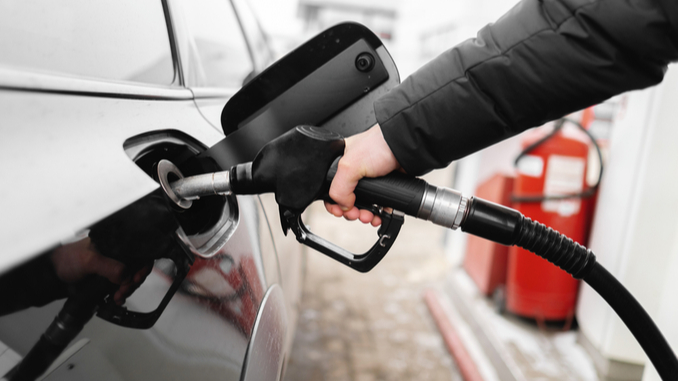
Republicans in the Arizona Senate are moving on legislation they believe will reduce gas prices.
A strike everything amendment to HB 2400 proposes to mitigate price spikes at the pump by filing an emergency waiver to increase Maricopa County’s fuel supply during emergencies.
Arizona policymakers anticipate prices to spike with pending supply constraints due to a forecasted California refinery closure in April. Federal environmental regulations require Valley drivers to use a more expensive and limited specialized fuel blend year-round, a requirement that expands to affect residents elsewhere in the state during the summer months.
Should the bill be enacted, the Department of Environmental Quality and the Arizona Department of Agriculture would submit an emergency fuel waiver to the Environmental Protection Agency (EPA) within 30 days.
State Sen. Shawnna Bolick (R-LD2) introduced the strike everything amendment. Bolick said the state does have recourse, but it’s up to executive leadership to allow for the remedy to occur.
“We see the warning signs. Refineries are shutting down, and if we don’t act now, prices will go up. HB 2400 will make sure Arizona can quickly access additional fuel when shortages hit, instead of waiting and hoping for relief,” said Bolick in a press release.
According to Stanford University’s Woods Institute for the Environment, the California refinery shutdowns were caused by multiple factors: depleting crude oil fields, declining in-state gasoline sales, consolidating oil infrastructure, and increasing availability of imported finished fossil fuel products.
A similar issue occurred in 2023. Gov. Katie Hobbs declined to file an emergency fuel waiver with the Biden administration despite a request from petroleum refiner HF Sinclair.
The company’s senior vice president, Jerry Miller, advised Hobbs in a letter of a critical supply shortage of several counties’ Cleaner Burning Gasoline (CBG), the special gasoline formulations required in certain parts of the state by the EPA under the Clean Air Act (CAA).
These formulation requirements are laid out in Arizona’s State Implementation Plan (SIP). The SIP establishes different CBG requirements depending on the season. CBG is required in Maricopa County and certain parts of Pinal and Yavapai counties year-round (called “Area A”). CBG requirement expands to include more of Pinal County during the summer months of May through September (called “Area C”).
As in 2023, it will mostly be Maricopa County drivers who will feel the brunt of forecasted supply constraints.
Senate lawmakers will also consider HB 2955, which would expand the state’s fuel options by modifying the state’s fuel standards for CBG in order to expand supply options.
Sen. Bolick shared that she and other Republican lawmakers have laid the groundwork with the Trump administration to ensure that the fuel standard updates and emergency fuel waiver would be processed immediately upon filing.
“We are coordinating with the Trump Administration so Arizona is ready to act the moment these bills are signed into law,” said Bolick. “This is about getting ahead of the problem and making sure families aren’t stuck paying the price for decisions made in other states.”
AZ Free News is your #1 source for Arizona news and politics. You can send us news tips using this link.
State Representatives David Marshall (R-LD7) and Ralph Heap (R-LD10) introduced House Bill 2269, a measure to eliminate the state sales tax on electric and gas utility bills for Arizona residents and businesses.
The proposed legislation would suspend the state’s 5.6% sales tax on electricity and natural gas utilities until either $2.3 billion in cumulative tax relief has been provided to Arizonans or December 31, 2046—whichever comes first.
Once the $2.3 billion threshold is reached, the Legislature would then decide whether to extend, modify, or reinstate the exemption.
“People are getting crushed by rising costs, making it harder to live and do business in our state,” said Representative Marshall. “Almost everyone pays a local utility for electricity or gas. Eliminating the tax on this expense represents one of the most immediate and direct ways we can help working families keep costs affordable.”
The 5.6% tax on electricity and gas quietly adds up on monthly bills, leaving the average household paying more than $100 a year in utility tax—funds that could instead support necessities like groceries, housing, and childcare.
Representative Marshall highlighted a structural concern with the current system: “Taxing electric and gas utilities creates a perverse incentive for the government to support increased rate hikes. If rates go up, the state gets more money. That leads some to view rate increases as a source of potential funds for their liberal pet projects. That’s not right; it’s time to put the people of Arizona first.”
“While we’re unsure of any legal way to get ratepayers’ money back, there are things we can do to help reduce costs today,” Marshall continued. “In my opinion, the next best thing we can do is try to provide justice by eliminating taxes on electric and gas utilities moving forward. That’s why, over the next 20 years, we are proposing no state tax on utilities until every penny of the $2.3 billion that was wrongfully extracted from the Arizona ratepayer is metaphorically ‘paid back’ to hardworking families.”
He added, “This bill will save most residents between $100 and $120 per year, on average. Once the $2.3 billion threshold has been met, then the state can determine what it wants to do with the exemption from there, including whether to reassess the tax or extend the exemption even further.”
Representative Heap pointed to actions taken by the Arizona Corporation Commission as the basis for the bill’s $2.3 billion figure: “In 2006, Arizona Corporation Commissioner Kris Mayes catered to outside special interests and adopted expensive renewable energy surcharges that cost ratepayers more than $2.3 billion over the last 20 years. This special interest slush fund also led to foreign-owned boondoggles like the Solana Generating Station, which Kris Mayes personally supported, and which cost ratepayers more than three times the above-market rate of power.”
“While repealing these mandates may help to prevent new costs,” Heap added, “it will do nothing to compensate customers for the unjust surcharges that Kris Mayes forced ratepayers to pay over the last 20 years.”
Ethan Faverino is a reporter for AZ Free News. You can send him news tips using this link.
California is poised to lose a significant portion of its oil refining capacity by the end of 2026, as Valero announced the closure of its Benicia refinery—its second largest in the state—just months after Phillips 66 declared plans to shut down its Los Angeles facility. Together, the closures will eliminate roughly 17.4% of California’s total refining output, a shift expected to ripple beyond state borders, potentially triggering gasoline price spikes and supply disruptions in neighboring Arizona and Nevada.
These developments come on the heels of new state regulations introduced under Governor Gavin Newsom, which impose strict oversight on refinery operations. The rules limit when refineries can conduct maintenance, mandate increased inventory storage, and aim to curb perceived “price manipulation.” However, the energy industry and regional leaders argue these measures are accelerating refinery shutdowns and undermining fuel stability across the Southwest.
California operates as an “energy island,” with limited ability to import refined fuel from other U.S. regions due to the federal Jones Act, which restricts domestic shipping to U.S.-built and -crewed vessels. With U.S. shipbuilding capacity far behind that of countries like China, domestic maritime transport remains scarce and costly. As a result, California will increasingly rely on foreign tanker ships for fuel imports—an emissions-intensive, volatile, and expensive solution.
Governor Newsom claims California’s high gas prices are due to refinery “price gouging,” despite his own administration’s lack of evidence. His regulatory push has faced bipartisan opposition, including a joint letter from Arizona Governor Katie Hobbs and Nevada Governor Joe Lombardo warning that new refinery laws could lead to “higher costs for consumers” in all three states. Chevron echoed this concern, stating that the regulations would increase both the likelihood and duration of fuel shortages, while permanently raising consumer prices.
Refineries in California are already operating at or near full capacity. With no new facilities planned—especially as the state pushes to ban new gas-powered car sales by 2035—any closure tightens supply margins. The upcoming shutdowns will reduce daily refining capacity to 1.34 million barrels, well below the state’s consumption level of 1.8 million barrels per day, necessitating a shortfall of over 140 million barrels per year.
Due to California’s requirement for a specialized gasoline blend, few out-of-state refiners can meet demand, further narrowing supply options. These vulnerabilities were recently exposed when the temporary shutdown of the Martinez refinery sent gas prices soaring across the region, including in Arizona and Nevada.
With California gas prices already the nation’s highest—averaging $4.86 per gallon—experts warn that future supply shocks could bring about even more dramatic volatility and potential fuel shortages across the Southwest.
Jonathan Eberle is a reporter for AZ Free News. You can send him news tips using this link.
Things are just not going well for the leftwing activist groups, billionaire-funded NGOs and trial lawyer firms who have recruited a growing number of state and local government entities to sue U.S. oil and gas companies involving specious claims for damages caused by climate change. In recent months, the lawfare campaign, coordinated mainly from the offices of one San Francisco-based firm, has suffered a series of adverse judicial decisions in what appears to be a rising consensus in the nation’s courts.
Just two weeks after suffering a major setback in a decision involving Anne Arundel County, Maryland, the pushers and funders of this lawfare campaign were tossed out in a case targeting ExxonMobil, Chevron and additional defendants in New Jersey. There, Superior Court Judge Douglas H. Hurd dismissed the Garden State’s lawsuit with prejudice based on the same federal primacy arguments which prevailed in recent decisions in New York City and Baltimore, as well as in the Anne Arundel case.
In seeking damages, New Jersey adopted similar tactics adopted in the other cases that make up this lawfare campaign, claiming they’ve been harmed by “climate change” impacts allegedly caused by the emissions by oil companies, but attempting to couch the damages as violations of state laws unrelated to air pollution. But Hurd was having none of it.
“Despite the artful pleading by the Plaintiffs in this case,” the judge says in his decision, “this court finds that Plaintiffs’ complaint, even under the most indulgent reading, is entirely about addressing the injuries of global climate change and seeking damages for such alleged injuries.”
The problem for the states, cities and counties who have signed up for this lawfare campaign in the hopes of grabbing some big bucks from Big Oil is that their arguments inevitably amount to a local effort to de facto regulate air quality, an area of regulation in which the federal government has always asserted its primacy. There’s a very good reason for this: If every city, county and state in America were allowed to regulate air quality, the economy would soon grind to a halt as it becomes impossible to do business in this country.
Like the judges in the other cases decided thus far, Hurd conceded to that reality in dismissing the New Jersey case, saying, “As Defendants state in their moving brief, ‘the federal system does not permit a State to apply its laws to claims seeking redress for injuries allegedly caused by interstate or worldwide emissions,’” adding, “In conclusion, only federal law can govern Plaintiffs’ interstate and international emissions claims because ‘the basic scheme of the Constitution so demands.’”
The decision in the New Jersey case no doubt comes as a real disappointment for the billionaire-funded foundations and NGOs who spent years pushing for the state attorney general’s office to bring a case. In 2023, Energy Policy Advocates obtained emails detailing tactics employed by the Rockefeller-funded Center for Climate Integrity (CCI) to convince various cities and counties in the state to sign onto the lawfare campaign.
Those emails revealed close coordination between CCI and New Jersey officials, even to the extent of CCI funding an “Accountability University” to educate lawfare participants about the best tactics and talking points to deploy in their big money grab efforts.
CCI even offered to “ghost write” opinion pieces for public officials and “serve as an extra set of hands,” adding, “…there are absolutely no legal obligations. Since we are a 501 c3, there is no pledge or legal sign on’ required. Rather, we view ourselves as an extra set of hands to help public officials…”
So, what’s the point of all this, you might ask? Well, the point is that when you see one of these lawsuits brought by a city, county or state government, just know that none of this is happening organically. Also know that this big money grab costs these companies millions to defend themselves, and we all end up paying for it at the gas pump and in our home utility bills. Maybe it’s time we all demand these billionaires and trial lawyers find more productive ways to spend their time and money.
David Blackmon is a contributor to The Daily Caller News Foundation, an energy writer, and consultant based in Texas. He spent 40 years in the oil and gas business, where he specialized in public policy and communications.
During his campaign and since taking office, President Donald Trump often repeated his desire to bring back the same “drill, baby, drill” oil and gas agenda that characterized his first term in office.
But that term began 8 long years ago and much has changed in the domestic oil business since then. Current market realities are likely to mitigate the industry’s response to Trump’s easing of the Biden administration’s efforts to restrict its activities.
Trump’s second term begins as the upstream segment of the industry has enjoyed three years of strong profitability and overall production growth by employing a strategy of capital discipline, technology deployment and the capture of economies of scale in the nation’s big shale play areas. Companies like, say, ExxonMobil and Oxy and their peers are unlikely to respond to the easing of government regulations by discarding these strategies that have brought such financial success in favor of moving into a new drilling boom.
This bias in favor of maintenance of the status quo is especially likely given that the big shale plays in the Permian Basin, Eagle Ford Shale, Bakken Shale, Haynesville and the Marcellus/Utica region have all advanced into the long-term development phases of the natural life cycle typical of every oil and gas resource play over the past 175 years. Absent the discovery of major new shale or other types of oil-or-natural gas-bearing formations, a new drilling boom seems quite unlikely under any circumstances.
One market factor that could result in a somewhat higher active rig count would be a sudden rise in crude oil prices, if it appears likely to last for a long period of time. Companies like Exxon, Chevron, Oxy and Diamondback Energy certainly have the capability to quickly activate a significant number of additional rigs to take advantage of long-term higher prices.
But crude prices are set on a global market, and that market has appeared over-supplied in recent months with little reason to believe the supply/demand equation will change significantly in the near future. Indeed, the OPEC+ cartel has been forced to postpone planned production increases several times over the past 12 months as an over-supplied market has caused prices to hover well below the group’s target price.
But it is wrong to think the domestic oil industry will not respond in any way to Trump’s efforts to remove Biden’s artificial roadblocks to energy progress. Trump’s efforts to speed up permitting for energy projects of all kinds are likely to result in a significant build-out of much-needed new natural gas pipeline capacity, natural gas power generation plants and new LNG export terminals and supporting infrastructure.
Instead of another four years of “drill, baby, drill,” the Trump efforts to speed energy development seem certain to result in four years of a “build, baby, build” boom.
Indeed, the industry is already responding in a big way in the LNG export sector of the business. During Trump’s first week in office, LNG exporter Venture Global launched what is the largest energy IPO by value in U.S. history, going public with a total market cap of $65 billion.
With five separate export projects currently in various stages of development, all in South Louisiana, Venture Global plans to become a major player in one of America’s major growth industries in the coming years. Trump’s Day 1 reversal of Biden’s senseless permitting pause on LNG infrastructure is likely to kick off a number of additional LNG projects by other operators.
The Trump effect took hold even before he took office when the Alaska Gasline Development Corporation entered into an exclusive agreement in early January with developer Glenfarne to advance the $44 billion Alaska LNG project. The aim is to start to deliver gas in 2031, with LNG exports following shortly thereafter.
America’s oil and gas industry has demonstrated it can consistently grow overall production to new records even with a falling rig count in recent years. Now it must grow its related infrastructure to account for the rising production.
That’s why Trump’s “drill, baby, drill” mantra is likely to transform into “build, baby, build” in the months and years to come.
David Blackmon is a contributor to The Daily Caller News Foundation, an energy writer, and consultant based in Texas. He spent 40 years in the oil and gas business, where he specialized in public policy and communications.