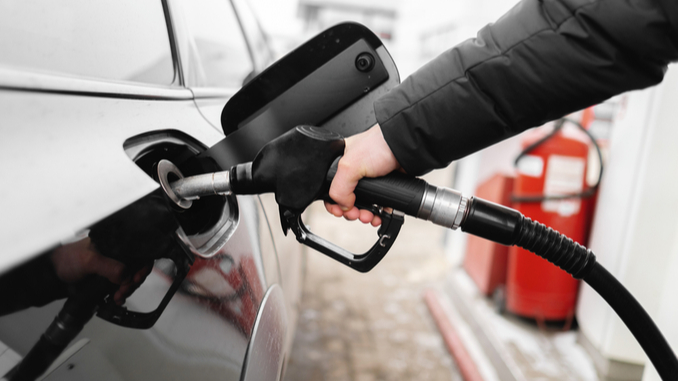
For Maricopa County motorists, high gasoline prices are no longer an occasional inconvenience but a recurring hit to their wallets.
The story is the same every year. Every summer as temperatures rise, prices at the pump jump as well, often by as much as fifty cents per gallon in Maricopa County. Yet these price fluctuations, as frustrating as they have been for drivers, may soon look mild compared to what’s coming.
Arizona’s Historic Fuel Problem Will Only Get Worse In the Future
Arizona’s chronically high gas prices have been driven by two key factors. The first is that Maricopa County is required to use a specialized “clean burning gasoline” (CBG) blend that only a handful of refineries from around the country can produce. Compounding this issue is that Arizona does not have any in-state refining capacity of our own, making us reliant on imported refined fuel from high-cost California.
These complications have made our state vulnerable to price shocks. In 2003, a major pipeline failure limited gasoline shipments into Arizona and caused immediate price spikes and shortages.
In 2022, while gas prices did increase throughout the nation due to the Russian invasion of Ukraine, Maricopa County motorists were hit with significant price spikes, and consistently paid far above the national average. In 2023 and again in 2024, price volatility in Phoenix surged even when national averages stabilized.
Arizona House Republicans on the Natural Resources, Energy, and Water Committee have taken action to address skyrocketing gas prices and utility bills, passing a sweeping package of bills designed to lower fuel costs, enhance energy reliability, and defend ratepayers.
✅House Republicans Advance Energy Affordability Package to Lower Costs for Arizona Families
“The cost of living for Arizona families, including gas and electricity, continues to increase, and Republicans are acting. This package puts affordability first by lowering fuel costs,… pic.twitter.com/4a3T1JOIPo
Under the leadership of Chairman Gail Griffin (R-LD19), the measures align with the House Republican Majority Plan’s core priorities of unleashing economic prosperity, promoting government efficiency, and protecting individual rights and liberties.
The legislation, which advanced on a party-line vote with Democrats in opposition, targets the challenges faced by Arizona families, particularly in Maricopa and Pinal Counties, where severe summer fuel blend requirements have driven up prices at the pump. By prioritizing affordability and reliable power, these bills aim to ease the financial burden on households amid rising energy demand.
“The cost of living for Arizona families, including gas and electricity, continues to increase, and Republicans are acting,” stated Chairman Griffin. “This package puts affordability first by lowering fuel costs, protecting ratepayers from higher utility bills, and making sure Arizona has dependable power as demand grows. The Majority Plan is clear: government should work to ease the cost burden on families, not make them worse.”
Bills Tackling High Gas Prices
HB 2145 (Rep. Griffin): Amends motor fuel statutes to empower the President of the Senate and Speaker of the House to jointly request EPA fuel waivers during shortages if the Governor does not act, providing a defense against price surges.
HB 2400 (Reps. Willoughby, R-LD13, and Biasiucci, R-LD30): Implements a seasonal suspension of the state’s 18-cent gas tax from May through September in Maricopa and Pinal Counties. The bill ensures local governments are reimbursed for lost highway revenue through allocations from the Arizona Highway User Revenue Fund, including $27.588 million to counties, $39.93 million to cities and towns, and $5.082 million to larger municipalities. It also includes an emergency clause for immediate implementation and exempts the Department of Transportation from rulemaking for one year.
HB 2696 (Rep. Willoughby): Directs the Arizona Commerce Authority to prioritize reducing fuel and gas prices as its primary objective for two years, expiring December 31, 2029. The authority must collaborate with the oil and gas industry to study repealing the cleaner-burning gasoline blend, building new pipelines, establishing a strategic reserve, and exploring in-state refineries, including reviving a proposed facility in Yuma County. Status updates will be provided to legislative committees, with a final report due by October 1, 2026.
HB 2955 (Rep. Willoughby): Amends motor fuel standards to end the expensive summer fuel blend in populous counties, subject to EPA waiver under the Clean Air Act. It allows for gasoline compliant with ASTM D4814 and vapor pressure limits, addressing supply shortages and enabling lower-cost alternatives.
HCM 2008 (Rep. Willoughby): A concurrent memorial urging Congress and the EPA to eliminate the federal gas tax on Arizona’s cleaner-burning gasoline in Maricopa and Pinal Counties from May to September or grant the EPA administrator emergency waiver authority for costlier blends. This recognizes Arizona’s progress toward National Ambient Air Quality Standards while highlighting the undue tax burden on specialized fuels.
Supporting these efforts are additional bills to promote long-term solutions:
HB 2014 (Rep. Fink, R-LD27): Requires the Department of Environmental Quality (ADEQ) and Arizona Department of Agriculture to conduct air emissions modeling and feasibility studies on alternative gasoline blends, including federal reformulated, California phase 3, and conventional options. Reports must be published by September 30, 2027, with $100,000 appropriations each for modeling and studies.
HB 2401 (Willoughby and Biasiucci): Mandates biennial reviews by ADEQ of fuel formulations available under federal standards, assessing air quality impacts in regulated areas, and submitting recommendations to the Department of Agriculture, the Governor, the President of the Senate, the Speaker of the House, and the Secretary of State by December 31 of each review year.
HB 2428 (Griffin): Authorizes voluntary mobile emissions reduction credit programs, permitting emissions credits for nonroad engines under Clean Air Act guidelines, with permits issued by ADEQ for up to 20 years, supported by chambers of commerce, utilities, and Maricopa County.
“Today we heard from organizations with the time and resources to lobby against affordable prices for Arizona families, but not from the families paying more at the pump,” explained Majority Whip Julie Willoughby. “Working families cannot take time off to come to the Capitol and ask for relief; that is why we are here to help be their voices.”
“Eighteen cents a gallon may sound small to some, but it matters to families trying to make ends meet,” Willoughby added. “I will do everything in my power to deliver relief now while we continue working to fix the fuel blend and supply problems. Families need lower prices, not excuses.”
Bills Ensuring Energy Reliability and Ratepayer Protections
HB 2331 (Reps. Marshall, R-LD7 and Heap, R-LD10): Renames and expands energy reliability statutes to require public power entities and service corporations to prioritize domestically produced fuels, minimize foreign reliance, and evaluate resources for affordability, reliability, and cleanliness. Defines “clean energy” to include low-emission sources like nuclear and natural gas, with reliable sources needing at least 50% capacity factor and rapid ramp-up capabilities. The bill emphasizes hydrocarbons and finds domestic sourcing essential for public health and safety.
HB 2756 (Reps. Griffin and Blackman, R-LD7): Adds provisions for public power entities and electric corporations to report quarterly on new extra-high load factor customers, including interconnection requests and completions. These customers must be factored into load growth projections. The Arizona Corporation Commission (ACC) is directed to adopt rules on contracts, minimum billing, and pre-execution reviews to protect other ratepayers, excluding member-owned cooperatives. Requires cost-of-service studies within 180 days and an ACC workshop within 90 days to assess impacts on residential bills and potential new customer classes.
These bills now advance for further legislative consideration.
Ethan Faverino is a reporter for AZ Free News. You can send him news tips using this link.
The Republican faction of Congress’ Joint Economic Committee (JEC) reported inflation as “hold[ing] steady” in its monthly update released last week.
JEC Republicans reported in a press release accompanying the update that the Consumer Price Index (CPI) “remained relatively steady” at just under 2.7 percent year over year in December.
The coalition stated that November’s end CPI (2.74 percent) represented “the biggest [inflation] drop” since March 2025.
Food and energy prices went up by half a percent to almost three percent from 2024 to 2025, respectively; the latter by far outpacing the former.
Food price inflation hit 3.07 percent, up .56 percent year over year. Energy price inflation hit 2.30 percent, up by 2.82 percent year over year.
The headline CPI-U remained relatively steady ending at 2.68% y/y in December, meeting expectations. Core CPI, which excludes food & energy, was 2.64% y/y, compared to 2.63% in November. Y/y, food price inflation was 3.07%, up 0.56pp & energy price inflation was 2.30%, up by…
— Joint Economic Committee Republicans (@JECRepublicans) January 13, 2026
These price increases were felt differently based on region. Those in the Northeast were hit hardest by inflation (3.3 percent), then the West (2.9 percent), and then the Midwest (2.7 percent). The South felt it the least of all the regions, with inflation hitting 2.2 percent.
Income year over year overall saw increases: an increase in 1.07 percent for all employees and a .57 percent increase in weekly earnings. There was a “virtually unchanged” decline in hourly earnings of .01 percent.
President Donald Trump broke down this latest report as part of his address on the state of the economy in Detroit last Tuesday.
Trump said the U.S. has experienced “the greatest year in history” in terms of its finances.
“Under our administration, growth is exploding, productivity is soaring, investment is booming, incomes are rising, inflation is defeated. America is respected again like never before,” said Trump. “There’s never been numbers like this.”
Trump said the stagflation (low growth, high inflation) that took place under his predecessor, Joe Biden, was “a disaster” for the country. Trump claimed the current economy has “the highest growth” it’s ever had.
“The Trump economic boom has officially begun,” said Trump.
The president said he would work with Venezuela on oil, and aims to reduce gas prices beyond its current six-year low.
Trump called Federal Reserve Chairman Jerome Powell “a real stiff.” He expressed a desire to have a high-performing market matched with lower interest rates, not higher — he said the former arrangement was the norm years ago.
“Our growth potential is unlimited and could be much higher if we went back to sanity,” said Trump. “We announce good numbers and we see the stock market drop. And I say ‘What the hell is going on?’”
Trump said he secured commitments for over $18 trillion in new investments into the country, compared to Biden’s under $1 trillion secured in four years.
A White House press release following Trump’s remarks maintained that the latest inflation report came in below economists’ expectations. Their statement compared Trump’s core inflation (2.4 percent) as “much lower” than former President Joe Biden’s 3.3 percent annual rate.
Their summary also emphasized that wages are “rising” on track to four percent: an estimated $1,100 real wage gain among private sector workers, and $1,300 real annual earnings gain among goods-producing workers.
AZ Free News is your #1 source for Arizona news and politics. You can send us news tips using this link.
As families across the nation prepared for Thanksgiving travel, gas prices provided relief at the pump, holding steady around $3 per gallon and marking the lowest levels in years.
According to data from fuel savings tracker GasBuddy and the American Automobile Association (AAA), the national average for regular unleaded gasoline has fallen significantly in 2025, with some stations even offering prices under $2 per gallon for the first time since 2021.
This year’s average price stands at $3.12 per gallon so far, down from $3.31 in 2024 and $3.52 in 2023. The decline follows a peak above $5 per gallon in June 2022, reflecting a steady downward trend that has eased the financial burdens on drivers around the country.
One year ago, the average was $3.06, matching the price of October 2025, with only minor fluctuations of a few cents this pre-Thanksgiving week.
The Trump administration has highlighted these reductions as a direct result of its energy policies since President Donald Trump’s return to the White House.
In October, the White House issued a statement celebrating GasBuddy’s report that national averages had slipped below $3 per gallon – the lowest in four years.
Head of petroleum analysis at GasBuddy, Patrick De Haan, said, “It’s pretty compelling to see gas prices this low, falling ahead of Thanksgiving, and it signals what more Americans could experience in the coming months. Lower seasonal demand, falling oil prices, and rising OPEC output are all pushing prices down. While a few stations have recently dipped below $2 through temporary offers and promotions, this marks the first time we’ve seen a regular sub-$2 price.”
The lowest gas price in the country is now $1.99, available at four stations in Midwest City, Oklahoma, part of the Oklahoma City metro area. Reported on Monday, November 24, these are the first prices below $2 nationwide without discounts or promotions, marking the lowest U.S. prices since 2021.
In Arizona, gas prices have remained remarkably stable in recent weeks, with the current average for regular unleaded at $3.336 per gallon – just 4 cents below what it was a week ago ($3.380). Compared to October ($3.339), regular prices have essentially held flat, while showing a modest year-over-year increase of 12.2 cents from $3.214.
Ethan Faverino is a reporter for AZ Free News. You can send him news tips using this link.
The Environmental Protection Agency officially proposed to terminate what President Trump has long called the “climate hoax.” If successful, the federal government will be out of the climate regulation business with no hope of returning to it without congressional authorization.
The Trump EPA proposed to rescind a 2009 Obama EPA rule called the “endangerment finding.” In that rulemaking, the Obama EPA determined that emissions of greenhouse gases threatened human health and welfare by causing global warming. Simultaneously with the EPA proposal, the Trump Department of Energy issued a scientific report summarizing why emissions are actually a good thing and threaten nothing.
The scientific findings, however, are superfluous since EPA never had express authority from Congress to regulate greenhouse gases under the Clean Air Act in the first place. Controversy and litigation about EPA’s authority to regulate greenhouse gases resulted in the 2007 Supreme Court decision in Massachusetts v. EPA. In that case, the Court determined in a 5-4 holding that EPA could, but did not have to, regulate emissions.
But the decision was controversial. Clean Air Act co-author and famed Democrat Congressman, the late John Dingell, afterwards stated: “I think the Supreme Court came up with a very much erroneous decision on whether the Clean Air Act covers greenhouse gases. I was present when we wrote that legislation and we thought it was clear enough that it did not, and we didn’t clarify it thinking that even the Supreme Court was not stupid enough to make that finding.”
Following the decision, the Bush EPA decided that it would not regulate emissions. When the Obama administration came into power in 2009, it reversed the Bush EPA’s decision and began using the endangerment finding as the basis for regulation of smokestack and tailpipe emissions of greenhouse gases.
Although many questioned the scientific basis of the Obama EPA’s decision, it was impossible to get a judicial hearing on the science. Federal judges informally decided decades ago that they would defer to regulatory agency decisions on questions of science.
With the endangerment finding apparently firmly in place, the Obama administration, and later the Biden administration, proceeded to regulate tailpipe and power plant emissions of greenhouse gases.
Cracks in the ability of EPA to use the endangerment finding soon began to appear. In 2014, the Supreme Court determined that the Clean Air Act did not authorize EPA to use the endangerment finding to regulate emissions of greenhouse gases from industrial smokestacks. In 2022, the Supreme Court in West Virginia v. EPA nullified an effort to regulate emission from power plants, holding that EPA could not launch major regulatory programs without express congressional authorization.
Today, all that remains of EPA’s endangerment finding-based rules are tailpipe regulations in the form of the Biden EPA’s de facto EV mandate, a rule that the Trump administration is in the process of reversing.
Since the Obama EPA made the endangerment finding, electricity prices have soared. Gas prices and inflation soared during the Biden administration. Tens of thousands of high-paying coal miner jobs have been destroyed and their communities devastated.
Our electricity grid has been made less reliable by the advent of existentially subsidized wind and solar power. Periods of peak electricity demand like summer heat waves and winter cold spells now routinely result in blackout/brownout warnings. This problem will get worse before it gets better with the ongoing electricity demand from AI data centers and the re-industrialization of America.
Blue states and their climate activist allies will no doubt sue the Trump EPA to stop the rescission of the endangerment finding. But all this will accomplish is the Supreme Court almost certainly reversing its original sin committed in Massachusetts v. EPA. Some of us can’t wait.
Steve Milloy is a contributor to The Daily Caller News Foundation, a biostatistician, and lawyer, who publishes JunkScience.com and is on X @JunkScience.