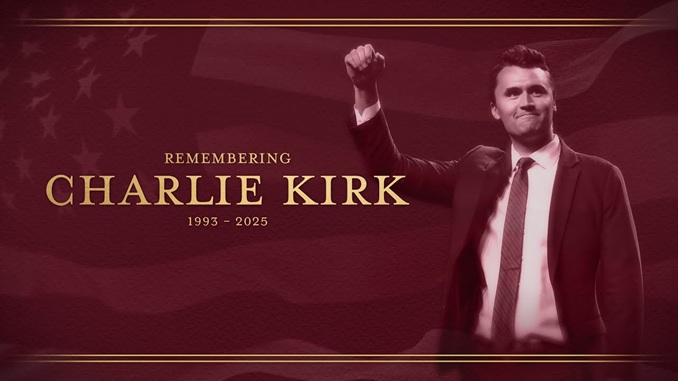
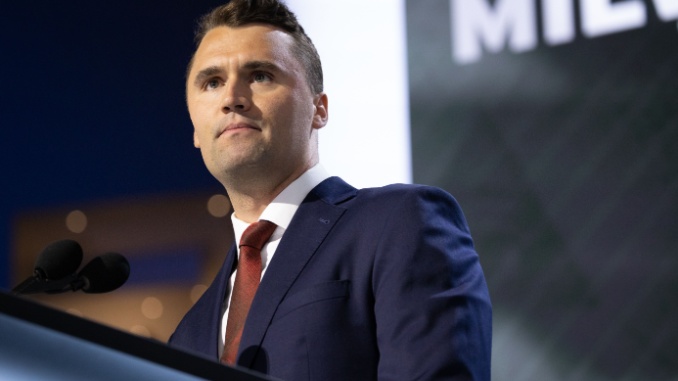
Earlier this year, I introduced a bill in the legislature to designate one of our state’s busiest freeways, Loop 202, as the Charlie Kirk Loop 202, in honor of the life, work, and legacy of an Arizonan whose voice, energy, and commitment to civic engagement resonated across this state and throughout the nation. Charlie stood unapologetically for free speech, open debate, and civic participation. For future generations to understand and celebrate those ideals, this bill must become law.
Charlie Kirk devoted his life to public discourse and political participation. He traveled the country—and even the world—engaging Americans, especially young people, in robust discussion on the issues that shape our future. Even as opinions diverged, he believed Americans could—and must—engage one another civilly and respectfully, anchored in the principles of free speech and civic responsibility. This belief has been under serious assault, with a growing number of Americans looking to silence their opponents and disagreeable viewpoints, rather than looking for common bonds that should unite us. Charlie rejected this dangerous mindset, and he relentlessly searched for avenues and platforms to reverse this dangerous trend.
On September 10, 2025, Charlie was speaking at an event in Utah when he was fatally and tragically shot—assassinated for exercising free speech in the heart of a college campus, which he had done hundreds of times during his shortened life. His death was an act of political violence and terror that shocked our nation and renewed discussions on the importance of preserving civil discourse. Millions across the country mourned his passing and sought to understand more about his thinking and prolific writings about countless issues of moral, societal, and political importance.
Charlie understood better than most the beauty and necessity of the First Amendment—even acknowledging that he might have to pay the ultimate price for his willingness to engage the masses. He believed disagreement should be met with dialogue, not division. He believed vigorous debate strengthens our republic rather than weakens it, and that Americans can still find common ground even when deep divisions exist. His dedication to these ideals inspired millions and encouraged countless individuals to participate actively in civic life. Few public figures reached young Americans the way Charlie did, and his influence was only growing as he worked tirelessly to re-elect President Donald J. Trump to the White House in 2024.
Arizona was not only Charlie’s home. It was where he built an organizational empire with international reach as a teenager, where he raised a family, and developed a national following among young Americans. Charlie’s tremendous impact on America was evident as two large stadiums of people showed up to pay their respects at his memorial. In fact, Charlie posthumously received the honor of the largest memorial service our state had ever seen in its history. Never has an Arizona citizen received so much respect and adoration from its citizens. And all of the bestowed honors were richly and rightly earned by a man who had done so much to restore our nation to the spirit of our Founding Fathers when they fought to give us a new nation, conceived in liberty, and dedicated to the proposition that all men are created equal.
Designating Loop 202—the roadway that carries hundreds of thousands of drivers each day—as the Charlie Kirk Loop 202 ensures that his contribution to civic engagement, free speech, and the public square will not be forgotten. This highway winds through the Valley of the Sun, which encompasses the fifth-largest city in the United States, serving not only Arizonans but visitors from across the nation and abroad. It would be a great tragedy if this legislation failed because of partisan obstinance. Instead, let us unite across party affiliations to resolve that this name will stand as a daily reminder of the principles he lived for and the importance of peaceful civic participation. It’s only right that the state Charlie called his home gives back to a patriot who sacrificed his life to promote and defend our God-given right to free speech.
A federal judge has allowed key claims to proceed in the civil rights lawsuit filed by Rebekah Massie, a Surprise, Arizona, resident who was arrested after criticizing a city attorney’s salary during a city council meeting.
According to the Foundation for Individual Rights and Expression (FIRE), Judge Roslyn O. Silver of the U.S. District Court for the District of Arizona ruled this week that Massie’s First Amendment, Fourth Amendment, and Arizona Open Meeting Law claims will move forward into discovery. The lawsuit stems from an August 2024 city council meeting in Surprise, where Massie was removed, arrested, and charged with trespassing after criticizing the pay of a government attorney during public comment. She was later taken to a detention center.
LAWSUIT: With FIRE’s help, an Arizona mom is suing the City of Surprise, AZ., after the mayor ordered her arrest for questioning a pay raise for a city official.
In America, the last thing citizens should fear when they attend public meetings is leaving in handcuffs. pic.twitter.com/ox6EyEiVAW
FIRE said the city did not challenge Massie’s federal constitutional claims in its motion, allowing those claims to proceed. The judge also permitted Massie’s Open Meeting Law claim to move forward, noting that Arizona law places express limits on how government bodies may regulate public comment during meetings.
Several state law claims were dismissed, according to FIRE, after the court determined they were duplicative of the constitutional claims and barred under Arizona’s notice-of-claim statute.
FIRE attorney Adam Steinbaugh said the organization will continue pursuing the case.
“We’re going to continue to fight not only to vindicate Rebekah’s constitutional rights, but to ensure that all Arizonans are free to speak their minds. All of us have the right to criticize our government without being arrested.”
The ruling marks the latest development in a case that has already prompted changes from the City of Surprise.
In September 2024, the Surprise City Council voted to repeal its policy prohibiting criticism of public officials during meetings following public backlash and the filing of the lawsuit. The following month, a judge dismissed the criminal trespassing charge against Massie, calling the government’s suppression of her speech “objectively outrageous.”
According to FIRE, body-camera footage later released showed a Surprise police officer responding to Massie’s complaint that she had been thrown to the ground during her arrest by saying, “That’s what happens when you’re resisting arrest.”
The civil lawsuit against the City of Surprise and individual officials remains ongoing as the case enters the discovery phase.
Recently, the District of Columbia Court of Appeals Board of Professional Responsibility recommended the most drastic punishment—disbarment—for former U.S. Assistant Attorney General Jeff Clark over his private strategic counsel in the aftermath of the 2020 election. This complaint was pushed by liberal activists, showing the lengths they will go to punish individuals by going after their livelihoods despite the clear lack of criminal, unlawful, or unethical behavior.
Even past Attorneys General – William Barr, Jeff Sessions, and Michael Mukasey – filed an amicus brief to push back against this “dangerous precedent,” writing, “Disciplining Mr. Clark would open the door to charging federal lawyers with ‘dishonesty’ or ‘attempted dishonesty’ for statements made during oral arguments, theories in briefs, legal advice provided in memoranda, or even (as here) proposals in privileged internal draft documents and discussions. Such acts of political retribution would severely discourage lawyers from serving in the federal government and invite extraordinary dysfunction as federal lawyers constrain the advice they provide for fear of political retaliation by the Bar.”
Over the past decade, radical politicians and interest groups have weaponized the key to attorneys’ livelihoods over partisan disputes, as in Clark’s matter before the DC Appeals Board. These parties seek to bring their vengeance on conservative attorneys’ bar licenses, which allow them to do their jobs and provide for themselves and their families. The obvious intent of these attacks—which echo other attacks from the left such as debanking conservatives, voting against company directors, and threatening doctors’ licenses—is to terrorize and chill any conservative voices.
Attorneys are one of the most important groups to protect from these attacks because their entire job is to open the courthouse doors for their clients; if they are chilled by the left from representing certain groups, those groups will lose their constitutional rights to access the courts and have their causes zealously argued or even to receive legal advice in the first place. Simply put, if our nation is to exist in a society where attorneys feel free to perform the services their clients expect and deserve, we must enhance the protections for their licenses – especially from outside agitators who have no business engaging in this interference.
Perhaps no greater example can be found of this abuse of our judicial system than after the 2020 election in Arizona, when two respected attorneys found themselves facing legal complaints for their work to represent the Arizona Republican Party, as political officials across the country worked to hash out challenges to the hotly contested General Election. The most insidious part of the claims against these men wasn’t simply about the filings, but that a New Jersey Congressman, U.S. Representative Bill Pascrell, led the official accusations.
Most people, regardless of their understanding of our legal system, can apply good-old-fashioned common sense to conclude that lawsuits must be waged between two sides with a substantial nexus to the alleged misconduct. Yet, Pascrell had no connection to the case. He filed a complaint against the Arizona-based attorneys, which was ultimately dismissed. However, the damage was done to these attorneys’ reputations because of their fight to beat the frivolous charges from an unconnected, unhinged, partisan Democrat thousands of miles away.
Whether you agree or disagree with the efforts to extend litigation in the courts in the aftermath of the 2020 election, it is uncontestable that the left and their allies grossly abused their powers to assault, undermine, and intimidate attorneys who were attempting to do their jobs within a legal system enshrined by the American Constitution and laws. These tactics were experienced across the country, as President Trump and Republican-affiliated attorneys – like Jeff Clark – found themselves not only defending their clients but their livelihoods against increasingly personal and vicious attacks – from parties that, again, had no direct interest or tie to the case.
This reality was also seen more recently in the State of Montana, where dozens of charges were leveled against the Attorney General, the honorable and respected Austin Knudsen. The allegations were, in part, brought against Montana’s Attorney General for exercising his First Amendment right to criticize justices on the state’s Supreme Court as he worked to execute his constitutionally appropriated responsibilities to the people and legislature. Again, what was most egregious about this case was that one of the earliest steps was an ethical complaint being lodgedby a California-based attorney – hundreds of miles away from the action. Because of this complaint, Attorney General Knudsen is now fighting a serious suspension that could complicate his abilities to represent Montanans.
These cases, and plenty more, are why I have been working on legislation in Arizona to protect well-meaning, law-abiding, and ethical attorneys from fear of reprisal from outside radical left agitators. If eventually passed and signed into law, the bill would mandate [is it now law now? – no] that the State Bar of Arizona and the Supreme Court immediately dismiss all complaints against attorneys, where the complainant does not have an attorney-client relationship with the attorney or another substantial nexus to the attorney’s alleged violation or conduct, and where it is clear that the complaint is simply a difference of political opinion. In addition, I collaborated with the Arizona Supreme Court to change its rule that had allowed this persecution to take place. This reform is necessary for many good conservatives who deserve to work their profession without fear of political persecution. I’m grateful that the court made the right decision to strike the balance of protecting the public from bad attorneys while defending good attorneys from frivolous complaints.
If the events of the past decade, as our nation becomes more politically polarized, have taught us anything, it is that we must guard the legal profession to ensure that bad actors are not permitted to chase away good attorneys who are committed to doing their jobs. Not everyone will agree with the cases those attorneys assume — and that’s okay. Our nation’s judicial system, which allows parties to peacefully work out their disagreements, is part of what makes our nation the envy of the entire world. We should resolve to defend this proud institution from nefarious agitators who must not be allowed to interfere with or manipulate our hallowed judicial system.
Warren Petersen is the President of the Arizona State Senate and represents Legislative District 14.
Attorneys from the Goldwater Institute, representing the Center for Arizona Policy and the Arizona Free Enterprise Club, joined former Arizona Supreme Court Justice Andrew Gould on Thursday to challenge Proposition 211. The measure, called the “Voters’ Right to Know Act,” is being contested on the grounds that it violates the state Constitution’s protections for free speech and privacy.
In the wake of Turning Point USA co-founder Charlie Kirk’s assassination—and a decade marked by attacks on political figures—the security risks of effectively doxxing political donors loom large in the case.
If upheld, the law would force nonprofit groups that weigh in on ballot measures or reference incumbents near an election to publicly disclose their donors—not just names and amounts, but also home addresses and employers—in a searchable database.
In today’s climate of escalating political violence—from death threats and swatting to vandalism, arson, and even assassinations—a database like this could essentially become a “hit list.”
In the AZ Supreme Ct today w my @GoldwaterInst colleagues to defend free speech & privacy rights in the #Prop211 case. You can learn more about the case here https://t.co/AzcEiCOulg
And watch the oral argument live in a few minutes on the court’s website: https://t.co/dkcgE7KDHC
In a press release the Goldwater Institute explained its position stating, “While proponents of the Voters’ Right to Know Act say they’re simply combatting so-called ‘dark money’ in politics, it is clear to Goldwater and its clients — the Center for Arizona Policy, the Arizona Free Enterprise Club, and individual donors — that their real intent is to intimidate their political opponents into silence.”
“Arizona’s Proposition 211 is as un-American as it is dangerous. No one should be exposed to retaliation or violence simply for supporting causes they believe in,” said Jon Riches, Goldwater’s Vice President of Litigation. “The law also violates Arizona’s Constitution, which provides stronger protections for freedom of speech and privacy than even the U.S. Constitution. That’s why we at the Goldwater Institute believe the Arizona Supreme Court will ultimately strike down Proposition 211.”
Prop 211 is silencing free speech in Arizona!!!
At today’s press conference, Scot Mussi of the Arizona Free Enterprise Club explained how this vague and dangerous law forced us to curtail our speech last campaign cycle. Why? Because Prop 211 puts the privacy and safety of donors… pic.twitter.com/fgctJGt5K4
Arizona Free Enterprise Club President Scot Mussi added, “They’re afraid of the activist organizations out there. They’re afraid of politicians and others that want to exact retaliation because they simply support a position or belief that they disagree.”
Mussi characterized the law as “a dangerous threat to our right to free speech and association.”
“As drafted, the law can be used to unconstitutionally target and harass private citizens, including our organization and our supporters,” Mussi stated. “We are confident that the Supreme Court will recognize the danger this law poses and will rule in our favor.”
In a statement to AZ Free News in May, Mussi elaborated on the potential for political intimidation: “Both the U.S. Constitution and the Arizona Constitution guarantee citizens the right to speak freely, which includes the right to not be forced to speak. Prop 211 not only violates this right for donors by silencing them from supporting causes they believe in but impairs the speech of nonprofits like ours as well.”
Peter Gentala, President of the Center for Arizona Policy, stated in a press release that Proposition 211 “creates an atmosphere of fear among those who support nonprofits that engage in the most pressing issues in Arizona today.”
The tragic assassination of Charlie Kirk is not only the loss of a cultural leader, but also a chilling reminder of what happens when we confuse speech with violence. Kirk was a tireless champion of free expression, and his death underscores the urgent need to examine how the suppression of dialogue can set the stage for real violence.
In his own words, Kirk once warned: “When people stop talking, really bad stuff starts… when you stop having a human connection with someone you disagree with, it becomes a lot easier to want to commit violence against that group. What we as a culture have to get back to is being able to have reasonable disagreement where violence is not an option.” His words now read as both a prophecy and a plea for the culture of dialogue we so desperately need.
Suppressing Speech Is Not The Answer
Psychology teaches us that suppressing thoughts doesn’t eliminate them — it simply pushes them underground. Clinicians see this dynamic in individuals who repress emotions until they reemerge as passive aggression or even have destructive outbursts. The same pattern plays out in society: When people are told their perspectives are unspeakable, frustration grows, mistrust deepens, and the risk of acting out increases. Ironically, attempts to enforce “safe spaces” by silencing dissent often make communities more volatile. True safety comes from open dialogue, where conflict can be addressed directly rather than festering in silence.
The Danger Of “Social Justice Warrior” Rhetoric
When individuals adopt the mindset of “social justice warriors,” the very word “war” can take on a literal dimension. Combined with rhetoric that labels opponents as “Nazis,” “fascists,” or even as “threats to existence” for questioning prevailing ideologies, we create a psychological framework where violence feels like moral self-defense. Social psychologists call this groupthink — a process in which consensus becomes so rigid that dissenters can be irrationally cast as evil. Ingredients of groupthink include a belief in the moral superiority of the group, direct pressure on dissenters, strong outgroup stereotypes, and collective rationalization — all of which were present here. In such an atmosphere, attacking a speaker can feel like a righteous duty. Tragically, Kirk’s willingness to question aspects of trans ideology and other sacred cows of certain political groups placed him squarely in the crosshairs of this warped moral reasoning.
Words Are Not Violence
Words can sting, but they are not the same as physical harm. Equating speech with violence not only inflates anxiety but also undermines resilience. It conditions people to believe that discomfort is intolerable and that retaliation — even violent retaliation—is justified. By contrast, protecting free speech fosters self-efficacy — the belief in one’s ability to navigate challenges constructively. It strengthens authentic connection, reduces the loneliness that comes from self-censorship, and creates opportunities for genuine problem-solving.
Charlie Kirk’s assassination must be seen for what it is: a catastrophic failure to uphold the principle that dialogue is the antidote to violence, not its cause. As Kirk himself urged, the future of our culture depends on whether we can “have reasonable disagreement where violence is not an option.”
To honor his legacy, we must recommit to that vision — resisting the falsehood that words are violence — and embracing the truth that dialogue, even when difficult, is the path to peace. This is the very theme I explore in my book Can I Say That? Why Free Speech Matters and How to Use It Fearlessly, which offers psychological tools for protecting free speech and building the resilience that open dialogue requires. The book includes examples such as Andy Ngo and Riley Gaines, who have suffered violence for their speech — and tragically, Charlie Kirk is now added to that list in the worst possible way. I urge you to channel your grief into action — do not be silenced but use your voice and stand together. It’s exactly what Charlie would have wanted.
Dr. Chloe Carmichael is contributor to the Daily Caller News Foundation, a clinical psychologist, USA Today bestselling author of “Nervous Energy,” and a visiting fellow at Independent Women. Her upcoming book “Can I Say That? Why Free Speech Matters and How to Use It Fearlessly” (Skyhorse, Nov. 2025) explores the mental health benefits of open dialogue and the costs of self-censorship.