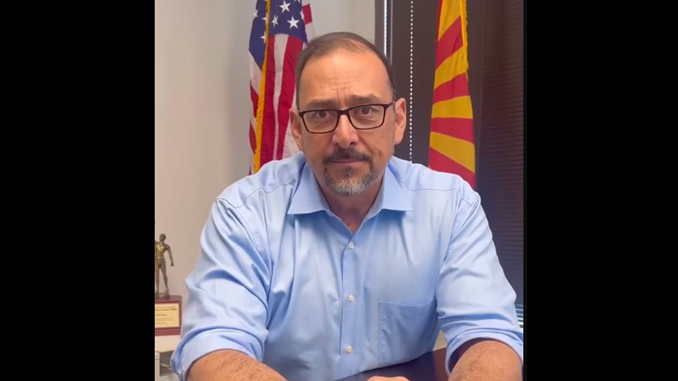
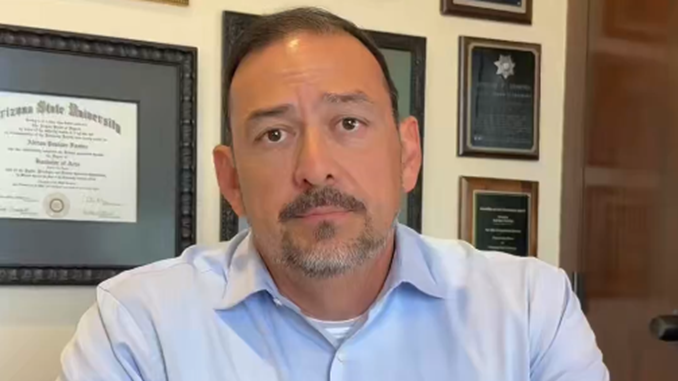
Secretary of State Adrian Fontes has released key records necessary to determine voter eligibility after his attempt to blame the federal government was disputed.
Fontes released those federal felony conviction reports on Tuesday after Maricopa County Recorder Justin Heap publicly contested Fontes’ explanation to county recorders as to why those records were missing.
Fontes reportedly claimed that the federal government hadn’t provided updated felony reports for about a year, telling ABC 15 that the Department of Justice (DOJ) was responsible for holdup and that Heap was engaging in “a purely political stunt.”
However, Heap revealed last week that the DOJ confirmed to him that those reports were provided to Fontes.
Heap said in an updated statement on Tuesday that he learned about the reports’ availability after calling the DOJ directly. Heap said Fontes’ delayed release of the reports has put the recorders under an extremely tight deadline since early voting begins October 23.
“After we exposed his failure publicly, the missing files suddenly appeared,” said Heap. “Our pressure delivered results for all 15 counties. Now Recorders across the state must tackle his backlog just days before early voting begins.”
ELECTION INTEGRITY UPDATE: Last night the County Recorders received years of felony records withheld by the Secretary of State. Fontes blamed the DOJ. I called the DOJ directly: they had provided the reports for years. After we exposed his failure publicly, the missing files… https://t.co/97jzy08Lwd
— Maricopa County Recorder Justin Heap (@azjustinheap) September 30, 2026
Heap expressed concern to The Center Square that felons may cast votes in the upcoming election due to the delayed delivery of the records.
“I think there’s a strong likelihood that some felons are going to be voting this election cycle because the secretary of state has not carried out his lawful responsibility,” said Heap.
Heap also advised that the delivery format of records in the past has been problematic. According to Heap, Fontes’ office has delivered files in an unusable format by providing them in a PDF form rather than CSV plain-text format.
Sergio Arellano, Arizona Republican Party chair, accused Fontes of being a habitual liar and endorsed Fontes’ opponent, Alex Kolodin.
“A pattern of lies and deceit from the Secretary of State Fontes is not what AZ needs,” said Arellano.
Fontes yet again caught with his hand in the cookie jar 🍪. A pattern of lies and deceit from the Secretary of State Fontes is not what AZ needs . Submit your ballot immediately, Vote for @realAlexKolodin !! Big thank you to @azjustinheap for sticking through with this, election… https://t.co/HJ4hgABbsT
Fontes did not issue a statement addressing the withheld records. However, he did address the results of the probe into alleged noncitizen voters discovered by Heap’s office.
Maricopa County Attorney Rachel Mitchell reported that 52 of the 60 voters referred to her office for alleged noncitizen voting were citizens, and eight of the 60 voters were legal residents registered due to a flaw in the Motor Vehicle Department system.
Fontes appeared to echo Heap’s critical language in his statement responding to Mitchell’s findings.
“I find it deeply disappointing that others have used this moment to spread the false narrative that our elections are not secure but, thankfully, they have once again failed to provide any proof to substantiate their claims,” said Fontes.
PRESS RELEASE: Secretary of State Adrian Fontes Responds to County Attorney Mitchell’s Finalized Maricopa County Voter Roll Probe pic.twitter.com/4yTIhbdpyB
Heap said in his statement last week that he was “disappointed” by Fontes’ decision to misrepresent the status of the withheld felony reports.
“As the County Recorder for Arizona’s most populated county, I am disappointed that Secretary Fontes would gamble the trust of Arizona voters on a lie,” said Heap. “Arizona is missing at least three full quarters of felony data and voter ineligibility due to Secretary Fontes’ failure to follow the law.”
AZ Free News is your #1 source for Arizona news and politics. You can send us news tips using this link.
Arizona Secretary of State Adrian Fontes reportedly hasn’t received updated felony reports from the federal government for about a year, but the Department of Justice (DOJ) says it has provided them.
Maricopa County Recorder Justin Heap stated in a press release on Thursday that he learned the reports were available after contacting the DOJ. Heap said Fontes has refused to provide these reports for a year. As a result, county recorders are reportedly missing three quarterly reports containing up-to-date data on ineligible voters.
Heap said he was “disappointed” by Fontes’ decision to misrepresent the status of the reports.
“As the County Recorder for Arizona’s most populated county, I am disappointed that Secretary Fontes would gamble the trust of Arizona voters on a lie,” said Heap. “Arizona is missing at least three full quarters of felony data and voter ineligibility due to Secretary Fontes’ failure to follow the law.”
Heap also reported that the DOJ advised him that it had issued its second quarter federal felony report for 2026 to Fontes on Thursday.
“I am calling on Secretary Fontes to produce the missing reports immediately, so that Recorders can do their job and ensure integrity on our voter rolls,” said Heap.
Rather than focus on giving county recorders the data they need to locate those who need to be removed from the voter rolls, Fontes has focused his efforts on addressing the Trump administration’s recent initiative to purge voter rolls of unlawful voters.
This week, Fontes submitted a letter to the Arizona District Attorney’s Office addressing “troubling allegations” from a whistleblower that the Unlawful Voter Initiative, the federal government’s new initiative to identify and remove unlawful voters, was granting unauthorized access to voter registration information.
The Department of Homeland Security (DHS) and Citizenship and Immigration Services were cited as partners in the initiative. These agencies coordinate to cross-reference voter rolls with immigrant databases.
As the Attorney General of Arizona and the Arizona Secretary of State, we are charged with protecting the personal identifying information of Arizonans.
Today, we jointly sent the undersigned letter to U.S. Attorney Courchaine regarding troubling allegations that the federal… pic.twitter.com/Ar0OODb7N8
District Attorney Timothy Courchaine responded on Friday that the federal government was not violating privacy laws, citing the Supreme Court’s Friday decision in DHS v. League of Women Voters permitting DHS to request and receive citizenship status information.
“By prohibiting interference with the disclosure of information regarding citizenship status to DHS — ‘[n]otwithstanding any other provision of Federal, State, or local law’ — Congress necessarily authorized DHS to request and receive that information,” stated the ruling. “It is improbable that Congress intended to place officials in such a bind when it passed the [Illegal Immigration Reform and Immigrant Responsibility Act of 1996].”
President Donald Trump issued an executive order last March directing DHS to grant every state and local official responsible for voter registration systems with free access to federal citizenship and immigration status verification systems.
U.S. Attorney Tim Courchaine's response to concerns raised by Attorney General Mayes and Secretary of State Fontes earlier this week about Arizona voter registration information. pic.twitter.com/nNNTH88IOa
DHS praised the ruling as supportive of a new safeguard for American elections.
“This decision is a victory for election integrity,” said DHS General Counsel James Percival. “It’s remarkable that we had to file an emergency petition in the Supreme Court just so we can use government data to stop noncitizens from voting illegally. American elections are for Americans. The Trump Administration and the Department of Homeland Security will use every tool at our disposal to secure our elections.”
AZ Free News is your #1 source for Arizona news and politics. You can send us news tips using this link.
A teachers’ union-backed initiative to end Arizona’s universal school choice program relied on a variety of violent felons to collect signatures in violation of state law.
In what some critics have called a twist of irony, the initiative allegedly failed to conduct background checks on those gathering signatures for a reform that would require background checks for providers within the Empowerment Scholarship Account (ESA) program.
An amended complaint filed by the Goldwater Institute this week identified nearly 28,000 signatures collected by multiple felons, including a child predator, kidnapper, human trafficker, meth dealer, and killer.
In all, the Goldwater Institute estimated that these signatures, combined with all other invalid signatures, would render the petition ineligible for the November ballot. The Protect Education Act ballot initiative would need about 256,000 signatures at minimum to qualify.
One of the signature gatherers was Jess Redhorse, Jr., convicted of sexual abuse of a minor. According to a mandatory notice issued by the Flagstaff Police Department, Redhorse was convicted of sexual abuse of a minor in 2015 and released in October 2017 as a Level Two sex offender. Level Two signifies intermediate risk to the community. Redhorse’s victim was a 14-year-old female.
Redhorse is not listed on Arizona’s sex offender registry.
Per the Goldwater Institute complaint, Redhorse gathered more than 600 signatures for the petition.
Save Our Schools and the teachers unions say they are fighting to “protect” Arizona’s children.@NEAToday@ArizonaEA@arizona_sos
This is who their campaign trusted to collect signatures.
According to the verified complaint filed by the Goldwater Institute, Jess Redhorse Jr.… pic.twitter.com/NUecaSieoa
— Arizona Free Enterprise Club (@azfec) July 22, 2026
Other signature gatherers had violent felony-level criminal pasts as well according to the Goldwater Institute:
Dwight Perkins, Jr., was convicted of aggravated assault in Arizona and cocaine dealing in Illinois. Perkins gathered nearly 3,400 signatures.
Aaron Soto and Jose Roberto Valencia Toscano were convicted of trafficking illegal aliens for profit in Arizona. Soto gathered more than 3,100 signatures and Toscano gathered nearly 1,800 signatures.
According to a complaint filed with the Arizona District Court in 2023, Valencia Toscano trafficked illegal aliens using an unregistered vehicle in March 2023.
Freddie Wilkerson, Jr., was convicted of conspiracy to sell or transport marijuana in Arizona. Wilkerson gathered more than 2,900 signatures.
Alvin Harrison, Jr., was convicted of involuntary manslaughter in Nevada. Harrison gathered nearly 2,700 signatures.
News reports state that Harrison was convicted of manslaughter in the case of a slain security guard, Jose Parra. It appeared that Harrison robbed the man after he killed him, taking his watch and wedding ring.
Melvin Alston was convicted of attempted manslaughter in New York. Alston was included in the amended complaint but not included in the original complaint.
Mark Trusiak, Sr., was convicted on a drug paraphernalia-related felony in Arizona. Trusiak gathered more than 2,000 signatures.
Adam Lopez Milligan was convicted of assault, kidnapping, and weapons misconduct in Arizona. Milligan gathered more than 1,100 signatures.
Kisha Antoinetta Christian was convicted of importing methamphetamines in Arizona. Christian gathered more than 50 signatures. Christian was also convicted of trafficking illegal aliens in 2018.
Trevor Tatsuya Murphy was convicted of assault with a deadly weapon, unlawful taking of a vehicle, and trafficking stolen property in California. Murphy was not included in the original complaint.
A police department in California issued a press release in 2014 identifying Murphy as one half of a pair responsible for a series of thefts and vehicle burglaries that concluded with the pair striking a victim with a stolen vehicle while fleeing.
Robert Smith, Jr., was convicted of attempted murder, arson, stalking, criminal threats, and drug-related charges in California. Smith gathered two signatures.
Scott Simpson was convicted of felony drug offenses in Arizona. Simpson gathered about 100 signatures.
Jennifer Smith was convicted of drug possession in California. Smith was not included in the original complaint.
AZ Free News is your #1 source for Arizona news and politics. You can send us news tips using this link.
Legislation allowing courts to redesignate certain lower-level felony convictions as misdemeanors after successful completion of a sentence passed the Arizona Legislature unanimously. It now awaits action from Arizona Governor Katie Hobbs.
House Bill 2749, sponsored by State Rep. Tony Rivero (R-LD27), would establish a process allowing eligible individuals convicted of certain Class 4, 5, or 6 felonies to petition a court to have those convictions redesignated as Class 1 misdemeanors five years after completing all terms of their sentences.
According to the Arizona House Republican Caucus, the measure received unanimous support in both legislative chambers before being transmitted to the governor’s desk.
“HB 2749 is about accountability, redemption, and common sense,” Rivero said in a statement announcing the bill’s passage. “When someone commits a nonviolent, victimless offense, pays their debt, completes every requirement ordered by the court, and proves for years that they are living the right way, Arizona should not force that person to carry a felony label forever.”
Under the legislation, eligibility would be limited to individuals convicted of non-dangerous offenses that did not involve a victim and who have no prior felony convictions. Applicants must also successfully complete all terms of their sentence before petitioning the court for redesignation.
The bill would not apply to dangerous offenses, offenses involving victims, or individuals with prior felony convictions.
According to the Senate fact sheet, the legislation would permit a court to redesignate an eligible felony conviction as a Class 1 misdemeanor if the court determines the person meets the statutory requirements and redesignation is appropriate. The measure does not provide for automatic redesignation and leaves the final decision to the court.
Rivero said the legislation is intended to help individuals who have demonstrated rehabilitation overcome barriers that can remain long after completion of a sentence.
“This bill protects public safety, excludes victim crimes, and gives deserving people a fair chance to work, find housing, support their families, and fully rejoin their communities,” he said.
According to the legislative fact sheet, the bill applies only to a limited category of felony convictions and requires individuals to affirmatively petition the court for relief. Courts would retain discretion in determining whether redesignation is warranted in each case.
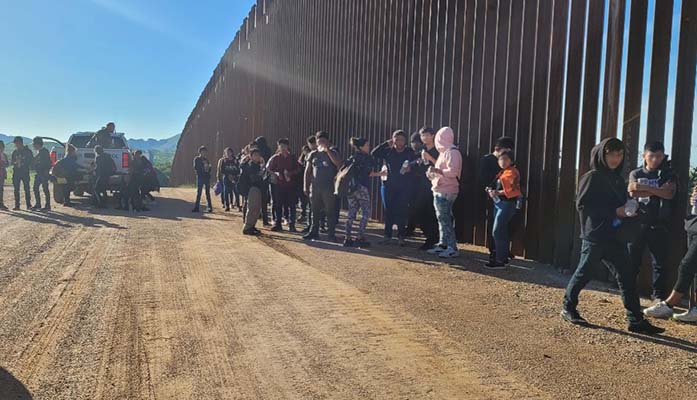
A bill to enhance punishment for human smuggling in Arizona is advancing through the state legislature.
Late last month, SB 1608 passed the Arizona Senate. The bill, which was sponsored by Senator Justine Wadsack, “classifies the unlawful use of an electronic device to smuggle human beings as a class 2 felony and prohibits a person from being released from confinement, if convicted” – according to the purpose provided by the chamber.
The bill passed with a 16-13 vote (with one member not voting). All Republicans voted in favor of the bill.
In a statement after the vote, Wadsack said, “Human smuggling is at an all-time high. Cartels are recruiting people, often our children, to participate in smuggling operations using various apps such as Snapchat and WhatsApp. The use of social media platforms to carry out these crimes has grown exponentially and contributes to the humanitarian crisis caused by Biden’s open border policies. Our children, our law enforcement, and our communities are being targeted, and it won’t be tolerated.”
According to the fact sheet from the Arizona Senate, a class 2 felony carries presumptive prison sentence of 5 years, and a sentence to pay a fine for a felony must be a sentence to pay an amount fixed by the court of up to $150,000. With some exceptions, a “general” human smuggling violation and conviction carries a class 4 felony, which comes with a presumptive prison sentence of 2.5 years.
On the Arizona Legislature’s Request to Speak system, a representative from the American Civil Liberties Union of Arizona signed in to oppose the bill, while former state legislator Nancy Barto indicated her approval of the measure.
Earlier in February, the proposal was approved by the Senate Committee on Transportation, Technology and Missing Children with a partisan 4-3 vote. The bill also passed narrowly out of the Senate Rules Committee.
SB 1608 now resides in the Arizona House of Representatives for consideration. If passed by that chamber, it will most certainly be vetoed by Democrat Governor Katie Hobbs, who has opposed most – if not all – of Republicans’ solutions to help the state combat the border crisis at hand.
Daniel Stefanski is a reporter for AZ Free News. You can send him news tips using this link.