by Matthew Holloway | Feb 5, 2026 | News
By Matthew Holloway |
The Arizona House of Representatives approved bipartisan election integrity legislation on Monday intended to enhance voting oversight and protect the rights of military and overseas voters.
The measure, House Bill 2022, sponsored by State Representative Alexander Kolodin (R-LD3), cleared the full House after receiving bipartisan support. The bill’s passage comes amid ongoing discussions nationwide about election security and voter access.
According to the AZ House GOP, the legislation aims to protect Arizona’s military voters by ensuring election procedures account for service members and other Arizonans living or serving outside the state. Specific provisions in the bill address the handling and timely delivery of ballots for individuals covered under the Uniformed and Overseas Citizens Absentee Voting Act (UOCAVA), a federal law that safeguards absentee voting rights for military and overseas voters.
Specifically, the bill moves the Arizona primary election date to the second-to-last Tuesday in July, to better align with the federal election timeline adopted by the U.S. Congress and prevent military UOCAVA ballots from going uncounted.
In a statement announcing the bill’s passage, Representative Kolodin said, “This bill exists for one reason: to make sure Arizona voters, especially our men and women serving overseas in uniform, are not disenfranchised because Congress changed the rules and failed to check the calendar. HB 2022 locks in the fix that worked in 2024. Military ballots went out on time, and our men and women serving in uniform were able to exercise their right to vote as citizens of the United States. There is no excuse to walk away from something we know works.”
HB 2022 also includes a series of measures intended to strengthen election oversight and transparency, including requirements for updated reporting and procedural reviews by election officials, according to the bill summary.
The following changes will also be made:
- Modifying the deadline for ballot curing in elections that include a federal office to five calendar days, from the previous five business days.
- Broadening the type of locations that may be observed or challenged by party representatives, including ballot replacement locations, voting centers, in-person early voting locations, and emergency voting locations.
- And allowing permitting nomination and local initiative petition forms circulated under the previous law to be considered valid for the July 2026 primary.
State Representative Kolodin chairs the House Ad Hoc Committee on Election Integrity and Florida-style Voting Systems with Co-Chair Rep. John Gillette (R-LD30). The panel was formed to study election procedures and propose electoral reforms. This committee has previously advanced legislation to improve voter identification requirements, tighten security around mail-in and absentee ballots, and restrict certain external influences on Arizona elections.
HB 2022 will now move to the Arizona Senate for further consideration.
Matthew Holloway is a senior reporter for AZ Free News. Follow him on X for his latest stories, or email tips to Matthew@azfreenews.com.
by Matthew Holloway | Jan 24, 2026 | News
By Matthew Holloway |
A proposed constitutional amendment aimed at reshaping Arizona’s election system passed its first major legislative hurdle in a hearing on Wednesday, as the Arizona House Committee on Federalism, Military Affairs & Elections (FMAE) approved Rep. Alexander Kolodin’s (R-LD3) Arizona Secure Elections Act.
The Committee advanced House Concurrent Resolution 2001 with a 4-3 vote. It now heads to the House Rules Committee. If approved by both chambers of the Arizona Legislature, the measure would be referred to voters on the November 2026 general election ballot.
Kolodin announced the committee hearing on social media ahead of the meeting.
According to supporters, HCR 2001 is intended to address concerns about voter confidence following recent election cycles. If approved by voters, the constitutional amendment would establish several requirements for statewide election administration.
Those provisions include limiting voter registration and participation to U.S. citizens, prohibiting foreign contributions to candidates or ballot initiatives, and requiring government-issued identification in order to vote.
Additional requirements would mandate that early voting concludes no later than 7:00 p.m. on the Friday preceding a Tuesday general election, prohibit the acceptance of ballots after polls close on Election Day, preserve in-person voting options at accessible polling locations, and require mail-in voters to verify their address each election cycle.
Committee Debate
During the hearing before the committee, Kolodin described HCR 2001 as an effort to overhaul Arizona’s election system by drawing comparisons to reforms adopted in Florida after the 2000 presidential election.
“This year the Arizona State Legislature will give the voters of Arizona the opportunity to transform our system of elections from a national embarrassment to a national model,” Kolodin told committee members, arguing that Florida’s reforms improved election security, sped up results, and increased voter satisfaction.
Kolodin urged lawmakers to advance the measure, saying the proposal would allow voters to address longstanding concerns about election administration.
Democrats raised concerns about voter access and election logistics. Rep. Aaron Márquez (D-LD5) argued that the proposal would effectively end the active early voting list and push large numbers of voters back into in-person voting without funding for additional polling locations, potentially creating longer lines on Election Day.
Kolodin rejected that characterization, emphasizing that HCR 2001 is a constitutional ballot referral rather than a statutory change.
“You have mistaken assumptions right off the bat,” Kolodin said. “It’s not a piece of legislation. It’s not modifying statutory law. This is a constitutional ballot referral.”
Kolodin explained that constitutional amendments are intended to establish broad governing principles, while election administration details are left to statute.
“In a statute, you want to be prescriptivist,” he said. “With a constitutional amendment, you must refrain from being overly prescriptivist,” noting that constitutional provisions are designed to endure for generations.
Addressing concerns about early voting, Kolodin said the proposal would not eliminate early or mail-in voting but would require voters to confirm their address each election cycle before automatically receiving a ballot.
Kolodin also defended the proposal’s voter identification requirements, arguing that the current signature verification system is imprecise and can result in lawful ballots being rejected.
“Our current system of signature verification, which is incredibly imprecise, leads to a large number of valid votes sometimes be[ing] rejected. It’s a very imperfect system. A more precise system, where a definite match can be obtained, where you don’t have to squint at the loops and the squiggles to try to figure out the signatures match, or if a ballot should be sent to curing, and potentially rejected, but where there’s something where it’s binary: it’s either a yes or no. There’s no matter of opinion there [that] will actually lead to fewer votes cast by lawful voters being rejected in the system,” Kolodin said.
Advocacy Groups Weigh In
The Arizona branch of the American Civil Liberties Union, represented by Katelynn Contreras, opposed the Resolution during the public comment period, stating, “HCR 2001 does not improve election integrity. Instead, it will restrict access for eligible voters to create confusion and rigid, unworkable rules in the Arizona Constitution. This resolution significantly curtails early and non-voting options that most Arizonans rely on.“ The ACLU representative cited what she described as survey data, claiming that 70 percent of Arizona voters say elections are fair and that roughly 80 percent vote by mail or early, and suggested that the ballot measure would “ban a method of voting that is widely used in the state.”
The figures cited by the ACLU couldn’t be independently verified by AZ Free News.
Asked to clarify the claim, Contreras said the measure would create “new discretionary areas that could be used to restrict mail voting for future.” Kolodin responded, “Mr. chair, I just wish to point out that that is untrue. OK, I just want to put that very clearly.”
The Arizona Freedom Caucus has promoted the proposal on its social media channels since the resolution’s prefiling in November, identifying it as a legislative priority and encouraging public engagement ahead of committee consideration. Arizona House Republican accounts have also circulated prior statements from Kolodin outlining the proposal’s intent.
Arizona Freedom Caucus Chairman Jake Hoffman (R-LD15) urged legislative leaders to advance the proposal following committee review.
“The Arizona Freedom Caucus is grateful that AFC Member Representative Alexander Kolodin has once again provided much-needed leadership in the critical mission to secure Arizona’s elections today and into the future,” Hoffman said. “Once it is heard by the FMAE Committee this week, I urge House Leadership to move it quickly to a floor vote and then send it to the Senate.”
Kolodin criticized the objections raised during the hearing, saying opponents had failed to cite provisions supporting claims that the measure would end early voting.
“We have now reached the point where the opposition to this measure has become truly silly,” Kolodin said, arguing that the proposal would expand, not restrict, voting opportunities.
He added, “It is time for the people of Arizona to have the opportunity to get their kids and their grandkids, my kids and your kids, an election system that we can be proud of, an election system that actually works, instead of inconveniencing and disenfranchising voters, and an election system that provides more opportunities for community participation by casting one’s vote at the polls or to return you ballot to the polls as you prefer. And it’s time, in other words, to take this choice out of the hands of politicians and put it in the hands of the people who actually deserve to have it: you, the voters of Arizona, and that’s where we’re sending it, despite the opposition.”
AZ Free News previously reported on Kolodin’s election integrity proposals and related legislative efforts, including the prefiling of HCR 2001 and its Senate mirror measure, SCR 1001, in November 2025. The Senate resolution, introduced by Sen. Shawnna Bolick (R-LD20), passed a hearing with the Senate Judiciary Committee 4-3 on Wednesday and will be heard next by the Senate Rules Committee.
The resolution must be approved by both the Arizona House and Senate before it can be referred to voters for consideration in 2026.
Matthew Holloway is a senior reporter for AZ Free News. Follow him on X for his latest stories, or email tips to Matthew@azfreenews.com.
by Staff Reporter | Jan 8, 2026 | News
By Staff Reporter |
The Department of Justice (DOJ) sued Arizona for refusing to turn over voter registration records.
Arizona joins 22 other states and the District of Columbia facing legal action from the DOJ for withholding access to the voter rolls.
A press release issued on Tuesday from the DOJ also named Connecticut as the latest to be sued.
“Accurate voter rolls are the foundation of election integrity, and any state that fails to meet this basic obligation of transparency can expect to see us in court,” said Attorney General Pam Bondi.
The requested records would include each voter’s full name, date of birth, residential address, and either their state driver’s license number, last four digits of their Social Security number, or HAVA unique identifier.
The DOJ’s lawsuit asserts the agency maintains legal authority under the Civil Rights Act (CRA) to access any election records it desires.
“If the custodian to whom the written demand is made refuses to comply, the CRA requires ‘a special statutory proceeding in which the courts play a limited, albeit vital, role’ in assisting the Attorney General’s investigative powers,” stated the lawsuit.
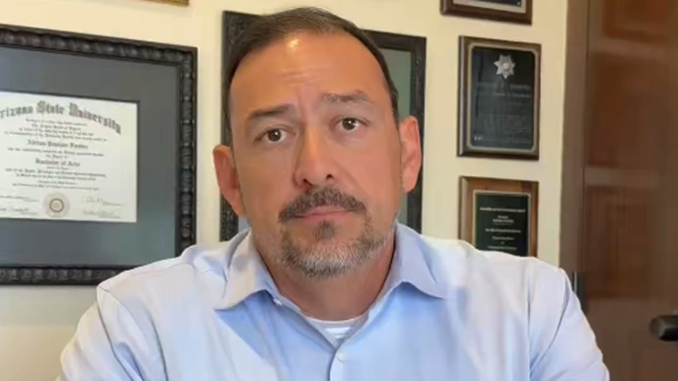
The DOJ requested the records from Secretary of State Adrian Fontes last July, and again in August. Both times Fontes responded with refusals, claiming that state and federal privacy laws prevent him from turning over the requested records.
Fontes rejected another follow-up request by the DOJ last month. The secretary of state claimed that voter rights to privacy trumped the federal government’s chief authority over elections.
“Arizona voters also have important privacy rights that cannot be infringed because they choose to exercise their constitutionally protected voting rights,” said Fontes.
Fontes said in a statement to Democracy Docket that he would rather be imprisoned than cooperate with the Trump administration.
“They’re going to have to put me in jail if they want this information,” said Fontes.
In a video statement on X, Fontes again declared compliance would break state and federal law.
“Pound sand,” said Fontes.
Arizona Attorney General Kris Mayes backed Fontes’ take on privacy laws negating the authority of election oversight laws.
“Both state and federal law prohibit the unrestricted release of Arizona’s complete voter registration database to the DOJ,” said Mayes.
Fontes also published a blog post on Tuesday commemorating the fifth year to pass since the January 6 invasion of the Capitol. The secretary of state claimed that the government remains under active threat, and compared the political climate to the Civil War era.
“Today’s challenges — polarization, misinformation from the top down, foreign interference — are real and daunting. But they pale in comparison to the existential crisis of 1864, when the nation itself was at risk of dissolution. If democracy could survive that, it can survive now — provided we do our part,” said Fontes. “Confidence in our electoral system is not naïve; it is necessary. Election officials across the country are working tirelessly to secure voting infrastructure, expand access, and ensure transparency. These efforts deserve not only our trust but our active participation. Cynicism is easy. Engagement is harder — but it is the only way forward.”
AZ Free News is your #1 source for Arizona news and politics. You can send us news tips using this link.
by Warren Petersen | Dec 16, 2025 | Opinion
By Sen. Warren Petersen |
For years, Arizona has been an emerging bastion of conservative leadership. Recently the AZ Republic called the Legislature the “most conservative” ever. Over the last decade it has passed landmark policies and defended critical laws around the country, setting an example for the rest of the nation to emulate.
This conservative advantage was threatened a few short years ago, when Katie Hobbs and Kris Mayes assumed their positions as Arizona governor and attorney general, respectively, after an extremely volatile election cycle. These two have stopped at nothing to insert their radical agenda as they seek to transform our state into a liberal utopia to please their friends in California and New York.
While Hobbs has sought to remake Arizona’s policies from her perch as the state’s chief executive, Mayes has been busy on the legal side. Throughout her tenure in office, Mayes has either done the bare minimum or nothing at all to defend key Arizona or national laws. Instead, she has spearheaded the left’s efforts to undermine President Trump’s work to make America great again.
Thankfully, however, the Arizona Legislature, under my leadership as Senate President, has stepped in the gap to uphold laws of great importance to our citizens. Despite our state’s top prosecutor missing in action as she seeks affirmation from her colleagues in New York and California, we have led or joined dozens of lawsuits and legal briefs to preserve conservative laws across our state and nation. These efforts have largely been unprecedented, as legislatures typically defer to their state attorneys general or other government prosecutors on the legal fronts. From early on, though, in Arizona’s divided government, I determined that our state could not afford to sit on the sidelines as Mayes hijacked our legal apparatus for her extremist ways. As a result, Arizona has again asserted itself as a national example, showing other states how to maintain the rule of law in the face of divided governments.
Here are some of the highlights of the cases:
Protecting Election Integrity
In the absence of the state’s attorney general taking action, the Arizona Legislature has been engaged in a prolonged legal battle to protect the integrity of our state’s elections, defending two laws that restrict voters who do not provide documentation that confirm their American citizenship. After I filed an emergency stay application at the U.S. Supreme Court, the Justices affirmed Arizona’s right to reject state form registrations that do not include proof of citizenship. This case is ongoing because of activist judges on the Ninth Circuit Court of Appeals who are attempting to circumvent the Supreme Court’s ruling. Arizona will continue to defend our own law, and we will come to the aid of any state working to require proof of citizenship.
Protecting the Integrity of Women’s Sports
Over half the states in America have enacted legislation to preserve fairness in sports, including Arizona, which passed the Save Women’s Sports Act, to ensure that girls’ athletic events at public schools are reserved for biological females. Arizona’s law, like most other states, remains tied up in federal litigation, with the Legislature itself stepping in to defend the statute after Mayes declined to do so. We defended Arizona’s law up to the U.S. Supreme Court, in addition to filing briefs of support for other states’ fights. We cannot allow activist judges and radical groups to erase protections that women and girls have fought for generations to secure.
Protecting Children
The Arizona Legislature defended the state’s lifetime registration and reporting requirements for convicted sex offenders, giving families and law enforcement greater abilities to track high-risk offenders. Despite the importance of the protections, Mayes failed to defend the law, abandoning the state’s responsibility to safeguard communities. However, we refused to allow the safety of our children to be jeopardized, and we recently won in federal court. The judge’s ruling in this case was a victory for every parent in Arizona.
Protecting the Second Amendment
The Arizona Legislature joined a national coalition to urge the U.S. Supreme Court to end Mexico’s frivolous lawsuit against U.S. firearm manufacturers for crimes committed by Mexican cartels in that country. Earlier this year, the Court agreed with our position, ruling that the lawsuit infringes on U.S. sovereignty by trying to impose restrictions on Second Amendment rights and to control how the American firearms industry is regulated. We were proud to work with other states to uphold our nation’s sovereignty, protect Americans’ right to bear arms, and safeguard lawful gun manufacturers from those attempting to destroy this industry. I will always engage in legal battles to protect our Second Amendment rights when Mayes refuses to do so.
Protecting Against Federal Land Grabs
Two years ago, the Biden-Harris administration confiscated nearly a million acres of land in northern Arizona, designating this space as a “national monument.” This unlawful designation will result in fewer jobs, diminished state trust land values, and billions in lost tax revenues. I sought to overturn this action in federal court to free our state from the grasp radical environmentalists had over the previous administration. As we argued throughout this case, Biden’s maneuver had nothing to do with protecting actual artifacts, but halting all mining, ranching, and other local uses of federal lands that are critical to our independence from adversary foreign nations, our food supply, and the strength of our economy.
Protecting America’s Energy
After the Arizona Legislature joined a national coalition to challenge a radical and costly rule imposed by California requiring trucking companies to retire their diesel-fueled models, the state agreed to repeal its ‘Advanced Clean Fleets’ mandate. This rule would have created dire impacts to the supply chain, raising costs for local trucking companies and their customers. For years, California has operated with near impunity as its leaders passed unconstitutional regulations that brought great harms to Arizona consumers. In the absence of our attorney general holding California accountable to the rule of law, the state Legislature gladly stepped up to protect our citizens from this egregious abuse of power and emerged victorious.
Warren Petersen is the President of the Arizona State Senate and represents Legislative District 14.
by Jonathan Eberle | Nov 19, 2025 | News
By Jonathan Eberle |
Arizona voters could soon decide on sweeping changes to the state’s election rules under a new ballot referral filed by Sen. Shawnna Bolick (R-LD20), marking the latest push by Republican lawmakers to overhaul election procedures ahead of the 2026 cycle. Bolick submitted the measure, SCR 1001, over the weekend. The proposal seeks to place several election-related requirements directly into state law—changes lawmakers say are intended to bolster public confidence following years of political tension and disputes surrounding Arizona’s voting processes.
“Election integrity is paramount to maintain our Republic,” Bolick said, describing the measure as a direct response to years of public calls for tighter verification and clearer rules. “It’s time we give [voters] the chance to secure those protections permanently.” If approved by the Legislature and then by voters in November 2026, the ballot referral would require documented proof of citizenship before a ballot is issued to any voter; end early voting at 7 p.m. on the Friday before Election Day, shifting Arizona’s voting schedule and creating firmer deadlines for processing ballots; and mandate government-issued identification for both in-person voting and early ballots.
Republicans argue these standards are necessary to ensure the accuracy and security of election results. Bolick said the proposal is designed to “put voters – not bureaucrats, not activists, and not foreign interests – back in charge of how our elections are run.” Bolick has introduced similar legislation in the past, including bills to prohibit foreign donations in Arizona elections and proposals to speed up vote counting—efforts she often frames as moving Arizona closer to “Florida-style” same-day reporting.
SCR 1001 will be taken up during the 2026 legislative session, which begins January 12. If it clears both chambers, the measure will bypass the governor and head directly to voters. The proposal is expected to draw both support and criticism as the Legislature debates the balance between election security and voter access—a fault line that has defined Arizona’s election-law discussions for several years.
Supporters say the measure would strengthen trust and accountability. For now, the question heads to the Legislature, where SCR 1001 is set to become a key part of the debate over how Arizona runs its elections.
Jonathan Eberle is a reporter for AZ Free News. You can send him news tips using this link.