by Staff Reporter | Jan 8, 2026 | News
By Staff Reporter |
The Department of Justice (DOJ) sued Arizona for refusing to turn over voter registration records.
Arizona joins 22 other states and the District of Columbia facing legal action from the DOJ for withholding access to the voter rolls.
A press release issued on Tuesday from the DOJ also named Connecticut as the latest to be sued.
“Accurate voter rolls are the foundation of election integrity, and any state that fails to meet this basic obligation of transparency can expect to see us in court,” said Attorney General Pam Bondi.
The requested records would include each voter’s full name, date of birth, residential address, and either their state driver’s license number, last four digits of their Social Security number, or HAVA unique identifier.
The DOJ’s lawsuit asserts the agency maintains legal authority under the Civil Rights Act (CRA) to access any election records it desires.
“If the custodian to whom the written demand is made refuses to comply, the CRA requires ‘a special statutory proceeding in which the courts play a limited, albeit vital, role’ in assisting the Attorney General’s investigative powers,” stated the lawsuit.
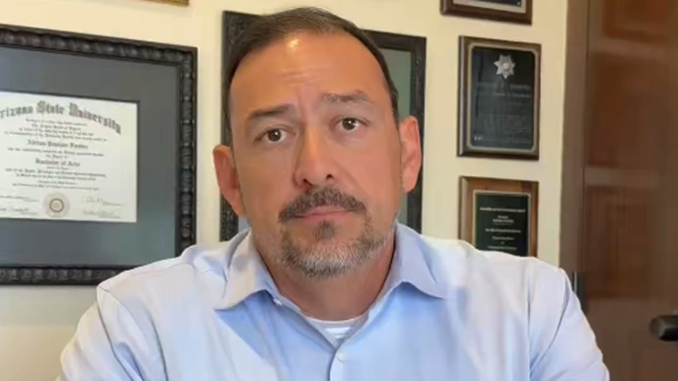
The DOJ requested the records from Secretary of State Adrian Fontes last July, and again in August. Both times Fontes responded with refusals, claiming that state and federal privacy laws prevent him from turning over the requested records.
Fontes rejected another follow-up request by the DOJ last month. The secretary of state claimed that voter rights to privacy trumped the federal government’s chief authority over elections.
“Arizona voters also have important privacy rights that cannot be infringed because they choose to exercise their constitutionally protected voting rights,” said Fontes.
Fontes said in a statement to Democracy Docket that he would rather be imprisoned than cooperate with the Trump administration.
“They’re going to have to put me in jail if they want this information,” said Fontes.
In a video statement on X, Fontes again declared compliance would break state and federal law.
“Pound sand,” said Fontes.
Arizona Attorney General Kris Mayes backed Fontes’ take on privacy laws negating the authority of election oversight laws.
“Both state and federal law prohibit the unrestricted release of Arizona’s complete voter registration database to the DOJ,” said Mayes.
Fontes also published a blog post on Tuesday commemorating the fifth year to pass since the January 6 invasion of the Capitol. The secretary of state claimed that the government remains under active threat, and compared the political climate to the Civil War era.
“Today’s challenges — polarization, misinformation from the top down, foreign interference — are real and daunting. But they pale in comparison to the existential crisis of 1864, when the nation itself was at risk of dissolution. If democracy could survive that, it can survive now — provided we do our part,” said Fontes. “Confidence in our electoral system is not naïve; it is necessary. Election officials across the country are working tirelessly to secure voting infrastructure, expand access, and ensure transparency. These efforts deserve not only our trust but our active participation. Cynicism is easy. Engagement is harder — but it is the only way forward.”
AZ Free News is your #1 source for Arizona news and politics. You can send us news tips using this link.
by Warren Petersen | Dec 16, 2025 | Opinion
By Sen. Warren Petersen |
For years, Arizona has been an emerging bastion of conservative leadership. Recently the AZ Republic called the Legislature the “most conservative” ever. Over the last decade it has passed landmark policies and defended critical laws around the country, setting an example for the rest of the nation to emulate.
This conservative advantage was threatened a few short years ago, when Katie Hobbs and Kris Mayes assumed their positions as Arizona governor and attorney general, respectively, after an extremely volatile election cycle. These two have stopped at nothing to insert their radical agenda as they seek to transform our state into a liberal utopia to please their friends in California and New York.
While Hobbs has sought to remake Arizona’s policies from her perch as the state’s chief executive, Mayes has been busy on the legal side. Throughout her tenure in office, Mayes has either done the bare minimum or nothing at all to defend key Arizona or national laws. Instead, she has spearheaded the left’s efforts to undermine President Trump’s work to make America great again.
Thankfully, however, the Arizona Legislature, under my leadership as Senate President, has stepped in the gap to uphold laws of great importance to our citizens. Despite our state’s top prosecutor missing in action as she seeks affirmation from her colleagues in New York and California, we have led or joined dozens of lawsuits and legal briefs to preserve conservative laws across our state and nation. These efforts have largely been unprecedented, as legislatures typically defer to their state attorneys general or other government prosecutors on the legal fronts. From early on, though, in Arizona’s divided government, I determined that our state could not afford to sit on the sidelines as Mayes hijacked our legal apparatus for her extremist ways. As a result, Arizona has again asserted itself as a national example, showing other states how to maintain the rule of law in the face of divided governments.
Here are some of the highlights of the cases:
Protecting Election Integrity
In the absence of the state’s attorney general taking action, the Arizona Legislature has been engaged in a prolonged legal battle to protect the integrity of our state’s elections, defending two laws that restrict voters who do not provide documentation that confirm their American citizenship. After I filed an emergency stay application at the U.S. Supreme Court, the Justices affirmed Arizona’s right to reject state form registrations that do not include proof of citizenship. This case is ongoing because of activist judges on the Ninth Circuit Court of Appeals who are attempting to circumvent the Supreme Court’s ruling. Arizona will continue to defend our own law, and we will come to the aid of any state working to require proof of citizenship.
Protecting the Integrity of Women’s Sports
Over half the states in America have enacted legislation to preserve fairness in sports, including Arizona, which passed the Save Women’s Sports Act, to ensure that girls’ athletic events at public schools are reserved for biological females. Arizona’s law, like most other states, remains tied up in federal litigation, with the Legislature itself stepping in to defend the statute after Mayes declined to do so. We defended Arizona’s law up to the U.S. Supreme Court, in addition to filing briefs of support for other states’ fights. We cannot allow activist judges and radical groups to erase protections that women and girls have fought for generations to secure.
Protecting Children
The Arizona Legislature defended the state’s lifetime registration and reporting requirements for convicted sex offenders, giving families and law enforcement greater abilities to track high-risk offenders. Despite the importance of the protections, Mayes failed to defend the law, abandoning the state’s responsibility to safeguard communities. However, we refused to allow the safety of our children to be jeopardized, and we recently won in federal court. The judge’s ruling in this case was a victory for every parent in Arizona.
Protecting the Second Amendment
The Arizona Legislature joined a national coalition to urge the U.S. Supreme Court to end Mexico’s frivolous lawsuit against U.S. firearm manufacturers for crimes committed by Mexican cartels in that country. Earlier this year, the Court agreed with our position, ruling that the lawsuit infringes on U.S. sovereignty by trying to impose restrictions on Second Amendment rights and to control how the American firearms industry is regulated. We were proud to work with other states to uphold our nation’s sovereignty, protect Americans’ right to bear arms, and safeguard lawful gun manufacturers from those attempting to destroy this industry. I will always engage in legal battles to protect our Second Amendment rights when Mayes refuses to do so.
Protecting Against Federal Land Grabs
Two years ago, the Biden-Harris administration confiscated nearly a million acres of land in northern Arizona, designating this space as a “national monument.” This unlawful designation will result in fewer jobs, diminished state trust land values, and billions in lost tax revenues. I sought to overturn this action in federal court to free our state from the grasp radical environmentalists had over the previous administration. As we argued throughout this case, Biden’s maneuver had nothing to do with protecting actual artifacts, but halting all mining, ranching, and other local uses of federal lands that are critical to our independence from adversary foreign nations, our food supply, and the strength of our economy.
Protecting America’s Energy
After the Arizona Legislature joined a national coalition to challenge a radical and costly rule imposed by California requiring trucking companies to retire their diesel-fueled models, the state agreed to repeal its ‘Advanced Clean Fleets’ mandate. This rule would have created dire impacts to the supply chain, raising costs for local trucking companies and their customers. For years, California has operated with near impunity as its leaders passed unconstitutional regulations that brought great harms to Arizona consumers. In the absence of our attorney general holding California accountable to the rule of law, the state Legislature gladly stepped up to protect our citizens from this egregious abuse of power and emerged victorious.
Warren Petersen is the President of the Arizona State Senate and represents Legislative District 14.
by Jonathan Eberle | Nov 19, 2025 | News
By Jonathan Eberle |
Arizona voters could soon decide on sweeping changes to the state’s election rules under a new ballot referral filed by Sen. Shawnna Bolick (R-LD20), marking the latest push by Republican lawmakers to overhaul election procedures ahead of the 2026 cycle. Bolick submitted the measure, SCR 1001, over the weekend. The proposal seeks to place several election-related requirements directly into state law—changes lawmakers say are intended to bolster public confidence following years of political tension and disputes surrounding Arizona’s voting processes.
“Election integrity is paramount to maintain our Republic,” Bolick said, describing the measure as a direct response to years of public calls for tighter verification and clearer rules. “It’s time we give [voters] the chance to secure those protections permanently.” If approved by the Legislature and then by voters in November 2026, the ballot referral would require documented proof of citizenship before a ballot is issued to any voter; end early voting at 7 p.m. on the Friday before Election Day, shifting Arizona’s voting schedule and creating firmer deadlines for processing ballots; and mandate government-issued identification for both in-person voting and early ballots.
Republicans argue these standards are necessary to ensure the accuracy and security of election results. Bolick said the proposal is designed to “put voters – not bureaucrats, not activists, and not foreign interests – back in charge of how our elections are run.” Bolick has introduced similar legislation in the past, including bills to prohibit foreign donations in Arizona elections and proposals to speed up vote counting—efforts she often frames as moving Arizona closer to “Florida-style” same-day reporting.
SCR 1001 will be taken up during the 2026 legislative session, which begins January 12. If it clears both chambers, the measure will bypass the governor and head directly to voters. The proposal is expected to draw both support and criticism as the Legislature debates the balance between election security and voter access—a fault line that has defined Arizona’s election-law discussions for several years.
Supporters say the measure would strengthen trust and accountability. For now, the question heads to the Legislature, where SCR 1001 is set to become a key part of the debate over how Arizona runs its elections.
Jonathan Eberle is a reporter for AZ Free News. You can send him news tips using this link.
by Jonathan Eberle | Nov 17, 2025 | News
By Jonathan Eberle |
The Arizona Freedom Caucus (AFC) is throwing its support behind a new election-related proposal from Rep. Alexander Kolodin, announcing its endorsement for the Arizona Secure Elections Act, a measure the group says is aimed at restoring trust and stability in the state’s voting system.
The bill outlines a series of election policy changes that AFC members argue are necessary to address ongoing concerns about administration errors, delays, and voter confidence. According to the caucus, repeated issues in recent election cycles have eroded public trust and demand a comprehensive response.
“The integrity of our elections remains a top priority,” the caucus said in its statement, pointing to what it described as persistent failures that have “made it impossible for reasonable people to trust the integrity of the process and therefore outcomes.” The AFC said its legislative agenda will continue to center on tightening election procedures and removing what it views as opportunities for error or abuse.
The Arizona Secure Elections Act would make a series of changes to election laws, including affirming the principle of “one citizen, one vote”; banning campaign or ballot-measure contributions from foreign individuals or corporations; requiring government-issued identification for all voters; ending early voting at 7 p.m. on the Friday before Election Day; prohibiting ballots from being cast or accepted after polls close on Election Day; guaranteeing access to in-person voting at local polling places; and requiring mail-in voters to confirm their mailing address every election year.
If approved by lawmakers, the measure would appear on the next general election ballot for voters to decide, setting up a statewide vote as soon as 2026. AFC Chair Sen. Jake Hoffman praised both the proposal and Kolodin’s involvement, calling the act a pivotal step toward what the caucus views as long-needed structural reforms.
“With our endorsement, we will be working to ensure that Arizonans have the opportunity to vote for this Act on the 2026 ballot,” Hoffman said, crediting Kolodin and other AFC members for advancing what he characterized as essential election security priorities.
The legislation, if passed, would bypass the governor and head directly to voters for final approval. The AFC says it intends to campaign for the measure statewide ahead of the 2026 election. The proposal is likely to draw significant attention as lawmakers continue to debate voting access, election security, and administrative reforms—issues that have dominated Arizona politics across several cycles.
Jonathan Eberle is a reporter for AZ Free News. You can send him news tips using this link.
by Jonathan Eberle | Oct 31, 2025 | News
By Jonathan Eberle |
The Arizona Freedom Caucus announced that Representative Alexander Kolodin will lead a special hearing on “The Implications of Artificial Intelligence for Democratic Governance and How to Preserve Meaningful Elections” on Friday, November 14, 2025, at 9:30 a.m. in House Hearing Room 4 at the Arizona State Capitol.
The hearing, open to the public and livestreamed through the Arizona Legislature’s website, will focus on how the rapid development of artificial intelligence (AI) is reshaping democratic institutions and the electoral process. Lawmakers plan to explore both the opportunities AI presents for improving government efficiency and the potential threats it poses to election security, voter confidence, and public trust.
Representative Kolodin, who chairs the House Ad Hoc Committee on Election Integrity and Florida-style Voting Systems, will be joined by four other Arizona House members, including fellow Freedom Caucus member Representative Rachel Keshel.
“The states cannot be complacent when it comes to the rapid development of AI,” Kolodin said in a statement. “The risk of insufficient oversight of AI is literally what dystopian nightmares are made of. Although it is reasonable to be excited about the prospects of AI to improve human life and society, it is equally critical to be vigilant about the ways it can be abused to erode our freedoms, including threatening democratic governance and our elections.”
The Arizona Freedom Caucus said it views the hearing as a proactive step toward crafting policy that anticipates how AI could be weaponized to undermine democratic processes. The group emphasized that while AI offers enormous benefits, its misuse could have far-reaching consequences for liberty, privacy, and electoral integrity.
“There is perhaps no greater concern than how AI will impact our elections,” the caucus said in its release. “We believe the best way to prevent destructive scenarios is to address AI’s prospective impacts and uses on the frontend.”
The November 14 session is expected to feature expert testimony and legislative discussion on strategies to safeguard Arizona’s electoral systems while responsibly integrating emerging technologies.
Members of the public can view the livestream of the hearing here.
Jonathan Eberle is a reporter for AZ Free News. You can send him news tips using this link.