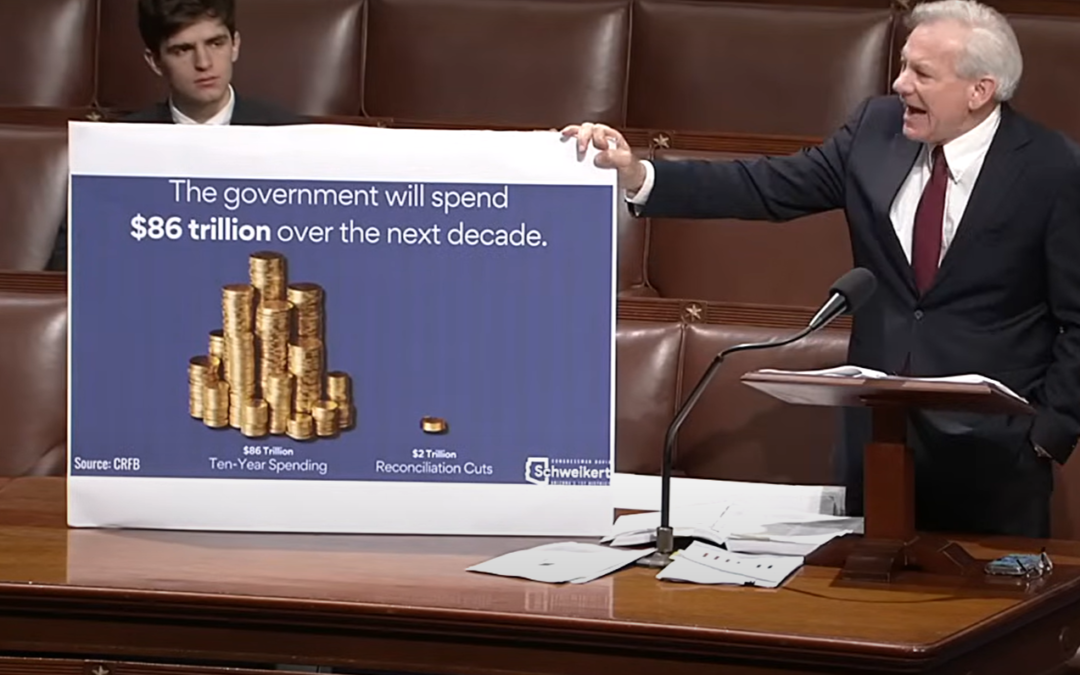
Congressman David Schweikert (R-AZ-01) raised an alarm about what he believes is the oncoming fiscal demise of the U.S. in a speech from the House floor.
Schweikert explained that a simple series of calculations “point to a shrinking labor force, and lack of young people in our society, and the reality that in 8 years, the United States will have MORE deaths than births,” citing the Congressional Budget Office (CBO).
"The fact of the matter is, and @RayDalio said it himself, there's a shortage of borrowable money in the world. We've run out of global savings. Our goal is stability, not collapse." – Chairman @RepDavidhttps://t.co/2dkQCJcYIG
— Joint Economic Committee Republicans (@JECRepublicans) March 26, 2025
The congressman’s speech coincided with the release of a devastating report from the CBO, which warned that the federal government’s capacity to borrow through “extraordinary measures” will be exhausted by the end of August or September.
Speaking to the House, Schweikert laid out the dire projections of the CBO report, as well as the remarkable insufficiency of the metrics the government is using, in the face of three unassailable facts: “debt, deficits and demographics:“
“I’m going to walk you through just how dangerous the game we are playing right now, because when you look at these charts — and this is online. Go on C.B.O. from last Friday. It’s not a hard read. Why are my brothers and sisters so terrified to tell the truth to the public? You have a country that — and I’m going to show the charts, that in 7 1/2 years we have more deaths than births. You have a country that, when we get out of the extraordinary measures…remember right now we are borrowing from different funds because we are up against the debt ceiling, we may be borrowing almost $70,000 every second of every day. For those of you who turn to me and say, ‘David, I demand you balance the budget.’ I could do it tomorrow. Lets’ see…if I use the 2024 numbers for every dollar we took in tax collections, we spend $1.39.
“Tell me the 39 cents you want me to cut. And the problem with that math is that when you look at the charts, you see what’s in blue. That’s everything a member of Congress gets to vote on, defense and nondefense. The only problem is. it’s 26% of the spending. So, if you ask a member of Congress right now to balance the budget, we can do it, we can do it. Gotta get rid of all defense, all non-defense, discretionary. That’s basically the park service, the EPA, all the agencies. And then tell me what portion…because you have to pay your interest or you blow up the world economy.
“Tell me what portion of social security, medicare, medicaid, other things you want to hack away at. The reality of it is, in this fiscal year, our projection is…for every dollar we take in tax collections, we are going to spend functionally $1.36.
“Do you understand how screwed—excuse me, yeah that’s the technical economic term— how SCREWED WE ARE when we don’t tell the truth about the math?
“And it is not fixable, but it is possible to stabilize. We can stabilize this. We just have to think and do things that are hard. So often around here, the thinking part is complex and it’s hard and we have to go home and tell our constituents the truth about math.
But remember, the math will win. How many have you heard about how people are protesting and terrified there are going to be cuts? Ok, let’s actually have a moment of truth about math. This was baseline. Over the next 10 years, we are going to spend $86 trillion. Next 10 years, CBO baseline, we are going to spend $86 trillion. The reconciliation budget had $1.3 trillion in cuts, and if we get lucky, we’ll get to $2 trillion over 10 years on $86 trillion of spending.
That’s what the left over here is losing their minds over because they need something. They have lost the working middle class. They’ve lost so much, and American voters no longer trust them because the spent decades not telling them the truth about the math. And it’s not hard, except the problem is 30% of that is borrowed. 30% of that is borrowed. And people are losing their mind that we are trying to cut $2 trillion on $86 trillion of spending. That’s what this place has become. This place has become a clown show of math.
“Think about this. We are functioning and going to spend about $7 trillion this fiscal year. We’re going to take in about $5 trillion. And this is in a time when the economy is good. We’re not in a pandemic. We’re not in a war. We’re not in a recession. And understand when you take some of these charts of interest exposure into the future, one of my charts, it shows in nine budget years interest, just interest is over $2 trillion a year. Just interest. Why aren’t we running around terrified here? If you care about your retirement or someone that’s crazy like my wife and I, we are older parents. I have a 2 1/2-year-old and a 9-year-old. You do realize for my 2 1/2-year-old, when he turns like 24 or 23, 25, every tax in the United States has to have been doubled just to maintain baseline services. This is the morality of this place.
“The United States and other countries are binging on debt. The United States borrows about 40% of all the world capital that goes into sovereign loans. His argument is, your problem is, there’s not enough savings in the world. We are consuming more money. China, Europe, now Germany’s going into the debt markets as they’re raising their spending caps. What happens in a world when there’s a shortage of borrowable money? Remember, every day when we borrow, what, $6 billion a day, functionally that debt has to be sold. Most of it’s actually financed domestically. You know, it’s in this pension, it’s in this bank…And then foreigners, except the foreigners have been lowering their U.S. Debt because they’re having to finance their own governments. And you start to look at our interest payments, and there’s this concept called a term premium. When we make the bond markets nervous, we pay a higher interest rate.”
Congressman Schweikert summarized the fiscal nightmare scenario saying, “And you look at the next 10 years, it’s the point I’m trying to make. Is, ok, here’s the growth. 24% of the growth in spending over the next 10 years is interest. 31% of the growth of spending over the next 10 years is Social Security and disability. 28% of the growth of spending over the next 10 years is Medicare. Other mandatory and discretionary growth, about 13%. But a portion of that is actually you think defense and other things in that. The fact of the matter is your government is an insurance company with an army.”
President Trump, by his own declaration, loves tariffs. In fact, tariff is his “favorite word.” Tariffs purportedly produce funds, “billions and billions, more than anybody has ever seen before,” which can be used for essential spending or to reduce taxes and meanwhile will “bring back jobs.”
The president is all in on his enthusiasms. As matters now stand, he is imposing both universal baseline as well as country-specific tariffs, affecting more than $1 trillion of imports. This compares to the mere $380 billion in tariffs passed in 2018 and 2019 by the first Trump administration but will rise to $1.4 trillion when/if the temporary exemptions for Mexico and Canada expire in April.
There is a logic to tariffs which appeals to those with a protectionist bent. If foreign producers are selling in your country and taking profits which could otherwise be earned by domestic enterprises, why not make the cost of doing business higher for them and keep the profits at home?
Yet the history of tariffs is, to put it kindly, dismal. The 1930 Smoot-Harley tariff is America’s best known and most instructive experience with protectionism. In 1929, the League of Nations passed a resolution declaring that tariffs were destructive and should be ended by all. When Smoot-Hawley was introduced, Franklin Roosevelt campaigned against it. After the bill passed, 1,028 economists and even some business leaders like Henry Ford urged a veto.
President Hoover termed the measure “vicious, extortionate and obnoxious.” He signed it anyway at the urging of his advisors. Americans, especially the agricultural sector, were facing a perceived problem with overproduction, mainly due to electrification and other laborsaving innovations. Republicans generally agreed that prices were too low, and it would help pull us out of our economic slump if American producers were shielded from foreign competition.
Big mistake. Trading partners had warned of retaliation and indeed boycotts and reciprocal trading restrictions soon broke out. Canada, our most loyal trading partner, imposed tariffs on 30% of our products and formed closer economic ties to the British empire. France, Britain, and Germany all formed new trading alliances.
Yet initially, the medicine seemed to be working. Factory payrolls, construction contracts, and industrial production all profited from the reduced market competition.
But the loss of the inherent advantages of trading soon became clear. From 1929 to 1933, U.S. imports fell 66% and exports decreased 61%. World trade nearly ground to a halt, falling by two-thirds from 1929 to 1934.
Unemployment was about 8% when Smoot-Harley was enacted, but the promises to lower it further never panned out. The rate jumped to 16% in 1931 and 25% in 1932-33, falling back to pre-depression levels only during World War II.
Tariffs didn’t cause the Great Depression, but they clearly deepened and prolonged it. Without Smoot-Hawley, it might have just been another temporary recession, not much worse than many other economic downturns in our history.
The take-home message is that free trade is a voluntary interaction that reliably promotes prosperity, both in theory and in practice. It is a classic win-win for participants, in contrast to protectionism which is based on the principle that the stronger party wins by defeating the weaker one.
The 2018-19 tariffs imposed by Trump and expanded by the Biden administration proved the point once again, by reducing long-term GDP by 0.2% and resulting in the loss of 142,000 full-time equivalent jobs.
Still, Trump favors strength and domination, based on negotiations where he “holds the cards.” The lack of success last time has not dissuaded him from unleashing a barrage of tariffs with impositions, pauses, increases, suspensions, and escalations that have left producers around the world desperately scrambling to protect their businesses by anticipating his next move.
Trump is playing with fire here. If he does ignite a trade war that results in another downturn, he may find that the American economy is not as resilient as it once was. Decades of uncontrolled deficit spending have left us deeply in debt and without the reserves necessary to withstand much more fiscal abuse.
The lessons of history and the laws of economics are clear. Tariffs don’t work. Proceed with caution.
Dr. Thomas Patterson, former Chairman of the Goldwater Institute, is a retired emergency physician. He served as an Arizona State senator for 10 years in the 1990s, and as Majority Leader from 93-96. He is the author of Arizona’s original charter schools bill.
Donald Trump’s renewed pledge to “Make America Great Again” requires nothing less than reigniting economic growth and prosperity. Wealth creation is essential. Yet as Congress prepares to extend and expand upon Trump’s landmark Tax Cuts and Jobs Act of 2017, he can take matters into his own hands by issuing an executive order to index capital gains for inflation.
Taxing inflationary “phantom” capital gains is an unfair and ill-advised policy that punishes risk and success.
Consider this: You invest $1,000, and after four years of Joe Biden in the White House, you sell that investment for $1,100. But since inflation raged during Biden’s tenure, the $1,100 you receive will be worth less in real terms than the $1,000 you invested. And yet, under current law, you will pay a tax on your $100 capital “gain.”
Talk about perverse!
“As has been well documented,” writes Alan Auerbach, University of California economist, “realized capital gains may be subject to tax rates that easily exceed 100% of real gains in the presence of inflation.”
But it’s the law. And not only would eliminating it be the fair thing to do for investors, it would ignite a surge of American prosperity.
Eight years ago, the late Treasury economist Gary Robbins estimated that indexing capital gains for inflation would, by 2025, create an additional 400,000 jobs, grow the U.S. capital stock by $1.1 trillion and boost GDP by roughly $500 billion. Because capital gains were never indexed, average household income today is $3,600 lower than it could have been otherwise.
However, it’s never too late to start doing the right thing.
Congress has repeatedly toyed with indexing capital gains. In fact, indexing capital gains used to be a bipartisan issue. In the early 1990s, congressional Democrats touted indexing as an effective way to boost economic growth and benefit workers.
“If we really want to increase growth,” said a youthful Chuck Schumer, the then-future Senate minority leader, “there are proposals that we can do. I would be for indexing all capital gains, savings and borrowings.”
Having mastered the ways of the D.C. swamp, Schumer now opposes indexing capital gains. Listen to Congressman Schumer, not Senator Swamp.
Indeed, as Trump emphasized in 2019, “Indexing is something that a lot of people have liked for a long time. It’s something that would be very easy to do. It’s something that I am certainly thinking about.”
Looking forward, the Congressional Budget Office estimated last month that federal capital gains tax receipts will total $2.8 trillion over the decade ahead. If only one-fourth of those tax receipts—a conservative estimate—are due to taxing phantom gains, American taxpayers will pay $700 billion in taxes on income that doesn’t exist.
Opponents of capital gains indexation say the subsequent revenue loss would be too great. But inasmuch as inflationary gains should not have been taxed in the first place, a revenue loss is a good thing. It represents the correction of a tax injustice.
The second-order effects that Robbins documents should remove any reservations based on revenue loss. Without the federal tax on inflationary gains, asset prices will adjust until they reach a new, higher equilibrium. Investors will see their portfolios appreciate bigly.
It’s a safe bet that millions of American investors and pensioners would choose a Dow Jones average of 50,000 with indexation over a Dow Jones average of 44,500 without indexation.
As taxpayers realize real capital gains, the federal government will collect billions of dollars in new tax revenue. Federal tax revenue may ultimately be higher with indexation, not lower.
There is the question of whether Trump has the legal authority to issue an executive order instructing the Treasury secretary to issue new regulations indexing the capital gains cost basis for inflation. It comes down to whether the governing Internal Revenue Code section covering the definition of the word “cost” is sufficiently ambiguous to allow regulatory reinterpretation. Congress never specifically mandated that “cost” was to be determined in nominal terms, nor did it prohibit the use of real valuation.
According to a watershed 2012 paper by Charles Cooper and Vincent Colatriano in the Harvard Journal of Law & Public Policy, “jurisprudential developments over the last two decades have confirmed . . . that Treasury has regulatory authority to index capital gains for inflation.” With that justification, Trump has little reason to hold back.
James Carter is a contributor to The Daily Caller News Foundation and a principal with Navigators Global. He previously headed President Donald Trump’s tax team during the 2016-17 transition and served as a deputy assistant secretary of the Treasury for then-President George W. Bush.
An Arizona lawmaker has introduced a bill to solve the murky funding situation with the stadium of the hometown professional baseball franchise.
Last week, State Representative Jeff Weninger filed HB 2704 to “create a dedicated funding source needed to maintain Chase Field and keep it a world class facility for baseball and other events.” The proposal comes as the stadium lease for the Arizona Diamondbacks is set to run its course in 2027.
In a statement accompanying his press release, Weninger, the Chairman of the House Commerce Committee, said, “The Arizona Diamondbacks are an indispensable part of our state’s identify and economy. I’m proud to sponsor HB 2704, which provides a dedicated funding solution to renovate Chase Field and ensure the Diamondbacks remain right here in Arizona where they belong. With the departure of the Coyotes last year, it is more important than ever to take proactive steps to protect the future of our teams and the venues that make them possible.”
Representative Weninger added, “The Arizona Diamondbacks are a pillar of our community, and Chase Field has been a cornerstone of Arizona’s sports and entertainment scene for decades, welcoming millions of fans and creating unforgettable memories. That’s why there’s widespread interest in finding a sustainable solution. HB 2704 is a crucial step toward preserving Chase Field and ensuring it continues to be a world-class venue for generations to come.”
According to the information provided by Weninger’s release, HB 2704 “would recapture sales and income taxes associated with Chase Field and the Arizona Diamondbacks and direct them to a fund dedicated to repairing and maintaining the ballpark. The concept mirrors the Arizona Sports and Tourism Authority, which is responsible for the maintenance and funding of State Farm Stadium – the west valley home of the Arizona Cardinals. The Diamondbacks would also provide most funds necessary for the repairs required for the continued upkeep of their stadium.
The President, CEO, and General Partner of the Arizona Diamondbacks, Derrick Hall, also released a statement to endorse Weninger’s bill and encourage its passage through the Arizona Legislature. He wrote, “We are thrilled with all the momentum and positivity surrounding this legislation. We greatly appreciate the hard work and commitment from all who are delivering this public-private partnership to save baseball at Chase Field. Our ballpark has provided memories to fans and their families for over 27 years, and we will now reestablish and maintain it as one of the premier venues in the game with this funding, and the hundreds of millions the team is committed to investing. This solution avoids any new taxes and demonstrates civic pride for a franchise that cherishes its role in creating jobs, impacting the economy, bettering the community, and providing an exciting product.”
Daniel Stefanski is a reporter for AZ Free News. You can send him news tips using this link.
The federal government owns multiple trillions of dollars of federal assets — from land, to buildings, to patent rights, to mineral rights, to immigrant visas, to oil fields to trucks and trains and unused office furniture equipment.
The government could earn well more than $1 trillion and perhaps as much as $10 trillion by selling off these assets that are simply hoarded (figuratively) in the dark and dusty basement of government buildings. These assets could then generate added annual tax receipts once they are utilized for productive purposes.
I’m not talking about selling the Washington Monument or Yellowstone National Park. The sales could and in most cases should be limited to American citizens and American businesses.
I’m referring to NON-environmentally sensitive properties that could be put to use growing our economy and using the money to retire some of our $35 trillion national debt. The sales could and should in most cases be limited to American citizens or businesses.
It’s a win-win for taxpayers, our children (who will be handed a lower debt obligation) and the U.S. economy.
One of the most valuable assets that should be put on the auction block immediately is tracts along the electro-magnetic spectrum. The spectrum contains the invisible airwaves that power mobile phones, Wi-Fi and other wireless technologies such as 5g communications.
In the past, auctioning spectrum rights to telecommunication firms and tech companies has raised more than $100 billion for the U.S. Treasury.
Congress could raise at least another $100 billion in another round of spectrum auctions. This would sell or lease space that the military doesn’t need and that other agencies of government (such as local police and fire departments) are fine without.
This strategy would help stimulate the economy in two ways. First, as in the past, the revenues raised can offset any real or imagined revenue loss from the imperative of making the Trump tax cuts permanent.
A new report by the economic consulting firm NERA, finds that auctioning 100 megahertz of mid-band spectrum that’s licensed for 5G will boost U.S. GDP by more than $260 billion, and create 1.5 million new jobs
On at least four previous occasions, Congress has used dollars raised from spectrum auctions to offset tax cuts in reconciliation packages. That’s exactly what they should do again.
“Effectively allocating spectrum to meet the ever-growing need is critical to promoting American innovation and protecting our national security,” Chairman Richard Hudson said yesterday at the first House Energy and Commerce Subcommittee on Communications and Technology hearing of the new Congress.
He points out correctly that the U.S. government has been conducting spectrum auctions for the past 30 years, and they have a track record of success. They are much fairer than giving bureaucrats the power to decide who gets spectrum, which can lead to allocations that are politically or ideologically motivated, with the result that spectrum would be used inefficiently (or not at all) by beneficiaries.
Auctions are open and transparent, minimizing the risk of shady backroom deals. They ensure that the spectrum goes to those who value it most and can use it most effectively.
Anyone who is concerned about ensuring the uninterrupted connectivity of our electric grid system and our daily Internet connection should be all for these auctions — especially as the world goes wireless and communicates less through cables and more through satellite beams.
This is also critical to maintaining our technology lead against the Chinese communist government. One Chinese news agency reported last July that, “China’s 5G network now covers every city and town in the country, as well as more than 90 percent of its villages.”
We are dangerously lagging behind and without timely spectrum auctions the gap will grow wider.
Auctions of the spectrum and other federal assets will drive progress and prosperity — and raise revenue to pay for tax cuts or retire our debt that is soon to eclipse $40 trillion. What’s not to like about that?
Stephen Moore is a contributor to The Daily Caller News Foundation, a visiting fellow at the Heritage Foundation, and a co-founder of Unleash Prosperity. His latest book is “The Trump Economic Miracle.”