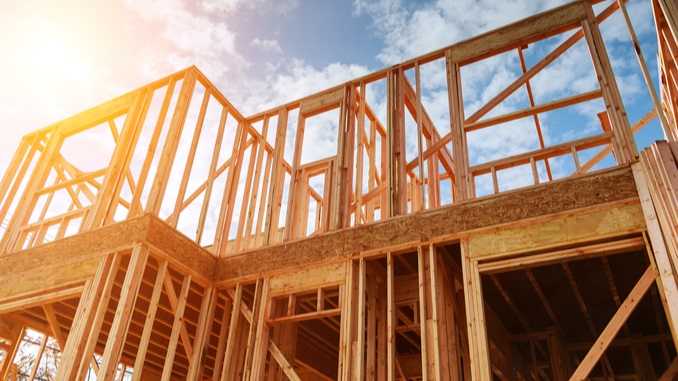
Home builders are warning that Gov. Katie Hobbs’ moratorium on home building will hurt the state’s economy severely.
The Home Builders Association of Central Arizona (HBACA) cited a recent study by Elliott Pollack, a Scottsdale-based real estate and economic consulting firm.
“From an economic perspective, the sudden and drastic measures announcing no new certifications of assured water supply from groundwater created uncertainty and risk, an effective deterrent to potential investors in our state’s economy,” read the study. “The prevailing sentiment that Arizona is out of water is now a significant hurdle that requires educating all future potential investment in our State.”
The study projected that the governor’s moratorium on new builds, imposed last June by ceasing certifications of assured water supply, could cost the Phoenix area over 26,000 jobs over the next decade. That, along with a projection that the moratorium would exacerbate the state’s affordable housing crisis.
Hobbs issued the moratorium in response to an Arizona Department of Water Resources (ADWR) report projecting a 100-year deficit of four percent in groundwater for the greater Phoenix area.
I unveiled the latest study of groundwater conditions across the Phoenix metropolitan area. Families and businesses from around the world come to Arizona in part because we are serious about water management, and that we are the leader in safeguarding groundwater supplies. ⬇️1/4
— Governor Katie Hobbs (@GovernorHobbs) June 1, 2023
Assured water supply requires demonstration that developers have a plan to use groundwater in compliance with water management rules set by the ADWR and facilitated by the Central Arizona Groundwater Replenishment District (CAGRD).
After ADWR allowed CAGRD membership to meet the renewable water management obligations in 1995, an estimated 460,000 homes were built, bringing in over 1.2 million residents. CAGRD’s existence ensured that water providers and landowners wouldn’t be on the hook for assuring the 100-year renewable water supply up front.
After the ADWR rule change concerning CAGRD, Elliott Pollack reported that the state brought in $50.4 billion in wages and $135.7 billion in economic impact. CAGRD region residents also spent over $180 billion in the local economy, and contributed over $35 billion in tax revenues.
According to a long-term forecast by the Maricopa Association of Governments (MAG), one out of seven newly built homes would be in Buckeye by 2030, with an estimated 14 percent of new builds cropping up in the city through 2060. That’s up to 3,700 new builds annually on average. However, Elliott Pollack said that this long-term forecast wouldn’t come to fruition under Hobbs’ moratorium — meaning, the expectation of the economy-boosting annual influx of around 10,000 new residents wouldn’t occur.
The study further projected the moratorium could cause mass out-of-state migration by escalating home prices in formerly affordable housing regions, with the supply of homes under $400,000 dwindling or ceasing to exist altogether. The median home price in Arizona sits at around $434,000.
Mortgage rates would demand a minimal income of about $100,000 to afford a $400,000 home. Census data estimated that around 40 percent of the greater Phoenix area’s population made $100,000 or more as of 2022, and further estimated median household income to be about $72,000.
That means about 60 percent of the area wouldn’t be able to afford a home in the area.
The study also found that most out-of-state migration from Arizona was to cities with more affordable homes. Out of nearly 30 cities analyzed, 25 had median home prices more affordable than Arizona’s.
Corinne Murdock is a reporter for AZ Free News. Follow her latest on Twitter, or email tips to corinne@azfreenews.com.
Friday’s jobs report is not the home run that Democrats and the mainstream media claim. In their rush to champion topline job creation, they overlook how the jobs report is actually made up of two surveys. And the other doesn’t look so good, though it’s far more reflective of the economic reality facing ordinary Americans and small businesses.
The Bureau of Labor Statistics surveys business establishments and households each month to generate its report on labor market conditions. The establishment survey of payrolls produces the monthly job creation number the media is quick to champion. Yet even the BLS admits the household survey is “more expansive” because it also measures self-employed workers and those employed privately in households. This survey produces the unemployment rate.
For years, these surveys have tracked each other in terms of employment growth, as you’d expect. However, beginning in mid-2022, they began to diverge, with the payroll survey showing far more job creation than the household survey. Over the last year, the payroll survey finds 2.9 million jobs have been created, while the household survey reveals only 1.1 million new jobs.
In stark contrast to the 353,000 jobs created in the payroll survey, the household survey shows employment actually declined by 31,000 last month. Full-time jobs declined by 63,000. That’s a far cry from today’s headlines about a booming economy.
These household survey numbers are in line with other anecdotal and empirical data. On Thursday, the job placement firm Challenger, Gray and Christmas reported a historic 82,300 layoffs in January. This week, UPS announced 12,000 layoffs. Major companies such as Zerox, Spotify, and Hasbro have recently laid off at least 15% of their workforce. There’s also a jobs bloodbath currently occurring in the media sector.
On Wednesday, ADP reported that only 107,000 private-sector jobs were created in January.
There are other technical problems with the jobs report. Seasonal adjustments and annual revisions to population estimates have made January jobs reports notoriously untrustworthy. I can’t understand why we need opaque “seasonal adjustments” to the job numbers at all. Americans are smart enough to understand that job creation will be higher in some months and lower in others for seasonal reasons. We don’t need green eyeshades smoothing them for us.
Bipartisan tax cut legislation passed this week in the House of Representatives can turbocharge job creation in both surveys in the months ahead. The legislation, brokered by House Ways and Means Chairman Jason Smith (R-MO), extends key tax cuts passed as part of the Tax Cuts and Jobs Act in 2017, making it easier for small businesses to invest, expand, and hire.
This legislation is overwhelmingly supported by Main Street, with small businesses calling the immediate expensing provision “a game-changer.” The Senate should quickly pass this legislation and send it to President Biden’s desk to be signed into law.
In the meantime, let’s see if the payroll and household surveys continue to diverge in the jobs reports ahead. If they do, it will be more confirmation that the economy is not out of the woods yet.
Alfredo Ortiz is a contributor to The Daily Caller News Foundation, president and CEO of Job Creators Network, author of “The Real Race Revolutionaries,” and co-host of the Main Street Matters podcast.
For the past thirty years or so the left has invented a narrative that there are two Americas. A group of very super-rich people (the one percenters) who have prospered over the past several decades, and everyone else who has gotten poorer. It’s a fairy tale narrative because almost all Americans have seen financial progress. The median household income adjusted for inflation rose by more than 40% since 1984.
Prosperity isn’t an “us versus them” zero-sum game. A rising tide really does lift all boats.
But there really are Two Americas today. First, there are the cultural and over-educated snobs – the kind of people who religiously read the New York Times, drive EVs, wear Harvard or Yale sweaters, and have never even heard of NASCAR or eaten at Popeyes or ridden a John Deere tractor.
And then there is normal main street America. The snobs thumb their collective noses at the unrefined working-class Americans. The elites believe they are intellectually, culturally, and morally superior to the working class and rural America. You won’t see too many elites at a Trump rally with 30,000 people.
A group I helped found, the Committee to Unleash Prosperity, just published a study entitled “Them Vs. U.S.” examining how America’s cultural elites (defined as at least one postgraduate degree, $150,000+ annual income, high-density urban residence, and attended an Ivy League school) are hopelessly out of touch with ordinary Americans. Pollster Scott Rasmussen did the research.
Here are some of the key jaw-dropping revelations from the survey:
Financial Well-being: Nearly three-quarters of the elites surveyed, believe they are better off now financially than they were when Joe Biden entered the White House. Less than 20% of ordinary Americans feel the same way.
Individual Freedom: Elites are three times more likely than all Americans to say there is too much individual freedom in the country. Astonishingly, almost half of the elites and almost six-of-ten ivy leaguers say there is too much freedom.
Climate Change: An astonishing 72% of the Elites – including 81% of the Elites who graduated from the top universities – favor banning gas cars. And majorities of elites would ban gas stoves, non-essential air travel, SUVs, and private air conditioning. That means no air travel with the kids to Disney World.
Education: Most elites think that teachers unions and school administrators should control the agenda of schools. Most mainstream Americans think that parents should make these decisions.
Oh, and about three-quarters of these cultural elites are Biden supporters. Surprised?
The Grand Canyon-sized divide between the elites in America and ordinary Americans is so profound that it is as if they live in two different countries. Silicon Valley, Manhattan, and Washington, D.C. have become bubbles that have lost contact with everyday Americans. This explains why the political class – which is a big part of the elite group – is confused by poll numbers showing that voters are feeling financially stressed out. The elites are doing fine, so they believe that everyone is prospering. I suspect that most don’t want radical change in the public schools because their kids attend blue-chip private schools. They are fine with abolishing SUVs because in big cities Americans generally don’t drive those cars – if they drive cars at all.
Crime, illegal immigration, inflation, fentanyl, and factory closings aren’t keeping the elite up at night because in their cocoons they don’t encounter these problems on a daily basis the way so many Americans do today. Not too many main street Americans are losing sleep about climate change or LGBTQ issues.
The elites in America tend to work in the “talking professions” – university professors, journalists, lawyers, actors, and lobbyists. They keep talking and normal Americans are more than ever not listening to them.
Stephen Moore is a contributor to The Daily Caller News Foundation, co-founder of the Committee to Unleash Prosperity, and chief economist with FreedomWorks.
As Christmas approaches, Americans are making a list and checking it twice — not to determine who’s been naughty or nice, but to determine what they can afford this Christmas. For all too many of them, the answer is, not much, and certainly not as much as before Joe Biden became president.
That creates a political problem for the president, because even as he’s spent the better part of the past six months touting the benefits of “Bidenomics” (suggesting the word connotes a rising standard of living for the majority), the American people have come to a different far different conclusion. For them, “Bidenomics” means, “I can’t afford it.”
A recent Bloomberg News analysis shows why: A basket of goods for the average family that cost $100 before the COVID-19 emergency costs $119.27 today. “Since early 2020,” says the piece, “prices have risen about as much as they had in the full 10 years preceding the health emergency.”
Electricity is up 25% since January 2020, and groceries the same. A pound of ground beef is up from $3.29 to $5.23; two pounds of chicken breast have risen from $6.12 to $8.44; and coffee has gone from $4.17 to $6.18.
You won’t save any money going out to eat — restaurant food is up 24%.
And getting there isn’t any less expensive, either. After peaking around $5 per gallon last year, gasoline has dropped somewhat, but gasoline prices today are still 60% higher than they were on the day Joe Biden took office.
Because of Biden’s bad energy policies (read: shutting down pipelines; stricter EV regulations; no leases for drilling; and new taxes on coal, oil, and natural gas, among others), energy prices have gone up overall by 30% in less than three years — electricity is up 25%, propane gas is up 23%, natural gas is up 25%, and diesel fuel is up 47%.
Housing, too, is far more expensive, and nearing unaffordable. In January 2021, the monthly mortgage payment on a median-priced home was $989. Today, that number has more than doubled, to $2,041. Mortgage rates have more than doubled since Biden took office, pricing many families out of the market – and forcing sellers to pull back and sit on properties they’d prefer to sell, but cannot.
Not surprisingly, American families have turned to their credit cards just to make ends meet. The result: Americans now hold more than $1 trillion in credit card debt. That’s a record high.
It’s no wonder Biden’s approval ratings, and, specifically, his approval rating on his handling of the economy, are down. In this recent survey, he’s at 40% approve, 49% disapprove on his overall job rating, and 36% approve, 61% disapprove on his handling of the economy. A full 76 percent said the economy was either “not so good” or “poor” when asked to rate economic conditions right now. Just 26% of the survey respondents said Biden’s economic policies had helped the economy “a lot” or “somewhat,” while 48 percent said his policies had hurt the economy “somewhat” or “a lot.”
And in this poll’s version of the killer question Ronald Reagan posed in his one debate with Jimmy Carter in October of 1980 – “Are you better off today than you were four years ago?” – just 4% say they are “much better off” and 10 percent say they are “somewhat better off” when asked how they have fared since Joe Biden became president.
Policies have consequences, and Americans are suffering under the real-world consequences of Joe Biden’s policies.
It’s bad enough that Americans have to suffer under the consequences of Biden’s bad policies. What makes it worse is that Biden and his administration are doubling down on their bad policies. They refuse to learn from the real-world experience of seeing the results of their policies; instead, they continue to act as if those consequences are not visible to anyone, let alone everyone.
Biden and his Democrat allies know they want more government spending, more government programs, more government regulation, more government power and control over our lives.
Meanwhile, Rudolph goes hungry, because Santa can’t afford to feed his reindeer.
The latest read on Gross Domestic Product (GDP) of 5.2% real growth suggests the US economy soared in the third quarter. As momentum matters, this suggests the next quarter and the next will also be strong. One can hope, but a great downshift is far more likely.
For starters, it’s likely the economy was nowhere near as strong as the headline suggests. GDP gets all the love in the press, but Gross Domestic Income (GDI) is an equally valid measure. If we could measure these things precisely, they would always equate. GDI came in at 1.5%, much lower than GDP’s 5.2%.
Much the same data conflict arises in the jobs figures. According to the press fave employers’ survey, the economy created about 200 thousand jobs monthly since May. But the equally valid household survey has been flat over the same period. Again, that’s a big difference over an extended period between equally valid measures of the labor market.
One measure strong; one weak. Secret sauce clue: When major economic indicators send very different signals, it usually means the economy is at a turning point.
Why now? First, because the American consumer, that great engine representing about two-thirds of GDP, is running low on gas. The hoard of excess saving built up in years past is now mostly gone. LendingClub reports 60% of Americans are living paycheck-to-paycheck, which means they’ve little to fall back on and little room for error or bad luck.
The New York Fed confirms the consumer’s stretched thin, reporting that credit card debt last year displayed “the largest such increase since the beginning of our time series in 1999.” Credit card balances shoot up when savings go down and the checking account’s running dry. The Fed also reports the share of newly delinquent credit card users is the highest in about a decade and on an upward trend.
Going into the pandemic the Fed threw the sink at sustaining the economy, one consequence of which was high inflation. Coming out of the pandemic, the Fed finally woke up to inflation’s gathering momentum. The consequent good news is that inflation is trending downward.
The problem for the American consumer is the damage that inflation has already done. When inflation shot up in 2021 and 2022, nominal wages didn’t. Families took a huge hit in what they could afford and the gap remains. To preserve their standard of living, they resorted to spending down their past savings and spending up their credit card balances.
The natural consequence of stressed consumers is a downshift in spending. The National Retail Federation reports that core retail sales have been essentially flat for two months straight. Retailers report consumers are resisting price increases, hesitating to pay full price, and are increasingly looking for discounts and promotions. The obvious reaction to financial insecurity is to cut back; think cutting out the Rib-Eye at Whole Foods for hamburger from Aldi.
A weakening of consumer spending would occur against a shaky background elsewhere. Housing has been flat or down for two years now. Shipments and new orders both suggest the manufacturing sector is weak. If the consumer really is about out of gas, then the economy could see a marked downshift. And now we come full circle back to the Fed, which put us on this rollercoaster with its kitchen sink response to the pandemic.
The Fed is standing pat with its restrictive policies even as inflation slows and will likely do so for many months. Quite reasonably, before relaxing the Fed wants to be sure inflation continues toward its 2% goal rather than re-igniting. But standing pat while inflation slows means Fed policy is actually becoming steadily more restrictive. Today’s tapping becomes tomorrow’s stomping on the brakes, and thus is likely to generate the great 2024 downshift.
J.D. Foster is a contributor to the Daily Caller News Foundation. He is the former chief economist at the Office of Management and Budget and former chief economist and senior vice president at the U.S. Chamber of Commerce. He now resides in relative freedom in the hills of Idaho.