by Daniel Stefanski | Oct 12, 2024 | News
By Daniel Stefanski |
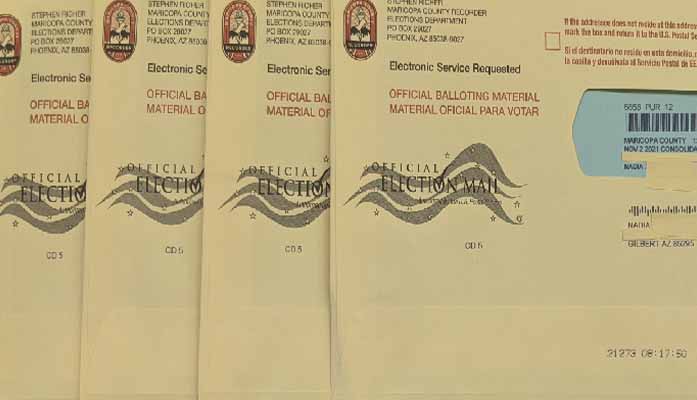
Early voting has officially commenced across the crucial swing state of Arizona.
Arizona political parties are encouraging their voters to cast their ballots as early as possible as the pivotal election in November nears.
The Arizona Democratic Party posted, “ARIZONA: Early voting begins today & your mail-in ballot should arrive soon. We have so much at stake this election – from the presidency to flipping our Republican-controlled state legislature. Make a plan to vote…”
The Republican Party of Arizona stated, “Early Voting starts TODAY! Don’t wait – cast your vote early for President Trump and Republicans up and down the ballot. Check the status of your ballot and find a vote center near you at Arizona.Vote! EVERY. VOTE. COUNTS.”
The AZGOP also shared a video clip from a recent speech from Chair Gina Swoboda, where she encouraged listeners to vote by mail to avoid any potential issues at the polling locations.
Last week, the Arizona Libertarian Party alerted its followers on social media that early voting would soon begin.
Arizona Secretary of State Adrian Fontes also promoted the start of early voting in his state, encouraging interested individuals to visit Arizona.Vote “for all your Arizona election needs.”
In the Republican stronghold of Yavapai County, the Recorder there highlighted the beginning of early voting and shared a website for local voters to find locations and time to cast their ballots over the next month.
Additionally, the Pima County Recorder’s Office posted information about early voting in this southern Arizona jurisdiction, including for the 19 early voting sites under its purview.
Daniel Stefanski is a reporter for AZ Free News. You can send him news tips using this link.
by Staff Reporter | Jul 20, 2024 | News
By Staff Reporter |
The global IT outage that occurred Thursday night impacted Arizona’s early voting operations well into Friday.
Arizona’s three largest counties — Maricopa, Pima, and Pinal — were impacted by the outage. Together, they account for over 80 percent of the state’s population.
In Maricopa County some vote centers’ check-in systems weren’t functioning, explained an elections department spokesperson.
“The vote center equipment is connected via a network to facilitate voter check in and cast their ballots,” said the spokesperson.
Maricopa County started the day with a few vote centers open. That number grew to 14 by the afternoon.
The outage impacted Pima County’s online system to request a mail-in ballot. As a result, early voting has been limited, with election workers providing provisional ballots instead.
Pinal County early voting was restored hours after the outage.
A majority of employee computer and server technologies unrelated to election operations were also impacted across Arizona’s counties.
The outage occurred through Microsoft’s partner CrowdStrike. The Austin, Texas-based software company said in a statement that the outage wasn’t caused by a cyber attack or security incident, but rather a defect in a single content update to its “Falcon Sensor” software for Windows hosts intended to protect against hackers. Mac and Linux hosts weren’t impacted.
CrowdStrike provides antivirus software to Microsoft for Windows devices. After 16 hours, Microsoft reported that all impacted apps and services had recovered.
The secretary of state’s office clarified that voter rolls weren’t affected by the outage.
In a press release, Secretary of State Adrian Fontes reassured voters that the registration system was secure and operational. Fontes noted that the closed, air-gapped tabulation networks were unaffected, and that access has been restored fully to agency computers used for verifying petition signatures.
“The current global outage is affecting systems worldwide and is not specific to elections or Arizona,” said Fontes.
Fontes clarified that the closed, air-gapped nature of the tabulation networks means that election-support infrastructure, such as email and web servers, are on separate systems.
“[It] is important to note that vote counting was not impacted at all by this event,” said Fontes. “No significant operational delays have been identified at this time.”
Arizona’s voting operations weren’t the only ones impacted. Both government agencies and private industries were affected: airports, airlines, banks, broadcasters, emergency 911 call centers, and hospitals were all affected. Among CrowdStrike users are over half of the nation’s Fortune 500 companies.
United, American, Delta, and Allegiant airlines were grounded overnight at Phoenix Sky Harbor Airport. Southwest Airlines was unaffected because they operate on Windows 3.1: a version over 30 years old.
Cochise County didn’t mention elections-related outages, but did report that their 911 dispatch center and sheriff’s department were impacted and required their IT team’s work. The Phoenix Police Department also experienced issues with its computerized 911 dispatch center.
AZ Free News is your #1 source for Arizona news and politics. You can send us news tips using this link.
by AZ Free Enterprise Club | Apr 11, 2021 | Opinion
By Free Enterprise Club |
This past week in Kentucky, HB 574 was signed into law. Despite the Kentucky legislature consisting of Republican supermajorities in both the House and Senate, the account for Democratic Governors tweeted, “While Republicans like @BrianKempGA are implementing Jim Crow 2.0, yet another Democratic governor just expanded voting rights…”
And the corporate media picked up this talking point with headlines such as “Kentucky Gov. Beshear signs into law bipartisan elections bill expanding voting access” from CNN, “Why Kentucky Just Became the Only Red State to Expand Voting Rights” from the New York Times, and “Democratic Governor in deep-red Kentucky signs bill to expand voting, bucking national trend” from the Washington Post.
Meanwhile, here in Arizona the headlines read “Arizona Republican lawmakers join GOP efforts to target voting, with nearly two dozen restrictive voting measures” under a bold “Voting Rights Under Attack” from CNN, “The next Georgia: Texas and Arizona emerge as voting rights battlegrounds” from the Guardian, and “23 voter suppression bills in Arizona legislature” from KOLD.
Let’s take a look at what the left and liberal media consider “Jim Crow 2.0” in Arizona compared to what they applaud as “expanding voting access” in Kentucky.
Early Voting
In Arizona, early voting begins 27 days before an election.
Under the Kentucky bill, early voting is limited to a mere 3 days: Thursday, Friday, and Saturday during normal business hours (Section 11).
Ballot Harvesting
In 2016, HB2023, which prohibited ballot harvesting, was signed into Arizona law. The Democrat party sued the state over it, claiming it has a disparate impact on minority voters. The case is currently in the Supreme Court.
Under the Kentucky bill, ballot harvesting is prohibited (Section 6).
Vote By Mail/SB1485
In Arizona, no excuse is required to vote by mail and voters can register to automatically receive a ballot for every single election, without having to reapply. SB1485 would remove a voter from this list only after the voter failed to vote in four consecutive elections and fails to respond to a notice. The voter would still be registered, they would just no longer receive a ballot in the mail automatically.
Under the Kentucky bill, an excuse is required to vote absentee and voters must apply within a short window of no earlier than 45 days before an election and no later than 14 days before an election (Section 11).
SB1003
In Arizona, SB1003 clarifies that if a ballot does not have a signature, the county must attempt to contact the voter and if a signature is not obtained by 7PM on election day, it is rejected.
Under the Kentucky bill, an absentee ballot must immediately be rejected if it has no signature (Section 14).
Voter Registration/SB1106
In Arizona, SB1106 would require a county recorder to cancel a voter’s registration upon confirmation the voter has registered in another county or state.
Under the Kentucky bill, a voter’s registration must immediately be canceled upon notification the voter has registered in another county or state (Section 5).
Voter ID/SB1713
In Arizona, voters on the early voter list automatically receive a ballot by mail for every election and do not have to reapply every time. SB1713 requires voters to write their date of birth and either their Arizona driver’s license or voter registration number on their ballot affidavit.
Under the Kentucky bill, a photo ID is required for voting in person and must be provided in the application for an absentee ballot, an application that must be made before every election (Section 41).
Catching the theme? All of these provisions leave Kentucky with a more restrictive election system than Arizona. If proposals in the Arizona Legislature are “Jim Crow 2.0” in the eyes of the democrats and media, then Kentucky would surely be “Jim Crow on steroids.”
If we have learned anything from Kentucky’s passage of HB574, it is that according to the leftist media, election integrity reforms are racist and disenfranchisement when Republicans pass them, but an “expansion of voter access” when a Democrat Governor signs on.
In reality, all of the bills Arizona is considering leave intact the many accessible options available to voters with modest reforms to ensure the integrity of each. They ensure it is simple to register, easy to vote, and hard to cheat, priorities Kentucky’s new law also ensure.