by Corinne Murdock | Oct 25, 2022 | News
By Corinne Murdock |
On Monday, Maricopa County began the tabulation of approximately 168,000 early ballots. The county estimated that around 150,000 to 250,000 early ballots will be dropped off on Election Day, with 98 percent of ballots reported by November 11.
The Maricopa County Elections Department counts all early and provisional ballots. Vote Center tabulators handle Election Day ballots. As the county noted, state law allows for early ballot tabulation prior to Election Day.
Bill Gates, Maricopa County Board of Supervisors chairman, assured voters in a press release that the tabulators were vetted and staff were bipartisan.
“Regardless of who wins or loses, voters can trust in the results that our election processes, procedures, and audits provide,” stated Gates.
The county noted that voters should be aware of the possibility of an automatic recount following the publication of final results. SB1008 increased the automatic recount threshold from .001 to .5 percent. If that occurs, the final election results would be available by late December at the earliest.
The county’s detailed explanation of its processes, prediction of when vote counting ends, and assurance of election integrity precautions are likely part of efforts to alleviate tensions after nearly two years of vocal voter distrust in elections — especially those in Maricopa County.
County leadership condemned citizens surveilling ballot drop boxes, saying that it amounts to voter intimidation. The county encouraged citizens to become poll workers or official party-affiliated observers rather than surveil drop boxes.
“Uninformed vigilantes outside Maricopa County’s drop boxes are not increasing election integrity. Instead they are leading to voter intimidation complaints. Although monitoring and transparency in our elections is critical, voter intimidation is unlawful,” stated the county.
Video surveillance of the drop boxes exists, but isn’t always reliable. As AZ Free News reported in August, the county failed to record an unstaffed drop box for three weeks — a mistake only discovered by the county after a records request for the video feed by the Maricopa County Republican Committee (MCRC).
Maricopa County Recorder Stephen Richer shared that approximately 1.9 million early ballots were mailed, accounting for around 77 percent of voters (over 2.4 million). Richer added that the county processed over 25,000 new or updated voter registration applications.
Election results will be made available here starting at 8 pm on Election Day, and updated every night. Voters can track and verify their ballot status by texting “JOIN” to 628-683 or by visiting BeBallotReady.Vote.
VISIT MARICOPA COUNTY’S ELECTION FAQS WEBSITE
Corinne Murdock is a reporter for AZ Free News. Follow her latest on Twitter, or email tips to corinne@azfreenews.com.
by Corinne Murdock | Feb 20, 2022 | News
By Corinne Murdock |
The House Government and Elections Committee narrowly approved a resolution requiring expanded voter ID requirements for any mail-in or early drop-off ballots.
HCR2025, called the “Arizonans for Voter ID Act,” would require voters to sign an affidavit with their ballot, including their birth date and an “early voter ID” constituting one of the following: their driver’s license number, nonoperating ID license number, last four digits of their Social Security number, or their unique identifying number. In order to protect the voter’s information, counties would be required to provide an additional privacy folder or slip.
The resolution would also prohibit the Arizona Department of Transportation (ADOT) from charging a fee for an ID if the applicant discloses that the ID was obtained for the purposes of registering to vote or voting. Photo ID that doesn’t contain a suitable address must be accompanied by additional documentation verifying ID.
State Representative John Fillmore (R-Apache Junction) introduced the resolution, formed with assistance from the Arizona Free Enterprise Club. The Club’s deputy director, Greg Blackie, explained that there’s currently a similar voter initiative being conducted throughout the state, also called Arizonans For Voter ID. Blackie added that this resolution expanded on last year’s universal ID efforts.
In response to concerns from Minority Leader Reginald Bolding (D-Laveen) that voters’ private information would be compromised, Blackie reminded Bolding that the same private information was routinely sent through the mail such as tax return forms.
Bolding said that he was in opposition to the legislation because it didn’t take into account the difficulties it might impose on the elderly or the Navajo nations. He said that many lack multiple forms of what would qualify as early voter ID. Bolding implied that legislators’ fears over Arizona becoming a purple rather than a red state were the real reason behind this bill, prompting chiding from Chairman John Kavanagh (R-Fountain Hills).
Fillmore rebutted that he witnessed all parties support the parallel voter initiative currently underway: supporters from the Green Party and independents, in addition to Democrats and Republicans.
“This is a pure voter integrity bill and the people get to speak on it,” said Fillmore.
Corinne Murdock is a reporter for AZ Free News. Follow her latest on Twitter, or email tips to corinne@azfreenews.com.
by AZ Free Enterprise Club | Oct 2, 2021 | Opinion
By the AZ Free Enterprise Club |
Easy to vote and hard to cheat. That should be the benchmark for every single election we have.
Voters should not have to choose between having a secure election or having an accessible election. They can have both. And in Arizona, we’ve certainly made our elections accessible.
But that hasn’t always been the case with the security of our elections. And the results of the Arizona audit issued in September show just that.
These are significant issues that need to be addressed. Thankfully, the audit report made multiple recommendations that are common-sense election integrity policies.
And the most important one is something we’ve been saying for years…
>>>READ MORE >>>
by Terri Jo Neff | Feb 28, 2021 | News
By Terri Jo Neff |
State senators are expected to debate Monday whether to approve a bill that requires Arizona’s 15 county recorders to drop registered voters from the Permanent Early Voting List (PEVL) who do not respond to a drop-notification letter that they have not utilized their mail-in ballots in a four-year period.
Since 2007, registered voters have been allowed to submit a written request to add their name to PEVL, which ensures the voter automatically receives a ballot by mail for each election instead of having to request one every time. More than 3 million voters in Arizona are on PEVL.
State law specifies that a failure to vote by early ballot does not constitute grounds to be removed from PEVL, although there are estimates that more than 100,000 PEVL voters across Arizona have not voted by early ballot in the last four years.
In January, Sen. Michelle Ugenti-Rita (R-LD23) introduced SB1069 which would have required county recorders to remove PEVL voters who do not cast their early ballot for two consecutive primary and general elections for which there was a federal, statewide or legislative race on the ballot.
The intent, according to Ugenti-Rita, is to ensure unwanted ballots are not mailed out, saving counties money and ensuring ballot integrity. PEVL would become EVL if the bill passes.
“There’s a cost associated with sending out ballots to people who aren’t voting by mail,” she said during one a committee meeting last month. “There’s also an integrity component,”
Every time a PEVL voter casts an early ballot in a primary or general election that includes a federal, statewide or legislative race it would restart the voter’s drop-off clock. Being removed from PEVL has no impact on a voter’s registration status.
As a safeguard, Ugenti-Rita’s legislation requires the county recorders or other county elections officials to send a written notification by Dec. 1 of each even-numbered year to any PEVL voter identified as being subject to removal. Such voters who wish to remain on PEVL must then send back a signed notice with their address and date of birth within 30 days.
On Feb. 16, Ugenti-Rita’s bill failed to pass the Senate Committee on Government on a 15-15 vote. Days later the text of SB1069 was swapped into SB1485, another election-related legislation. The full Senate is slated to vote on SB1485 on Monday.
The legislation is supported by the Barry Goldwater Institute for Public Policy Research, but has been opposed by the Stonewall Democrats of Arizona, the Arizona Education Association, and the American Civil Liberties Union of Arizona. Another PAC which opposes SB1069-turned-SB1485 is Unite Arizona, a political action committee financed by the Unite America Election Fund based in Denver.
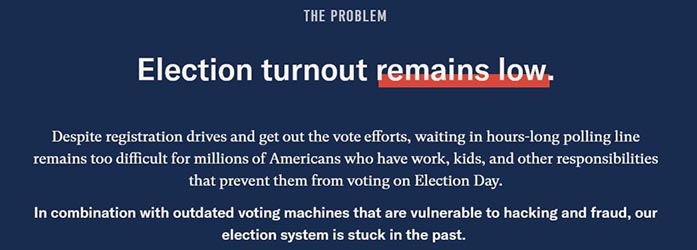
Despite the fact that Arizona has one of the most progressive early voting processes, Unite America/Arizona is fighting an effort to ensure that early ballots get to living residents of the state. The group’s website continues to use the now-challenged claim that election equipment can be hacked in order to sell their voting reform package which includes only mail-in ballot elections.
According TransparencyUSA.org, the Unite American Election Fund gave more than $850,000 in the past year to Unite Arizona. In turn, Unite Arizona gave $505,000 to Our Arizona Values, representing all of the funds received by that group.
Public records show 99 percent of the funds received by Our Arizona Values was paid to Polestar, which spent nearly $240,000 last year in an unsuccessful effort to unseat Sen. Nancy Barto (R-LD15) in the Republican primary. Barto is seen as strong voice on the Senate Judiciary Committee and has introduced bills this session aimed at election integrity issues.
RELATED ARTICLE: New York Billionaire Spends Big Money To Save Carter, Udall And Osborne
As sponsor of the bill, Ugenti-Rita has spent a lot of time responding to attacks by legislators who contend dropping voters from PEVL interferes with voting rights. She said during last week’s Senate Rules Committee meeting that she was offended by how some opponents appeared to be “purposefully mischaracterizing” the bill in an attempt “to demonize it” with voters.
“If you want to oppose the bill because there’s an actual provision in there that you don’t like, I mean, I get it,” she said last week. “But attacking voting rights? This is a voluntary list that we’re taking about. There is no right to be on PEVL.”
Ugenti-Rita added that suggestions by some legislators that the bill attacks individuals’ rights to vote or that it could prohibit someone from voting “is very dangerous rhetoric in a time when inflammatory, incendiary language should not be utilized especially when we are discussing relevant policy.”
The now-SB1485 is quite different from a PEVL bill introduced this session by Rep. Kevin Payne (R-LD21) who sought to do away with PEVL completely, even though in some counties more than 80 percent of all ballots cast in the 2020 General Election came in via mail or were dropped off early.
Meanwhile, election-related Senate Bill 1025 introduced by Sen. Kelly Townsend (R-LD16) passed the Senate on a 16 to 14 vote last week and is awaiting a First Read in the House.
SB1025 had been expected to receive greater bi-partisan support as it was intended to ensure voters understood what it meant if a machine reader alerted to an overvote situation. The bill requires election officials or polling station judges to know what an overvote (or undervote) warning means so they can explain it to in-person voters who might be faced with such a warning.