by Terri Jo Neff | Jul 6, 2021 | News
By Terri Jo Neff |
A new committee tasked with reviewing Cyber Ninjas’ findings of the Senate’s ongoing audit of Maricopa County’s 2020 general election is one of the provisions signed into law last week when Gov. Doug Ducey put his signature on the Fiscal Year 2022 budget bills.
Formation of the Special Committee on the Election Audit was included by Senate President Karen Fann in an amendment to SB1819, one of the 11 budget bills. The committee will run through Jan. 1, 2022 and be made up of Democrats and Republicans who are members of the current Senate Government Committee.
The purpose of the committee, according to the new state law, is to recommend to the senate president “the appropriate legislative action based on the findings of the audit, including a call for a special session of the legislature to implement the special committee’s recommendations.”
The Fann amendment also provides leverage for pressuring Ducey to call a special session if it appears new election-related legislation is needed which cannot wait until next January’s regular session. Without an assured two-thirds vote margin in either chamber, the governor is the only option for calling lawmakers back into session to pass laws to take effect before the 2022 primary in August.
Ducey, however, has been reticent on the subject, leaving it to a spokesman to comment.
“We will wait and see what the committee recommends,” C.J. Karamargin said last month about the possibility of an election-related special session.
One reason a special session to address the election audit is so important to Republicans is that the majority of the election reform and election integrity bills introduced by GOP lawmakers during the regular session were either watered down or did not pass. And the main reason for that was the ongoing feud between Sens. Michelle Ugenti-Rita (R-LD23) and Kelly Townsend (R-LD16).
Ugenti-Rita chaired the influential Senate Committee on Government. She and Townsend butted heads throughout the session, often over the fact Ugenti-Rita refused to allow the committee to consider some of Townsend’s bills.
Then during the last week of the session, the women took turns voting against each other’s election bills, both of which contained reforms many Republican voters supported.

by Terri Jo Neff | Jul 5, 2021 | News
By Terri Jo Neff |
Gov. Doug Ducey grew frustrated in May with the legislature’s slow pace of action on the Fiscal Year 2022 budget packet. So Ducey thought he would send the state’s 90 lawmakers a message by vetoing 22 bills, several which had passed with bipartisan support.
The vetoes did little to motivate either chamber to action and it would take more than one month before all 11 budget bills finally passed, and even then several bills were amended from what Ducey’s staff and legislative budget negotiators wanted.
But Ducey’s vetoes were not forgotten by many legislators. The Senate passed reintroduced versions of the 22 vetoed bills but was motivated enough to symbolically override one of the governor’s 22 snubs, something no other Arizona governor had faced in nearly 30 years.
The House did not follow the Senate’s suit, choosing instead to pass 20 of the Senate’s reintroduced bills. As of July 2, the governor had signed 10 of the reintroduced bills and the other 10 were transmitted to Ducey by the Senate prior to Sine Die on June 30.
Under current legislative rules, Ducey must act on the bills on his desk within 10 days after Sine Die of the bills automatically become law. The remaining two bills passed by the Senate died in the House.
The 10 bills Ducey has already signed:
SB1830 authorizes the creation of an individual and corporate state tax credit for the donation of real property to a school district of charter school. It passed with bipartisan support
SB1841 requires the Department of Law (the Arizona Attorney General’s Office) to review a federal executive order for constitutionality if requested by any member of the Legislature
SB1833 addresses proficiency testing by the Arizona Department of Health Services (DHS) of third-party marijuana laboratories and marijuana testing facilities
SB1834 allows DHS to conduct unannounced inspections of a medical marijuana dispensary
SB1835 requires that an election challenger or party representative must be a resident of Arizona and a registered voter of the state
SB1831 mandates that the State Registrar provide a person a copy of his or her original birth certificate sealed due to adoption if the person was born before June 20, 1968
SB1832 modifies Arizona’s DUI laws and requires traffic survival instruction courses to include information about aggressive driving. Such instruction is to be completed in person unless the Governor declares a state of emergency
SB1838 replaces the term “product of human conception” with “unborn child”
SB1839 outlines changes to Arizona Psychiatric Security Review Board
SB1843 changes the classifications of excessive speed and the statute related to waste of finite resources
The bills on Ducey’s desk:
SB1844 modifies the maximum Arizona adjusted gross income subtraction for college savings plan contributions authorized by section 529 of the Internal Revenue Code and allows subtraction of Achieving a Better Life Experience (ABLE) account contributions
SB1848 requires the Arizona Department of Housing to provide emergency shelter beds in western Maricopa County for homeless persons who are at least 55 years old
SB1846 exempts containers of spirituous liquor from prescribed labeling requirements under specified delivery conditions
SB1849 makes some changes to health and medical services offered to female inmates and allows a prisoner is to receive a certificate upon successful completion of training programs to work in a specific field or trade
SB1847 mandates DHS to provide grant monies from the Medical Marijuana Fund for research on the correlation of marijuana use and mental illness and requires DHS to develop a warning label to be affixed to the packaging of marijuana
SB1842 addresses the security, packaging, and labeling of marijuana and marijuana products
SB1845 requires the Department of Economic Security to implement a Produce Incentive Program
SB1850 contains technical corrections relating to multiple, defective, and conflicting statutory text
SB1851 outlines data required for the Arizona State Hospital financial and programmatic report, and establishes the Joint Legislative Psychiatric Hospital Review Council
SB1836 modifies sex offender registration requirements
HB2905 specifies that a county recorder or other election officer may not deliver or mail an early ballot to a person who has not requested an early ballot for that election.
HB2906 requires the certified public accountant (CPA) or auditor to present audit results to certain members within 90 days after a statutory audit and outlines requirements for training of certain employees (prohibits Critical Race Theory-based material/curriculum).
The other vetoed bills:
SB1837 would have banned a county recorder or other election officer from delivering or mailing an early ballot for an election to a person who did not requested an early ballot for that election
SB1840 would have required in certain instances that a certified public accountant or auditor present audit results within 90 days after a statutory audit, and it outlined requirements for employee training
by AZ Free News | Jul 3, 2021 | News
On Friday, Gov. Doug Ducey rescinded a series of executive orders issued during the coronavirus pandemic. The governor said the orders were no longer needed because the Legislature put them into law.
The governor said some of the orders would remain in place until legislation takes effect in 90 days. Those include orders preventing cities, towns and counties from issuing orders for businesses that are more stringent than those Ducey issues. Other orders ending after new legislation takes effect are ones barring universities from requiring COVID-19 vaccines or masks for unvaccinated students.
The governor ordered:
Effective July 1, 2021, the following Executive Orders related to the public health emergency will be rescinded:
- Executive Order 2020-17 deferred requirements to renew state agency and board licenses that had an expiration date between March 1, 2020 and September 1, 2020 by six months from the expiration date, unless those requirements could be completed online. The timeframe for the deferrals lapsed on March 1, 2021.
- Executive Order 2020-28 was enacted to address critical demand for nursing home and long-term care facility staff, allowing caregiver trainees to utilize on-the-job training to meet a certification program. This policy was codified through legislation in 2020.
- Executive Order 2020-58 ensured cost-sharing requirements, such as co-pays and co-insurance, for the COVID-19 vaccine are waived. This policy was codified by congress through the CARES Act.
- Executive Order 2021-04 required schools to return in-person, teacher-led instruction by March 15, 2020. In-person, teacher led instruction will continue to be required beyond the March 15, 2020 deadline.
Effective July 9, 2021, the following Executive Orders related to the public health emergency will be rescinded:
- Executive Orders 2020-08 & 2020-53 extended standard driver licenses that originally expired between March 1, 2020 and December 31, 2020, in an effort to limit visits to the state Motor Vehicle division. An expiration deferral issued as a result of this order remains valid and in effect.
- Executive Order 2020-20 allowed pharmacists to dispense emergency refills of maintenance medications for up to 180 days, minimizing unnecessary trips to the doctor. With legislation expanding availability of telemedicine, obtaining refills is now more accessible.
- Executive Order 2020-25 allowed struggling Arizona restaurants to repackage and sell grocery items they have on hand, including items not normally packaged and labeled for resale. Arizona restaurants can now fully resume operations.
Effective September 29, 2021, the following Executive Orders related to the public health emergency will be rescinded upon enactment of legislation to codify the policies:
- Executive Order 2020-12 was a proactive and administrative measure to ensure consistent mitigation guidance across the state, and prohibited any county, city or town to issue an order, rule or regulation that restricts or prohibits any essential service.
- Executive Order 2021-05 lifted occupancy limits that were implemented due to COVID-19.
- Executive Order 2021-06 transitioned COVID-19 mitigation requirements for businesses to recommendations.
- Executive Order 2021-09 banned “vaccine passports” and prevented state and local governments from requiring Arizonans to provide their COVID-19 vaccination status to receive service or enter an area.
- Executive Order 2021-10 rescinded orders related to K-12 health guidance.
- Executive Order 2021-15 ensured students of public higher education institutions cannot be mandated to take the COVID-19 vaccine or submit COVID-19 vaccination documents, and prohibited mandatory testing and mask usage for students.
The following will be repealed on a date determined by the Arizona Department of Health Services:
- Executive Orders 2020-13, 2020-23, 2020-30, 2020-37, 2020-48, 2020-54, 2020-56, 2020-57, 2021-01, 2021-07, 2021-14, identified as Enhanced Surveillance Advisory Orders. The State Legislature provided authority to the Arizona Department of Health Services to continue requiring hospitals, testing laboratories and other health facilities to provide detailed information and data related to COVID-19.
by Terri Jo Neff | Jul 1, 2021 | News
By Terri Jo Neff |
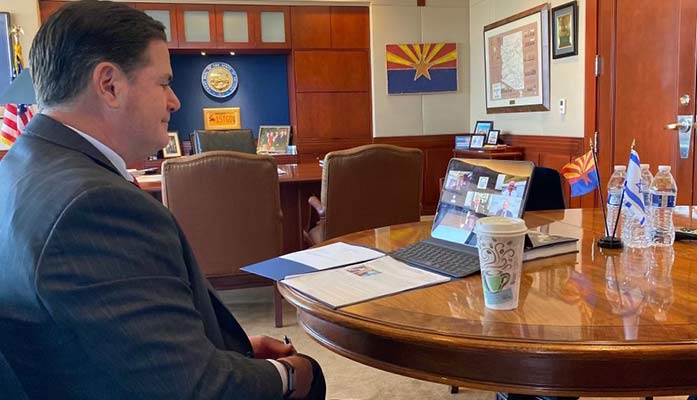
On Wednesday, Gov. Doug Ducey signed what he called “a fiscally conservative, forward-looking budget” for Fiscal Year 2022, cutting taxes for all taxpayers for every Arizona taxpayer no matter what their income.
“While we’re giving money back to taxpayers, this budget makes responsible, targeted and substantial investments in the things that matter,” Ducey said. “Under this budget plan, Arizona is paying off more than $1 billion in debt, we’re helping to protect families with the most sweeping child care package in the nation, and we’re making record investments in K-12 and higher education, infrastructure, public health and public safety.”
Ducey received high marks for the budget from the Washington Post and the Wall Street Journal’s editorial board, particularly the transition of Arizona’s income tax system from a tiered rate to a 2.5 percent flat rate over a three-year period starting Jan. 1, 2022. There are also provisions in the budget for nearly $1 billion in debt payments, as well as another $1 billion to reduce Arizona’s pension liabilities.
Public safety was also a major part of the budget, with $1.5 billion allocated for things like border security and other critical safety investments such as body cameras, increased recruitment funding, and cybersecurity.
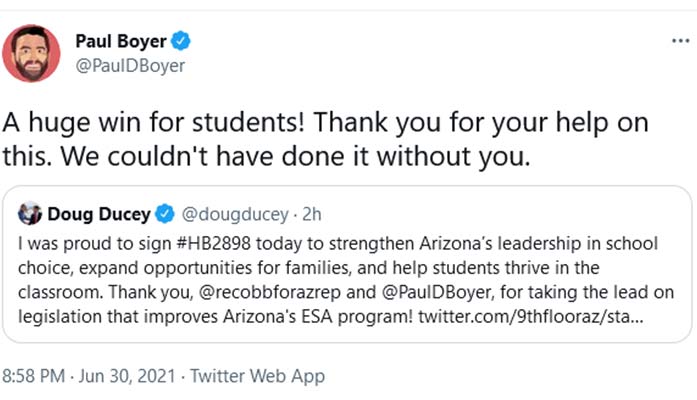
K-12 funding was another priority for Ducey, with more than $6 billion allocated, including $47.2 million to develop early literacy programs for children across the state, $30 million for school transportation, and $50 million in student disability aid. One K-12 education bill, HB2898, signed by Ducey makes it easier for families to utilize Empowerment Scholarship Accounts (ESAs) to help fund lower-income students who wish to attend private schools.
“Arizona’s budget puts students first,” Ducey said after signing HB2898. “Under this plan, we will continue to ensure K-12 students, teachers and schools have resources necessary to help Arizona kids excel in and out of the classroom.”
Ducey has several other bills on his desk which were transmitted this week by the Legislature. Many are do-overs of 22 bills which Ducey vetoed at the end of May in an effort to prod lawmakers to get to work on the budget package.
Although passage of the budget bills took longer than anyone expected in the Republican-controlled Legislature, Ducey’s comments Wednesday stayed focused on the final product, including more options for parents in need of childcare.
by Terri Jo Neff | Jul 1, 2021 | Education, News
By Terri Jo Neff |
The Democrats in the Arizona Legislature may have held firm on their complete opposition to the proposed K-12 budget bill, but all 47 Republicans worked through their differences in the House and Senate to get the multi-faceted House Bill 2898 to Gov. Doug Ducey’s desk Wednesday.
The major holdup with the 200-plus page HB2898 involved a Senate amendment which expanded eligibility for Empowerment Scholarship Accounts (ESAs) from about 250,000 students to more than 700,000. ESAs give credit to an eligible child for most of the government education funding that would have been paid to that student’s public or charter school.
Those funds can then be used toward expenses at private schools as well as other educational costs.
Most House Republicans supported the Senate’s amended version of the K-12 bill but opposition from Reps. Joel John (R-LD4), Michelle Udall (R-LD25), and Joanne Osborne (R-LD13) meant the House ended up approving a K-12 bill which differed from the Senate’s version.
The 16 Republican senators and 31 Republican representatives could pass any bills if they all vote together. But the differing positions on HB2898 required members of both chambers to negotiate a compromise. The result was changes to how soon certain students can qualify for an ESA, although the bill will not benefit another 450,000 students.
Rep. Bret Roberts (R-LD11) supported a larger ESA expansion in the Senate’s bill, but noted the final version still “gives parents more choices.” He added that it “brings the free market into the education system.” Meanwhile, Rep. Jake Hoffman (R-LD12) liked the “opportunities and power” the new legislation gives to parents.
Ducey signed HB2898 on Wednesday along with the 10 other bills which make up the $12.8 billion Fiscal Year 2022 budget package. The new fiscal year starts Thursday.
ESA eligibility was not the only compromise necessary to get HB2898 to Ducey’s desk. An amendment added to the bill with limited debate earlier this week mandated controversial standards for civics curriculum. It faced pushback from Sen. Paul Boyer (R-LD20). Without Boyer’s vote, the entire K-12 budget bill was in peril.
Another compromise led to removal of the last minute civics amendment and Boyer then voted for HB2898.
Other education-related bills were sent to Ducey on Wednesday, including HB2241 which requires information about the Holocaust and other genocides to be taught at least twice between grades 7 and 12. The bill passed both chambers with overwhelming bipartisan support.
The other bill, SB1572, involves early literacy policy at the State Board of Education and the Arizona Department of Education. It impacts dyslexia training and screening requirements, establishes a literacy endorsement for qualified teachers, creates an entry evaluation tool for kindergarten pupils with parental notification requirements, and mandates a K-3 Reading Program report.