On Tuesday, Senate President Warren Petersen issued a press release, blasting his Democrat counterparts for “refusing to come to the table for budget negotiations.”
🚨 FOR IMMEDIATE RELEASE: Senate Democrats Kick Off 2024 by Refusing to Come to the Table for Budget Negotiations
Petersen’s release revealed that the Senate Appropriations Chairman, John Kavanaugh, had transmitted two messages to Democrats – one on December 21, 2023, and the other on January 4, 2024. Those emails requested “input on which areas of government the Minority Caucus would prefer to reduce expenditures on, and which areas to prioritize continued funding for. According to Senate Republicans, not only have Kavanaugh’s emails gone without “response or acknowledgement,” but Petersen “was informed the Minority Leader is directing her Caucus not to engage with the Senate Appropriations Chairman on the budget.”
In a statement accompanying the news release, Petersen said, “It’s unfortunate we’re kicking off this legislative session with Senate Democrats playing games at the expense of our taxpayers. It’s time to be adults. We want all lawmakers to be at the table during budget negotiations, as the citizens of Arizona expect of their elected leaders, but we’ve heard nothing but crickets from the Minority Leader on her statutory obligation. We may have no other choice but to move forward without their input.”
The Senate Republican leader’s words hit a nerve with the chamber’s Democrats, who fired back through their “X” account, writing, “FOR IMMEDIATE RESPONSE: it’s day 2 of session. You’ve moved forward on every other budget without Democrats, so this newest attempt at grandstanding falls flat. The state’s revenue picture has gotten worse month over month, so you know it’s not fiscally responsible to make budget decisions prior to the next Finance Advisory Committee meeting.”
FOR IMMEDIATE RESPONSE: it's day 2 of session.
You've moved forward on every other budget without Democrats, so this newest attempt at grandstanding falls flat. The state’s revenue picture has gotten worse month over month, so you know it’s not fiscally responsible to make… https://t.co/bVERhgqoOn
Senate Republicans corrected the record by reminding Democrats that they had “actually invited Democrats to the table last year as well.” The Republican Caucus shared an email from Kavanaugh from March 2, 2023, in which he extended an invitation to the Senate Minority Leader to “begin the process of discussing with you the budget priorities of the Senate Democratic Caucus.”
“You've moved forward on every other budget without Democrats”
🚨FACT CHECK: We actually invited Democrats to the table last year as well, but don’t let the facts get in the way of a good story. 😏 pic.twitter.com/Hql3FE1WOM
The early back-and-forth between the two political parties follows Democrat Governor Katie Hobbs’ second State of the State address, where she called on legislators to “find common ground” and to “work together to solve this gap.”
Both parties have vastly differing approaches to solving the state’s budget shortfall, though their rhetoric is somewhat similar at the start of the legislative session. In the Senate Republicans’ Majority Plan for 2024, they vowed to complete this mission “without irresponsibly tapping into the Rainy-Day Fund or using budget gimmicks,” promising instead to “use sound fiscal management strategies, like trimming unnecessary spending and prioritizing government’s top functions.” Hobbs stated that her soon-to-be-released budget would “rein in wasteful spending without sacrificing public safety and public education, establish guardrails on unaccountable programs without hurting hard-working families, and tighten our collective belts through increased efficiencies and innovation without gutting programs that support small businesses, seniors, and those in need.”
Last year, House and Senate Republicans approved a budget that was vetoed by Hobbs. Despite many partisan fights in the public eye between Republicans and the governor, Petersen and House Speaker Ben Toma deftly managed a surprise budget compromise, in which their policy priorities remained largely intact. Hobbs will be under increased pressure this time around to extract more concessions from Republicans – especially over the Empowerment Scholarship Account (ESA) program.
Daniel Stefanski is a reporter for AZ Free News. You can send him news tips using this link.
An Arizona Republican lawmaker is warning his state about what it could experience if Democrats were to control the legislature.
Last week, freshman State Representative Austin Smith highlighted a handful of bills that had been pre-filed by his Democrat colleagues, referring to those proposals as “DEMOCRAT EXTREMISM 2024.”
🚨DEMOCRAT EXTREMISM 2024 🚨
So far leftwing extremists have pre-filed bills this legislative session to:
1. Allow changing genders on birth certificates after undergoing surgical, hormonal, psychological treatments.
Smith summarized four Democrat bills, which included the following:
Allow changing genders on birth certificates after undergoing surgical, hormonal, psychological treatments.
Banning unmarked police vehicles.
Repealing no duty to retreat law.
Repealing drug possession paraphernalia laws.
The Republican legislator from the Southwest Valley sounded the alarm that these bills could become reality for Arizona “in one year under the rule of an extremist Democrat controlled legislature.”
Representative Joseph Chaplik, one of Smith’s fellow Republicans in the chamber, echoed the sentiments, writing, “We are in the front row seats seeing these ideas. Most voters have no idea how radical the democrats are with trying to destroy our society.”
We are in the front row seats seeing these ideas. Most voters have no idea how radical the democrats are with trying to destroy our society. #Arizona
The warning from Smith comes at the start of a pivotal election year for the Grand Canyon State, with both the Arizona House and Senate hanging in the balance for 2025. Republicans have razor-thin majorities in both chambers, giving them very little leeway in conducting business. In addition, Democrat Governor Katie Hobbs occupies the Ninth Floor of the State Executive Tower, which means that many conservative policies are vetoed. As Smith alluded to, should Democrats take over the legislature, they would be able to enact many leftist reforms into law with the support of Hobbs.
Many Republicans have also warned about greater restrictions to the state’s school choice opportunities (like the Empowerment Scholarship Account program) or to Arizonans’ Second Amendment freedoms if legislative Democrats have free rein in the House and Senate.
Arizona may undergo another significant makeover before Democrats even could have an opportunity to pass unfettered legislation. Special interest groups are attempting to refer several issues to the November ballot, including an abortion access amendment and a change to the state’s elections systems. Voters’ passage of those initiatives would save political capital for Democrats in 2025 and beyond, while accomplishing the work they might attempt anyway if they simultaneously controlled the legislature and the Governor’s Office.
With Republicans now in control of the Arizona Legislature, though, the Democrats’ transformative policies are likely dead on arrival. Republican leaders and Hobbs will have to negotiate compromises on select items, such as the state’s budget.
Daniel Stefanski is a reporter for AZ Free News. You can send him news tips using this link.
Independent voters are now the largest voting group in Arizona, toppling the Republican Party for the first time in years.
Secretary of State Adrian Fontes’ office advised ABC 15 of this change earlier this month, pending the upcoming publication of their quarterly voter registration report. Independent voters last outranked both the Republican and Democratic parties in 2016.
The most current data available on the secretary of state’s website, from April, registered over 1.43 million independent voters.
In two months, that number grew to surpass the leading number of Republican voters at the time, which was just over 1.44 million. Democratic voters totaled over 1.26 million. The “No Labels” party at the time had 17 voters total; the secretary of state’s office also disclosed that the party had grown to around 6,000.
Libertarian voters registered at over 33,300 in April.
Last year, the number of registered independent voters decreased from over 1.44 million in April to just over 1.4 million in the general election. Republican voters decreased from over 1.47 million to over 1.43 million; Democratic voters decreased from 1.33 million to 1.27 million.
At the time of the 2020 election, which had more registered voters than in April, there were over 1.35 million independent voters. Republicans had over 1.5 million registered voters, while Democrats had over 1.37 million.
The 2016 general election — which had over 815,600 less voters registered than the most recent registration counts — had over 1.21 million independent voters compared to over 1.23 million Republican voters and just over 1 million Democratic voters. Although the number of registered independent voters increased from May to November 2016, there were more to register as Republican during the same time frame.
The 2016 general election broke a two-year streak in which more voters registered as independents than anything else. Midway through former President Barack Obama’s second term, more registered as independents than Republicans. There were around 900,000 less registered voters at the time.
Ahead of last year’s midterm election, some candidates sought to appeal to the growing base of independents.
In this century, independents first outranked Democrats after the 2010 midterm election. In July 2011, registered independent voters (over 1 million) surpassed registered Democratic voters (over 999,000).
Independent voters have maintained that lead on Democratic voters since then — 12 years.
The shift in 2011 also marked the first session in which Republicans enjoyed their largest majority in the state legislature since 1981: 21 Republicans to 9 Democrats in the Senate, and 40 Republicans to 20 Democrats in the House. Since then, the majority has dwindled. This session, there’s a slim majority: 15 Republicans to 14 Democrats in the Senate, and 31 Republicans to 29 Democrats in the House.
Independent voters may vote in all primaries except presidential.
Corinne Murdock is a reporter for AZ Free News. Follow her latest on Twitter, or email tips to corinne@azfreenews.com.
Benjamin Franklin once famously said, “[I]n this world, nothing is certain except death and taxes” — true, unless you’re a leftist political nonprofit. For many of them, taxation isn’t certain, even if they run afoul of tax-exempt status requirements.
Funding sources, expenditure recipients, and even those operating these nonprofits may remain secretive under the current state of lax federal enforcement. These tax-free and opacity perks are possible through two interrelated federal tax classifications: 501(c)(3), or “C3,” and 501(c)(4), or “C4.” There are over 27,000 C3s and just over 1,200C4s registered in Arizona. The big difference between the two classifications is that donations to IRS-recognized C3 organizations are deductible under our income tax code. And the Left has learned how to exploit this tax status for their political benefit.
In Arizona, many liberal C3 and C4 nonprofits work in tandem, each executing symbiotic duties while coordinating their activities and sharing data and resources. Sometimes, these C3 and C4 duos are “sister” organizations — meaning, they’re affiliated rather than independent entities allied over common goals.
These arrangements are legal so long as clear distinctions are made between charitable and non-charitable activities. Over the last several months, AZ Free News has conducted an extensive review of over a dozen different liberal nonprofits in the state, examining their websites, tax documents, and social media accounts. Our research has found that many of these organizations have blurred the lines on their political activities via various C3 and C4 groups. In some cases, there appeared to be no distinction at all, with some C3 organizations providing completely different accounts of their tax-deductible program activities to the IRS compared to what they shared publicly.
How the IRS Intended for C3 and C4 Organizations to Operate
C3s have two major qualifiers: they’re supposed to be nonpartisan and apolitical—meaning, they can’t expend funds or use resources to coordinate with political activity being conducted by C4s.
C3s must organize and operate exclusively for purposes that are one or more of the following: charitable, religious, educational, scientific, literary, testing for public safety, fostering national or international amateur sports competition, and preventing cruelty to children or animals.
The IRS defines “charitable” as relief of the poor, the distressed, or the underprivileged; advancement of religion; advancement of education or science; erecting or maintaining public buildings, monuments, or works; lessening the burdens of government; lessening neighborhood tensions; eliminating prejudice and discrimination; defending human and civil rights; and combating community deterioration and juvenile delinquency.
The IRS expressly prohibits C3s from being an “action organization”: those engaging in political or legislative activities. Political activities include the direct or indirect participation or intervention in any political campaign on behalf of or in opposition to any political candidate. The IRS also prohibits political campaign fund contributions or public statements of positions, either verbal or written, on behalf of the organization in favor of or opposing any candidate.
The IRS does condone voter education activities, such as get-out-the-vote (GOTV) efforts like voter registration. However, any evidence of political bias is forbidden: favoritism of a candidate, opposing a candidate in any way, or “hav[ing] the effect of favoring a candidate or group of candidates.” Lobbying is also largely forbidden.
Comparatively, the IRS classifies C4 organizations into one of two categories: social welfare organizations or local association of employees. The former concerns civic leagues or organizations organized exclusively for social welfare promotion, not profit. The IRS clarifies that social welfare promotion doesn’t include direct or indirect participation or intervention in political campaigns on behalf of or in opposition to any candidate. Those that do must not render that activity as their primary activity, and risk being subjected to taxation. The latter concerns membership-based organizations with net earnings devoted exclusively to charitable, educational, or recreational purposes.
How Leftist C3 and C4s Operate in Arizona
Our review of leftist C3s in Arizona appears to indicate that their activities are overtly partisan and political. They coordinate with politically active C4s to achieve shared, partisan goals, and receive political action committee (PAC) funding while doing so. Often, these leftist C4s have either direct or indirect participation or intervention in political campaigns on behalf of or in opposition to one or more candidates.
Progressive activists leading these C3s have effectively mastered the art of exploiting the IRS code for partisan advantage, helping to maximize liberal donor partisan impact with their dollars while still hiding their identity. The C3s will claim that their allowable vote (GOTV) efforts, such as voter registration, are nonpartisan. They will claim they’re reaching out to certain, “marginalized” demographic groups; however, these groups turn out to be known Democratic voter bases.
One example of this is Mi Familia Vota Education Fund, the C3 sister organization of Mi Familia Vota, the C4. The former admitted on their 2020 tax filing to coordinating political activity with the latter. The executive director of Mi Familia Vota Education Fund, Hector Sanchez Barba, has publicly advocated for the losses of Republican candidates.
“We will keep working to keep extremism, Trump and MAGA out of our democracy,” wrote Sanchez Barba. “@MiFamiliaVota.”
In response to a Politico article documenting the GOP’s underperformance in last year’s midterm elections, Sanchez Barba thanked Latino voters for having Democrats win.
Meanwhile, their partner C4s pay for media and partisan activities like ad campaigns for candidates. It’s uncertain whether the funding for these activities comes from their C3 partners since those grant or cost-sharing agreements aren’t public. The IRS requires that C3 funds given to C4s be restricted to charitable uses — not electioneering activity.
The C3-C4 duo targets certain voter demographics to achieve a partisan outcome. They contact Democrat-leaning voters to get their vote cast, convince newly registered voters to vote Democratic through mailers and ads supportive of Democratic candidates and causes, and publicly support certain partisan ballot initiatives.
The C3-C4 sister organizations thinly veil their efforts that a division exists between them. For example, Mi Familia Vota spent tens of thousands on TV advertising that advocated for the election of Reginald Bolding ahead of last year’s primary. However, they listed a staffer for their C3 sister organization, Mi Familia Vota Education, as the point-of-contact on that campaign filing.
As AZ Free News reported in Part One of this series, Mi Familia Vota receives funding from One Arizona, a C3, which in turn receives its funding from the Tides Foundation, George Soros’ Open Societies Foundation, and several different organizations under Arabella Advisors.
.@RealMarkFinchem, a MAGAmigo, lies, & says that the 2020 election was fraudulent. If elected, he would use his position to help Trump. We are fighting for free and clear elections this cycle. Our democracy is at stake in Arizona, we must fight back. We say #BastaFinchempic.twitter.com/WPVSjflt2L
Ahead of the midterm election last June, One Arizona advertised a job opening for an independent expenditure (IE) campaign manager. The position appears to be one for a political staffer, which would constitute prohibited electioneering.
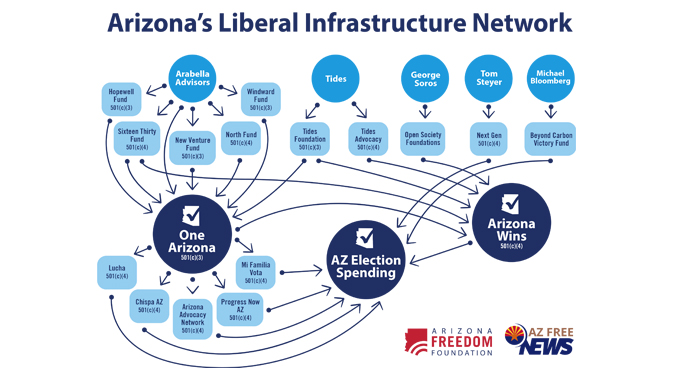
While not a complete pitcure, the above graphic illustrates some of the connections in the left’s secretive infrastructure and how they relate to Arizona elections.
Leftist C3s also hire for both the C3 and C4, resulting in shared jobs and salaries. One Arizona (C3) and Arizona Wins (C4) co-hired staff including a field director, field program coordinator, and finance and compliance director. That shared salary should not be used for political work. One recent example of this was a job listing by Arizona Coalition for Change (C3) and Our Voice Our Vote (C4) for a data manager that would work within the duo’s political and grassroots lobbying arms.
These blurred lines surrounding co-hires don’t just apply to staff. Arizona Center for Empowerment (ACE, a C3) and LUCHA (C4) share an executive director, Alejandra (Alex) Gomez, as well as staffers. This relationship is further complicated by the fact that ACE listed LUCHA as its “Employer of Record” on their latest tax return. Under Gomez, both organizations have expressed their partisanship.
Last year, LUCHA launched an initiative to get Democratic candidates elected: “LUCHA Blue.” The nonprofit pledged to prioritize certain races and voter bases in its GOTV efforts. On its hiring page for the initiative, LUCHA disclosed that it would staff between 70 and 105 people.
“We believe that not all candidates align with the mission of LUCHA, and this is why we created a campaign not only to flip Arizona Blue — but LUCHA Blue!” stated LUCHA. “Overall, the goal of the campaign is to win these targeted races, increase Latin/Hispanic voter turnout, and educate voters on the voting process.” (emphasis added)
In one post following Sen. Mark Kelly (D-AZ) winning re-election last November, LUCHA appeared to affirm that both it and ACE assisted in organizational efforts to assure Kelly’s victory.
Wealthy dark money donors have a greater financial incentive to back C3s. 75 percent of their donations can go to politics and qualify as tax deductible — effectively maximizing their gift-giving while affording them a tax break. C4 donations aren’t tax deductible.
The IRS has long been aware of the disparity between the lawful intent for C3 and C4 entities, and the current reality of C3-C4 relationships. As ProPublica revealed in 2019, the IRS essentially gave up on holding nonprofits accountable.
The following are some of Arizona’s liberal C3-C4 nonprofit duos: One Arizona and Arizona Wins, Arizona Center for Empowerment and Living United for Change in Arizona, Mi Familia Vota Education Fund and Mi Familia Vota Victory, Chispa AZ/League of Conservation Voters Education Fund and League of Conservation Voters, Arizona Coalition for Change and Our Voice Our Vote, Instituto Lab and Instituto Power, Rural Arizona Engagement and Rural Arizona Action, and Voto Latino Foundation and Voto Latino.
The relationships between these nonprofits and the awareness of their straining tax law will be further explained in the next installment of this series.
This is Part Two in a series on the Left’s secret infrastructure to turn Arizona blue. Be sure to sign up for our newsletter to be notified of Part Three in the series.
Corinne Murdock is a reporter for AZ Free News. Follow her latest on Twitter, or email tips to corinne@azfreenews.com.
The Republican-controlled Arizona House of Representatives took its first steps this week to lower the state’s corporate income tax rate in four successive years starting Jan. 1, 2026
House Bill 2003 would gradually decrease the current 4.9 percent business tax rate to only 2.5 percent. The bill sponsored by Rep. David Livingston was approved Wednesday by the House Ways & Means Committee and the House Appropriations Committee.
All of the Democrats on the two committees cast nay votes.
Arizona’s current corporate income tax rate in place since Tax Year 2017 is the greater of $50 or 4.9 percent of net income. Under HB 2003, that rate would drop to 4 percent for Tax Year 2023, then 3.5 percent the next year, and 3 percent the following year. For Tax Year 2026 and each year thereafter the rate would be only 2.5 percent.
Livingston (R-Peoria), who serves as chair of the House Appropriations Committee, said reducing Arizona’s corporate income tax (CIT) rate is a matter of fairness and sound tax policy.
“Cutting the corporate rate continues the state’s commitment to creating a low tax environment,” Livingston said after the two committee votes. “We’ve done great work to lower the rate on personal income and now we must take the next step to equalize our rate for C-Corps to make them even with other businesses who file via the personal income tax, such as S-Corps and partnerships.
The Joint Legislative Budget Committee (JLBC) advised lawmakers it is difficult to determine the revenue impact from the proposed change, due to the fact most corporations do not follow a calendar-year fiscal year. A final note issued by JBLC includes a “highly speculative” estimated impact on state coffers of nearly $1.7 billion.
But such estimates must be interpreted with caution at this time, according to JLBC.
“Finally, we would note that the estimates above do not reflect the potential behavioral response of taxpayers to the changes under the proposed CIT rate reduction,” the final note explained. “For example, all else equal, a reduction of corporate income taxes can serve as an incentive for businesses to invest in more capital and hire more labor than they would otherwise. Such ‘dynamic’ effects may result in an increase in economic output, which in turn may generate more tax revenue dollars for the state General Fund than what a ‘static’ analysis assumes.”
HB 2003 will move on to the House Committee of the Whole on a date to be announced.