Arizona’s growing role as a national hub for data centers could be undermined by municipal regulations driven by concerns over water use, electricity demand, and land use, according to a new policy report released by the Goldwater Institute. The report, Data Centers: A Free Market Model for the Digital Future, argues that Arizona’s success in attracting data center investment stems from long-standing policy choices that favor predictable regulation, private property rights, and a stable legal environment.
The authors note that “artificial intelligence has dramatically accelerated these trends. Demand for data has increased exponentially. How communities, businesses, and policymakers respond to this transformation will shape economic competitiveness for decades to come.”
The report also cautions that a rise in local-level restrictions could threaten the state’s competitive position in the digital infrastructure sector.
William Beard, municipal affairs liaison at the Goldwater Institute and a co-author of the report, explained, “Data centers are the physical backbone of cloud computing, artificial intelligence, digital commerce, and national security. They are core infrastructure, no different in principle from transportation networks, energy production, or large-scale agriculture built to meet the demands of a particular era.”
Beard added that Arizona’s emergence as a leader in data center development has already produced economic benefits for the state. “Arizona is thriving as a leader in data centers, the state is reaping the economic benefits, and policymakers must take steps to ensure that continues,” he said.
According to the report, the Greater Phoenix region has become one of the top data center markets in the United States, with capacity projected to exceed 5,000 megawatts—an expansion of more than 500 percent. Goldwater attributes the dramatic growth to regulatory predictability and policies that encourage investment rather than discourage it, as well as “affordable land; reliable energy; and a legal environment anchored in strong private property rights.”
However, the report also warns, “Continued growth is no guarantee, especially as local governments threaten data centers with restrictive policies.”
Citing growing municipal resistance to data center projects, Jen Springman, coalitions manager at the Goldwater Institute and a co-author of the report, said opposition is often rooted in misunderstandings about the impacts of infrastructure.
“Arizona’s advantage is increasingly threatened by a growing municipal-level regulatory backlash, often driven by misconceptions about water use and electricity demand,” Springman said.
Regarding water consumption, Springman said, “Modern data centers are among the most water-efficient industrial facilities ever built.”
The report further challenges claims that data center development is responsible for rising electricity prices. “Electricity prices, meanwhile, are not a data center problem; they are a policy outcome,” Springman said.
She added that misdirecting blame can lead to ineffective policy responses. “Blaming infrastructure for political energy choices obscures the real cause—and produces the wrong solutions,” Springman said.
Goldwater’s report argues that local restrictions do not reduce demand for digital services, but instead risk shifting investment to other states while increasing costs for consumers and businesses.
In a summary of the report’s conclusions posted to X, Goldwater stated, “The question is not whether data centers will exist, but whether Arizona will continue to lead—or retreat in the face of the future.”
Data centers are coming to Pima County, whether residents like it or not.
The Pima County Board of Supervisors has approved a new data center despite major community opposition and no end user formally lined up.
Amazon was outed earlier this summer as the longtime, unofficial end user lined up for the 290-acre data center, Project Blue, but the e-commerce giant reportedly backed out around the beginning of this month after the developer, Beale Infrastructure, nixed water cooling in favor of the more electricity-dependent air cooling process.
Amazon’s departure was uncovered during the Arizona Corporation Commission (ACC) hearing earlier this month by sources first reported on by the Arizona Daily Star. ACC approved, 4-1, a decade-long Energy Supply Agreement between Tucson Electric Power (TEP) and the developer to power Project Blue.
Beale Infrastructure made the cooling process switch after the Tucson City Council voted unanimously to deny access to their reclaimed water system back in August. Tucson Mayor Regina Romero also pledged to place limits on future data centers.
The days leading up to the council vote were filled with contentious community information meetings on the project.
Per 13 News, multiple unnamed sources told Pima County Supervisor and Tucson City Councilman Paul Cunningham that up to eight other companies expressed interest in taking Amazon’s place. Sources conflicted on whether one of the companies is Meta, or whether Meta had already backed out as Amazon had.
Project Blue’s developer, Beale Infrastructure, presented the proposed data center as both an economic driver and environmentally friendly operator: “no risks or financial burdens [will be] passed on to other customers,” their representatives promised in their presentations during the community information meetings.
Opponents argue these data centers will further strain an already stressed water supply and electric grid, ultimately leading to scarcity as well as higher fiscal and health costs for the consumer.
It was the promised economic benefits that won over the 3-2 majority of Pima County supervisors. The two supervisors against the data center, Andres Cano and Jen Allen, expressed concerns over the long-term unknown impacts on the environment and community health.
Pima County’s vote came several weeks after ACC approved Beale Infrastructure’s application for Project Blue.
Data centers are the powerhouse for platforms covering virtually every aspect of modern life online: government, streaming, remote work, cloud storage, e-commerce, education, finance, and healthcare.
An independent Economic Impact Study on Project Blue projects a $3.6 billion total capital investment, $250 million in tax revenues, 180 new jobs by 2029, and over 3,000 direct construction jobs during the building phase.
The project will be located north of Pima County Fairgrounds, at the I-10 and Houghton interchange. The development site is over a mile away from the nearest resident, located within an unincorporated area that’s part of the Southeast Employment & Logistics Center.
Beale Infrastructure is also moving on another, equally controversial data center development in Marana totaling 600 acres. Two rezoning applications were filed recently for potential data center development: Luckett North and Luckett South. Earlier this month, the town’s planning commission recommended rezoning for development.
As with Project Blue, the closest resident lives about a mile away from the proposed data center campus. It will also be an air-cooled facility.
In preparation for consideration of the data center, town officials produced two podcast episodes on the town’s data center ordinance and potential for development.
Marana Town Council is scheduled to consider the data center project on Jan. 6, 2026. Progress on the project is available for viewing on the town’s development projects and activity portal.
AZ Free News is your #1 source for Arizona news and politics. You can send us news tips using this link.
Former Senator Kyrsten Sinema claims she’s not a lobbyist, but her emails tell a different story.
Emails uncovered by FOIAzona revealed Sinema’s lobbying for a major new AI data center in Chandler.
When Sinema joined Hogan Lovells, global law and lobbying firm, as senior counsel back in March, she told reporters she wasn’t registering as a lobbyist. Sinema is also an advisory council member for Coinbase Global, a cryptocurrency company; and president and CEO of Arizona Business Roundtable.
Federal law requiring a “cooling off” period for former representatives and senators doesn’t apply to lobbying at local levels — only lobbying in Congress.
The federal lobbyist system doesn’t have Sinema registered. However it does have the registration of Hogan Lovell’s policy advisor: her former congressional aide, Daniel Winkler.
Emails revealed that Sinema met with Chandler council members in mid-June to discuss the data center. Following that meeting, Sinema used her Hogan Lovells email to push plan proposals for the data center to six city officials: a development agreement and a white paper advocating for AI data centers as an economic boon. Her emails to city officials were consistent thereafter.
“Single User – We demo the property and leave the front part open to attract the single use that [City Manager] Micah [Miranda] envisions. We build only the data center and the north building at the same time. R&D buildings along Dobson – We commence construction of these two eastern buildings within 18 months of C of O of data center. This gives Micah the time to attract a single user, but we still will process plans for these two buildings in the meantime to hit the 18 month mark. This leave the middle portion open to still attract a single user and build to suit. Full buildout – We commence spec construction of the middle building within 36 months of C of O of data center. This gives Micah the time to attract a single user, or a middle user but we still will process plans for all the buildings to hit the 36 month mark.”
Councilmember Matt Orlando then met with Sinema and Winkler in early August.
About a week later, Sinema was attempting to get the ear of another member of the council, Jennifer Hawkins.
In the days that followed, Orlando advised the city manager and economic development director that councilmembers were receiving constant communications about AI, and directed the pair to reach out to Sinema for possible development sites.
“We should not only look at the old Northrop Grumman site, but at the airport and other areas of our community for many AI clusters,” said Orlando. “We need to look at the economic model of such complexes. Please get with Kirsten [sic] Sinema, our existing companies and others in the industry and get us some ideas for a truly strategic plan to position our city for the future.”
The city’s economic development director advised in September that there wasn’t “any definitive cause relationship” between AI data centers and the desired location site for companies.
Then came the widely reported day in mid-October when Sinema argued for the data center at the Chandler Planning and Zoning Commission meeting.
It was there that Sinema threatened to use the power of the Trump administration against the city should they not approve the data center.
“[My coalition] works hand-in-glove with the Trump administration as we prepare for AI American dominance,” said Sinema. “We all know that the innovation campus has been vacant for over seven years. What I’d like you to know today is this: if we choose not to move forward with this development, the land will continue to sit vacant until federal preemption occurs.”
Sinema argued on behalf of the data center developer Active Infrastructure. She presented herself as the founder and co-chair of the AI Infrastructure Coalition (AIC), which formally launched with a swanky D.C. party last month.
AIC members include Andreeseen Horowitz, Cisco, ExxonMobil, Google, Lumen, Meta, Microsoft, and Pinnacle West. AIC’s executive director, Brian Walsh, formerly led the Congressional Leadership Fund and America First Action.
NEW – 🚨@KyrstenSinema claimed she's "not a lobbyist" … but I obtained internal emails from @CityOfChandler suggesting otherwise
For months, Sinema & her DC lobbying firm have been strong-arming the City to approve a massive AI data center
The Arizona Corporation Commission (ACC) voted 4-1 on Wednesday to approve a legally binding 10-year Energy Supply Agreement (ESA) between Tucson Electric Power (TEP) and Humphrey’s Peak Power LLC to power a planned data center campus proposed for Pima County.
The Commission underscored that its review of the agreement was limited solely to ensuring statutory compliance and safeguarding ratepayers’ interests. Regulators noted they do not hold jurisdiction over the nature or approval of the associated data center project itself, only the energy contract enabling its power supply.
As reported by the Arizona Capitol Times, the ACC meeting on December 3rd was contentious, with almost two dozen members of the public calling on the Commissioners to vote against the agreement in over three hours of discussion. Commissioner Rachel Walden was the only dissenting vote.
“I’m still wary about whether or not there is a data center at the end of this,” Walden said, according to the Times.
The ACC voted 4-1, w/Commissioner Walden casting voting "nay", to approve an Energy Supply Agreement between TEP & the company behind a planned data center in Pima County. The ACC's role is to ensure regulatory requirements are met, & protections for TEP customers are provided. pic.twitter.com/EkSQkaIJwz
TEP, a regulated public utility, is legally obligated to serve all eligible customers within its designated service territory without discrimination and may not refuse service to applicants who meet interconnection and regulatory requirements, the ACC explained in a press release. Commissioners reiterated that ESA terms must provide protections not only for the contracting parties but also for the broader TEP ratepayer base.
During the meeting, TEP executives said that the data center customer will ultimately decrease other customers’ rates, arguing the facility will make a larger revenue contribution than the actual cost of serving it, according to the Times.
Erik Bakken, senior vice president and chief administrative officer at TEP, explained, “We believe that we’ve got the gold standard special contract for a data center with existing resources and existing capacity that’s available.”
In a press release, TEP said its usage-based rates are set by dividing the total revenue the utility is allowed to collect by projected energy sales. Bringing in a large new user like a data center increases overall sales, the company argued, which allows per-kilowatt-hour charges for other customers to move lower than they otherwise would be.
In comments to 13 News, Pima County Supervisor Matt Heinz told the outlet that Amazon Web Services (AWS) will no longer be the end user for the data center referred to as “Project Blue,” citing multiple sources. He stated that there are now as many as seven or eight different potential end users. The outlet reported Tuesday that Facebook’s parent company, Meta, could potentially be the new suitor for Beale Infrastructure’s project based on comments from Heinz and Tucson City Councilman Paul Cunningham.
Arizona Capitol Times reported that this shift was owed to the project switching from water-cooling to air-cooling. Beale Infrastructure, the project developer, reportedly told commissioners that it is confident an end user will be found in time for the data center’s projected completion in 2027.
The data centers’ proposed 290-acre campus in Pima County, per Beale’s ESA application obtained by AZ Luminaria, has sparked a massive public debate in southern Arizona, including questions about grid load growth, long-term power procurement, water use before Beale’s conversion to air-cooling, and whether infrastructure planning is keeping pace with rapid expansion in energy-intensive industries.
An internet search engine giant is making a significant investment in the Grand Canyon State.
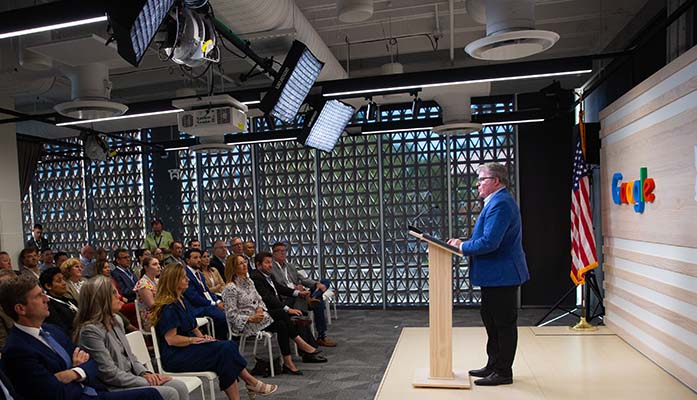
Last week, Google unleashed a significant announcement, revealing that it would soon be constructing a $600 million data center in Mesa, marking the first time the company has put down physical roots in Arizona.
Governor Katie Hobbs, who attended the event with Google executives and other local leaders, issued the following statement to commemorate the news for her state: “Google’s investment in Arizona will be critical for the Mesa community and our state’s economy. Arizona continues to attract global technology leaders due to our skilled workforce, dynamic economy and focus on innovation. We are proud to welcome Google to Arizona and look forward to the many opportunities this partnership will bring.”
Google's $600 million investment in a new Mesa data center is a great example of how Arizona is leading the way in sustainable growth while creating good paying jobs in the process. There is no better time or place to invest in technology and innovation than right here and right… pic.twitter.com/ouUEMto0DT
Mesa Mayor John Giles added, “The City of Mesa is thrilled to welcome Google to our community. Google’s decision to designate Mesa as the home for its first facility in Arizona underscores its profound confidence in our city and residents.”
Mesa will be home to @Google's first facility in AZ, with an over $600 million investment into our community. Our city is a great place to locate a business and we continue to compete on a global scale. We look forward to a strong relationship with Google. https://t.co/rq9Nk76AHJpic.twitter.com/7k2bMyaf0R
According to a release published by the City of Mesa, “the new Mesa data center will help power popular digital services – like Google Search, Gmail, Maps, Google Cloud, and others – for people and organizations worldwide.”
The Vice President for Google’s Data Centers, Joe Kava, said, “We are proud to put down roots in Arizona with both the data center in Mesa and the Phoenix cloud region. Not only do data centers help keep digital services up and running for people and businesses, they are economic anchors in the communities where we operate. We are appreciative of the continued partnership with the local leadership across the state.”
In addition to the multi-million-dollar infrastructure project, Google revealed that the Phoenix area would soon be welcoming “a new Google Cloud region to complement its existing network of regions around the world, bringing Google Cloud technologies closer to local customers – ranging from small, medium and large businesses to public sector entities and other organizations – to help them deliver digital services to their own users more reliably and at higher speeds.”
The Arizona Governor’s Office stated that “Google’s Mesa facility is the first data center in the United States to use zero-water cooling and has announced plans to be completely carbon-free and pursue net-zero emissions across its operations by 2030.”
Per an internal economic report, Google “helped provide $11.43 billion of economic activity for tens of thousands of Arizona businesses, publishers, nonprofits, creators and developers in 2022,” and “more than 367,000 Arizona businesses used Google’s free tools to receive phone calls, bookings, reviews, requests for directions and other direct connections to their customers.” Google also “provided $15.55 million of free search advertising to Arizona nonprofits through the Google Ad Grants program in 2022.”
Daniel Stefanski is a reporter for AZ Free News. You can send him news tips using this link.