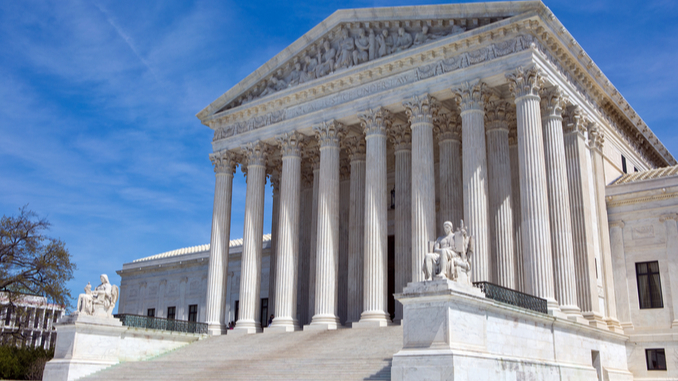
Rep. Andy Biggs is advancing a constitutional amendment to permanently set the size of the U.S. Supreme Court at nine justices. He says the proposal would prevent future attempts to expand the Court through legislation.
According to a statement released by Biggs’ office, House Joint Resolution 1 would amend the U.S. Constitution to require that the Supreme Court consist of one chief justice and eight associate justices. The proposal seeks to place the Court’s size in the Constitution rather than leaving it subject to change by Congress.
The resolution was introduced at the start of the 119th Congress and referred to the House Judiciary Committee.
On June 3, the House Judiciary Committee voted 15-8 to advance the proposed amendment. According to Reuters, the vote fell largely along party lines, with Republican members supporting the measure and Democratic members opposing it.
During the committee proceedings, Biggs framed the proposal as a response to court-packing efforts.
“How can the Supreme Court protect Americans from government overreach if the same government can pack the Court whenever it dislikes a ruling?” Biggs asked. His office stated that the resolution is intended to preserve judicial independence and to prevent future court expansion efforts.
“Our nation’s founders built a system of checks and balances to protect citizens from concentrated power – a central part being the U.S. Supreme Court, whose duty is to defend the rights and freedoms of every American, not to serve as a political tool for any party,” Biggs said. “The judiciary was designed to be the quiet guardian of liberty, insulated from the passions of the moment. Unfortunately, special interests have been increasing their attacks on the Court, threatening to pack this iconic American institution to ensure favorable outcomes for their causes. The goal is not ethics or protecting rights but gaining power and intimidating the Court.”
This week, the U.S. House Judiciary Committee passed H.J. Res. 1, which proposes an amendment to the Constitution of the United States to require that the Supreme Court of the United States be composed of nine justices.
The U.S. Constitution does not specify the number of Supreme Court justices. Congress has altered the Court’s size several times throughout American history, with the number of justices ranging from five to ten before being set at nine by statute in 1869. The Court has remained at nine members since that time.
Supporters of the amendment have cited proposals by some Democrats in recent years to increase the number of Supreme Court justices. Opponents have argued that Congress should retain its constitutional authority to determine the Court’s size and structure through legislation.
“The ongoing and escalating assault on the U.S. Constitution and Supreme Court must stop,” Biggs noted. “That is why I have introduced this constitutional amendment to fix the number of justices at nine. This action will protect the Court’s legitimacy, preserve the checks and balances that safeguard our cherished freedoms, and ensure every American’s rights remain secure – no matter who holds political power. I’m grateful for my colleagues’ support of this amendment, and I look forward to its passage on the U.S. House floor.”
Constitutional amendments face a high threshold for approval. A proposed amendment must receive support from two-thirds of both the U.S. House of Representatives and the U.S. Senate before being sent to the states for ratification. Ratification requires approval from three-fourths of the states.
The last newly proposed constitutional amendment to clear Congress and be ratified by the states was the 26th Amendment, setting the national voting age at 18 in 1971. The D.C. Voting Rights Amendment was passed by Congress in 1978 but failed to meet the state ratification requirement before its statutory deadline expired. The 27th Amendment, which bars changes to congressional compensation from taking effect until after an intervening House election, was ratified in 1992; however, Congress originally passed it in 1789 as part of the Bill of Rights package.
In a decisive step to strengthen voter confidence and streamline Arizona’s election processes, the Arizona House of Representatives passed HCR 2016, a proposed constitutional amendment sponsored by Representative Rachel Keshel (R-LD17).
HCR 2016 seeks to require in-person voting to take place exclusively at designated precinct polling places, eliminating the use of countywide voting centers, emergency voting centers, and on-site early voting locations.
If approved by voters in the upcoming election, the resolution would cap election precincts at no more than 2,500 registered voters at the time precincts are designated. It would also remove statutory authority for voting centers and related provisions in election administration, electioneering, and unlawful acts statutes.
“Arizonans want elections they can understand, observe, and trust, and the precinct model delivers that,” stated Rep. Keshel. “HCR 2016 puts Election Day voting back where it belongs: at clearly designated polling places tied to precincts, with reasonable precinct sizes that are easier to staff and manage. Voting centers and last-minute location changes create confusion, weaken consistent procedures, and slow results. This helps restore faith in our elections for Republicans, Independents, and Democrats who expect clear rules and timely results.”
The resolution would end the option for in-person voting at on-site early voting locations through 7:00 p.m. on the Friday before an election and eliminate references allowing on-site tabulation of early ballots at voting centers.
House republicans advanced HCR 2016 as a key priority under the House Republican Majority Plan to secure elections by reinforcing the structure of in-person voting and empowering Arizona voters to decide the issue directly at the ballot box.
The measure aligns with broader efforts to ensure fast, accurate ballot counting for timely results, protect election integrity, and promote transparency.
Secure elections remain a top focus for Arizona Republicans, who emphasize that voters deserve free, fair, and transparent processes where ballots are counted quickly and results are known sooner. HCR 2016 supports these goals by addressing structural elements that contribute to delays and confusion in election administration.
The measure now advances to the Arizona Senate for further consideration.
Ethan Faverino is a reporter for AZ Free News. You can send him news tips using this link.
Arizona House Concurrent Resolution 2048, sponsored by State Representative Michael Way (R-LD15), passed the Arizona House Government Committee last week in a party-line vote and now heads to the full Arizona House of Representatives.
HCR 2048 is a proposed constitutional amendment that would prohibit salary increases for elected state officers from taking effect during their current term. It would also require legislators, the Governor, and other statewide executive officers to forgo regular salaries and subsistence payments if the general appropriation bill is not signed into law by April 30.
The measure states that compensation withheld during a budget delay would not be paid retroactively. Salaries would resume with the first full pay period after the budget becomes law.
Rep. Way’s ‘No Budget, No Pay’ Resolution Advances Out of House Government Committee
“If we do not pass a budget on time, we should not get paid. It is that simple. Arizonans are expected to meet deadlines in their jobs. Lawmakers should be held to that same standard. If we fail… pic.twitter.com/B8cJc9ZUDJ
“If we do not pass a budget on time, we should not get paid. It is that simple,” Way said in a statement. “Arizonans are expected to meet deadlines in their jobs. Lawmakers should be held to that same standard. If we fail to finish the budget by April 30, there should be consequences.”
The resolution is described as complementing House Concurrent Resolution 2005, introduced by Rep. Justin Wilmeth (R-LD2), which would require the Legislature to adjourn its regular session by April 30.
“Deadlines matter,” Way said. “Families and businesses across Arizona operate on them every day. State government should do the same.”
If approved by the full Legislature, HCR 2048 would be referred to Arizona voters at the next general election.
Way represents Legislative District 15, which includes Mesa and Queen Creek in Maricopa County and San Tan Valley in Pinal County.
Arizona lawmakers advanced a constitutional proposal last week that would set a firm deadline for ending the Legislature’s regular session, a major procedural change supporters say would provide a clearer structure for what is currently an open-ended calendar.
Under the state’s current system, the Arizona Constitution requires lawmakers to convene the regular session on the second Monday in January each year, but does not set a deadline for when that session must end. Regular sessions in recent years have stretched into late spring or early summer, with the 2025 session adjourned on June 27 after roughly 169 days in session.
The absence of a constitutional adjournment deadline means lawmakers can continue legislative work beyond traditional spring months, even though state law governs per diem reimbursements for extended sessions.
By contrast, other states employ more rigid schedules. Texas lawmakers meet in regular session once every two years for a constitutionally limited period, and adjourn by a set date unless a special session is called. In 2025, for example, the Texas Legislature concluded its most recent regular session in early June as the statutory timeline expired.
The House Government Committee on Wednesday passed House Concurrent Resolution 2005 (HCR 2005), sponsored by State Representative Justin Wilmeth (R-LD2) of North Phoenix. The resolution would amend the Arizona Constitution to mandate that the Legislature adjourn its regular session sine die no later than April 30 each year.
Under the proposal, lawmakers could still convene special sessions after April 30, but those would be subject to the subjects specified in the Governor’s call. If HCR 2005 clears both chambers of the Legislature, it would be placed on the ballot at the next general election for voter approval.
Wilmeth said the measure is aimed at restoring discipline and accountability to the legislative calendar. “I appreciate the committee moving this measure forward, allowing the discussion to continue,” he said in a statement.
“This proposal is about accountability and discipline. Arizonans expect the Legislature to do its job, pass a budget, and finish its work on time. President Ronald Reagan kept a sign on his desk in the Oval Office that said, ‘It CAN be done.’ I agree with that. Finishing our work by April 30 is achievable, and it should be the standard.”
Wilmeth, a Republican member of the Arizona House of Representatives and Chairman of the House Committee on Artificial Intelligence & Innovation, introduced the constitutional adjournment proposal earlier this year.
Supporters of the resolution have pointed to frequently extended sessions, which in recent years have stretched deep into spring and summer, as justification for a defined end date. In several recent cycles, lawmakers did not adjourn until June, well past traditional deadlines for bill passage and budget agreement.
In a post to X on January 23, Wilmeth wrote, “Decades ago, we told the people we’d have a part-time legislature conducted by citizen-legislators. Nowadays, the legislative session basically goes seven months! That’s unacceptable to me. It’s just responsible government to stick to our part-time commitment.”
Decades ago, we told the people we’d have a part-time legislature conducted by citizen-legislators.
Nowadays, the legislative session basically goes seven months! That’s unacceptable to me. It’s just responsible government to stick to our part-time commitment.
— AZ State Rep. Justin Wilmeth (@JustinWilmethAZ) January 23, 2026
If voters approve a constitutional amendment, Arizona would become one of the states with a fixed legislative deadline, rather than relying on internal legislative rules and per diem incentives to guide the calendar. That model differs from states like Texas, where sessions are inherently limited by statute or constitution and extend only through specified time windows.
HCR 2005 now moves to further consideration in the Arizona House as it continues through the legislative process.
State Representative Michael Way (R-LD15) has introduced House Concurrent Resolution 2048 (HCR 2048), a proposed constitutional amendment that would hold Arizona’s elected officials financially accountable for failing to pass a state budget on time.
If approved by the Arizona Legislature and subsequently by voters in the next general election, HCR 2048 would amend Article V, Section 12 of the Arizona Constitution.
The measure would require that the Governor, all statewide executive officers—including the Secretary of State, Attorney General, State Treasurer, Superintendent of Public Instruction, and Lieutenant Governor—as well as all members of the Legislature, forgo their regular salaries and subsistence payments whenever the general appropriation bill for the upcoming fiscal year has not been signed into law by April 30.
Compensation withheld under this provision would not be paid retroactively once a budget is finally enacted; instead, salaries and payments would resume only on a forward basis, beginning with the first full pay period after the budget becomes law.
“Taxpayers do not get paid for work they do not finish, and lawmakers should not be treated any differently,” expressed Rep. Way. “We are elected to do one essential job each year, pass a state budget. If we fail to meet that deadline, we should not collect a paycheck.”
Rep. Way noted that Arizona has long experienced recurring delays in budget passage, with deadlines frequently treated more as flexible guidelines than firm requirements. “For too long, budget deadlines have been treated as suggestions instead of requirements,” Rep. Way added. “HCR 2048 changes the incentive structure and makes elected officials accountable for doing the job they were sent here to do.”
The resolution operates alongside HCR 2005, which would require the Legislature to adjourn its regular session by April 30 of each year. Together, the two measures aim to shorten the prolonged legislative sessions and bring greater discipline to the annual budget process.
Ethan Faverino is a reporter for AZ Free News. You can send him news tips using this link.