The people of Arizona do not want to turn our state into the next California. But just a few weeks into her reign as governor, Katie Hobbs has made it clear—that’s exactly what she intends to do. Last week, Hobbs released her first budget plan, and it’s nothing more than a liberal wish list of big spending, extreme proposals, and corporate welfare designed to reward her special interest friends.
Her first target is education, and she wasted no time going after Arizona’s expansion of Empowerment Scholarship Accounts (ESAs). Yes, the program that is so popular that it overwhelmed the Department of Education’s website immediately after launch—the one that even some Democrats have openly supported. Despite being a private schooler herself, Hobbs wants to dismantle school choice for all with a full repeal of universal ESAs. And that’s just the start…
Last Tuesday, hundreds of concerned Gilbert citizens enlivened a town council study session with vocal opposition to funding any rail project — not even a survey.
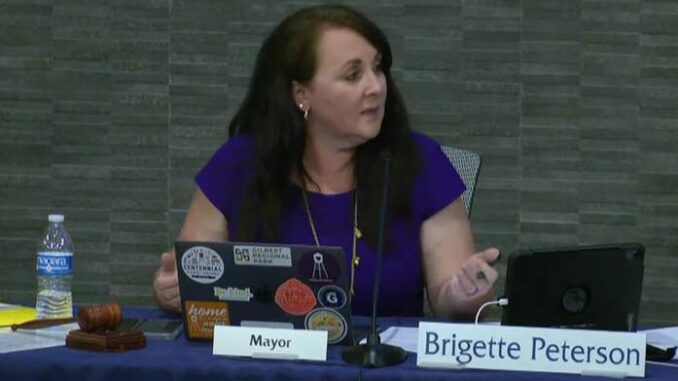
Most of the council expressed confusion about the citizens’ discontent, denying intent on establishing a commuter rail in the town. Councilwoman Kathy Tilque stated repeatedly that there were no plans to bring a commuter rail to Gilbert, and that it probably wouldn’t ever happen. Mayor Brigette Peterson and councilmembers Scott Anderson, Yung Koprowski, and Scott September echoed Tilque’s sentiment throughout the study session, which neared two hours.
“I’m just trying to figure out why we have so many upset people thinking we’re spending taxpayer dollars to bring a commuter rail here,” said Tilque.
Earlier this year, the council proposed a $289,000 consulting contract for a feasibility study on establishing a commuter rail. Council discussion on the subject revealed similar divisions that persisted in last week’s discussions.
When Peterson repeated that Gilbert hasn’t issued plans to build a commuter rail, the citizens shouted “Lies!” Peterson insisted she was telling the truth, further claiming that Gilbert wouldn’t have any say over the establishment of a commuter rail on existing rail lines. Vice Mayor Aimee Yentes rebutted that the town’s actions over the years conflicted Peterson’s claim.
Yentes told AZ Free News that the council’s denial of commuter rail planning was “semantics,” pointing out a February 2018 development agreement, Resolution No. 3955, that Peterson signed onto while a councilwoman. That development agreement described the possibility of a light rail as well as a commuter rail, further conflicting with another one of Peterson’s claims in a July statement that the term “light rail” was used by outside groups and individuals, and that “there are no plans, discussions, or any considerations to construct or extend a light rail” to Gilbert.
The development agreement further noted that the town of Gilbert would be responsible for the cost of future development of a transit station at Cooley Station Village Center. According to a 2018 study on commuter rails conducted by the Maricopa Association of Governments (MAG), nearly all commuter rails require a dedicated local sales tax to operate.
During the study session, Yentes asserted that the community’s discontent stems from the council’s unwillingness to take a definitive stance for or against a commuter rail, not a misunderstanding over the town’s role as one of several decision makers on establishing a commuter rail.
“Clearly they’ve been planning for it. They’ve done studies. They’ve dedicated transit stations. They’ve entered into a development agreement that tried to bind us to it. There’s lots of things that Gilbert can do to either plan to do it or be a thorn in their side,” said Yentes.
Yentes proposed an ordinance to prohibit the use of town resources for the furtherance of commuter and light rail development. That would also prohibit additional taxes and application of funds to carry out related studies. It will be voted on during next Tuesday’s town council meeting.
Yentes warned that the city of Phoenix’s commuter and light rails “cannibalized” their transportation budget to the extent that the city couldn’t fix potholes, prompting citizens to pass an additional sales tax in 2017 to cover those expenses.
Tilque called Yentes’ proposed ordinance “dishonest representation” since future councils may overturn it. However, that’s something that new leadership may do at any given time with any ordinance, which Yentes pointed out.
One citizen, Brandon Ryff, told AZ Free News that Tilque’s opposition to the ordinance came across as doubting citizens’ intelligence. Ryff expressed frustration over the conflict between Peterson’s remarks and actions concerning a commuter rail, citing the 2018 development agreement.
Ryff also criticized commuter rails as outdated, “19th-century” technology, pointing out the consistent drop in ridership throughout major cities in Arizona and other states. He contrasted the decline in ridership with the consistent uptick in crime. In Phoenix, crime rates have nearly doubled since 2016; a majority of those crimes were aggravated assault and drug offenses.
“We laugh at it and say that [a commuter rail] looks like a solution looking for a problem,” said Ryff. “For whatever reason and whatever motivation, our town council is defying all logic concerning crime statistics and progress. I can’t help but feel this is related to money from somewhere. Someone is influencing these people to behave this way. It just doesn’t make sense.”
Another citizen, Tyler Farnsworth, remarked to AZ Free News that their opposition was a positive example of engaged citizenry, yet most of the council portrayed it as a negative. Farnsworth commended Yentes’ proposed resolution barring their tax money from funding town rail projects.
“The Mayor and several members of the Council were visibly and vocally annoyed that citizens chose to show up and speak their mind,” said Farnsworth. “We just want to be heard. We want our tax money to be spent wisely. I hope the meeting was a wake up call to this Council. We are watching. Welcome to democracy in action.”
Watch the study session below:
Corinne Murdock is a reporter for AZ Free News. Follow her latest on Twitter, or email tips to corinne@azfreenews.com.
If there’s one entity that specializes in giving people something they don’t need—or aren’t even asking for—it’s the government. So, naturally, while the country faces sky-high inflation and Arizonans make sacrifices in their family budgets, the Town of Gilbert saw fit to discuss a potential…commuter rail.
That’s right. At the end of April, the Gilbert Town Council announced that it’s considering a $289,000 consulting contract for a feasibility study on establishing a commuter rail. What this would accomplish—and why anyone thinks this would be good for Gilbert—remains a mystery.
Even before COVID, public transit usage has been on the decline. And that’s only worsened since…
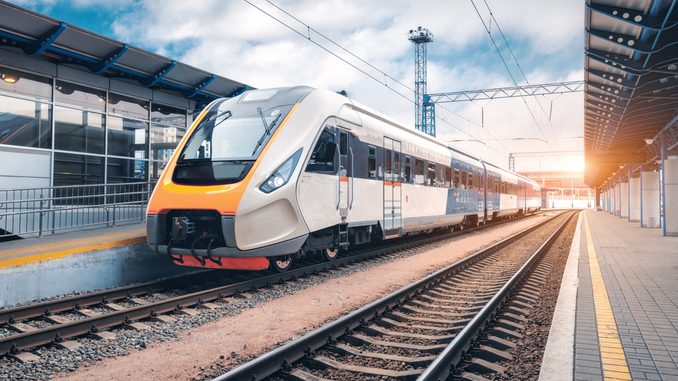
On Tuesday, the Gilbert Town Council announced a $289,000 consulting contract for a feasibility study on establishing a commuter rail. The commuter rail, a mode of public transportation at the core of major metropolitan areas like Chicago and New York City, would likely be located somewhere within the Heritage district. The council moved to consider the contract during a later study session.
The proposal comes at a time when transit crime rates have reached an all-time high in areas where they have the most use such as New York City, San Francisco Bay Area, Philadelphia, and Los Angeles. Multiple studies link the presence of public transit such as light rail and commuter rail to an increase in crime and decrease in surrounding property values.
Vice Mayor Aimee Yentes asserted that the goal of the study wasn’t to establish feasibility, but rather to whip up something with “pretty pictures” that would distract from the facts behind commuter rail and inspire public support. Yentes accused Washington, D.C. lobbyists of pushing an agenda for financial gain at the loss of taxpayers and locals, mocking President Joe Biden’s “Build Back Better” campaign slogan as well.
“I think quite frankly we’re taking crazy pills if we think people are going to be excited about commuter rail,” said Yentes. “The complete boondoggle that this will be not just for this community, but for this state. We are literally observing California living this nightmare. I can’t point to a state that Amtrak is not being heavily and deeply subsidized by taxpayers despite 75 percent decline in their ridership. I can’t point to a state where we have a good model that makes any amount of sense for this. We’re going to put the foot on the pedal because we’ve got ‘Build Back Bankruptcy’ dollars that are going to be flooding the jurisdictions?”
Yentes also pointed out that all commuter rails require a local sales tax in addition to all the state subsidies and federal monies they receive. She predicted widespread community backlash.
“I think this is insane,” said Yentes. “I don’t think it’s a matter of timing. There is no good timing for broken 19th-century technology. I think this is a broken model and I think there’s a lot of buyer’s remorse in other states that have gone down this track.”
In addition to commuter rail, the transportation expansion would eventually become transit centers accommodating other types of transit: bus, bicycle, micromobility, and rideshare. Town research explained that such an initiative had been in the works since 1993.
Vice Mayor Aimee Yentes said she has “a lot of problems” with the proposed transit center, specifically the commuter rail, calling it “premature.” Yentes said that the scope of the project for stakeholder involvement wasn’t clear, and that the stakeholders’ work were oriented toward designing and planning rather than community outreach to assess desire and need.
Councilwoman Yung Koprowski insisted that the community at large was aware of the city’s intention to establish a commuter rail based on published documents made available to the community.
Yentes disagreed. She said it was one thing for these initiatives to be laid out in planning documents, but that the reality was the community weren’t involved in them. She said that only an “inner bubble” of the community kept an eye on planning documents.
“I think if I asked 100 of my neighbors if they know a commuter rail is coming to Gilbert, I think approximately zero of those people would be aware,” said Yentes.
Koprowski then clarified that this council decision would be the “first step” to get background and decide whether to move forward with the transit center.
Koprowski owns a transportation planning and civil engineering firm, Y2K Engineering.
Councilman Scott Anderson expressed doubts that the transit center would happen, citing Amtrak’s exclusion of Gilbert as a station location in previous reports and agreeing with Yentes that it was premature. Development Services Director Kyle Mieras revealed that Amtrak recently expressed support for a station location. He added that federal funds would be available to back the project.
“We wanted to show support for this and get ahead so if and when Amtrak or commuter rail does come forward, we’ve at least studied this and in a position where we’re going to come out ahead of it, so we’re skating to where the puck is going not where it’s been,” said Mieras.
Mayor Brigette Peterson added that the Amtrak southwest representative was shocked at Gilbert’s exclusion from viable locations. Peterson divulged that Phoenix Mayor Kate Gallego said that Gilbert was “way ahead” of their city when it came to establishing commuter rail, noting that the town had two areas open for stations, citing Cooley Station as an example.
“If Amtrak comes knocking with those federal dollars, is Gilbert on board to do that?” asked Peterson.
Koprowski noted that the feasibility study would offer some conclusion as to whether commuter rail was feasible and, if not, how the two potential areas could be repurposed. Yentes challenged the council to define its standard of feasibility.
Watch discussion of the transit center below:
Corinne Murdock is a reporter for AZ Free News. Follow her latest on Twitter, or email tips to corinne@azfreenews.com.