The Common Sense Institute of Arizona (CSI) has released a comprehensive report setting facts versus myths surrounding Arizona’s Empowerment Scholarship Accounts (ESA) program.
According to the CSI, the full eleven page report, “dispels misconceptions and presents data-driven insights into the fiscal and educational impacts of the ESA program on Arizona’s public education system and state budget—an issue of growing interest for states considering ESA expansion.”
Although it follows an argumentative “claim/fact” format, the primary findings of the report can be broken down into five key area: K-12 Funding Growth, Per-Pupil Spending, Public School Enrollment Decline, ESA Program Costs, and Accountability and Oversight.
According to the release, during the nine year-span from Fiscal Year 2016 to 2025, the K-12 funding for Arizona Public Schools exploded by approximately 60 percent, jumping up by over $6.3 billion. Conversely, the funding allocated to ESAs only increased by $792 million over the same period, amounting to barely 11% of the budget’s overall growth. This simple fact torpedoes the popular online fiction that legislators are making cuts to public school funding to pay for the ESA.
Arizona's K-12 funding has outpaced inflation and enrollment. Public school funding increased by $6.3B from FY2016-FY2025, including $2B in just the last three years.
— Common Sense Institute Arizona (@CSInstituteAZ) October 9, 2024
As previously reported by AZ Free News, the report aligns well with a statement from Superintendent of Public Instruction Tom Horne as well as a report from the Arizona Legislative Budget Committee and the Goldwater Institute.
Answering concerns on per-pupil spending, the CSI found, “Arizona now spends over $15,100 per public school student, a 30% increase since FY2016 (adjusted for inflation). Despite a decrease of over 23,500 students in public school enrollment over the past five years, overall funding has continued to grow.”
In a post on X, the CSI observed, “Traditional district public school enrollment has been steadily declining in Arizona for years. This trend, driven by demographic shifts and changing attitudes, is likely to continue regardless of the ESA program. ESA is the response not the cause.”
Traditional district public school enrollment has been steadily declining in Arizona for years. This trend, driven by demographic shifts and changing attitudes, is likely to continue regardless of the ESA program. ESA is the response not the cause.
— Common Sense Institute Arizona (@CSInstituteAZ) October 9, 2024
Easily the most divisive effort to assail ESA funding has come from the claim that it only benefits wealthy, urban students. The CSI joins the Joint Legislative Committee in dashing the notion, stating, “Since the pandemic, demand for traditional district public schools has fallen nationwide – among broad demographic groups. With the expansion of things like home schooling, Microschooling, etc., non-traditional students may look very different than you’d expect!”
Since the pandemic, demand for alternatives to traditional district public schools has grown across diverse demographic groups. With the expansion of things like home schooling, Microschooling, etc., non-traditional students may look very different than you'd expect!
— Common Sense Institute Arizona (@CSInstituteAZ) October 9, 2024
As noted in prior reporting: the Goldwater Institute, the nonpartisan Common Sense Institute, and multiple conservative outlets have repeatedly verified that families of ESA children cover the full breadth of the socio-economic strata from crushingly impoverished to blindingly wealthy, from the broken down trailer parks of South Phoenix to the most lavish homes of Paradise Valley.
The report notably cites the Black Mother’s Forum, an Arizona microschool operating two locations and serving over 150 pupils since 2021. All the students use ESAs and 90% are non-white with a wide majority classified as low-income. According to the Forum’s CEO, “Without the universal ESA program, these schools would not exist.”
Congressman Juan Ciscomani (R-AZ) released a new advertising campaign Thursday taking aim at the enormous economic fallout of the Biden-Harris administration’s fiscal policies. Those policies are also supported by Ciscomani’s Democrat opponent, former Arizona State Senator Kirsten Engel.
Sharing the new ad in a post to X, Ciscomani wrote, “Arizonans are feeling the impact of rising prices, an open border, and out-of-touch politicians pushing failed policies. My opponent, Kirsten Engel, supports the reckless spending that got us here. ‘It’s exactly what we need,’ said Engel. I’m focused on real solutions: bringing costs down, securing our border, and standing up for Arizona families. Watch my latest ad to learn more. #AZ06”
According to a campaign press release, the advertisement is designed to capture, “everyday struggles Arizonans face: rising costs, an open border, and out-of-touch D.C. politicians who continue to push policies that worsen inflation.”
The partisans love to talk without making any progress. As Arizona's most bipartisan member of Congress, I'm delivering results: ✅Better water infrastructure ✅Improved roads ✅Secure border And… 🇺🇸Endorsed by 40+ local leaders, police, border agents, & small businesses
As reported by the Common Sense Institute of Arizona, as of September 2024, the average Phoenix household is spending $1,004/month more than they would have at a 2% inflation rate.
The CSI of AZ reported, “Since the end of 2020, the typical Arizona household would have had to spend a cumulative $39,722 more on food, housing, transportation, and other goods and services to buy the same stuff as they were buying three years ago.”
“In Congress, I’ve been focused on delivering real solutions for Arizona – securing the border, cutting wasteful spending, and lowering taxes for middle-class families,” Ciscomani said in a statement. “My opponent, Kirsten Engel, supports the same reckless, inflation-driving policies that have made it harder for Arizonans to afford everyday essentials. We need leadership that understands our struggles and is willing to take decisive action, not another out-of-touch politician who rubber-stamps the failed policies that got us here.”
Citing Engel’s legislative history of voting against essential measures like the Border Strike Force, Ciscomani continued, “Kirsten Engel’s out-of-touch record speaks for itself. From voting against border security measures to advocating for reckless spending, Engel has proven time and again that she would fit right in with the D.C. politicians who have failed Arizona families.”
Shortly after releasing the ad, Ciscomani addressed the tightly choreographed “Border Visit” conducted by Vice President Kamala Harris in a statement to KVOA saying, “Vice President Harris’ visit to the border smells like nothing more than a photo opportunity to try and score political points. For three and a half years, the vice president has been in a position to address this crisis but instead she has ignored it. As a result border districts, like mine, have suffered under her lack of leadership. Our communities have become less safe and vulnerable people are being exploited by coyotes, human smugglers, drug cartels, and transnational criminal organizations. If she was truly serious about addressing the crisis at the border, she would have done something as the sitting vice president to help border communities that have been calling for help.”
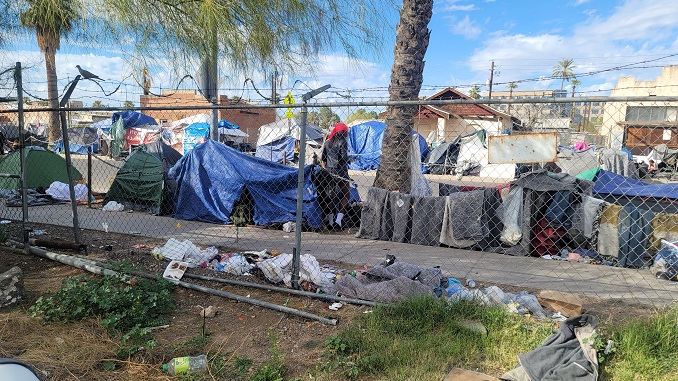
Arizonans looking for more information about a ballot measure that addresses the state’s growing homelessness issues can access vital research from a local think tank organization.
Late last month, the Common Sense Institute Arizona (CSI) released a report “on the economic and fiscal impact of Proposition 312, finding that there is indeed a link between the increase in homelessness and declining property values.”
According to CSI, “Proposition 312 is aimed at tackling Arizona’s growing homelessness crisis, offering property owners the opportunity to receive tax relief for costs incurred due to unmitigated public nuisances, such as homelessness, vandalism, property crime, and drug use.”
The report from CSI found “that under the status quo, property owners in areas with unmitigated public nuisances are seeing their values decrease in real value [while] homelessness is on the rise.”
“The rising rates of crime, homelessness, and drug activity in key areas of Phoenix appear to have taken a toll on property values and overall economic activity,” said Glenn Farley, Director of Policy & Research for CSI. “In this kind of environment of declining relative property values and higher crime rates, there are ongoing problems requiring mitigation – like security and cleanup costs. In practice, though, the real impact is likely to be preventive: local governments may ultimately be more proactive about mitigating these nuisances if this proposal is enacted than they are today.”
The Arizona-based Goldwater Institute took a position in support of Proposition 312 ahead of the November General Election. On its website, the influential organization wrote, “We saw it in Phoenix’s homeless Zone when the city allowed lawlessness to run wild. We saw it in Tucson, too. Amid rampant homelessness, hardworking Arizona taxpayers are being forced to bear the burden of a city’s refusal to do its duty to protect public health and safety, paying out of pocket to install fences, hire security, clean up garbage, human waste, and other hazardous materials themselves. Prop 312 ensures that when government fails to enforce existing laws regarding illegal camping, loitering, pollution, and other nuisances, taxpayers will no longer be forced to foot the bill.”
Proposition 312 was made possible by the Arizona State Legislature earlier this year, when Republicans led the way to pass HCR 2023, which, if eventually passed by state voters in November, would “allow a property owner to apply for a primary property tax refund if the owner documents expenses caused by a city, town or county adopting a policy, pattern or practice which declines to enforce existing laws or the maintaining of a public nuisance” – according to the overview provided by the state House.
In a statement after the successful passage of the bill out of his chamber, Senate President Warren Petersen said, “There are instances where local governments routinely and repeatedly fail their citizens by not enforcing laws. An example of this would be the City of Phoenix’s handling of the former homeless encampment known as ‘The Zone.’ This area was not only a public safety and public health disaster for those who camped there, but it was also a detriment to the livelihoods of small business owners who set up their shops in the area.”
Petersen added, “Money talks, and as a way to encourage municipalities to enforce the law, Speaker Toma and I teamed up to sponsor HCR 2023/SCR 1006. This measure is a ballot referral that would protect law-abiding citizens. If approved by voters, property owners would be allowed to request a refund for expenses incurred to mitigate the problem, up to the amount of their property tax liability. The funds would be deducted from the local government’s state shared revenue.”
The chamber’s president also noted that “all Senate Democrats voted ‘no’” on the referral.
The key findings from CSI about Proposition 312 are as follows:
“Problem increasing: Crime, drug overdoses, unsheltered homelessness, and other public nuisances have risen dramatically in Arizona and the greater Phoenix area since 2019. But the impacts are disproportionate: the problem has become more visible in certain parts of the city. This creates a negative economic impact for those parts of the city where local officials have failed to enforce existing laws
“Property Value Loss: Commercial properties in Phoenix affected by unmitigated public nuisances have seen market rent appreciation fall to just 15.7% between 2019 and 2023, compared to the citywide rate of 30.2%. This represents up to $2.1 billion in lost property value due to slower appreciation in areas with high levels of homelessness, crime, and public nuisances.
“Increased Crime: In areas with high public nuisance activity, the average crime rates for drug offenses, burglaries, robberies, and arson were between 3 to 5 timeshigher than the Phoenix average, driving up costs for property owners due to increased security measures and property damage.
“Impact on Businesses: Businesses located in areas with elevated public nuisance levels experience significantly lower property appreciation and higher vacancy rates. The economic toll of unmitigated public nuisances has made it harder for businesses to thrive in these areas.”
During the legislative process this year, representatives from Barry Goldwater Institute for Public Policy Research, QuikTrip, Arizona Free Enterprise Club, Arizona Chamber of Commerce, Arizona Food Marketing Alliance, and the National Federation of Independent Business, indicated their support for the proposal on the Arizona Legislature’s Request to Speak system. Representatives from the League of Arizona Cities & Towns, Living United for Change in Arizona, Arizona Coalition to End Sexual and Domestic Violence, Professional Fire Fighters of Arizona, Arizona Association of Counties, County Supervisors Association of Arizona, Arizona Housing Coalition, and several state cities and towns, signed in to oppose the measure.
Interested voters can read the full CSI report regarding Prop 312 here.
Daniel Stefanski is a reporter for AZ Free News. You can send him news tips using this link.
An Arizona thinktank has released its ballot guide for local and statewide propositions facing voters in the November General Election.
Last week, the Common Sense Institute Arizona issued a ballot guide for a number of local and statewide propositions. The report analyzes Scottsdale Proposition 490, Glendale Proposition 499, Proposition 138, and Proposition 312.
“In a year where many Arizonans will face the longest ballot in recent history, CSI is pleased to provide this resource on some of the statewide and local ballot questions that have economic implications,” said Katie Ratlief, Executive Director of the Common Sense Institute. “CSI strives to be a go-to resource for voters looking for just the facts, data, and impact on jobs. We hope this resource will be helpful to voters in making informed decisions in 2024.”
The summary of Scottsdale Proposition 490, according to CSI, is that it “would enact a new transaction privilege and use tax at a rate of 0.15% to fund city parks and preserves.” CSI’s bottom line for Prop 490 is as follows: “Given the local nature, small size, and offsetting public spending of the proposed tax, its economic impacts are difficult to model and probably small. Given clarification that this is a new tax, city voters must decide whether a new $30 million annual sales tax is needed to maintain and protect its popular parks and preserves within the larger context of the total city budget.”
The summary of Glendale Proposition 499, according to CSI, is that it “would enact a $20 minimum wage for certain hotel and event center workers, set limitations on the amount of square feet a room attendant can clean before earning twice the hourly wage rate, require service charges to be distributed directly to the person performing the service, and establish a new City Department of Labor Standards.”
CSI’s bottom line for Prop 499 is as follows: “Ultimately, if enacted, the Act would have dramatic implications for the city of Glendale and its economy. Though the implications would play out over time, rather than immediately, the results would be stark. Glendale is long, thin, and surrounded by the state’s urban core. The assets it has invested in — like State Farm Stadium — may be fixed, but other event and accommodation facilities could easily relocate outside of Glendale and still be within a mile or two of major landmarks.”
The summary of Proposition 138, according to CSI, is that it “will modify the minimum wage credit for tipped workers in the state through a constitutional amendment from $3/hr to 25% of the current state-wide minimum wage amount so long as the individual makes at least $2 above the state-wide minimum in wages and tips combined. CSI estimates the 25% offset in Prop 138 would be $3.69/hr in 2025.”
CSI’s bottom line for Prop 138 is as follows: “By lowering labor costs for certain tipped workers in the Arizona economy, the state’s minimum wage tipped worker credit supports a higher overall level of employment in these industries than would happen otherwise. The current fixed dollar credit both declines in relative value over time (when the minimum wage is increased) and is vulnerable to changes when the minimum wage itself is changed (since it is a part of state law).”
The summary of Proposition 312, according to CSI, is that it “would allow property owners in the state to apply for a property tax refund if the city or locality in which the property is located does not enforce laws or ordinances regarding illegal camping, loitering, obstructing public thoroughfares, panhandling, public urination or defecation, public consumption of alcoholic beverages, and possession or use of illegal substances.”
CSI’s bottom line for Prop 312 is as follows: “Property crime, illegal camping, the public use of drugs and alcohol, and other public nuisances are on the rise in Arizona. The impact of this is disproportionate, however — the problem is often isolated to specific areas. While this can limit the exposure of the city as a whole to the issue, for property owners in these areas, the impacts can be significant if the issue isn’t mitigated.”
The ballot guide also includes a number of key facts for each proposition that allows voters to obtain more information and context as they research the reasons and importance of the measures.
Daniel Stefanski is a reporter for AZ Free News. You can send him news tips using this link.
Despite Arizona spending over $1 billion annually to address homelessness, a new report finds that the problem has grown into a crisis in recent years.
The Common Sense Institute Arizona (CSI) issued a report on Monday revealing that the homeless population has grown by 40 percent in the last five years (9,900 in 2015 to 14,200 in 2023), with 53 percent of the current homeless population living without shelter.
Arizona’s 2023 Point in Time (PIT) count estimated the state to have over 14,000 homeless individuals; CSI speculated the PIT count was an undercount. CSI noted that the homeless population was more stagnant from 2015 to 2018, but that it has undergone “marked acceleration” from 2019 to present.
For the 10,000 homeless that Arizona’s emergency shelters serve annually, another 6,000 go without any shelter provisions.
CSI proposed the burgeoning homelessness crisis was due to gaps in data sharing between service providers — like the Homeless Management Information Systematic — as well as a shortage in affordable housing.
The organization arrived at those proposed solutions through consultations with 24 stakeholders representing the state’s over 200 public and private providers behind the $1 billion in homelessness-related expenses.
“Arizona lacks a unified, by-name list that would allow real-time tracking and service prioritization for individuals experiencing homelessness,” said CSI in a press release. “The state faces a severe housing affordability crisis, with a shortage of over 150,000 affordable housing units.”
Though the stakeholders were more unified in approaches to treating the problem, they disagreed about the root causes of homelessness. Some argued it was the housing markets, while others argued it was mental health and addiction.
The report also proposed that current coordination-related gaps exist in the state’s homelessness response systems, particularly the Continuums of Care (COCs). Additionally, stakeholders advised CSI that Arizona’s current system overly prioritizes meeting federal and external stakeholder requirements at the expense of effective services and interventions, such as tailored interventions addressing mental health or substance abuse.
“Decades of focus on permanent solutions to poverty and housing, although well intended, have left a system poorly adapted to the pressing problem – addiction, mental health, and chronically unsheltered homelessness,” stated the report. “Refocusing on emergency shelter, developing an effective command system to identify and respond to incidents in real time, and other reforms are needed to solve this crisis.”
These services and interventions, said CSI, ought to cultivate personal accountability and self-sufficiency within the homeless as steps to independence.
“To safeguard Arizona’s economic resilience and maintain a robust safety net for our most vulnerable citizens – the chronically homeless, who are often suffering with mental illness or addiction – public policy must acknowledge the paradox that the true strength of this safety net lies in preventing as many people as possible from needing it, rather than maximizing funding for, and the number of people permanently dependent on, that safety net,” stated the report.
CSI fellow Julie Katsel said in the same press release that Arizona’s homelessness reaching crisis levels proves that the state’s approach to the issue needs work, which she characterized as “injecting more money” into programs.
“We know that current systems haven’t solved the problem so far,” said Katsel. “[Arizona needs] improved coordination, more effective interventions, and better rapid response tactics are critical steps we need to take.”
AZ Free News is your #1 source for Arizona news and politics. You can send us news tips using this link.