The U.S. Department of Agriculture has issued two drought disaster designations covering several Arizona counties, making eligible farm operators in affected areas able to seek emergency loan assistance through the Farm Service Agency.
The designations name multiple Arizona counties as primary or contiguous natural disaster areas because of drought conditions, according to an announcement from Rep. Eli Crane’s office. The first designation, issued June 29, named Coconino and Maricopa counties as primary natural disaster areas. Gila, La Paz, Mohave, Navajo, Pima, Pinal, Yavapai, and Yuma counties were listed as contiguous counties.
In a post to X on Wednesday, Crane wrote, “The @USDA’s drought designations give our farmers and ranchers access to meaningful financial support during a difficult period. I appreciate @SecRollins and her team for recognizing the seriousness of these conditions and taking action.”
The @USDA’s drought designations give our farmers and ranchers access to meaningful financial support during a difficult period.
A second designation elevated Gila, Pinal, and Yuma counties to primary status. Coconino, Graham, La Paz, Maricopa, Navajo, Pima, and Yavapai counties were listed as contiguous counties under the second designation.
The determinations were made under 7 CFR 759.5(a), which provides for Secretarial disaster area designations when any portion of a county experiences D3, or extreme drought, or higher during the growing season, or D2, or severe drought, for at least eight consecutive weeks during the growing season of affected crops.
The Arizona Department of Water Resources says the U.S. Drought Monitor is the official record for federal drought relief claims. The department’s drought status page said Arizona’s Drought Monitoring Technical Committee advises U.S. Drought Monitor authors on current drought conditions in the state using precipitation, streamflow, drought indices, and impact data.
ADWR’s May drought status summary reported that severe short-term drought had advanced in Mohave, Coconino, Navajo, Gila, Maricopa, and Yavapai counties, covering 60% of the state, while extreme short-term drought expanded in Apache County. The department’s long-term drought update for January through March said Arizona experienced the hottest and 28th driest January-to-March period on record, as well as the hottest and 27th driest four-year period from April 2022 through March 2026.
Crane said the designations will give agricultural producers in affected counties access to federal assistance after years of drought pressure in rural Arizona.
“For years, rural Arizonans have faced worsening drought conditions without adequate federal assistance,” Crane said. “These designations finally give our farmers and ranchers access to meaningful financial support and help our producers during a difficult period.”
Crane thanked Agriculture Secretary Rollins and the USDA for recognizing the drought conditions and urged eligible applicants to work with their local Farm Service Agency office to determine whether low-interest loans could help offset recent losses.
Under Section 321(a) of the Consolidated Farm and Rural Development Act, USDA may extend disaster designations beyond counties that meet the drought criteria directly by naming neighboring counties as contiguous disaster areas. Crane’s office said both primary and contiguous classifications make farm operators eligible to be considered for FSA emergency loan assistance.
The FSA stated that emergency loans may be used to replace essential items such as equipment or livestock, reorganize a farming operation, or refinance certain debts. The agency reviews loan applications based on the extent of losses, available security, and repayment ability.
Farmers and ranchers in the affected counties have eight months from the date of their county’s listing to apply. Crane’s office said applicants should contact their local FSA office for help with the application process and required documentation.
Applicants with questions may also email FPAC.BC.Congressional@usda.gov and reference disaster designation number 2026N00000369 for the June 29 announcement or 2026N00000419 for the Monday announcement.
Flagstaff and Coconino County officials plan to spend thousands to pay for a new annual gala by Northern Arizona University (NAU) celebrating diversity and Martin Luther King Jr.
The Coconino County Board of Supervisors approved the expenditure of nearly $9,000 from its Community Initiative Funds for NAU’s first annual Martin Luther King Jr. Gala during their regular meeting earlier this month.
Coconino County funds will pay $4,000 for rental of the host venue, $1,325 for audio-visual services and related costs, $650 for an IT specialist to manage the audio-visual services, $2,610 for staffing charges for venue set up and tear down, and $124 for room rental tax and associated sales taxes.
The gala plans to prioritize diversity and inclusion throughout its guest list and unique opportunities provided to attendees. It will focus on “promoting Black/African American culture and traditions through educational, historical, and performing arts events.”
In addition to elected and appointed leaders with both the city of Flagstaff and Coconino County, gala attendees will consist of select leaders within Flagstaff and Coconino County’s commercial, industrial, and business sectors, and NAU students, staff, educators, and administrators.
At the gala, the organizers will recognize “local leaders who embody Dr. King’s legacy as a ‘drum major for peace.’”
Flagstaff City Council plans to vote on an expenditure of $1,000 from the present total of $11,200 within the Council Initiative Fund during their regular council meeting next week. That agenda item also left room for further consideration of “any other programs” the council may want to subsidize using the Council Initiative Fund, which maintains $25,000 annually.
The city council established that fund as part of its fiscal year 2020-2021 budget.
The Martin Luther King Jr. Gala will take place on Jan. 17, 2026 at NAU’s High Country Conference Center. NAU’s Center for Inclusive Excellence and Access planned the gala.
A similar event last year hosted by NAU’s Black Student Union, which partly inspired this year’s gala, featured Coral Evans as the keynote speaker: the former Flagstaff Mayor and Senator Mark Kelly’s current Northern Arizona director.
Evans is the sister of the Center for Inclusive Excellence and Access program director, Dr. Rev. Bernadine Lewis.
Lewis told the Arizona Daily Sun that the event is meant to bring communities together across the city and county.
“Our focus is on economic development, workplace development and just community wellbeing,” said Lewis. “That is everything the center stands for and it is also everything that Dr. King stood for, fought for and died for.”
Details of the event have not been available on NAU’s Events page or elsewhere that AZ Free News could discover. The Center for Inclusive Excellence and Access did not respond to our questions about the event as of this report.
NAU is also hosting another, separate event to celebrate MLK Jr.: MLK Day ‘26.
This MLK Jr. celebration marks one of the top expenditures Coconino County made with its Community Initiative Funds, and one of the lowest expenditures Flagstaff made with its Council Initiative Fund from this past year.
AZ Free News is your #1 source for Arizona news and politics. You can send us news tips using this link.
Rep. Eli Crane (R-AZ-02) has introduced the North Rim Restoration Act of 2025 to streamline federal contracting and accelerate recovery from the Dragon Bravo Fire.
The fire, sparked by lightning on July 4, burned 145,504 acres in Grand Canyon National Park and the Kaibab National Forest before being declared fully contained, almost four months later, on September 29th. It destroyed key infrastructure across the parks, including the historic Grand Canyon Lodge, leading to partial closures of the North Rim that are likely to continue throughout the 2025 season. The closures have reportedly impacted park staff, local communities, and the tourism revenue from the site that generates billions annually for Arizona’s economy.
'MEGAFIRE': Grand Canyon's Dragon Bravo Fire has now exploded across more than 100,000 acres pic.twitter.com/F3dZdF4w6F
The bill grants the National Park Service emergency contracting authority to bypass standard procurement delays for fire recovery efforts, including forest management, maintenance, rebuilding, and infrastructure upgrades. It requires the agency to submit progress reports to Congress every 180 days.
Original cosponsors include Reps. Andy Biggs (R-AZ05) and Abe Hamadeh (R-AZ08), as well as House Natural Resources Committee members: Subcommittee on Oversight and Investigations Chairman Paul Gosar (R-AZ09), Subcommittee on Federal Lands Chairman Tom Tiffany (R-WI07), Congressional Western Caucus Chairman Doug LaMalfa (R-CA01), and Rep. Celeste Maloy (R-UT02).
“While the Dragon Bravo Fire dealt a setback for Northern Arizona, we won’t let this tragedy define our future. We have an opportunity to rebuild stronger and better than before, and we can’t let unnecessary regulations get in the way,” Crane said in a statement. “This legislation paves the way for an efficient recovery, and I’m grateful for the bipartisan support on this approach. I also want to thank our heroic firefighters and first responders who brought the fire to full containment, as well as the local leaders in Coconino County who are committed to restoring this treasured place.”
The Coconino County Board of Supervisors praised the act stating, “Coconino County supports the North Rim Restoration Act, which gives the National Park Service the ability to respond swiftly and thoughtfully, not only to rebuild the physical structures, but to restore the enduring spirit of the Grand Canyon’s North Rim. We are deeply grateful to Representative Crane for championing this legislation and recognizing the devastation caused by the Dragon Bravo Fire and the heartbreaking loss for everyone who treasures this extraordinary place.”
Tomorrow, I'm introducing the North Rim Restoration Act of 2025.
This legislation will eliminate bureaucratic hurdles and expedite the rebuild of the Grand Canyon.
While the Dragon Bravo Fire dealt a setback for #AZ02, we won't let this tragedy define our future.… pic.twitter.com/ZXDJi8Tn5R
Crane previewed the bill in an Oct. 9 post to X, writing, “Tomorrow, I’m introducing the North Rim Restoration Act of 2025. This legislation will eliminate bureaucratic hurdles and expedite the rebuild of the Grand Canyon. While the Dragon Bravo Fire dealt a setback for #AZ02, we won’t let this tragedy define our future.”
Crane also announced the availability of low-interest federal disaster loans via the U.S. Small Business Administration in early September. The loans will assist businesses, nonprofits, and tribal nations that endured economic losses from the Dragon Bravo and White Sage fires.
The bill has been referred to the House Committee on Natural Resources.
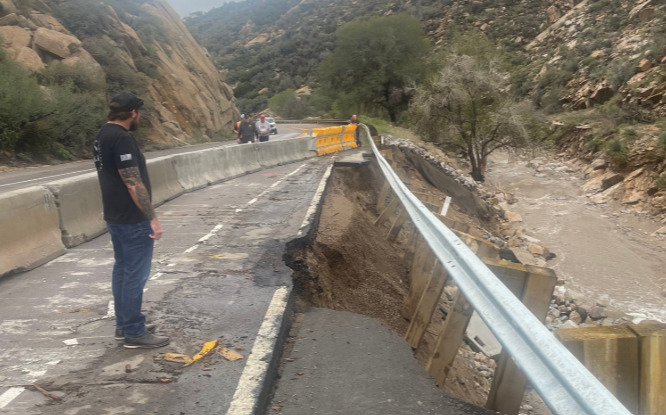
With tropical storm-fueled rains hammering various parts of Arizona and flood losses mounting, the U.S. Small Business Administration (SBA) announced that low-interest loans are now available for the victims of severe flooding in Coconino, Gila, Graham, Maricopa, Navajo, Pinal, and Yavapai Counties, as well as tribal nations.
Had a chance to visit Globe and Miami again this afternoon.
They continue to receive heavy rainfall and devastating flooding.
We are coordinating with federal, state, and local officials.
The SBA is offering low-interest federal disaster loans to eligible businesses, nonprofits, residents, and tribal nations—similar to those provided for the Dragon Bravo Fire victims in September.
In a post to X announcing the relief for Gila County, Congressman Eli Crane (R-AZ02) called for continued prayers for those hit by the massive flooding. Remnants of Hurricane Priscilla hammered the area over the weekend, adding to late September’s monsoon deluge that devastated Globe-Miami.
Crane wrote: “@SBAgov has declared an economic disaster due to the severe flooding in Gila County. Through this declaration, SBA’s Economic Injury Disaster Loan (EIDL) program is available to eligible businesses, private nonprofits, and residents,” providing a link to resources.
He followed up: “Please continue to keep those impacted by the devastating floods in Gila County in your prayers. For those affected, @SBAgov is offering Business Physical Disaster Loans, Home and Personal Property Loans, and Economic Injury Disaster Loans.”
Please continue to keep those impacted by the devastating floods in Gila County in your prayers.
For those affected, @SBAgov is offering Business Physical Disaster Loans, Home and Personal Property Loans, and Economic Injury Disaster Loans.https://t.co/W85mlmctxi
“Businesses and nonprofits are eligible to apply for business physical disaster loans and may borrow up to $2 million to repair or replace disaster-damaged or destroyed real estate, machinery and equipment, inventory, and other business assets.
“Homeowners and renters are eligible to apply for home and personal property loans and may borrow up to $100,000 to replace or repair personal property, such as clothing, furniture, cars, and appliances. Homeowners may apply for up to $500,000 to replace or repair their primary residence.
“Applicants may be eligible for a loan increase of up to 20% of their physical damage, as verified by the SBA, for mitigation purposes. Eligible mitigation improvements include insulating pipes, walls and attics, weather stripping doors and windows, and installing storm windows to help protect property and occupants from future disasters.”
The Economic Injury Disaster Loan (EIDL) program is also available to help small businesses, nurseries, and non-profit organizations with financial losses directly related to this disaster.
For more information, the SBA directs victims to visit this website. They can apply online, call SBA’s Customer Service Center at (800) 659-2955, or email disastercustomerservice@sba.gov.
“When disasters strike, SBA’s Disaster Loan Outreach Centers play a vital role in helping small businesses and their communities recover,” Chris Stallings, associate administrator of the Office of Disaster Recovery and Resilience at the SBA, said in a press release. “At these centers, SBA specialists assist business owners and residents with disaster loan applications and provide information on the full range of recovery programs available.”
Rep. Eli Crane (R-AZ02) and the U.S. Small Business Administration announced last week that low-interest federal disaster loans are now available. The aid applies to businesses, nonprofits, and tribal nations that suffered losses from the Dragon Bravo and White Sage fires on the Grand Canyon’s North Rim and Kaibab Plateau.
The SBA has since announced that a series of meetings will be held across Coconino County, with in-person mobile services available to assist with the application process.
According to a press release from Rep. Crane, “These loans are intended to cover working capital needs and operating expenses that could have been paid had the disasters not occurred.”
The Economic Injury Disaster Loan (EIDL) is available to eligible businesses, small agricultural cooperatives, nurseries, and PNPs with financial losses directly related to the disaster. However, the administration noted it is “unable to provide disaster loans to agricultural producers, farmers, or ranchers, except for aquaculture enterprises.”
ICYMI: The SBA is offering 30-year loans at a 4% interest rate for Arizonans impacted by the Dragon Bravo and White Sage fires.
To assist with the application process, the SBA has scheduled several in-person meetings throughout Coconino County.
The purpose of the loans, as explained by the SBA, is “for working capital needs caused by the disaster, and are available even if the business did not suffer any physical damage. They may be used to pay fixed debts, payroll, accounts payable, and other bills that could have been paid had the disaster not occurred.”
As of this report, the Dragon Bravo fire has burned 145,504 acres and is 64% contained. It has cut a smoldering path of destruction from the north rim of the Grand Canyon along both sides of Arizona State Route 67 reaching as far as House Rock Valley and then along the east side of the State Route for nearly another twenty miles, leaving a scar almost 16 miles wide at its widest point.
The White Sage fire burned nearly 59,000 acres and was completely contained as of August 21st after spreading in a widening eastward arc from White Sage flat through the Kaibab National Forest toward Coyote Valley.
For more information about the SBA EID loans or to apply, please click here, call SBA’s Customer Service Center at (800) 659-2955, or email disastercustomerservice@sba.gov.