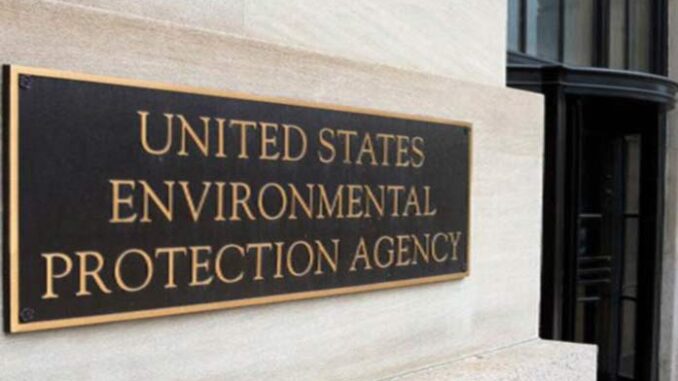
The Trump administration recently unveiled a proposal to repeal the 2009 “Endangerment Finding,” a controversial U.S. climate policy that declared carbon dioxide and other greenhouse gases a threat to public health and welfare.
The Environmental Protection Agency’s (EPA) proposed rule, if finalized, would dismantle the legal foundation for numerous climate regulations under the Clean Air Act, repealing all resulting greenhouse gas emissions regulations for motor vehicles and engines.
EPA Administrator Lee Zeldin described the move as “the largest deregulatory action in the history of America,” arguing that the Endangerment Finding has been misused to impose costly regulations.
“There are people who, in the name of climate change, are willing to bankrupt the country,” Zeldin said. “They created this endangerment finding, and then they are able to put all these regulations on vehicles, on airplanes, on stationary sources, to basically regulate out of existence, in many cases, a lot of segments of our economy. And it cost Americans a lot of money.”
The proposal, which follows an executive order from President Trump, directs the EPA to review the findings’ legality. It is part of a broader push to roll back 31 environmental regulations.
Zeldin criticized the Obama and Biden administrations, saying they “twisted the law, ignored precedent, and warped science to achieve their preferred ends and stick American families with hundreds of billions of dollars in hidden taxes every single year.”
In states like Arizona, the Endangerment Finding has been used to enforce mandates and shut down energy sources that Arizona relies on.
The Arizona Free Enterprise Club celebrated the EPA’s proposal, viewing it as a critical step toward alleviating economic burdens imposed on Arizona families and businesses from overreaching environmental mandates.
The Club argues that the Endangerment Finding has forced the closure of reliable energy facilities and imposed costly environmental policies that have led to soaring utility costs and raised concerns about the reliability of the state’s energy grid.
Scot Mussi, President of the Arizona Free Enterprise Club, reacted to the Trump administration’s proposal, saying, “[The Endangerment Finding] has always been junk science used to shut down Arizona’s economy, close down our coal plants, and force our state into California-style green mandates. Repealing the Endangerment Finding is a necessary step to restore energy independence, protect ratepayers, and stop the unelected bureaucrats at the EPA from hijacking our economy in the name of climate alarmism.”
Ethan Faverino is a reporter for AZ Free News. You can send him news tips using this link.
The Trump administration is gearing up to try to revoke one of the most overreaching, unscientific regulatory edifices ever erected: the EPA’s 2009 “endangerment finding.” News broke this week that the Environmental Protection Agency has drafted a plan to rescind this cornerstone of federal climate policy, which declared that greenhouse gases like carbon dioxide and methane pose a danger to human health and welfare.
If this move succeeds, it would limit the federal government’s ability to regulate carbon dioxide emissions from cars, power plants, and industries—a prospect that has the climate alarmist crowd clutching their pearls. And frankly, it’s about time someone challenged this rank absurdity.
Let’s take a walk down memory lane to 2009, when the Obama-era EPA, emboldened by the 2007 Supreme Court ruling in Massachusetts v. EPA, decided to anoint itself the arbiter of America’s energy future. The endangerment finding was born, asserting that CO2 – literally plant food, and the fundamental building block for all life on planet Earth – is actually a “pollutant” that “endangers public health” as defined under the Clean Air Act.
This vast expansion of the regulatory state wasn’t based on some groundbreaking scientific discovery but rather on a political agenda dressed up in green rhetoric. The finding has since provided the legal foundation for a slew of regulations, from tailpipe emissions standards to power plant rules, all designed to choke the fossil fuel industry and push the U.S. toward a so-called “clean energy” utopia that exists only in the fever dreams of climate activists.
Now, the Trump EPA, led by Administrator Lee Zeldin, appears poised to dismantle this house of cards. Zeldin’s draft proposal argues that the EPA overstepped its authority by issuing such a sweeping determination.
The plan focuses on a legal argument that the EPA’s administrator lacks the power to make broad proclamations about greenhouse gases without specific congressional authorization. This is a direct jab at the 2007 Supreme Court decision, a judicial overreach that gave unelected bureaucrats a blank check to regulate the economy. It is key to also remember that that decision came at a time when the Chevron Deference, which the Court did away with a year ago, was still in effect.
Adopted in 1984, the Chevron Deference held that courts must defer to the judgment of regulators when interpreting the congressional intent of federal statutes. But the Clean Air Act was never designed to regulate CO2, a point even the late Rep. John Dingell, a co-author of the law, made clear.
Of course, the climate alarm lobby will drag this fight into the courts, so overturning the finding will not be easy. The EPA must navigate a minefield of procedural requirements under the Administrative Procedure Act, and the alarmists will try to overwhelm the courts with claims that climate change has only grown since 2009, asserting that every extreme weather event somehow proves their case.
But the Trump administration isn’t denying climate change outright; it’s questioning whether the EPA has the legal authority to act as America’s climate czar. This is a fight worth having, because if the agency can regulate CO2 without clear congressional approval, what’s stopping it from declaring water vapor a pollutant next?
The bigger picture here illustrates the absurdity of the energy transition itself. The endangerment finding has been a cudgel to force a shift away from reliable, affordable fossil fuels toward a fantasy of windmills and solar panels that can’t power a modern economy. The U.S. is the second-largest emitter of greenhouse gases globally, but even if we zeroed out emissions tomorrow, global temperatures would barely budge without similar action from China and India.
Meanwhile, Americans bear the brunt of higher energy costs and a less reliable grid. Rescinding the endangerment finding could free up the economy to innovate without the EPA’s heavy hand, letting market forces—not bureaucrats—drive energy and climate solutions.
This move is a bold step toward dismantling the regulatory state’s stranglehold on American energy. It won’t be quick or easy, and the climate zealots will fight tooth and nail. But if the Trump administration can pull it off, it’ll be a victory for common sense over green dogma, a win for innovation over regulation. A long, hard fight lies ahead, but it is one worth having, and which is long overdue.
David Blackmon is a contributor to The Daily Caller News Foundation, an energy writer, and consultant based in Texas. He spent 40 years in the oil and gas business, where he specialized in public policy and communications.
The city of Phoenix will base its next climate, energy, and food policies on a community survey.
The city’s Office of Environmental Programs (OEP) has an ongoing survey this month in which they offer a $100 VISA gift card drawing as a reward.
The bulk of the questions provide insight as to the potential policy directions the city is looking to take to address climate, energy, and food.
The survey suggested the greatest barriers to addressing climate change may be lack of public information and education, motivation to address climate change, government mandated regulations/support, business or industry support, and public-private coordination; cost of implementation; and difficulty in changing individual behaviors.
The following were proposed incentives for public and alternative modes of transportation: increasing the options, routes, and frequencies of public busing and light rail; increasing infrastructure and safety measures for pedestrian and bicycle transportation; increasing electric vehicle infrastructure; and establishing subsidies for installing electric vehicle chargers in homes and businesses.
Potential policies for aiding in heat relief were also presented: improving access to affordable electricity to reduce electricity costs related to cooling systems; increasing shade by planting more trees and installing shade structures; incorporating heat reducing materials into construction of new or remodeled buildings; using cooling materials and techniques in street surfaces, parking lots, and roofing; and subsidizing the replacement of old cooling systems for energy efficiency.
The survey offered policy proposals for drinking water supply: offering residential and commercial tiered water rate structure plans and rebates for those who adopt water conservation and climate adaptation practices; increasing access to rainwater harvesting, water storage, and wastewater conversion infrastructure; incentivizing and subsidizing residential replacement of lawns to xeriscape or artificial grass or turf; and implementing an education initiative for residential and business/commercial/industrial water conservation.
The survey also requested some insight into residents’ current conservation practices.
Residents were asked to divulge information about their cooling and heating systems and their satisfaction with their function and cost. The survey also sought to learn residents’ financial stability, the impact of their utility bills on their finances, and energy assistance program participation.
Residents were also asked about their food acquisition and consumption practices. In relation to these questions, the survey asked residents to reflect on potential food-related policies: transportation support such as free shuttle services, transit passes, fruit and veggie home delivery; a map of community food access points such as gardens, farmers markets, food box sites; vouchers or assistance for food; neighborhood-based food outlets at corner stores, transit stops, schools, and community spaces; physical spaces to grow food in neighborhoods such as community gardens; and education programs with supplies and hands-on training for gardening.
Residents were also asked to prioritize policies to reduce the environmental impact of food reduction; encourage sustainable farming practices; reduce food insecurity and hunger; increase access to local food; prevent and reduce food waste; educate the community about healthy eating; develop opportunities for new local food businesses; and protect or add new space for farmland or greenspace.
The survey also asks respondents to share where they obtain their information on climate change, the word that comes to mind when they hear the term “climate change,” how often they think about climate change, and their feelings about climate change (whether they are worried, anxious, fearful, overwhelmed, or motivated to take action).
AZ Free News is your #1 source for Arizona news and politics. You can send us news tips using this link.