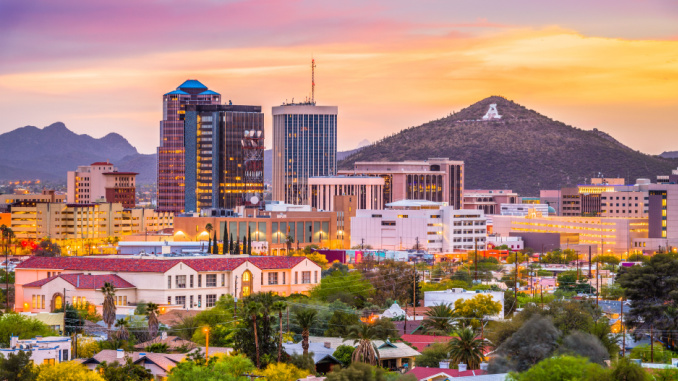
This November, Tucson voters will decide whether they would like to continue doubling down on Tucson’s failed policies that have invited rampant crime, made it impossible to navigate the city without extreme frustration, and drain its wealth and livability to pursue virtue-signaling but poverty-inducing policies. Or if they would rather get off the merry-go-round of insanity.
Prop 417 is the city’s updated 10-year general plan, and a ‘Yes’ vote continues the madness. A ‘No’ vote on Prop 417 is the only reasonable choice for anyone who wants to save Tucson from itself.
Take for example the city’s climate action plan published in 2023 which set the delusional goal of having 40% of Tucson residents to be walking, biking, taking public transit or “rolling” around the city by 2050. The plan includes a commitment to “net zero” by 2030 for government operations and by 2045 city-wide—including private residents and businesses.
To achieve this fantasy, the city plans to build out a massive transit agency that if they meet their targets of hiring 900 new people every year will eventually eclipse Raytheon as the largest employer in Tucson by more than double (despite collapsing ridership and a 100% taxpayer subsidy since fares were permanently eliminated in 2020.)
The plan requires residents to hold to a “Zero Waste” commitment to empty out the landfills, imposes new road diets, and even pays city employees to not use their cars. This list of insane ideas is also very very expensive, with a price tag of roughly $365 million…
President Trump’s historic victory in the November election gave him a clear mandate from the American people. And so far, he hasn’t wasted any time getting to work. In his first month back in office, Trump signed 45 Executive Orders (EO) in an effort to put America first and undo much of the damage created by the Biden administration. And that’s especially true with his executive actions to unleash American energy.
Ending the Net Zero Climate Cult Fantasy
For four years under President Biden, the American people were forced to endure an administration that was hellbent on pursuing a net zero agenda. Across the country, they pushed these radical and costly climate action plans to fundamentally transform and restrict the energy options available to consumers. Along with this came calls from the Left to ban gas stoves, gas cars, gas-powered lawn equipment, and hundreds of other draconian ideas to limit the freedom of the American people.
If the high cost of these plans wasn’t enough, they have also proven to be unreliable. States and countries that have committed to energy sources like solar and wind as part of this net zero fantasy have experienced rolling blackouts, continually demand that their customers use less, and eventually have to make haste to open reliable sources of generation they had closed down. Isn’t that right, California?
But Trump’s Executive Order 14154 unleashes fossil fuel production and use in America while unwinding much of the damage caused by the Biden administration…
If you can’t get people to like your ideas, change the system. That’s the clear agenda behind the Prop 140 scheme that seeks to bring ranked-choice voting and jungle primaries to Arizona. And there’s no more hiding it.
At a recent news conference organized by the Prop 140 campaign, Kimber Lanning—founder and CEO of a group called Local First Arizona that wants to build “equitable” systems for Arizona’s businesses—let the mask slip. Lanning revealed that when other states have adopted the reforms included in Prop 140, they have been able to move forward on transformational ideas like climate action plans and providing driver’s licenses to illegal immigrants.
Wait. Aren’t ranked-choice voting and jungle primaries supposed to lead to more moderation in the government? That’s what the backers of Prop 140 continue to push. But since when did climate action plans and special benefits for illegal immigrants become moderate?
Therin lies the true motivations behind Prop 140. Liberal billionaires from Colorado and others states around the country are pouring millions and millions into Arizona to pass this initiative in an effort to turn Arizona blue. They envision a system anchored around ranked-choice voting and jungle primaries will put them in charge of the political and policy agenda here in Arizona.
And in their zeal for power and control, they don’t even recognize the underlying hubris and irony of their entire campaign…
For local governments—and councils of governments—in Arizona, it appears that creating a climate action plan has become all the rage. Maybe that’s because it pays well.
The latest group to bow down at the altar of the Biden administration’s climate change agenda is the Maricopa Association of Governments (MAG). Back in August, MAG received a $1 million grant from the Environmental Protection Agency’s (EPA) Climate Pollution Reduction Grant Program to serve as the lead planning organization for the Phoenix-Mesa-Chandler metro area. The grant requires MAG to develop a priority climate action plan by next March, a comprehensive climate action plan by 2025, and a status report in 2027 after the four-year grant period expires.
But this $1 million grant isn’t the only way MAG stands to benefit…
Maricopa Association of Governments (MAG) may oversee up to $4.6 billion in federal funding to implement emissions reduction plans.
The billions cover the second of two phases required by the Environmental Protection Agency (EPA) under the Climate Pollution Reduction Grant (CPRG) Program. That phase concerns implementation grants for greenhouse gas emissions reduction policies, programs, and projects. The preceding phase covers planning grants for the development of regional climate plans.
For phase one, the EPA gave Maricopa Association of Governments (MAG) a $1 million CPRG Program grant to serve as the lead planning organization for the Phoenix-Mesa-Chandler metropolitan statistical area. This grant requires MAG to develop a priority climate action plan due next March, comprehensive climate action plan due in 2025, and a status report due in 2027 after the four-year grant period expires.
MAG accepted the $1 million during a meeting on Wednesday, amending their 2024-2025 Biennial Planning Work Program and Budget to do so.
The priority climate action plan is a prerequisite for the $4.6 billion implementation grant. As part of this plan, MAG must issue a benefits analysis for how their plan produces the most significant benefits to low-income and disadvantaged communities, which the Biden administration refers to collectively as “LIDAC.”
The EPA emphasized arranging all three CPRG plans around LIDACs. Tribes and territories won’t be required to include special LIDAC provisions in their plans.
The EPA guidance on LIDACs explained that the equity lens for the CPRG funding constitutes a greater pledge by the Biden administration per the Justice40 Initiative to issue 40 percent of federal investments to those marginalized, underserved, or overburdened by pollution.
LIDACs are determined by federally defined burdens concerning climate change, energy, health, housing, legacy pollution, transportation, water and wastewater, workforce development, low median income, and poverty. The agency recommended the use of the Biden administration’s Climate and Economic Justice Screening Tool (CEJST).
The billions for energy and climate initiatives may address something advocated for greatly by Democratic leaders like Phoenix Mayor Kate Gallego and Rep. Ruben Gallego (D-AZ-03): extreme heat and urban heat island effects. The EPA cited both on page 8 of their LIDAC guidance.
Public comment during Wednesday’s meeting largely represented opposition to the federal funding to implement net zero goals. Members of the public warned that such climate agendas would result in energy poverty tantamount to shortages and scarcity experienced in third-world countries.
Last year, China permitted coal burning plants at the rate of two new plants every week. High costs with lower supply, as seen in Germany, which resulted in an energy crisis last winter that plummeted the population into the freezing winter temps.
Members of the public also expressed concerns over the financial impact on taxpayers, citing woes faced by the taxpayers of neighboring California. Despite all public comments expressing opposition during the meeting, MAG approved the EPA funding as one part of its consent agenda.
The EPA received $5 billion for the CPRG Program through the Inflation Reduction Act (IRA): $250 million for noncompetitive planning grants, and $4.6 billion for competitive implementation grants.
The White House issued a comprehensive, searchable guidebook on the IRA funding for “clean” energy and climate change initiatives. IRA funding to reorient the economy for “clean” energy totals around $369 billion.
Of the planning grants, states received $156 million, local governments received $67 million, tribes received $25 million, and territories received $2 million.
Corinne Murdock is a reporter for AZ Free News. Follow her latest on Twitter, or email tips to corinne@azfreenews.com.