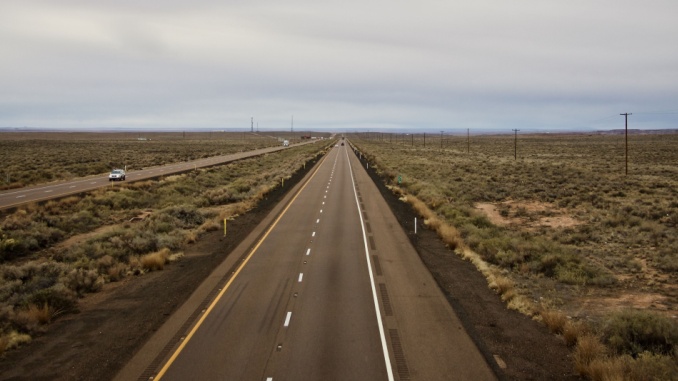
The Arizona Senate has passed a comprehensive package of transportation bills designed to enhance roadway safety, improve mobility, reduce congestion, and support long-term economic development across the state.
The measures, which advance critical infrastructure projects in both rural and urban areas, were approved this week without raising taxes or imposing new fees on Arizona drivers.
The legislation targets high-priority corridors experiencing pressure from population growth, increased freight traffic, and tourism demand. Key components of the package include targeted safety and capacity improvements on several major routes.
SB 1062, sponsored by Senator Wendy Rogers (R-LD7), appropriates $1,000,000 from the state general fund for FY26-27 to the Arizona Department of Transportation. The funding will support planning, design, construction, and right-of-way acquisition for an additional left-turn lane and related intersection improvements at the busy intersection of U.S. Route 60 and Superstition Mountain Drive in Pinal County. These enhancements aim to ease traffic flow and improve safety along this heavily traveled corridor.
SB 1063, also sponsored by Senator Rogers, allocates $11,100,000 for critical safety improvements on U.S. Route 70 between Mile Post 225 and Mile Post 301. This rural route serves commuters, freight operators, and emergency services in eastern Arizona. The project addresses longstanding roadway deficiencies to enhance travel reliability and safety for users across the region.
SB 1064, another measure sponsored by Senator Rogers, appropriates $3,000,000 from the state general fund in FY26-27 to the Arizona Department of Transportation for distribution to the City of Flagstaff. The funding will support the design and construction of improvements along U.S. Route 66 between I-40 and Milton Road. Under the bill, the Department of Transportation must enter into an intergovernmental agreement with the City of Flagstaff by September 15, 2026, and, if executed, distribute funds to the city by November 1, 2026. The project will help modernize infrastructure along one of northern Arizona’s busiest tourism and business corridors.
“Transportation is about safety, mobility, and economic opportunity,” stated Senator Rogers. “These projects address real pressure points on our highways, keep traffic moving, and support the continued growth of communities across Arizona.”
SB 1204, sponsored by Senator Janae Shamp (R-LD29), provides $5,500,000 for planning and environmental analysis for future interchange improvements at the intersection of U.S. Route 60 and Loop 303 in the rapidly growing West Valley. The area continues to see significant residential expansion and rising freight traffic.
“The West Valley is growing at an incredible pace, and our infrastructure has to keep up,” stated Senator Shamp. “This project prepares one of our most important corridors for the traffic we know is coming, improving daily commutes while supporting job growth and regional commerce, as well as preventing traffic fatalities.”
SB 1455, sponsored by Senate Appropriations, Transportation & Technology Committee Chair David Farnsworth (R-LD10), appropriates $500,000 for surveying, design, and study work on the future extension of State Route 24 east of Ironwood Drive in the East Valley—one of Arizona’s fastest growing regions.
“As families and businesses continue moving into the East Valley, transportation planning has to look ahead, not behind,” stated Senator Farnsworth. “Extending SR 24 will strengthen regional connectivity, reduce future congestion, and ensure infrastructure keeps pace with responsible growth.”
The measures now move to the Arizona House as part of the ongoing state budgeting process.
Ethan Faverino is a reporter for AZ Free News. You can send him news tips using this link.
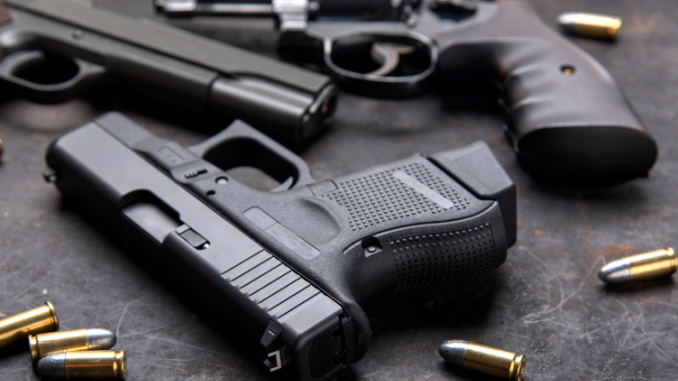
The city of Flagstaff may face a lawsuit over its forthcoming decision to ban a firearms advertisement.
In a press release issued earlier this week, the Goldwater Institute said that the city’s ban, if approved, would constitute an illegal violation of free speech.
“When a city operates a public facility, it cannot use that authority to censor messages or viewpoints it disagrees with,” said the Goldwater Institute. “But that’s just what the city of Flagstaff is doing: abusing its power to push an anti-gun agenda.”
The Phoenix-based public policy organization reached out to the city to request they reject the ban on behalf of a business owner who, it appears, prompted the ban: Rob Wilson, owner of the indoor gun range Timberline Firearms and Training.
“By denying Mr. Wilson’s request to advertise based on an unreasonable and pretextual application of the advertising policy, the City has violated Mr. Wilson’s constitutional rights to freedom of speech and due process of law,” stated the letter. “Moreover, the new policy currently under consideration is unconstitutional, both as applied to Mr. Wilson (as it expressly targets his expression) and on its face (as it bans broad, poorly-defined categories of speech and discriminates based on content and viewpoint).”
Wilson had run his gun range business ads without issue at the Flagstaff Pulliam Airport since 2019. It wasn’t until April that the city denied his ad. City officials claimed that Wilson’s advertisement conflicted with their advertising guidelines by representing “violence or antisocial behavior.” Wilson’s contested ad video is below.
The city refused Wilson’s attempt at an appeal. Afterwards, the city developed a new policy specifically prohibiting the inclusion of firearms in advertisements.
Heidi Hansen, director of Economic Vitality, was responsible for the policy changes. Hansen explained during a council meeting last month that the rejection of the Timber Firearms and Training ad was due to the video depicting a firearms instructor “firing rapidly” at a “silhouette of a person.” The figure in question was likely the B-27 silhouette paper target, a common tool for shooting ranges, especially for law enforcement training.
“It was firing quite rapidly at a silhouette of a person and we felt like that might make someone uncomfortable,” said Hansen.
Wilson, a Navy veteran, said that his city leadership went against the Constitution he fought to defend for decades.
“Denying my right to advertise is simply wrong,” said Wilson. “After serving 22 years on active duty to defend the Constitution, I’m not about to sacrifice my rights.”
Lawmakers warned the city last month, ahead of a city council discussion of the ban, that it would be both unconstitutional and unlawful.
During discussion of the policy, city officials said they felt that the advertisement video was unwelcoming and discomforting. Councilmember Miranda Sweet said that Timber Firearms and Training might have to compromise on the issue.
“I was very uncomfortable when I watched [the ad video],” said Sweet. “We’re trying to welcome people into the community when they come into the airport, and the video didn’t portray that.”
Although the Goldwater Institute stated in its letter that the Flagstaff City Council may consider the firearms advertisement ban during its Nov. 7 regular meeting, a city spokesperson informedAP News that an “updated version” of the policy would be included in the Nov. 14 council meeting.
Corinne Murdock is a reporter for AZ Free News. Follow her latest on Twitter, or email tips to corinne@azfreenews.com.
The City of Flagstaff can be forced to pay the State of Arizona more than $1.1 million for enacting a minimum wage that is significantly higher than the state wage, according to an Arizona Court of Appeals opinion released Tuesday.
But whether the State gets to keep the money will be determined once a Maricopa County judge conducts a trial on the matter.
Back in 2006, Arizona voters approved Proposition 202 which allows cities and towns to set their local minimum wage, as long as it is not below the state level. Flagstaff did just that in 2016 with the passage of a local voter initiative.
The Arizona Legislature passed a new law in 2019 which allows the State to collect yearly assessments from any municipality with a minimum wage that exceeds the State’s. The assessment entails a detailed process involving state agencies estimating their costs “attributable” to the higher minimum wage.
Each assessment must be approved annually by another act of the legislature, after which the Arizona Department of Administration (ADOA) is required to issue an assessment to the municipality by July 31.
Any impacted municipality then has until the end of the calendar year to remit payment or the Arizona Treasurer must withhold the amount with applicable interest from the municipality’s share of tax revenues.
In the Flagstaff case, the state agencies were asked by the Legislature in 2019 to calculate their “projected costs attributable to Flagstaff’s higher minimum wage” in their 2021 budget estimates. That amount was calculated at $1,110,992, based on Flagstaff’s $15 per hour minimum wage effective Jan.1, 2021.
The Arizona hourly minimum at the time was only $12.15.
The $1.1 million Flagstaff assessment was approved by the Legislature via Senate Bill 1827 on June 30, 2021 and signed the same day by then-Gov. Doug Ducey. ADOA then advised city officials the assessment would be formally issued 90 days later, well after the July 31 deadline.
In the meantime, city officials filed a lawsuit, challenging the 2019 statute as well as the 2021 Senate Bill, arguing both were unconstitutional under the Voter Protection Act (VPA). The effective date of the assessment also plays a big role in the lawsuit.
Without opining on Flagstaff’s constitutional arguments, a Maricopa County trial judge quickly issued a preliminary injunction to prevent the State from enforcing the assessment while the lawsuit is being litigated.
The judge primarily relied on the belief at the time that the June 2021 assessment did not take effect the day it was signed into law, thus making ADOA’s plan to collect the money 90 days later untimely.
The trial judge also briefly noted he was granting the preliminary injunction “out of an abundance of caution” as Flagstaff officials had argued about the “possibility of irreparable harm” with funding critical services if forced to pay the $1.1 million.
The Arizona Attorney General’s Office appealed the preliminary injunction order, arguing on behalf of ADOA and Treasurer Kimberly Yee that the Maricopa County judge made multiple errors to support issuing it. And in a Feb. 21 opinion, the Court of Appeals agreed.
The opinion authored by Acting Presiding Judge Randall M. Howe noted the trial court erred in considering Flagstaff’s irreparable harm argument under the set of facts as they are in the case. Howe added that the city had sufficient funds to cover the assessment, and could have gotten the fund back if the State lost the lawsuit.
As a result, Howe was joined by Judge D. Steven Williams and Vice Chief Judge David B. Gass in overturning the preliminary injunction and sending the case back to the Maricopa County Superior Court “for a trial on the merits.”
The opinion also strongly suggests the trial judge consider a 2022 ruling by the Arizona Supreme Court (Ariz. Free Enter. Club v. Hobbs) in which the justices clarified that revenue laws proving “for the support and maintenance” of “existing state departments or state institutions” are valid upon enactment instead of taking effect at a later date.
If applied to SB1827, that would have allowed ADOA to issue the assessment to Flagstaff in plenty of time to meet the July 31 deadline.
The Court of Appeals also unanimously declined a request from the parties for the judges to weigh in on some other key legal issues with the case, including whether the 2019 statute allowing for assessments of costs to cities like Flagstaff “impliedly amend the VPA, violating Arizona’s constitution.”
Howe wrote that the court of appeals “sits as a court of review, not of first view,” and would not decide the merits of the case without the benefit of having a fully developed record from the trial court.
“While the parties are understandably eager to resolve this case as quickly as possible, quickness must not eclipse thoroughness,” Howe wrote. “We respect the role of the trial court and trust in its competence to resolve all legal and factual matters before it in the first instance.”
The opinion does not take effect for at least 30 days, giving both sides time to petition for review by the Arizona Supreme Court.
As of Jan. 1, 2023, Flagstaff’s minimum is to $16.80 per hour ($14.80 tipped) while the state minimum rose to $13.85.
Terri Jo Neff is a reporter for AZ Free News. Follow her latest on Twitter, or send her news tips here.