by AZ Free Enterprise Club | Feb 26, 2026 | Opinion
By the Arizona Free Enterprise Club |
It’s not an accident that the top issue talked about by politicians these days is affordability. Over the last 5 years the cost of pretty much everything has gone through the roof, largely caused by the trillions in reckless spending by Joe Biden and the Democrats in Washington.
Taming inflation must remain our top economic priority, and the good news is that Arizona Republicans are taking meaningful steps to bring costs down. After adopting a 2.5% flat income tax under Governor Doug Ducey in 2022, state lawmakers have fought to slash grocery taxes, residential rental taxes and eliminate regulations that are driving up the cost of energy and housing.
Yet while the Republican controlled legislature is doing everything it can to make sure hardworking taxpayers get to keep more of their hard-earned dollars, municipalities throughout Arizona are passing an avalanche of tax and fee increases that are costing taxpayers hundreds of millions of dollars every year…
>>> CONTINUE READING >>>
by Staff Reporter | Jan 20, 2026 | News
By Staff Reporter |
Arizona cities reported increased murder rates that outpaced declines, per preliminary crime statistics.
The following cities reported murder rate increases per the Real-Time Crime Index, whose data goes through October: Gilbert (600 percent), Scottsdale (400 percent), Yuma (300 percent), Peoria (300 percent), Chandler (100 percent), Mesa (33 percent), and Tempe (25 percent).
The Real-Time Crime Index, which collects crime data from over 500 law enforcement agencies across the nation, comes from AH Datalytics.
Other cities reported decreases in murders: Buckeye (100 percent), Casa Grande (100 percent), Flagstaff (100 percent), Marana (100 percent), Prescott Valley (100 percent), Avondale (66 percent), Peoria (55 percent), Glendale (43 percent), Phoenix (24 percent), and Tucson (22 percent).
Pima, Pinal, and Yavapai Counties all reported decreases in crime (55, 100, and 100 percent, respectively).
This occurred despite the predictions of 2025 crime to have dropped to the lowest levels since 1960. The cause behind the disparity remains unknown. One theory speculates underreporting by major cities; another speculates actions by the current administration to address rising crime.
AH Datalytics’ cofounder, Jeff Asher, said in an interview with ABC News that even conservative estimates of the preliminary data reflect the largest one-year drop in crime statistic recordkeeping dating back to 1960. Prior to cofounding the company, Asher was a crime analyst for the CIA.
Asher clarified that a major influence on the significant crime drop manifested in major cities notorious for their high levels of violent crime. Some of these cities are anticipated to have crime rates better than those seen over 60 years ago — some by over 80 years, said Asher.
“You’ve got places like Detroit, Philadelphia and Baltimore that are on track to have the fewest murders since the 1960s. New Orleans, in spite of the terrorist attack on January 1, is on pace to have the fewest murders since 1970,” said Asher. “San Francisco is on track to see the fewest number of murders since 1940.”
The preliminary review across the nation reflected a 20 percent decrease in murders, eight percent decrease in aggravated assault, and over 20 percent decrease in car theft.
The findings confirm early analysis published in July by the Council on Criminal Justice. These analyses are only preliminary estimates — the FBI hasn’t yet released its official annual crime report.
Some have attributed the decline to actions taken by President Donald Trump, but crime rates have been dropping since 2022.
2024 reflected a 15 percent decline in murders; 2023 reflected a 13 percent decrease; and 2022 reflected a six percent decrease.
It wasn’t until this past June that Trump began deploying National Guard troops and other federal forces into major cities. Trump first directed troops to Los Angeles, California, followed by Washington, D.C. in August, then Memphis, Tennessee in October.
Those sorts of actions have come to an end, for now. Trump responded this week to a Supreme Court ruling from last week with an announcement that he would no longer deploy the National Guard to major cities. Specifically, he ordered troops pulled back from Chicago, Illinois; Los Angeles, California; and Portland, Oregon.
The president also had his eye on New York, San Francisco and Oakland in California, and Baltimore, Maryland.
AZ Free News is your #1 source for Arizona news and politics. You can send us news tips using this link.
by Staff Reporter | Dec 13, 2025 | News
By Staff Reporter |
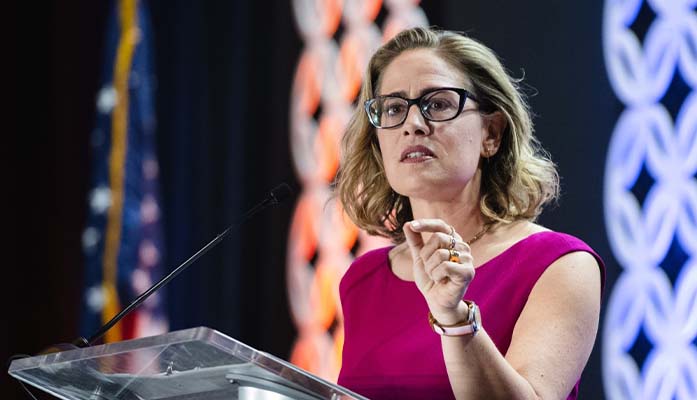
Former Senator Kyrsten Sinema claims she’s not a lobbyist, but her emails tell a different story.
Emails uncovered by FOIAzona revealed Sinema’s lobbying for a major new AI data center in Chandler.
When Sinema joined Hogan Lovells, global law and lobbying firm, as senior counsel back in March, she told reporters she wasn’t registering as a lobbyist. Sinema is also an advisory council member for Coinbase Global, a cryptocurrency company; and president and CEO of Arizona Business Roundtable.
Federal law requiring a “cooling off” period for former representatives and senators doesn’t apply to lobbying at local levels — only lobbying in Congress.
The federal lobbyist system doesn’t have Sinema registered. However it does have the registration of Hogan Lovell’s policy advisor: her former congressional aide, Daniel Winkler.
Emails revealed that Sinema met with Chandler council members in mid-June to discuss the data center. Following that meeting, Sinema used her Hogan Lovells email to push plan proposals for the data center to six city officials: a development agreement and a white paper advocating for AI data centers as an economic boon. Her emails to city officials were consistent thereafter.
“Single User – We demo the property and leave the front part open to attract the single use that [City Manager] Micah [Miranda] envisions. We build only the data center and the north building at the same time. R&D buildings along Dobson – We commence construction of these two eastern buildings within 18 months of C of O of data center. This gives Micah the time to attract a single user, but we still will process plans for these two buildings in the meantime to hit the 18 month mark. This leave the middle portion open to still attract a single user and build to suit. Full buildout – We commence spec construction of the middle building within 36 months of C of O of data center. This gives Micah the time to attract a single user, or a middle user but we still will process plans for all the buildings to hit the 36 month mark.”
Councilmember Matt Orlando then met with Sinema and Winkler in early August.
About a week later, Sinema was attempting to get the ear of another member of the council, Jennifer Hawkins.
In the days that followed, Orlando advised the city manager and economic development director that councilmembers were receiving constant communications about AI, and directed the pair to reach out to Sinema for possible development sites.
“We should not only look at the old Northrop Grumman site, but at the airport and other areas of our community for many AI clusters,” said Orlando. “We need to look at the economic model of such complexes. Please get with Kirsten [sic] Sinema, our existing companies and others in the industry and get us some ideas for a truly strategic plan to position our city for the future.”
The city’s economic development director advised in September that there wasn’t “any definitive cause relationship” between AI data centers and the desired location site for companies.
Then came the widely reported day in mid-October when Sinema argued for the data center at the Chandler Planning and Zoning Commission meeting.
It was there that Sinema threatened to use the power of the Trump administration against the city should they not approve the data center.
“[My coalition] works hand-in-glove with the Trump administration as we prepare for AI American dominance,” said Sinema. “We all know that the innovation campus has been vacant for over seven years. What I’d like you to know today is this: if we choose not to move forward with this development, the land will continue to sit vacant until federal preemption occurs.”
Sinema argued on behalf of the data center developer Active Infrastructure. She presented herself as the founder and co-chair of the AI Infrastructure Coalition (AIC), which formally launched with a swanky D.C. party last month.
AIC members include Andreeseen Horowitz, Cisco, ExxonMobil, Google, Lumen, Meta, Microsoft, and Pinnacle West. AIC’s executive director, Brian Walsh, formerly led the Congressional Leadership Fund and America First Action.
The Chandler City Council voted 7-0 against the data center in their meeting on December 11.
AZ Free News is your #1 source for Arizona news and politics. You can send us news tips using this link.
by AZ Free Enterprise Club | Oct 15, 2025 | Opinion
By the Arizona Free Enterprise Club |
What’s most likely to get your local officials fired up to fight for you? Lower utility rates? Wrong. Removing sexually explicit material from our libraries? Nope. How about just filling potholes in our roads? You’d think so. But what really gets the local officials in Chandler going is making sure they can sit on city council or as mayor longer.
Proposition 410, a local ballot measure, seeks to amend the city charter’s term limit section to extend the term for how long councilmembers and the mayor can serve. The measure is particularly problematic because it directly benefits a sitting councilmember, Matt Orlando, allowing him to run for mayor in 2026 without interruption after finishing his second consecutive council term. This proposition is not about reigning in political power; it’s about conveniently clearing the path for one councilmember to extend his political career. If it doesn’t pass in November, Orlando will face issues being elected mayor after his stint on the council, and clearly, he can’t have that.
The current city charter provision essentially says that one person can serve no more than two consecutive terms as councilmember, mayor, or a combination of both, and must wait four years before running again for either office. Therefore, someone can only serve two consecutive terms total.
However, some argue this language is ambiguous, allowing for another interpretation, one that allows a person to serve up to sixteen consecutive years: eight as a councilmember and eight as mayor. This interpretation has been the practice in Chandler for the past three mayors. Kevin Hartke, Boyd Dunn, and Jay Tibshraeny each served eight years as councilmembers and eight years as mayor – sixteen consecutive years.
The proposed language change on the ballot effectively attempts to legitimize the last three mayors by expanding the term limits in the city’s charter. It now states that a person can serve up to two consecutive terms as councilmember and two consecutive terms as mayor, sixteen years total. After reaching either limit, or a combined sixteen consecutive years in both offices, they must wait four years before running again for either position.
Why the rush for a change?
>>> CONTINUE READING >>>
by Charlotte Golla | Oct 10, 2025 | Opinion
By Charlotte Golla |
Chandler, Arizona, has a special election coming up on November 4, 2025. If you’re a resident, keep an eye on your mailbox. Ballots were mailed to voters on Wednesday, October 8, 2025.
One matter on this year’s special election ballot seems rather innocuous—Proposition 410—Charter Amendment Clarification of Term Limits for Councilmembers and Mayor.
At first glance, this appears to be a simple clarification of murky language in an outdated city charter. The current city charter states: “No person shall be eligible to be elected to the office of councilmember for more than two consecutive terms, or to the office of mayor for more than two consecutive terms or to more than a consecutive combination of the same.”
Simply put, candidates can hold office for two consecutive terms and then must sit out four years before running again. This language, however, poses a major problem. The past three Chandler mayors all served 8 years (two terms) on city council and then served 8 years (two terms) as mayor. This is in violation of the charter as it is currently written.
This all came to light in May of this year. Matt Orlando, a current 2-term Chandler city councilmember who filed a statement of interest to run for mayor in 2026, was quoted as saying, “It’s all how we interpret the charter – Bottom line is this: there is some clarity that is needed to fix the charter language.”
There was some debate at the subsequent city council meetings about whether this should be fast tracked to the November 4th special election ballot or tabled for community discussion and then voted on in 2026. The council ultimately voted 6-1 in favor of clarifying the charter language to, in essence, EXTEND the term limits from 8 years in office at city level to 16 years in office at city level. As currently written, an individual could not run for mayor after two terms on city council without a legitimate legal challenge.
This all sounds pretty boring, right? I certainly thought so. The last three Chandler mayors all served 16 years—8 on council and 8 as mayor. And Chandler is one of the best run, most financially solvent cities in Arizona. So, who cares?
Then I started seeing the signs—VOTE YES ON PROP 410 – KEEP CHANDLER TERM LIMITS (emphasis added).
Wait…am I confused? Isn’t a yes vote intended to get rid of the current term limits and extend them to 16 consecutive years at city level—8 on council and 8 as mayor?
After seeing the signs, I went home and did some research. And I was right. A yes vote most certainly does NOT keep term limits as written. It extends them. So, then I made some phone calls, specifically asking if it is legal to lie on campaign signs. And guess what? IT IS LEGAL TO LIE ON CAMPAIGN SIGNS. Whoa. I just went from a whole level of not caring to being very perturbed.
Why the lies? What is going on? And who is behind the YES ON PROP 410 campaign? If we are being outright lied to on campaign signs up all over the city, these are questions we should be asking. And I am asking them.
I’m not sure who is behind it, but I do know that Councilmember Matt Orlando, who plans to run for mayor in 2026, has made it clear that he fully endorses the Yes on 410 messaging. And interestingly enough, he would be the one who would benefit the most from its passage.
Do we really want a city leader who knowingly misleads his constituents for personal gain?
I know I don’t.
Charlotte Golla is Chandler resident of 20 years, wife and mother of four children, fundraising consultant, and concerned citizen.