by Elizabeth Troutman | May 16, 2024 | News
By Elizabeth Troutman |
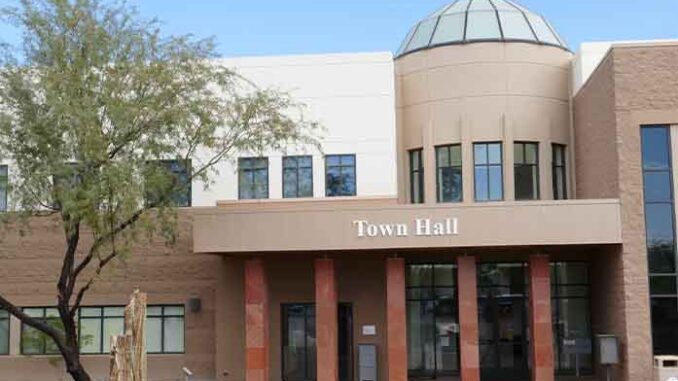
The Fountain Hills Town Council adopted its tentative budget plan for the upcoming fiscal year on a 6-1 vote May 7.
The council decided to set the budget at the maximum expenditure amount allowed under law, $45.1 million.
“Fountain Hills need to save some money and do more road repairs,” Councilman Allen Skillicorn said. “Last night the Liberal Ladies majority of council refused to cut just $1 from their ‘spend to max’ 2025 budget.”
Skillicorn, a Republican, suggested cutting 3% or $1.35 million from that budget to fund road repairs. The motion failed to receive a second. Skillicorn made a follow-up motion to cut the budget by just $1. This motion was seconded but failed three votes to four.
Voting to cut the budget were council members Gerry Freidel, Hannah Toth, and Skillicorn.
Mayor Ginny Dickey and council members Peggy McMahon, Sharron Grzybowski, and Brenda Kalivianakis voted against cutting just $1 from the budget.
“Four big spending Liberal Ladies voted for the maximum under law budget and could not cut just $1,” Skillicorn said. “If we cannot cut the budget by just $1 to fix roads, one wonders how Dickey, McMahon, Grzybowski, and Kalivianakis plan to fix our roads.”
Fountain Hills is a town in Maricopa County, Arizona with a population of roughly 24,000.
Elizabeth Troutman is a reporter for AZ Free News. You can send her news tips using this link.
by Dr. Thomas Patterson | Apr 26, 2024 | Opinion
By Dr. Thomas Patterson |
Joe Biden loves to give away money, especially if it’s not his own. He has spent trillions of dollars for political benefit that didn’t need otherwise to be spent.
The recipients laud his compassion and generosity. Common Americans though are trapped in an inflationary spiral while our grandchildren face an unpayable bill.
Thus, in a recent presentation about his second attempt to forgive student loan debt, he actually bragged about the hundreds of billions it would cost. He twice mentioned the fact that many blacks would receive benefits.
He became so consumed in self-congratulation that he apparently lost awareness of how blatant his political pandering was. We know black voters are a key demographic in play in the upcoming election.
Biden’s sheer enthusiasm for spending again evidenced itself in his response to the Baltimore bridge collapse. His first reaction was to guarantee that the federal government would underwrite the entire cost of reconstruction. What a guy!
Neither offer made sense. Regarding the student loan debt, the Supreme Court had affirmed that the Constitution means what it says, that the power to initiate spending lies solely with Congress. Most public criticism focused on the obvious unfairness of the policy, how it would disadvantage those who had been responsible in favor of those who wished to renounce their legal obligations.
Biden’s bridge proposal was also nonsense. The bridge isn’t owned by the United States. There is no conceivable reason for the federal government to be deemed responsible for its repair. The bridge was demolished by a cargo ship, in an industry which insures heavily against such misfortunes. Other jurisdictions have also acknowledged partial responsibility.
Here’s the problem with the mindset that it’s okay to get involved with all these giveaways: we don’t have the money. We’re seriously in debt, with expenses vastly exceeding our income and no plan in place for repayment or even deficit reduction.
Biden is hardly the only politician who has deduced that spending other people’s money (OPM) can win elections. Even many Republicans, to their shame, support the spending juggernaut. The spenders are the moral equivalent of a wastrel with no money and no job, with bankruptcy looming, who continues to pick up tabs and buy pricey gifts with credit cards he has no intention of paying off.
Still, the spenders know that Americans have mostly normalized excessive spending even when unnecessary. So, Biden was able to propose a whopping $7.3 trillion budget for next year (up $500 billion in the last year alone) without provoking much outrage.
The $2 trillion spent on COVID relief accomplished nothing. It was mainly an excuse to push more money out the door. At least it was supposed to be temporary. Biden’s budget though would pocket the COVID bump and add yet more permanent spending, mostly on programs for “climate change” and other boondoggles. A $10 trillion budget by 2033 is projected.
What can’t go on forever won’t. Our present course is unsustainable. Income tax revenues are soaring, yet the debt continues to grow. We are using borrowed money to pay the debt interest, which has surpassed all budget items except entitlement programs.
How do we get out of this death spiral? The left’s favorite solution is to raise taxes. That doesn’t work. The historical record shows that tax increases put us further in the hole.
For example, the Obamacare tax increases raised $1.4 trillion but so hindered economic growth, according to the Congressional Budget Office, that the feds lost $3.8 trillion in revenues. In contrast, President Clinton signed the 1997 Republican tax and spending cuts. Four years of budget surpluses ensued.
It’s well known that reform of Medicare, Medicaid, and Social Security is necessary for a balanced budget. Yet both parties are interested only in demagoguing the other if they catch them even considering the issue. If the politicians, including Donald Trump, continue to insist on prioritizing incumbent reelection, the only way out may be for the people to take matters into our own hands.
Anybody else interested in seriously revisiting the notion of amending the Constitution to mandate a balanced budget? Sure, it may (or may not) be difficult, but the consequence of doing nothing is surely worse.
Dr. Thomas Patterson, former Chairman of the Goldwater Institute, is a retired emergency physician. He served as an Arizona State senator for 10 years in the 1990s, and as Majority Leader from 93-96. He is the author of Arizona’s original charter schools bill.
by Daniel Stefanski | Jan 17, 2024 | News
By Daniel Stefanski |
Partisan lines have been drawn over the Arizona Governor’s Executive Budget Proposal for Fiscal Year 2025.
Late last week, Democrat Governor Katie Hobbs released her second budget for the Grand Canyon State. In a statement accompanying the announcement, Hobbs said, “Arizonans are counting on us to make the state we call home the best place to live, work, and raise a family. We made incredible progress during my first year in office, and my Executive Budget proposal builds on this foundation and expands opportunities for every Arizonan to reach their full potential. We are cutting out the wasteful taxpayer spending while making critical investments that will help middle class families buy a home, expand access to childcare, make prescription drugs more affordable, and protect disabled Arizonans and seniors. This is what it looks like to invest in our communities and build a state that works for every Arizonan.”
Legislative Republicans were quick to come out in opposition to the governor’s proposal. Senate Appropriations Chairman John Kavanagh wrote, “These elements in her proposal are dead on arrival with the Republican Majority. Her grandstanding of bipartisanship during her State of the State Address is a far cry from the reality of this budget proposal, as her funding cuts strictly target Republican priorities.”
House Appropriations Chairman David Livingston added, “Like last year’s proposal, the governor’s budget is an unserious mess. Her revenue and enrollment predictions don’t reflect reality, and her solution to the deficit proposes cuts to K-12 and water investments. We understand most of this is meant to appeal to her base. When she is willing to engage more seriously, Republicans are ready.”
Hobbs’ allies in the Arizona Legislature supported her proposal. House Democratic Leader Lupe Contreras released a statement, saying, “We applaud the Governor for producing a budget that protects the priorities that will drive our state forward and that our caucus has consistently championed for our communities – public education, affordable housing, childcare for working families and vital services for the most vulnerable Arizonans. She is listening and leading.”
The Senate Democrat Caucus posted, “This budget is a good first step in providing Arizona families with assistance in affording the high costs of childcare, housing, and prescription medications.”
In the inaugural week of the 2024 legislative session, Republicans and Democrats took political shots at one another over the budget in anticipation of the governor’s proposal. Arizona Senate President Warren Petersen accused his Democrat counterparts of “refusing to come to the table for budget negotiations,” threatening that his caucus might have to move on without them. The Senate Democrats Caucus clapped back at the Republican chamber leader, asserting that he had “moved forward on every other budget without Democrats, so this newest attempt at grandstanding falls flat.”
The early back-and-forth between the two political parties follows Democrat Governor Katie Hobbs’ second State of the State address, where she called on legislators to “find common ground” and to “work together to solve this gap.”
Both parties have vastly differing approaches to solving the state’s budget shortfall, though their rhetoric is somewhat similar at the start of the legislative session. In the Senate Republicans’ Majority Plan for 2024, they vowed to complete this mission “without irresponsibly tapping into the Rainy-Day Fund or using budget gimmicks,” promising instead to “use sound fiscal management strategies, like trimming unnecessary spending and prioritizing government’s top functions.” Hobbs stated that her soon-to-be-released budget would “rein in wasteful spending without sacrificing public safety and public education, establish guardrails on unaccountable programs without hurting hard-working families, and tighten our collective belts through increased efficiencies and innovation without gutting programs that support small businesses, seniors, and those in need.”
Last year, House and Senate Republicans approved a budget that was vetoed by Hobbs. Despite many partisan fights in the public eye between Republicans and the governor, Petersen and House Speaker Ben Toma deftly managed a surprise budget compromise, in which their policy priorities remained largely intact. Hobbs will be under increased pressure this time around to extract more concessions from Republicans – especially over the Empowerment Scholarship Account (ESA) program.
Daniel Stefanski is a reporter for AZ Free News. You can send him news tips using this link.
by Daniel Stefanski | Jan 13, 2024 | News
By Daniel Stefanski |
On Tuesday, Senate President Warren Petersen issued a press release, blasting his Democrat counterparts for “refusing to come to the table for budget negotiations.”
Petersen’s release revealed that the Senate Appropriations Chairman, John Kavanaugh, had transmitted two messages to Democrats – one on December 21, 2023, and the other on January 4, 2024. Those emails requested “input on which areas of government the Minority Caucus would prefer to reduce expenditures on, and which areas to prioritize continued funding for. According to Senate Republicans, not only have Kavanaugh’s emails gone without “response or acknowledgement,” but Petersen “was informed the Minority Leader is directing her Caucus not to engage with the Senate Appropriations Chairman on the budget.”
In a statement accompanying the news release, Petersen said, “It’s unfortunate we’re kicking off this legislative session with Senate Democrats playing games at the expense of our taxpayers. It’s time to be adults. We want all lawmakers to be at the table during budget negotiations, as the citizens of Arizona expect of their elected leaders, but we’ve heard nothing but crickets from the Minority Leader on her statutory obligation. We may have no other choice but to move forward without their input.”
The Senate Republican leader’s words hit a nerve with the chamber’s Democrats, who fired back through their “X” account, writing, “FOR IMMEDIATE RESPONSE: it’s day 2 of session. You’ve moved forward on every other budget without Democrats, so this newest attempt at grandstanding falls flat. The state’s revenue picture has gotten worse month over month, so you know it’s not fiscally responsible to make budget decisions prior to the next Finance Advisory Committee meeting.”
Senate Republicans corrected the record by reminding Democrats that they had “actually invited Democrats to the table last year as well.” The Republican Caucus shared an email from Kavanaugh from March 2, 2023, in which he extended an invitation to the Senate Minority Leader to “begin the process of discussing with you the budget priorities of the Senate Democratic Caucus.”
The early back-and-forth between the two political parties follows Democrat Governor Katie Hobbs’ second State of the State address, where she called on legislators to “find common ground” and to “work together to solve this gap.”
Both parties have vastly differing approaches to solving the state’s budget shortfall, though their rhetoric is somewhat similar at the start of the legislative session. In the Senate Republicans’ Majority Plan for 2024, they vowed to complete this mission “without irresponsibly tapping into the Rainy-Day Fund or using budget gimmicks,” promising instead to “use sound fiscal management strategies, like trimming unnecessary spending and prioritizing government’s top functions.” Hobbs stated that her soon-to-be-released budget would “rein in wasteful spending without sacrificing public safety and public education, establish guardrails on unaccountable programs without hurting hard-working families, and tighten our collective belts through increased efficiencies and innovation without gutting programs that support small businesses, seniors, and those in need.”
Last year, House and Senate Republicans approved a budget that was vetoed by Hobbs. Despite many partisan fights in the public eye between Republicans and the governor, Petersen and House Speaker Ben Toma deftly managed a surprise budget compromise, in which their policy priorities remained largely intact. Hobbs will be under increased pressure this time around to extract more concessions from Republicans – especially over the Empowerment Scholarship Account (ESA) program.
Daniel Stefanski is a reporter for AZ Free News. You can send him news tips using this link.
by AZ Free Enterprise Club | Jan 6, 2024 | Opinion
By the Arizona Free Enterprise Club |
After several years of inflated budgets propped up by trillions in unsustainable COVID cash flowing to the states from the federal government, Arizona lawmakers will be coming into the new year and the new legislative session facing a potential shortfall for the budget year in excess of $400 million. Naturally, the left and their sycophants in the media have for months been decrying this to be the result of 1) historic tax cuts enacted by Republicans in 2021 and 2) the successful universal expansion of school choice in 2022. This couldn’t be further from the truth, and there are three key facts that need to be remembered when discussing the state budget and a potential funding gap.
1. The Shortfall Is a Fraction of the Arizona Budget, Nothing Like California’s Crisis
The projected $400 million shortfall represents less than 5% of the total state budget, which spends $17.8 billion this year. Far from catastrophic. Compare this to our neighbor California, facing a $68 billion dollar deficit (nearly four times the size of our entire budget), which represents 22% of their $308 billion bloated budget – up from less than $200 billion only four years ago.
Opposite to our approach, California has continuously increased taxes, having one of the highest income tax burdens in the country. They also don’t provide choice to parents and families to make educational decisions themselves. Surely, if Arizona taking less of the people’s hard-earned money and providing ESAs to all families is the cause of our small funding gap, California, doing the exact opposite, should place them in tip top shape, right?
>>> CONTINUE READING >>>