Last Tuesday, hundreds of concerned Gilbert citizens enlivened a town council study session with vocal opposition to funding any rail project — not even a survey.
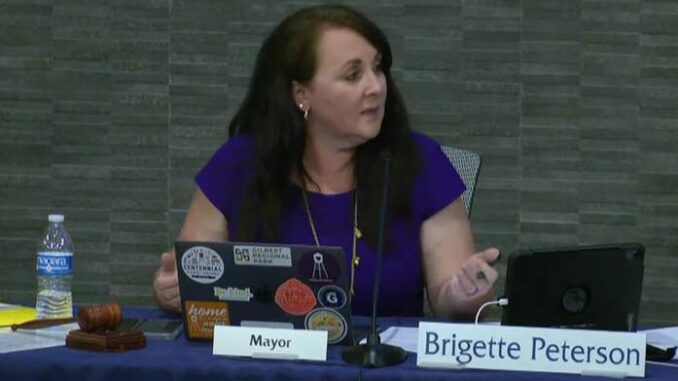
Most of the council expressed confusion about the citizens’ discontent, denying intent on establishing a commuter rail in the town. Councilwoman Kathy Tilque stated repeatedly that there were no plans to bring a commuter rail to Gilbert, and that it probably wouldn’t ever happen. Mayor Brigette Peterson and councilmembers Scott Anderson, Yung Koprowski, and Scott September echoed Tilque’s sentiment throughout the study session, which neared two hours.
“I’m just trying to figure out why we have so many upset people thinking we’re spending taxpayer dollars to bring a commuter rail here,” said Tilque.
Earlier this year, the council proposed a $289,000 consulting contract for a feasibility study on establishing a commuter rail. Council discussion on the subject revealed similar divisions that persisted in last week’s discussions.
When Peterson repeated that Gilbert hasn’t issued plans to build a commuter rail, the citizens shouted “Lies!” Peterson insisted she was telling the truth, further claiming that Gilbert wouldn’t have any say over the establishment of a commuter rail on existing rail lines. Vice Mayor Aimee Yentes rebutted that the town’s actions over the years conflicted Peterson’s claim.
Yentes told AZ Free News that the council’s denial of commuter rail planning was “semantics,” pointing out a February 2018 development agreement, Resolution No. 3955, that Peterson signed onto while a councilwoman. That development agreement described the possibility of a light rail as well as a commuter rail, further conflicting with another one of Peterson’s claims in a July statement that the term “light rail” was used by outside groups and individuals, and that “there are no plans, discussions, or any considerations to construct or extend a light rail” to Gilbert.
The development agreement further noted that the town of Gilbert would be responsible for the cost of future development of a transit station at Cooley Station Village Center. According to a 2018 study on commuter rails conducted by the Maricopa Association of Governments (MAG), nearly all commuter rails require a dedicated local sales tax to operate.
During the study session, Yentes asserted that the community’s discontent stems from the council’s unwillingness to take a definitive stance for or against a commuter rail, not a misunderstanding over the town’s role as one of several decision makers on establishing a commuter rail.
“Clearly they’ve been planning for it. They’ve done studies. They’ve dedicated transit stations. They’ve entered into a development agreement that tried to bind us to it. There’s lots of things that Gilbert can do to either plan to do it or be a thorn in their side,” said Yentes.
Yentes proposed an ordinance to prohibit the use of town resources for the furtherance of commuter and light rail development. That would also prohibit additional taxes and application of funds to carry out related studies. It will be voted on during next Tuesday’s town council meeting.
Yentes warned that the city of Phoenix’s commuter and light rails “cannibalized” their transportation budget to the extent that the city couldn’t fix potholes, prompting citizens to pass an additional sales tax in 2017 to cover those expenses.
Tilque called Yentes’ proposed ordinance “dishonest representation” since future councils may overturn it. However, that’s something that new leadership may do at any given time with any ordinance, which Yentes pointed out.
One citizen, Brandon Ryff, told AZ Free News that Tilque’s opposition to the ordinance came across as doubting citizens’ intelligence. Ryff expressed frustration over the conflict between Peterson’s remarks and actions concerning a commuter rail, citing the 2018 development agreement.
Ryff also criticized commuter rails as outdated, “19th-century” technology, pointing out the consistent drop in ridership throughout major cities in Arizona and other states. He contrasted the decline in ridership with the consistent uptick in crime. In Phoenix, crime rates have nearly doubled since 2016; a majority of those crimes were aggravated assault and drug offenses.
“We laugh at it and say that [a commuter rail] looks like a solution looking for a problem,” said Ryff. “For whatever reason and whatever motivation, our town council is defying all logic concerning crime statistics and progress. I can’t help but feel this is related to money from somewhere. Someone is influencing these people to behave this way. It just doesn’t make sense.”
Another citizen, Tyler Farnsworth, remarked to AZ Free News that their opposition was a positive example of engaged citizenry, yet most of the council portrayed it as a negative. Farnsworth commended Yentes’ proposed resolution barring their tax money from funding town rail projects.
“The Mayor and several members of the Council were visibly and vocally annoyed that citizens chose to show up and speak their mind,” said Farnsworth. “We just want to be heard. We want our tax money to be spent wisely. I hope the meeting was a wake up call to this Council. We are watching. Welcome to democracy in action.”
Watch the study session below:
Corinne Murdock is a reporter for AZ Free News. Follow her latest on Twitter, or email tips to corinne@azfreenews.com.
Gilbert awarded a $17,000 contract for a survey to a political consulting firm that Mayor Brigette Peterson used during her election campaign last year. During the campaign, Peterson paid a total of $9,530 to the firm, Camelback Strategy Group, for consulting and social media services.
Camelback Strategy Group doesn’t have any public record or advertisement of surveys completed prior to the one conducted for Gilbert. The closest thing that the firm offers to surveys is through their affiliated – but independent – company, Grassroots Advocates. However, that company only offers political data and strategy services like voter contact, door to door canvassing, phone-banking, sign set-up and delivery, signature gathering and validation, tracking and blocking – and according to email records obtained by AZ Free News, Grassroots Advocates didn’t complete the survey. Camelback Strategy Group did.
It is unclear how Camelback Strategy Group came to be selected to conduct the survey. Peterson’s spokesperson told AZ Free News that the mayor wasn’t involved with the transportation bond poll conducted.
We also reached out to Camelback Strategy Group for comment. They didn’t respond to AZ Free News by press time.
The survey was conducted through a phone poll. Based on email records between Camelback Strategy Group Partner Chad Heywood and Deputy Town Manager Leah Hubbard, the survey canvassed approximately 350 Gilbert residents and took about a week to complete.
The survey was completed about 6 weeks prior to the council vote on whether to place the transportation bond on the ballot. The council voted in favor of the transportation bond at the beginning of June, 5-2. Council Members Aimee Yentes and Laurin Hendrix both voted against the measure.
Although the council vote on the bond occurred over two months ago, the fact that the mayor’s political consulting firm received around $17,000 to conduct a survey stood out to constituents enough for it to be discussed during Tuesday’s council meeting.
Public commentary tied the $17,000 survey to the several open investigations against Peterson concerning issues like work environment and ethics complaints.
One resident, Jim Torgeson, said he was disappointed with the council for not holding Peterson accountable.
“Judgment includes those multiple ethics complaints, optics of favoritism – with no efforts to correct those – optics of racism, the optics of quid pro quo, the optics of hostile work environments, the optics of a poorly-run high school clique council. The mayor won’t fix it. I’m asking you to fix it,” said Torgeson. “The last thing I need to think of is that people are awarded contracts because they’re political consultants that worked on the mayor’s campaign, awarded $17,000 to do a phone poll. A phone poll, and they don’t even do phone polls.”
The public became further incensed when Peterson opened discussion on a proposal to overhaul public commentary protocols. Instead of 3 minutes for every person with up to 15 minutes of speaking time unless the council decides on an extension, the mayor proposed that she should be the sole decision-maker on who could speak and for how long.
The mayor’s opponent, Matt Nielsen, spoke up about this proposed rule change during the meeting. He reminded the council that America is still a constitutional republic, and said that the mayor was trying to control public commentary because of the ongoing investigations against her.
“The fact that [this proposal] has come before the council at all is further evidence that Mayor Peterson is more committed to the preservation of her own public image in light of multiple recent alleged ethics violations than she is with the American ideal of civic engagement in government,” stated Nielsen. “It’s a terrible look for our town’s top elected official to allow a consolidation of power to herself relative to the speech of Gilbert citizens when she is under heavy scrutiny for multiple serious allegations.”
The council members questioned Peterson’s intent and rationale for introducing the rule change.
Peterson responded that the proposal wasn’t borne out of “malicious” intent, but that she was simply trying to rewrite the code to match years of council operations. Despite her explanation, the council didn’t appear to back the proposed changes as written.
Council members motioned to table the proposed rule change.
Questions have been raised about a private law firm’s handling of a campaign finance violation investigation involving the Town of Gilbert’s recent mayoral race, while others are asking why the law firm was involved in the first place.
Last week an attorney with Fitzgibbons Law Offices reported to Gilbert Town Attorney Chris Payne that legal sufficiency does not exist to establish a violation of state election law with respect to dozens of campaign-related signs, despite a finding by the Phoenix City Clerk earlier this year of “reasonable cause” to believe a campaign finance violation occurred.
The law firm’s decision appears to have been made without reviewing bank records of the parties involved nor speaking to additional witnesses, a fact not sitting well with many in Gilbert and Maricopa County who support election integrity.
On Nov. 11, 2020, the Town of Gilbert received a complaint related to dozens of signs put up around town that were critical of Matt Nielsen, who lost to former city councilwoman Brigette Peterson in a mayoral runoff race.
Based on citizens’ statements and a private investigator’s report, none of the signs included “paid for by” or “authorized by” verbiage. Nielsen filed a campaign violation complaint alleging the Public Integrity Alliance Committee, headed by Tyler Montague, was involved with the anti-Nielsen signs. Public records show the committee was actively involved in supporting Peterson’s campaign.
The City of Phoenix handled the initial phase of the violation review to avoid the conflict of interest of having Gilbert town staff involved. In February, the Phoenix City Clerk announced there was “reasonable cause” to believe a campaign finance violation was committed in connection to the signs that Montague admitted paying for in cash and picking up at a print shop.
The second phase of the campaign finance complaint would normally have involved Town Attorney Chris Payne reviewing the reasonable cause report from the City of Phoenix in order to determine which state law had been violated.
However, town officials once again declared a conflict because Payne and his staff work at the pleasure of the town’s mayor and council. Instead of asking the Phoenix City Attorney or the Maricopa County Attorney’s Office to handle the second part of the investigation, town officials hired a private law firm to do the work; a law firm which needs to rely on Peterson’s approval for future business with the town.
During its investigation, attorneys for Fitzgibbons had access to a statement Montague provided the City of Phoenix in which he described seeing several of signs laying on the ground while driving by a polling place at the Gilbert Recreation Center on Nov. 3, Election Day.
According to Montague’s statement, he replaced four or five of the signs even though he did not originally place those signs. He also said he saw a woman remove the same signs he had just replaced and told her it was illegal to take down political signs without authorization.
The woman previously told a private investigator that the man told her she was committing a misdemeanor and she should not touch” his” signs. The man was identified as Montague through his license plate. He told the Phoenix clerk that his activities were not an operation of the Public Integrity Alliance Committee.
Once retained, a Fitzgibbons attorney issued a subpoena in March to the print shop where the anti-Nielsen signs were printed. In response, an invoice in Montague’s name was provided by the printer, who said Montague ordered and paid for the signs with $500 cash.
A subpoena was also issued to Montague seeking “all information related to the purchase of any signs pertaining to the 2020 election for the Mayor of the Town of Gilbert that reference Matt Nielsen. Such information shall include, but not be limited to, the name and contact information for any vendor that made such signs, purchase orders, receipts, wording included on the signs and any images of the signs.”
Montague replied again that the anti-Nielsen signs were not funded by himself or the Committee. He explained that the printer’s invoice ended up in Montague’s name only because he “volunteered to pick up those up for a friend who funded them. Public Integrity Alliance was not involved in any way.”
It should be noted that the invoice numbers for both Public Integrity Alliance’s sign purchases, as well as the order numbers for both purchases are sequential, indicating that the signs had been ordered at the same time and paid for at the same time.
In a July 6 report to Payne, Fitzgibbons attorney Tina Vannucci noted that ARS 16-925(A) states a “person that makes an expenditure for an advertisement or fund-raising solicitation, other than an individual, shall include [certain] disclosures in the advertisement or solicitation…”
Vannucci noted “there is not legal sufficiency” to establish that Montague acted in his capacity as President of the Committee, or on behalf of the Committee, or that the Committee purchased the signs at issue in the Complaint which were not properly labeled.” And because the statute specifically exempts individuals from the “paid for by” or “authorized by” language, if Montague was responsible for the signs at his own volition then he cannot be charged with the violation.
What is not mentioned in the Fitzgibbons report is whether Montague was asked who the “friend” was in the event that person was acting on behalf of a committee or other organization. In addition, there was no subpoena issued for bank records belonging to Montague and the Public Integrity Alliance Committee which may have revealed whether Montague received or requested reimbursement or petty cash for the anti-Nielsen signs.
The next meeting of the Gilbert town council has not been confirmed. It is unclear whether any formal action on the campaign complaint is necessary by the council, although the town will have to approve a bill at some point from Fitzgibbons for legal services.