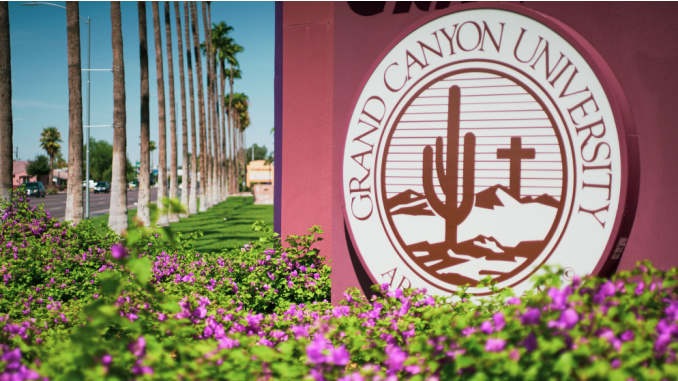
In October 2023, the U.S. Department of Education (DOE), under the Biden-Harris Administration, imposed a staggering $37 million fine against Grand Canyon University (GCU) in Phoenix, the largest privately owned Christian University in the nation. The fine came without revealing any serious complaint against the school. In February 2024, the Goldwater Institute announced that it advanced a lawsuit to determine why such a massive fine was levied. Now, a hearing has been scheduled in the case for April 18th.
Acoording to the Goldwater Institute, the DOE claimed that GCU “violated federal disclosure rules regarding continuing education courses for PhD students.” GCU leaders deny this outright. Further, in a press release regarding the fine, the DOE declined to include any complaints from students or members of the public to support its regulatory action.
When a federal judge in the U.S. District Court hears arguments in Goldwater Institute v. U.S. Department of Education, Goldwater hopes to compel the federal agency to disclose the alleged violation(s), which it believes are particularly suspicious. According to Goldwater, a public statement from Biden’s Secretary of Education Miguel Cardona vowed to “shut down” GCU.
Adding doubt to the DOE’s allegations, as Goldwater notes, GCU reportedly hasn’t raised tuition in over 15 years. The manner in which the fine was announced was also suspect with Goldwater noting, “The Department also announced its unprecedented fine with a widely reported press release that was heavy on rhetoric and bereft of any serious complaints from students or the public. It also appears that the fine was assessed in conjunction with suspicious coordination among various federal agencies.”
According to Goldwater, efforts through a Freedom of Information Act (FOIA) request to determine the motivation behind the fine have gone unanswered, leading up to the complaint.
“The request seeks emails between key individuals of the Department and other federal agencies that discuss the Department’s fine against GCU. The records may help inform the public about this extraordinary fine, as well as coordination between various federal agencies in what appears to be the intentionally targeting of a successful university based on extraordinarily thin allegations. However, the Department has refused to produce the records requested and has failed to otherwise comply with the FOIA.”
As reported by AZ Free News in February 2024, Goldwater staff attorney Stacy Skankey explained, “With its motto of ‘private, Christian, affordable’ and its track record of graduating students into high-demand and high-paying jobs, GCU is a success story by any metric. And it stands apart from universities across the country that are facing declining enrollment, that are indoctrinating students with radical politics, and that are under attack for failing to defend the First Amendment.”
In an op-ed for the Washington Times in December, Jon Riches, Goldwater Institute Vice President for Litigation, wrote, “As the Trump administration prepares to tackle an ambitious education agenda, ending the shameful attack on GCU should be a top priority. This would not only correct the injustice done to GCU but also make clear the broader principle that higher education should be a domain of innovation and student achievement — not a fiefdom for ideological conformity and bureaucratic rule.”
The initial action was brought by the Goldwater Institute during the Biden Administration and saw little to no response from former Secretary of Education Miguel Cardona. Though confirmed by neither party, the hearing had initially been delay and could be reflective of the whirlwind of changes at the DOE under Trump Administration.
The upcoming hearing could present a departure from the DOE’s previous position on the GCU fine, or at minimum provide transparency that was lacking under the previous administration.
President Donald Trump’s opening week included a flurry of executive orders seeking to make good on his promise to restore America’s energy dominance, sidelined by the Biden administration.
While we should all applaud the president’s vision for a secure energy future, Californians should be especially pleased. Even before taking office, the “Trump effect” helped restore a bit of sanity in the Golden State.
Five days before President Trump’s inauguration, the California Air Resources Board (CARB)rescinded its application for a waiver from the Environmental Protection Agency to extend its electric vehicle mandate to freight trains, citing “uncertainty presented by the incoming administration.” The first-of-its-kind regulation would have phased out diesel-fueled switch, industrial, and passenger trains by 2030 and freight trains by 2035 in favor of zero-emission trains.
Though now paused, CARB’s rationale for the rail electrification mandate mirrors broader green energy policies, and California will likely seek to revive it under a future Democratic administration. They shouldn’t.
CARB claimed the rule would be a net economic and environmental benefit, but ignored major costs. A report from my organization highlighted the substantial infrastructure upgrades needed to replace diesel engines with electric or hydrogen models. Further, transitioning to electric trains would have challenged the state’s already strained electricity grid. Lastly, the report shows that the emissions reductions CARB touted were greatly exaggerated.
California already has the highest electricity prices in the continental U.S. With more and more devices connecting to the grid, demand is expected to grow by 76% over the next couple of decades.
At the same time, California’s grid has become increasingly unreliable due to policies that force more and more renewables onto the system, exacerbating the risks of continued brownouts and blackouts.
The conversion of rail to zero-emission technologies that rely heavily on electrification would contribute to these problems. The CARB rule assumed the existence of energy infrastructure that simply does not exist.
New transmission and distribution line upgrades and incremental power generation would be necessary to accommodate the load growth necessary to comply with this mandate. Much of that new electricity generation would likely come from natural gas, which already accounts for 39% of the state’s electricity.
CARB’s claim that the switch to electric trains would reduce particulate matter by 7,400 tons, nitrogen oxides by 386,300, and greenhouse gas emissions by 21.6 million metric tons from 2023-2050 is questionable at best. There is no way that power systems, even in California, will be 100% renewable in the timeframe the rule was scheduled to take effect.
And, as already mentioned, new generation capacity would certainly include natural gas.
CARB’s suggested that hydrogen could serve as an alternative to electrification. This switch would also require additional upstream infrastructure, increase costs, and put upward pressure on emissions.
This new hydrogen would not even be “green,” since production from non-conventional resources is nowhere near the scale of hydrogen sourced from natural gas or coal gasification. Developing hydrogen pipelines could also drive emissions and costs higher.
CARB’s locomotive regulation was a high-cost, low-reward gamble. Thanks to President Trump, Californians dodged another disastrous energy policy — before he even took office.
Instead of trying to “Trump-proof” California, Gov. Gavin Newsom should be grateful for the opportunity to scrap more of Sacramento’s costly regulations.
President Trump’s historic victory in the November election gave him a clear mandate from the American people. And so far, he hasn’t wasted any time getting to work. In his first month back in office, Trump signed 45 Executive Orders (EO) in an effort to put America first and undo much of the damage created by the Biden administration. And that’s especially true with his executive actions to unleash American energy.
Ending the Net Zero Climate Cult Fantasy
For four years under President Biden, the American people were forced to endure an administration that was hellbent on pursuing a net zero agenda. Across the country, they pushed these radical and costly climate action plans to fundamentally transform and restrict the energy options available to consumers. Along with this came calls from the Left to ban gas stoves, gas cars, gas-powered lawn equipment, and hundreds of other draconian ideas to limit the freedom of the American people.
If the high cost of these plans wasn’t enough, they have also proven to be unreliable. States and countries that have committed to energy sources like solar and wind as part of this net zero fantasy have experienced rolling blackouts, continually demand that their customers use less, and eventually have to make haste to open reliable sources of generation they had closed down. Isn’t that right, California?
But Trump’s Executive Order 14154 unleashes fossil fuel production and use in America while unwinding much of the damage caused by the Biden administration…
In an Executive Order signed by President Donald Trump on Thursday, newly confirmed Attorney General Pam Bondi has been handed a mandate to chair a new Justice Department Task Force to eradicate anti-Christian bias.
According to the White House, the task force is to include Bondi’s fellow cabinet members in addition to ”the heads of such other executive departments, agencies, and offices that the Chair may, from time to time, invite to participate.”
In the text of the order, the President cited the U.S. Constitution’s prohibition against government interference with the free exercise of religion and the Civil Rights Act of 1964’s protections against religious discrimination. He declared, “The previous Administration engaged in an egregious pattern of targeting peaceful Christians, while ignoring violent, anti-Christian offenses.”
🚨 President Trump announces that he will be signing an Executive Order to make Attorney General Pam Bondi the head of a task force to eradicate anti-Christian bias. pic.twitter.com/IaxhAGuDBZ
Trump added that, “The Biden Department of Justice sought to squelch faith in the public square by bringing Federal criminal charges and obtaining in numerous cases multi-year prison sentences against nearly two dozen peaceful pro-life Christians for praying and demonstrating outside abortion facilities.” He also referred to the arrest and prosecution of “a Catholic priest and 75-year-old grandmother, as well as an 87-year-old woman and a father,” for praying and singing hymns outside an abortion facility in protest, as well as an FBI memorandum that claimed “radical-traditionalist” Catholics were domestic-terrorism threats.
Trump also pointed to attacks against Christian churches and organizations noting, “At the same time, Catholic churches, charities, and pro-life centers sought justice for violence, theft, and arson perpetrated against them, which the Biden Department of Justice largely ignored. After more than 100 attacks, the U.S. House of Representatives passed a resolution condemning this violence and calling on the Biden Administration to enforce the law.”
Trump also laid “hostility and vandalism against Christian churches and places of worship,” at the feet of the Biden Administration noting “the number of such identified acts in 2023 exceeding by more than eight times the number from 2018.”
He also highlighted Biden’s Department of Education seeking to repeal religious liberty protections for faith-based organizations on university campuses and attempting to compel “Christians to affirm radical transgender ideology,” contrary to their beliefs via the Equal Employment Opportunity Commission, and drive them out of the foster-care system. Finally he pointed to the highly controversial declaration of a “Transgender Day of Visibility,” on Easter Sunday 2024, by the Biden Administration which drew widespread scorn.
In the text of the order, the President concluded, “My Administration will not tolerate anti-Christian weaponization of government or unlawful conduct targeting Christians. The law protects the freedom of Americans and groups of Americans to practice their faith in peace, and my Administration will enforce the law and protect these freedoms. My Administration will ensure that any unlawful and improper conduct, policies, or practices that target Christians are identified, terminated, and rectified.”
In a speech at the National Prayer Breakfast on Thursday, Trump told the gathered press that the task force’s mission is to “immediately halt all forms of anti-Christian targeting and discrimination in the federal government.”
“In addition, the task force will work to fully prosecute anti-Christian violence and vandalism in our society, and to move heaven and earth to defend the rights of Christians and religious believers nationwide,” he continued.
Congressman Eli Crane (R-AZ-02) announced the reintroduction of a bill to rollback and nullify Biden administration policies that flew in the face of the sovereignty of native American property owners and tribal governments.
The congressman explained the need for this corrective measure, saying in a press release, “Secretary Haaland and President Biden engaged in selective sovereignty driven by extremists with no concern for Navajo interests or the energy needs of all Americans.”
He continued, “I’m proud to reintroduce this bill that would invalidate the Biden admin’s meddlesome ban. Together, with the Trump Administration, I’m confident we will be able to advance tribal interests, unleashing energy sovereignty and prosperity.”
The bill was drafted in reaction to a 2023 Public Land Order that banned the resource development of 336,404.42 acres of federal mineral estate surrounding the Chaco Canyon National Historical Park until 2043, barring Navajo citizens allotted the land from profiting from any possible mineral leases.
At the time, Navajo Nation Council Speaker Crystalyne Curley said, “The Navajo Nation attempted to compromise by proposing a 5-mile buffer as opposed to the 10-mile,” as reported by Cactus Politics. However, she continued, “The Biden Administration has undermined the position of the Navajo Nation with today’s action and impacted the livelihood of thousands of Navajo allotment owners and their families.”
Rep. @EliCrane_CEO has introduced legislation reversing a Biden Administration ban on mineral leasing land in Chaco Canyon, allowing the Navajo Nation to invest in energy development.
The Energy Opportunities for All Act would nullify and negate Public Land Order No. 7923, thereby declaring the restrictive order to “have no force or effect.”
During the 117th Congress, the House Committee on Natural Resources voted to bring the bill to the floor in a bipartisan decision after Navajo Nation President Buu Nygren offered his testimony in committee. Nygren said, “I appreciate Rep. Eli Crane for introducing this piece of legislation. The Navajo Nation continues to be an energy-producing tribal Nation. I support the Navajo people having a say in how their land and minerals are developed. In this case, the Navajo allottees have an important right to have their voices heard.”
Politico reported Friday that the Navajo Nation is also pursuing a route through the courts to fight the Biden administration’s action through a lawsuit filed in New Mexico Federal Court.
In the complaint filed in the U.S. District Court, the Navajo Nation argued, “From the very beginning of this process, Defendants have single-mindedly pursued an exact ten-mile buffer without sufficient analysis or explanation of why that particular number was chosen or how it relates the actual topography and geology of the landscape or the location of the Chacoan sites.”
The tribal leaders went on to allege that the Department of the Interior, under the previous administration, made the controversial decision without consultation from the tribe’s members to address the economic consequences to communities already beset by financial struggle.