by Corinne Murdock | Jul 20, 2022 | News
By Corinne Murdock |
Arizona was ranked the worst state to live in based on its quality of life and inclusivity scoring by one of the biggest news outlets in the country. Its weaknesses that gave it the bottom ranking were air quality, health resources, inclusiveness, and crime — earning it a “Life, Health, & Inclusion Score” of 67 out of 325 possible points.
As CNBC explained, the metric focused mainly on social justice issues:
Combine an era of enhanced social consciousness with a growing worker shortage, and it explains why, now more than ever, companies are demanding that states offer a welcoming and inclusive environment for employees. We rate the states on livability factors like per capita crime rates and environmental quality. We look at inclusiveness in state laws, including protections against discrimination of all kinds, as well as voting rights. While the pandemic may be past the crisis stage, health care quality, outcomes, preparedness and public health spending remain in the spotlight. All are key drivers in this category.
Part of the inclusivity scoring likely came from GLSEN — a national organization pushing LGBTQ+ ideologies onto minors through schools and communities — as well as the Brennan Center for Justice, Lumina Foundation, and National Education Association. CNBC relied on them as a source.
However, Arizona did rank within the top 10 states for several other categories. The state ranked fourth in business friendliness, sixth in infrastructure, and seventh in workforce.
CNBC published the ranking last week as part of their overall data from their annual “America’s Top States for Business” listing. The rankings were based on six different scoring criteria, weighted based on how frequently states use them as a selling point for economic development marketing materials: workforce, 410 points (16 percent); infrastructure, 380 points (15 percent); cost of doing business, 345 points (14 percent); economy, 325 points, 13 percent); life, health, & inclusion, 325 points (13 percent); technology & innovation, 250 points (10 percent), business friendliness, 200 points (8 percent); education, 165 points (7 percent); access to capital, 50 points (2 percent), and cost of living, 50 points (2 percent).
The other 9 of the 10 worst states to live in based on the Life, Health, & Inclusion Score were, in order: Texas, Oklahoma, South Carolina, Missouri, Louisiana, New Mexico, Indiana, Tennessee, and Nevada.
The outlet ranked the following as the top 10 states to live in based on their Life, Health, & Inclusion Score, in order: Vermont, Maine, Hawaii, North Dakota, Minnesota, Washington, Nebraska, Oregon, New Jersey, and Iowa.
With all factors considered, Arizona ranked 34th. The top ten states for business with all factors included were, in order: North Carolina, Washington, Virginia, Colorado, Texas, Tennessee, Nebraska, Utah, Minnesota, and Georgia.
Corinne Murdock is a reporter for AZ Free News. Follow her latest on Twitter, or email tips to corinne@azfreenews.com.
by Corinne Murdock | Jul 17, 2022 | News
By Corinne Murdock |
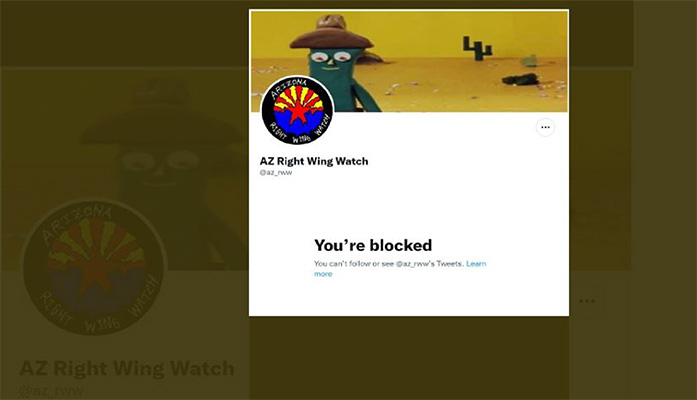
A popular anti-fascist account dedicated to researching and writing about Arizona’s “far-right extremism,” Arizona Right Wing Watch (ARWW), blocked this reporter despite having no direct interactions.
The individual behind ARWW, who we won’t name since she chooses to remain anonymous, is affiliated with a more established Antifa reporting group based in California: Left Coast Right Watch (LCRW). Though ARWW’s block was unexpected, it wasn’t unsurprising. She declared that she doesn’t believe in free and fair coverage across the political aisle.
There are some noteworthy reporters ARWW allowed to continue following her, all of whom work for mainstream media outlets and a majority of whom share similar political views: Garrett Archer with ABC15; Brahm Resnik with 12 News, Jeremy Duda with Axios and formerly Arizona Mirror, Jen Fifield with Votebeat and formerly the Arizona Republic, Tom Porter with Insider, Phillip Martin with WGBH, Jenifer Knighton with Newsbreak, Elliot Polakoff with AZ Family, and Jimmy Jenkins with the Arizona Republic.
With over 14,500 followers, ARWW has a significant presence in the political community and offers unique on-the-ground documentation of political events from the recent pro-abortion protests in the wake of the recent Supreme Court (SCOTUS) ruling all the way back to the first rounds of “Stop the Steal” rallies immediately following the 2020 election. That’s when ARWW first launched: late November.
LCRW’s editor-in-chief is Abner Hauge. He’s long documented Antifa riots, as well as participated in them, and researched what he characterizes as extremist right-wing groups or behaviors.
AntifaWatch, a research organization documenting the far left, identified Hauge dressed as Antifa at a counterprotest at Wi Spa last July — a business mired in conflict after a gender dysphoric man and convicted sex offender, Darren Agee Merager, exposed himself to young girls and women at a spa, and the staff allowed it.
The Washington Post profiled Hauge and others for their research on “right-wing extremists” four days after the January 6 riots at the Capitol. The UC Berkeley Graduate School of Journalism, Hauge’s alma mater, applauded Hauge for making headlines.
A month after the Washington Post mention, Rolling Stone gave Hauge another profile feature as an “undercover anti-fascist.” At the time, Hauge informed the outlet that he went by the “gender-neutral” pronouns “they/them.”
In ARWW’s closing remarks in an interview with “Adventures in HellwQrld,” a podcast focused on the QAnon conspiracy theories and other right-wing politics, she revealed that covering politics wasn’t the ideal lifestyle for her. She said she’d rather get high on marijuana.
“I think if there was no more right-wing s**t I would just turn the computer off and go back to smoking weed on the floor, you know?”
Corinne Murdock is a reporter for AZ Free News. Follow her latest on Twitter, or email tips to corinne@azfreenews.com.
by Corinne Murdock | Jul 14, 2022 | News
By Corinne Murdock |
On Monday, a federal judge determined that a 2021 law recognizing the personhood of unborn children was unconstitutionally vague and in conflict with other state laws.
The law, referred to as the “Interpretation Policy,” declares that all state laws should be interpreted and construed to acknowledge that unborn children have the same rights, privileges, and immunities as all other Arizonans. The statute includes specific cause of action exemptions for individuals who perform in vitro fertilization procedures and women who indirectly harm their unborn children due to improper or insufficient self-care.
The law also defines “unborn child” as the “offspring of human beings from conception until birth.” Conception is synonymous with fertilization, although the federal judge in the case, Arizona District Court Judge Douglas Rayes, an Obama appointee, contended that certain medical journals recognized conception as the moment a fertilized egg implants in the uterus.
READ THE LAW HERE
Rayes opined that Arizona’s Interpretation Policy was unclear in what it meant to “acknowledge” the equal rights of the unborn, pointing to the lack of definition anywhere in Arizona statutes and comparing the variety of definitions offered by Merriam-Webster and Black’s Law Dictionary. He agreed with the plaintiffs that authorities might employ a maximalist view of acknowledging the equal rights of the unborn.
On the subject of definitions, Rayes further contended that neither the Interpretation Policy or any other Arizona law amended the definition of “person” to include unborn children. Rayes added that the legal team of the lead defendant, Attorney General Mark Brnovich, couldn’t explain why that was in court proceedings.
“The Interpretation Policy either does absolutely nothing, or it does something. What that something might be is a mystery or, as Defendants put it, ‘anyone’s guess,’” wrote Rayes. “A law which requires such extraordinary effort to decipher fails to give ordinary people fair notice of the conduct it permits and proscribes.”
Brnovich hasn’t issued a statement on Rayes’ ruling. His latest press release announced a lawsuit excoriating the U.S. Department of Energy’s (DOE) latest dishwasher and laundry machine regulations. On the day Rayes issued his ruling, Brnovich only tweeted a statement about an ongoing lawsuit to prohibit charitable donations from being an alternative to class payouts.
Further on in his ruling, Rayes argued that the Interpretation Policy’s personhood requirement conflicted with other current laws regulating abortion: abortion providers’ licensing and credentialing requirements in A.R.S. §§ 36-2155, 36-2153(E), 32-3531(B), 36-449.03(C)(3)(a)–(b); abortion clinic licensing requirements in A.R.S. §§ 36-449.02; 36.449.03; abortion informed consent requirements in A.R.S. §§ 36-2153, 36-2156; abortion statistical and demographic data reporting requirements in A.R.S. §§ 36-449.03(I), 36-2161–62; second trimester abortion method restriction in A.R.S. § 13-3603.01; ban on abortion for reasons of race or sex in A.R.S. § 13-3603.02(A)(1); consent requirements for minors in A.R.S. § 36-2152; and restrictions on telemedicine for abortion care in A.R.S. § 36-3604.
Additionally, Rayes expressed concern that other parts of Arizona’s criminal code could leave abortion providers vulnerable to prosecution since they didn’t have exemptions for lawful abortions, such as statutes on assault, child endangerment, and child abuse.
“Abortion providers do not have fair notice of whether, if they conform their conduct to these laws, they nonetheless may face criminal, civil, or professional liability under other statutes based solely on what licensing, law enforcement, or judicial officials think it means to ‘acknowledge’ the rights of the unborn,” wrote Rayes.
In his concluding remarks, Rayes clarified that his ruling didn’t focus on abortion but rather the law’s justice.
“[This motion] is about giving people fair notice of what the law means so that they know in advance how to comply,” wrote Rayes. “The Interpretation Policy is so vague that it ‘makes it impossible for plaintiffs to do their work with fair notice of conduct that is forbidden or required, in violation of their procedural due process rights.”
The American Civil Liberties Union (ACLU) and Center for Reproductive Rights (CRR) filed the initial complaint on behalf of doctors Paul Isaacson and Eric Reuss, the National Council of Jewish Women Arizona (NCJW AZ), the Arizona National Organization for Women (AZ NOW), and the Arizona Medical Association (ArMA).
Isaacson is a Phoenix-based abortionist with Family Planning Associates (FPA) Medical Group, and previously a University of Arizona College of Medicine professor. After SCOTUS denied the existence of a constitutional right to abortion last month, Isaacson began crowdfunding $100,000. FPA Medical Group closed due to the current legal limbo concerning abortion in the state.
In an update last Saturday, Isaacson shared that the funds raised — at the time, just under $6,000 — enabled FPA Medical Group to keep its staff employed another week.
“We continued to dismantle the clinic today — very emotional moment taking my diplomas off the wall,” wrote Isaacson.
Reuss is a Scottsdale-based OBGYN who served previously on the board of Planned Parenthood of Arizona (PPAZ). Phoenix Magazine named Reuss a “Top Doc” seven times from 2010 to 2018.
Both Isaacson and Reuss have engaged in pro-abortion legal battles alongside ACLU and CRR before. Most recently, the parties came together to defeat Arizona’s requirement that abortion providers inform their patients about reversal procedures prior to taking an abortion pill.
Reuss wrote an opinion piece for the Arizona Republic in 2015 claiming that abortion pill reversal wasn’t evidence-based, calling the requirement “legislative overreach” and “hearsay.”
“There is absolutely no evidence-based data that the process can be reversed,” wrote Reuss.
Certain studies and current treatments for reducing risks of recurring miscarriage and premature births conflict with Reuss’ claim. A study specific to abortion pill reversal found that 64 to 68 percent of pregnancies were saved within 72 hours of taking the first abortion pill.
The Interpretation Policy was one part of a larger bill introduced by State Senator Nancy Barto (R-Phoenix), SB1457. The bill also made it a class 6 felony to abort children due to a genetic abnormality, except in a medical emergency. This provision added to current protections prohibiting the abortion of a child based on its sex or race. Last September, the court issued a preliminary injunction for that restriction. At the end of last month, the Supreme Court (SCOTUS) vacated that injunction.
Additionally, the bill prohibited public education institution facilities from performing or providing abortions except in a medical emergency. Instead, the bill required that abortion clinics either cremate or inter fetal remains, with the decision of the child’s final resting place given to the mother.
The bill also required that only qualified physicians provide abortion-inducing drugs and prohibited anyone from delivering or mailing those drugs.
Finally, the bill prohibited public or tax money from allocation to research projects using aborted fetal remains.
Corinne Murdock is a reporter for AZ Free News. Follow her latest on Twitter, or email tips to corinne@azfreenews.com.
by Corinne Murdock | Jul 8, 2022 | News
By Corinne Murdock |
The first Starbucks in Tucson unionized on Thursday in a 11-3 vote, the first in Pima County and the fifth in the state.
In an April letter announcing unionization intent with Starbucks Workers United (SBWU), 10 of the Tucson Starbucks workers said that unions were the only option for an ideal work environment. The words “partner” and “partnership” were brought up frequently.
“We do not see unions as an assault on Starbucks. Rather, we see unions as a symbol of both our love for the company and as an opportunity for partners to prosper alongside Starbucks moving forward,” wrote the workers.
The University of Arizona (UArizona) neighbor succeeded where two other stores’ unionization efforts failed earlier this year: one in Chandler, Arizona by a 1-9 vote taken last month, and another in Phoenix by a narrow 6-8 vote in May (though seven ballots were challenged and the official outcome is to be determined).
The following Arizona stores are unionized: in Mesa, the Power & Baseline Road and Crimson & Southern locations; and in Phoenix, the 7th Street & Bell location. The 7th & Roosevelt location in Phoenix filed to unionize and will take a vote next Friday.
Nationwide, 310 stores in 35 states filed to unionize. 186 of those stores won union elections. The nationwide unionization efforts have succeeded rapidly since the first Starbucks union formed last December in New York.
SWBU insists that coffee shop employees are overworked and underpaid, and often face issues like understaffing. Arizona Starbucks’ minimum wage sits around $14 an hour. Nationwide, that average sits around $17 an hour.
“We know what it’s like to be understaffed and overworked, on our feet for hours at a time, memorizing long menus, presenting a sunny demeanor to customers — even when they’re entitled, or impatient, or rude, or creepy,” reads the SWBU FAQ page. “We will have the right to negotiate a union contract and have a real voice in setting organization policies, rights on the job, health and safety conditions, protections from unfair firings or unfair discipline, seniority rights, leaves of absence rights, benefits, wages, etc.”
Starbucks unionization means that workers can’t be disciplined or terminated “at will,” and instead will be shielded by union contracts, or collective bargaining agreements. The employees do have to pay dues, which range depending on the region. In Buffalo, New York, where the first union launched, dues for full time workers are nearly $11 a week, or $5 a week for those who work under 25 hours.
The Tucson store’s unionization efforts weren’t without pushback. Employees claimed that they received a new district manager and had their hours reduced after announcing their intent to unionize.
Among the local officials who applauded the unionization was Tucson Mayor Regina Romero. The mayor said that the effort was a win for “justice, equality, and a better life.”
Corinne Murdock is a reporter for AZ Free News. Follow her latest on Twitter, or email tips to corinne@azfreenews.com.
by Corinne Murdock | Jul 5, 2022 | News
By Corinne Murdock |
The state of California will no longer fully fund official travel to Arizona because of laws banning gender transition procedures for minors (SB1138) and biological males from female sports (SB1165). The West Coast state’s attorney general, Rob Bonta issued the announcement on Thursday, the eleventh hour of Pride Month 2022.
California’s wielding of a 2016 law also applies to Indiana, Louisiana, and Utah, for their respective laws banning biological males, who believe they are transgender females, from participating in girl’s and women’s sports.
Bonta claimed in a press release that protections for women and children were solutions in search of a problem. Rather, Bonta asserted that the laws were veiled attacks on transgenderism and that the state would be “putting [its] money where [its] values are.”
“Make no mistake: There is a coordinated, ongoing attack on transgender rights happening right now all across the country,” said Bonta. “Blanket legislation targeting transgender children is a ‘solution’ in search of a problem. It is detached from reality and directly undermines the well-being of our LGBTQ+ community.”
As of press time, Attorney General Mark Brnovich hasn’t responded to California’s proclamation.
Later on Thursday, Bonta issued a several statements commending members of his staff within the LGBTQ+ community, including his deputy attorney general Lily Weaver, a man who identifies as a “lesbian transgender millennial woman.
Corinne Murdock is a reporter for AZ Free News. Follow her latest on Twitter, or email tips to corinne@azfreenews.com.