by Staff Reporter | Dec 18, 2025 | News
By Staff Reporter |
After this week, Arizona PBS will have one less program broadcasting the western news.
Arizona State University (ASU) declined to renew its contract with NewsHour West, a bureau in downtown Phoenix under the member station operated by ASU’s Walter Cronkite School of Journalism and Mass Communication, Arizona PBS (KAET).
NewsHour West provided western regional news, late breaking news, and a West Coast version of the news provided by the East Coast-based NewsHour.
NewsHour Productions sent out an email to PBS News supporters advising that ASU based their decision on “revised priorities,” according to Current.
Arizona PBS will continue its other programs, such as “Arizona Horizon” and “Horizonte.”
Arizona PBS programming under its call sign KAET — meaning “Arizona Educational Television” — dates back nearly 65 years to January 1961.
NewsHour West will have its final airing on Friday. The bureau launched in 2019.
The NewsHour West team consisted of Stephanie Sy, anchor and correspondent; Phil Maravilla, senior producer; Lena Jackson, deputy senior producer; Madison Staten, associate producer; and Justin Stabley, digital editor.
Back in April, Arizona PBS expanded in a different direction. The broadcasting station entered an agreement with Amazon Prime to offer free streaming to Arizona-based viewers.
The Corporation for Public Broadcasting (CPB), the private, nonprofit corporation which passes on federal funds to both PBS and NPR, announced in August that it would shut down after Congress reduced public broadcasting funds.
CPB lost around $1 billion in funding meant to fund broadcasting over the next two years.
A majority of CPB staff were laid off at September’s end; CPB said it planned to retain a skeleton crew until January, at least, to see through its remaining legal and financial obligations.
As it winds down, CPB has continued to administer its remaining millions as awards to various public broadcasting outlets and news organizations.
CPB’s demise occurred following its repeated resistance to efforts by President Donald Trump to bring the nonprofit to heel.
The Trump administration attempted to fire three CPB board members, prompting CPB to sue in April. That case is ongoing.
Then CPB refused Trump’s executive order, released in May, ordering CPB to cease federal funding for NPR and PBS. Longtime CPB President and CEO Patricia Harrison said Trump lacked authority over CPB, and that CPB was “wholly independent” of the federal government.
About 15 percent of the PBS budget relied on federal funding. The remainder comes from private donors, corporate sponsors, and nonprofits.
The NewsHour corporate sponsors are BNSF, Consumer Cellular, and Raymond James. Among the top foundation and individual funders are the Carnegie Corporation of New York, Doris Duke Foundation, Ford Foundation, Charles F. Kettering Foundation, Heising-Simons Foundation, William and Flora Hewlett Foundation, Robert Wood Johnson Foundation, John S. and James L. Knight Foundation, Judy and Peter Blum Kovler Foundation, Lumina Foundation for Education, John D. and Catherine T. MacArthur Foundation, The Andrew W. Mellon Foundation, Gordon and Betty Moore Foundation, David and Lucile Packard Foundation, Park Foundation, Laurie M. Tisch Illumination Fund, and The Walton Family Foundation.
AZ Free News is your #1 source for Arizona news and politics. You can send us news tips using this link.
by AZ Free Enterprise Club | Sep 25, 2025 | Opinion
By the Arizona Free Enterprise Club |
Taxpayer-funded resources should not be used to tilt the scales of any election. This isn’t a difficult concept to understand. So, when Arizona State University (ASU) and PBS were exposed for colluding to help Katie Hobbs in the 2022 governor’s race against Kari Lake, we demanded accountability. We called on Arizona Attorney General Kris Mayes and Maricopa County Attorney Rachel Mitchell to launch a full investigation. After all, Arizona law is clear that universities must remain impartial and neutral in election-related activities.
In a ridiculous decision, both Mayes and Mitchell refused to take action on our complaint. But this battle is far from over.
The Illegal Use of Public Funds
This all began back in 2022 when Katie Hobbs was ducking just about everyone during her campaign for governor, most especially Kari Lake. It culminated in Hobbs’ refusal to debate Lake on Arizona PBS. From there, the process should’ve been simple. According to long-standing Arizona Citizens Clean Elections Commission (AZCCEC) rules, Kari Lake should have been provided with airtime, and the AZCCEC planned to do just that. But hours before Lake’s interview was scheduled to take place, the AZCCEC learned that Arizona PBS went behind their back to schedule an exclusive interview with Katie Hobbs—moving them to postpone Lake’s interview.
Then, last month, a series of emails came to light revealing that ASU leaders including President Michael Crow, former Arizona Republic publisher Mi-Ai Parrish, and Arizona PBS leaders allegedly colluded to jettison the debate rules to help Hobbs. This was a blatant and illegal use of taxpayer funds, and that’s why we filed a Hatch Act complaint with Mayes and Mitchell against ASU. But in a shocking and shameful decision, both decided against taking action…
>>> CONTINUE READING >>>
by Ethan Faverino | Sep 18, 2025 | News
By Ethan Faverino |
The Arizona Free Enterprise Club escalated its call for accountability, urging the County Attorneys of Mohave, Pinal, and Yuma Counties to launch investigations into Arizona State University (ASU) leadership for allegedly manipulating 2022 gubernatorial debate rules to favor Democratic Katie Hobbs over Republican Kari Lake.
The action follows a complaint filed by the Club in August 2025, with the Arizona Attorney General and Maricopa County Attorney, which was dismissed without a thorough review, prompting a broader push for enforcement under state law.
In a sharply worded letter addressed to the Mohave County Attorney Matt Smith, Pinal County Attorney Brad Miller, and Yuma County Attorney Karolyn Kaczorowski, Club President Scot Mussi detailed evidence of ASU’s deviation from established debate protocols, accusing university officials of using public resources to influence the election in violation of A.R.S. § 15-1633.
The statute states: “A person acting on behalf of a university or a person who aids another person acting on behalf of a university shall not spend or use university resources for the purpose of influencing the outcomes of elections or to advocate support for or opposition to pending or proposed legislation.”
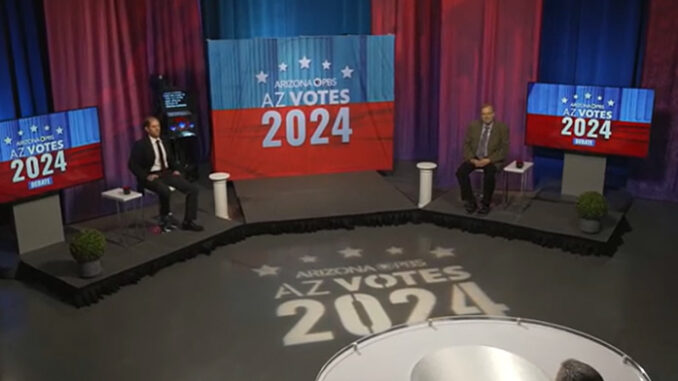
This call-to-action stems from a September 2022 debate co-sponsored by ASU, Arizona PBS, and the Citizens Clean Elections Commission (CCEC).
Under longstanding CCEC regulations (Ariz. Admin. Code § R2-20-107(K)), a candidate declining an invitation to debate their political opponent forfeits airtime, granting the attending opponent a 30-minute solo interview.
When Hobbs announced she would skip the debate, ASU and PBS bypassed set regulations, granting her an exclusive 30-minute interview, a first in years to do so.
Internal communications, obtained and reported by the Arizona Republic, exposed the intent behind the decision. ASU President Michael Crow, Chief of Staff James O’Brien, and ASU Media Enterprise Managing Director Mi-Ai Parrish allegedly prioritized Hobbs’ comfort over neutrality.
Parrish’s emails to O’Brien highlighted concerns that “Katie is getting roasted hard” for dodging the debate and pressed CCEC staff to limit Lake’s discussion of election integrity, arguing that airing “a person with those views was wrong.” CCEC Executive Director Tom Collins confirmed to the Republic that Parrish sought to suppress Lake’s platform.
Correction: A previous version of this story incorrectly listed the names of the County Attorneys. They have now been corrected.
Ethan Faverino is a reporter for AZ Free News. You can send him news tips using this link.
by AZ Free Enterprise Club | Sep 3, 2025 | Opinion
By the Arizona Free Enterprise Club |
If Katie Hobbs is thinking about what to do after her time as Governor is up, one option would be to test her skills in the Hide and Seek World Championships. After all, she proved during the 2022 gubernatorial election campaign that it’s what she’s best at.
After dodging any request to debate her opponent Kari Lake during her campaign, Hobbs also ducked reporters who dared to question her about it. She even hid in a restaurant bathroom after another reporter asked her why she didn’t like discussing politics.
All this hiding should have resulted in a simple decision. According to long-standing Arizona Citizens Clean Elections Commission (AZCCEC) rules, an opponent (in this case Kari Lake) should have been provided with airtime when a candidate (in this case Katie Hobbs) refused to debate. And the AZCCEC planned to do just that. But hours before Kari Lake’s interview was scheduled to take place, the AZCCEC learned that Arizona PBS went behind their back to schedule an exclusive interview with Katie Hobbs—moving them to postpone Lake’s interview.
If you think all this reeks of collusion, you’re right. And now, a public records request has made it clear. Katie Hobbs wasn’t playing hide and seek alone. She was purposefully aided by leadership at Arizona State University (ASU) and at PBS…
>>> CONTINUE READING >>>
by Matthew Holloway | Aug 23, 2025 | Education, News
By Matthew Holloway |
Controversy has once again embroiled Arizona State University (ASU), threatening the credibility of the institution, Arizona PBS, and the Walter Cronkite School of Journalism. Emails uncovered by the Arizona Republic reveal that ASU President Michael Crow, former Arizona Republic publisher Mi-Ai Parrish, and other officials allegedly favored Democratic gubernatorial candidate Katie Hobbs over Republican Kari Lake during the 2022 Arizona gubernatorial election.
Lake has accused them of “collud[ing] to prevent me from having a debate forum.”
Reporting from the Arizona Republic’s Stacey Barchenger earlier this month exposed internal discussions among ASU leadership that appeared to prioritize Hobbs while sidelining Lake. The emails, obtained through public records requests, show that Parrish emailed Arizona PBS leaders, writing, “We may have issues,” after discussions with PBS Senior Director of Content, Ebonye Delaney. They expressed concerns about equal time laws and the risk to ASU’s relationship with the Arizona Citizens Clean Elections Commission.
Crow emailed Parrish, stating, “Whatever the format there remains the fact that it is our venue and brand. We need structure…and format…….and….people who believe in elections as participants.” He later instructed his chief of staff, James O’Brien, and Parrish to “make sure you are both on the same page here,” prompting Parrish to ask, “What outcome are you seeking?”
ASU offered Hobbs a solo interview on Arizona PBS, a move that severed the university’s long-standing partnership with the voter-approved Clean Elections Commission. This decision was influenced by Crow’s reported disagreement with Lake’s views on election integrity and his labeling her an “election denier.”
Barchenger’s report, citing expert opinions, stated “That ASU leaders would consider one candidate’s views, and then reach down and influence television programming, called into question Arizona PBS’ independence as a news organization and its autonomy from university influence, experts said.”
“And it could have risked legal repercussions for Arizona’s largest university, they added.”
The Arizona Republic’s Robert Anglen shared the findings on X, writing, “Newly released emails detail how ASU’s top leaders sought to muzzle Kari Lake in 2022 for her election-denial views and give preferential treatment to Katie Hobbs on Arizona PBS during the governor’s race.”
Lake rejected Arizona PBS’s offer of a 30-minute solo interview, insisting on a joint debate with Hobbs. She told reporters at the time, “If she doesn’t appear with me, they should kick her out. If Democrats don’t have to sit on the debate stage with the Republicans, if they can just stomp their feet and demand a safe space … then we’ll never have a debate system again.” Lake instead participated in a Clean Elections-sponsored interview on another station and vowed to avoid PBS-related events.
In a statement responding to the exposé, Lake said: “Taxpayer-funded Michael Crow and taxpayer-funded ASU, along with taxpayer-funded PBS, colluded to prevent me from having a debate forum for fear I would talk about election fraud, and because their chosen candidate Katie Hobbs would’ve been destroyed in a debate with me. They interfered in the 2022 Arizona Gubernatorial election and trampled on my First Amendment rights. Their actions were not just unethical; they were likely illegal, too.”
ASU spokesman Jay Thorne defended the university’s actions, however, stating, “The shared objective of ASU and Arizona PBS after the gubernatorial debate was cancelled was to provide a forum for the voters of Arizona to hear from the two candidates for Governor in an interview format. It was an opportunity provided under identical conditions to each candidate, and only one accepted the offer.”
The controversy has raised serious questions about Arizona PBS’s journalistic independence and ASU’s impartiality. Crow, who received a contract extension with a pay raise and bonuses in 2024 despite prior scandals, faces renewed scrutiny over allegations of partisan interference in the electoral process. The decision to prioritize one candidate’s platform over another has sparked outrage and could have lasting repercussions for the institutions involved. This rewritten version organizes the information into clear sections, eliminates redundancy, and enhances readability while preserving all original quotes.
The Arizona Free Enterprise Club (AZFEC) announced August 20th that it has filed a Hatch Act complaint against ASU “for using taxpayer-funded resources to meddle in the 2022 Governor’s race.”
Scot Mussi, President of AZFEC, stated, “This was a blatant misuse of taxpayer-funded university resources to tilt the scales of a gubernatorial election. Arizona law is clear: universities must remain impartial and neutral in election-related activities.”
Matthew Holloway is a senior reporter for AZ Free News. Follow him on X for his latest stories, or email tips to Matthew@azfreenews.com.